Biên lợi nhuận bao nhiêu là cao cho dropshipping AliExpress?
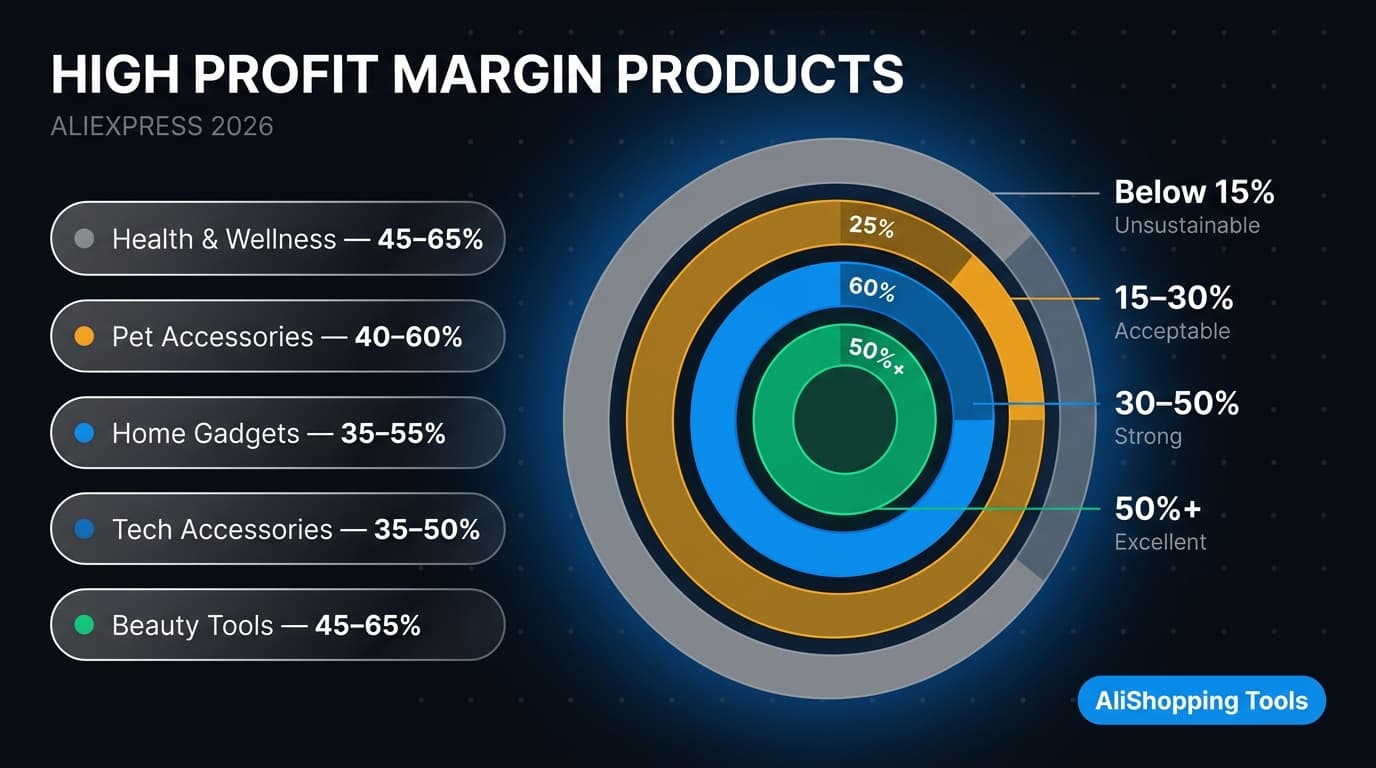
Bài đặt các mốc 2026: dưới 15% là không bền (một đơn hoàn hoặc một cú tăng ads là lỗ), 15–30% chấp nhận được nhưng chỉ sống sót, 30–50% là mạnh — vùng mục tiêu có không gian để test và xử lý hoàn, trên 50% là xuất sắc — thường cần perceived value hoặc positioning độc đáo. Đa số nhầm markup với margin: sản phẩm 5 USD bán 15 USD là markup 200% nhưng margin chỉ 66%, và margin mới là con số quan trọng.
2
Nhóm sản phẩm nào trên AliExpress có biên cao nhất?
Theo nghiên cứu bên thứ ba (ProductLair, DropCommerce), nhóm gross markup cao nhất gồm: Sports & Outdoors (82.6% median — cao nhất đo được), pet accessories/pet tech (thường 10x+ markup với hàng giá vốn thấp), beauty & personal care (markup 5x-18x), home organization & kitchen gadgets (được gộp định tính cùng nhóm trên bởi nhiều báo cáo, chưa có số đo riêng), và health & wellness devices (63% median — thấp nhất trong nhóm, và chịu nhiều rào cản chính sách quảng cáo về claim sức khỏe nhất). Đây là markup nguồn hàng, không phải margin thật.
3
Cách tính biên lợi nhuận thật thay vì markup ảo?
Công thức trong bài: Lợi nhuận thật = Giá bán − (Giá vốn + Ship + Phí platform + Phí thanh toán + Chi phí quảng cáo/đơn + Dự phòng hoàn).
Biên thật (%) = Lợi nhuận thật ÷ Giá bán × 100.
Các ví dụ trong bài là minh họa, không phải listing thật, nhưng cho thấy đúng mô hình: markup gộp 60-80%+ thường co lại gần mức trung bình toàn ngành sau khi trừ ship, phí Shopify/Stripe, CPA và dự phòng hoàn — margin thật trung bình ngành dropshipping thường được trích dẫn khoảng 10-30%, không phải 45-65%+ như nhiều bài tổng hợp gợi ý.
4
Nhóm sản phẩm nào trông có vẻ margin cao nhưng thực ra không phải?
Ba nhóm hay bị đánh giá quá cao: thời trang/apparel (markup gộp 30-40% nhưng tỷ lệ hoàn hàng 30-40%, cao hơn nhiều mức trung bình ~16-20% của dropshipping, chủ yếu do lỗi size/fit chiếm khoảng 60% lượt hoàn); hàng nặng/cồng kềnh (phí ship có thể lên 80-300+ USD/đơn do cách tính dimensional weight, người mới thường ước tính thiếu 40-60%); và ở mức độ nhẹ hơn, thiết bị sức khỏe/wellness (markup gộp thấp nhất trong nhóm margin cao, ~63%, cộng thêm rào cản chính sách quảng cáo về claim sức khỏe).
How to Find Products with High Profit Margins on AliExpress (2026)
Quick answer: Pet accessories, health gadgets, and home organization products consistently show up in third-party research as the categories with the highest gross sourcing markup on AliExpress — up to 82.6% for the strongest category measured (ProductLair). That is not the same as net margin: after shipping, fees, and ad spend, realistic net margins run lower, and categories that look strong on paper (fashion, bulky items) often lose most of that advantage to returns and shipping cost. This guide covers both numbers and where the gap between them comes from.
📊 AliShopping Data Insight: AliShopping's APS scoring engine evaluates products across price stability, seller trust, and sourcing viability. Our analysis of thousands of AliExpress listings confirms that categories like pet accessories and home organization consistently show the highest gross markup potential — but price history data also reveals that products in these categories are prone to sudden cost spikes during peak seasons. Use AliShopping's price chart and profit simulator to calculate real margins before committing to a product. Install AliShopping Tools →
Every dropshipper wants high margins. Very few actually get them. The reason is not that high margin products do not exist on AliExpress — they do, in massive quantities. The reason is that most people do not know how to identify them, how to calculate whether the margin is real, or how to avoid the hidden costs that silently eat their profit down to single digits.
This guide fixes that. You will learn exactly what counts as a "high margin" product, which five categories consistently show up in sourced research as the best performers, how to calculate your real profit (not the fantasy version), which categories look high-margin but usually aren't, and how to use a free tool that runs the numbers for you in seconds. We will also walk through three worked margin breakdowns so you can see the formula in practice.
What Counts as a "High Margin" Product?
Before chasing high margins, you need to know what the benchmarks actually look like. Most beginners confuse markup with margin, and that confusion costs them money. A product you buy for $5 and sell for $15 has a 200% markup, but only a 66% margin. The margin is what matters because it tells you what percentage of each sale you actually keep.
Here are the margin benchmarks for dropshipping in 2026:
Margin Range
Rating
What It Means
Below 15%
Unsustainable
One refund, one ad spike, or one shipping delay and you are in the red. Avoid unless you have massive volume.
15-30%
Acceptable
Survivable margins. Most generic products land here. You need consistent ad performance to stay profitable.
30-50%
Strong
The target zone. Products in this range give you breathing room for ad testing, returns, and seasonal dips.
Above 50%
Excellent
The sweet spot for high-margin dropshipping. Usually requires perceived value, unique positioning, or solving a specific problem.
If a product cannot realistically hit at least 30% margin after all costs, it is probably not worth your time unless you are running a high-volume operation with extremely efficient ads.
5 Product Categories with the Highest Margins on AliExpress
Not all categories are created equal. Some product types structurally lend themselves to higher markups because of perceived value, low competition, or strong emotional purchase triggers. The five below are the categories most consistently named across independent dropshipping-margin research as high-markup — but "high markup" (source cost vs. sell price) and "high net margin" (what you keep after ads, shipping, and fees) are two different numbers, and most guides blur them. Here's the distinction, sourced.
Real-world margin research, by category
Independent research firms that pull actual supplier-cost data give a different — and more conservative — picture than most dropshipping blogs. ProductLair's analysis of 232 curated products with verified supplier costs found Sports & Outdoors has the highest median gross sourcing markup at 82.6%, with Health & Wellness lowest among high-margin categories at 63% median (and facing tighter ad-platform health-claim restrictions, which adds real customer-acquisition friction those gross numbers don't show). Their companion product-level data cites pet-tech items like a silicone deshedding glove sourced around $1 and sold for $10-15 — a 10x+ markup — as a repeatable pattern in that category. Separately, DropCommerce's category breakdown puts consumer electronics at a much thinner 10-20% gross margin before any ad spend, and fashion/apparel at 30-40% gross — undercut by return rates that multiple sources put at 30-40% for apparel specifically, well above the ~16-20% dropshipping-wide average.
The gap that matters: gross sourcing markup of 60-80%+ is common in these categories. Realistic net margin — after shipping, platform fees, payment processing, ad spend, and returns — is a different, much lower number. Industry-wide, average net margin estimates cluster in the 10-30% range — Sparkshipping cites 10-20%, DropCommerce cites 10-30% — well below the 45-65% figures that circulate in category round-ups. The worked formula and examples later in this guide show exactly where that gap goes.
Category
Typical source cost pattern
Gross sourcing markup / margin
Basis
Sports & Outdoors
Low-cost small accessories
~82.6% median gross margin — highest of the categories measured
Gross markup ≠ what you keep. Every row above is source-cost-to-sell-price only, before shipping, platform fees, payment processing, ad spend, and returns — the "Real Margin" formula further down this page shows how much of that gap disappears in practice.
With that framing, here are the five categories:
1. Health and Personal Care Accessories
Products like posture correctors, massage tools, facial rollers, blue light glasses, and acupressure mats. The margin logic works because customers associate these products with their health and wellbeing, which makes them less price-sensitive — but per the research above, this category also carries the lowest median gross markup (63%) among the high-margin cluster, and stricter ad-platform rules on health claims than the other four categories here.
2. Pet Accessories and Novelty Items
Pet owners spend emotionally, not rationally. Pet products also have strong viral potential on TikTok, which means organic reach can supplement or replace paid ads entirely — pushing your effective margin higher by reducing customer acquisition cost. This is the category with the clearest sourced example of extreme markup (the ~$1-cost deshedding glove selling for $10-15 above), though a single product example is not a category-wide guarantee.
3. Home Organization and Kitchen Gadgets
Space-saving organizers, magnetic spice racks, silicone food covers, collapsible containers. These solve visible, everyday problems, which makes them easy to market. Multiple industry round-ups group this alongside pet and beauty as a repeat high-margin category, but it isn't broken out as its own line item in the sourced category data above — treat the "high margin" label here as directionally supported, not independently measured the way Sports & Outdoors or Health & Wellness are.
4. Phone and Tech Accessories
Not phone cases — those are a race to the bottom. Think magnetic car mounts, portable ring lights, cable organizers, laptop stands, and wireless charging pads. Worth flagging: the electronics category broadly (phones, gadgets, core tech) is the one place the sourced research above puts margins meaningfully lower (10-20% gross) — accessories aren't identical to core electronics, but the adjacency is a reason to run the actual numbers per product rather than assume this category behaves like pet or beauty.
5. Beauty Tools and Skincare Devices
LED face masks, derma rollers, electric blackhead removers, hair removal devices. These products sit at the intersection of beauty and technology, which allows for premium pricing — beauty and personal-care items are repeatedly named among the top-markup categories in the research cited above (commonly reported in a 5x-18x source-to-sell markup range for low-cost items). The key is strong product imagery and social proof — TikTok demonstrations drive enormous demand in this category.
How to Calculate Real Margin (Not Just Markup)
This is where most dropshippers get it wrong. They subtract the AliExpress price from their selling price, look at the number, and think that is their profit. It is not. Your real margin must account for every cost that sits between the customer's payment and the money that stays in your account.
Here is the formula:
Real Profit = Selling Price - (Product Cost + Shipping + Platform Fees + Payment Processing + Ad Cost per Sale + Return/Refund Reserve)
Real Margin (%) = (Real Profit / Selling Price) x 100
Let us say you find a product on AliExpress for $4.50 and plan to sell it for $29.99. Your napkin math says "$25.49 profit, easy money." Here is what actually happens:
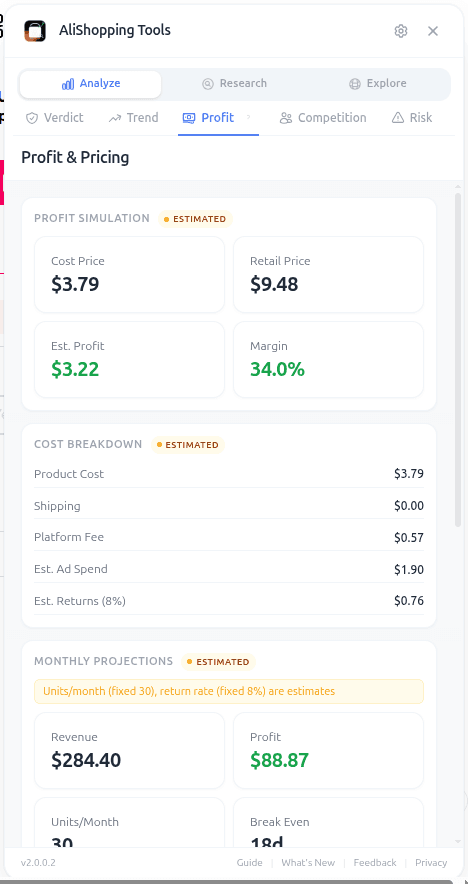
The Profit Simulator runs the real margin math — product cost, shipping, platform fees, ad spend, and return reserve — on any AliExpress product.
That $25.49 "profit" just became $11.72 in reality. Still a strong margin at 39%, but nearly 54% lower than what the napkin math suggested. Now imagine what happens if your ad costs spike to $12 per acquisition — suddenly your margin drops to 25.5%, and one or two refunds can tip individual orders into a loss.
What Hidden Costs Eat Into Your Margin?
Beyond the obvious cost breakdown above, there are several margin killers that do not show up until they have already done their damage.
Currency Conversion Fees
If you are paying AliExpress in USD but your supplier prices in CNY, your payment processor adds a conversion fee of 1-3%. On a $4.50 product, that is only $0.05-0.14. But across hundreds of orders per month, it adds up to a real number.
Chargebacks and Disputes
Payment processors charge $15-25 per chargeback, regardless of the outcome. If 1-2% of your orders result in chargebacks, that is an invisible cost that directly reduces your margin. Products with long shipping times or ambiguous descriptions generate more disputes.
Shipping Price Increases
AliExpress shipping costs are not static. They fluctuate based on fuel surcharges, seasonal demand (especially Q4), and carrier availability. The $2.20 ePacket rate you calculated in March might be $3.50 by November. Build in a 15-20% shipping buffer.
Ad Creative Fatigue
Your cost per acquisition is not a fixed number. Ad creatives fatigue over time, which means your CPA creeps upward unless you are constantly producing new angles and testing. A product that was profitable at a $7 CPA might become unprofitable at $11 CPA two months later. High margin products give you a wider buffer against this inevitable drift.
Returns Without Reverse Shipping
In dropshipping, you rarely ask customers to return items to China. That means returns are usually a full loss — you refund the selling price and the product is gone. A 5% return rate on a $29.99 product means you are absorbing $1.50 per order across your entire volume, whether or not each specific order gets returned.
Margin Traps: Categories That Look High-Margin But Aren't
A high sourcing markup on paper does not mean a high real margin. Three category-level patterns consistently turn "looks high-margin" into "actually thin" once the hidden cost structure of the category itself is accounted for — not the generic per-order costs above, but costs baked into the category.
Fashion and Apparel
Gross markup of 30-40% looks respectable next to electronics, but apparel carries the highest return rates in dropshipping — commonly cited at 30-40%, well above the roughly 16-20% dropshipping-wide average, and sizing/fit mismatches alone account for around 60% of dropshipping returns industry-wide. Each return costs an estimated $10-20 in logistics and processing on top of the lost product, and because dropshippers rarely pay for reverse shipping from Western customers back to a Chinese supplier, a return is usually a full loss, not a partial one. Combined, published estimates put the realistic margin erosion from returns and reverse-logistics-adjacent costs at 10-15 percentage points off the gross figure — turning a 35% "margin" into something closer to 20-25% before ad spend is even counted. (DropCommerce, DojoBusiness)
Heavy or Bulky Items
Anything oversized — furniture, large home decor, bulky fitness equipment — can carry shipping costs in the $80-300+ per order range once you account for dimensional (DIM) weight pricing, where carriers charge based on package volume, not just actual weight, and bill whichever number is higher. A single item's shipping cost can jump from roughly $12 to $150+ depending on which pricing method applies. On top of the base rate, bulky shipments commonly stack a residential delivery surcharge ($4.50-6.50), an additional handling fee ($12-18) for anything over 50 lbs, and a large-package surcharge (~$40-90) once length-plus-girth passes 130 inches. First-time dropshippers are estimated to underestimate bulky-item shipping costs by 40-60%. The practical takeaway: most genuinely high-margin dropshipping items skew light — commonly cited under roughly 500g — precisely because shipping cost scales against you as weight and dimensions grow. (Dropified)
Health and Wellness Devices (a milder version of the same trap)
This is the category from the sourced table above with both the lowest median gross markup of the high-margin cluster (63%) and the added friction of stricter ad-platform policies around health claims — Meta and Google both restrict language implying medical benefits, which raises effective customer-acquisition cost even before you touch the margin math. It's still a legitimately strong category; it's simply the one where "high margin" needs the most qualification.
How to Use AliShopping Tools Profit Simulator
Running these calculations manually for every product you research is possible, but tedious. And tedium leads to shortcuts — you start skipping products, estimating costs loosely, and eventually making decisions based on gut feeling instead of data.
AliShopping Tools eliminates this problem entirely. Here is how the Profit Simulator works:
Step 1: Install the AliShopping Tools Chrome extension. No account needed, no credit card, no trial period.
Step 2: Go to any product page on AliExpress. The AliShopping Tools panel appears automatically on the page.
Step 3: Click the Profit Tab. The Profit Simulator runs a full financial analysis of the product in seconds.
What you get:
Complete cost breakdown — product cost, shipping, platform fees, payment processing, ad spend estimate, and return reserve. Every cost component, calculated automatically.
Profit per unit and margin percentage — your real margin, not the markup illusion.
Monthly projections — estimated revenue, total profit, units per month, and break-even timeline based on realistic ad performance data.
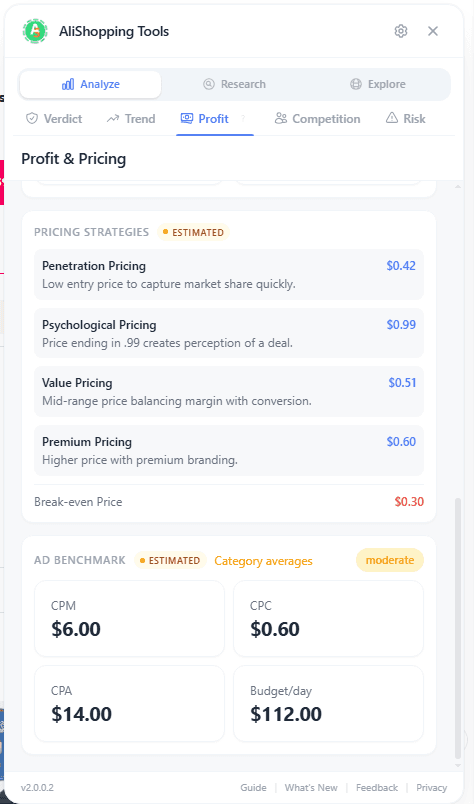
Multiple pricing strategies — the simulator generates 2-3 pricing approaches (penetration, psychological, premium) with the margin impact of each one, so you can choose the strategy that fits your positioning.
Ad benchmarks — CPM, CPC, and CPA data for the product's category, plus difficulty rating and recommended daily budget. This tells you what your ads will actually cost before you spend a dollar.
The entire analysis takes under 10 seconds and costs nothing. You can evaluate dozens of products per session and only commit to the ones with confirmed strong margins.
Three pricing strategies — penetration, psychological, premium — render side by side so you can pick the one that fits your positioning.
3 Real Examples with Full Margin Breakdown
Let us put everything together with three worked, illustrative calculations across different high-margin categories. These are teaching examples, not live AliExpress listings — the cost/price inputs are representative figures chosen to fall within the researched ranges above (source cost under $12, retail price in the $17-50 band), used to walk through the real-margin formula. Run the actual current price of any specific product you're evaluating through the Profit Simulator (covered next) rather than treating these numbers as sourcing quotes.
Example 1: Posture Corrector (Health Category)
Line Item
Amount
AliExpress cost
$3.80
Selling price
$27.99
Shipping
$1.90
Shopify fees
$0.84
Payment processing
$1.11
Ad cost (estimated CPA)
$6.50
Return reserve (5%)
$1.40
Total costs
$15.55
Real profit per unit
$12.44
Real margin
44.4%
This is a strong product. Even if your ad costs rise 40% to $9.10, your margin only drops to 35.1% — still comfortably in the target zone. At 5 sales per day, that is $1,866 in monthly profit.
Example 2: Magnetic Cable Organizer (Tech Accessories)
Line Item
Amount
AliExpress cost
$2.10
Selling price
$16.99
Shipping
$1.50
Shopify fees
$0.51
Payment processing
$0.79
Ad cost (estimated CPA)
$5.00
Return reserve (5%)
$0.85
Total costs
$10.75
Real profit per unit
$6.24
Real margin
36.7%
Lower absolute profit per unit, but the low price point means higher conversion rates and easier impulse purchases. This product works best as an add-on in a store with complementary items, or as a TikTok viral play where organic views reduce ad costs.
Example 3: LED Face Mask (Beauty Tools)
Line Item
Amount
AliExpress cost
$9.50
Selling price
$49.99
Shipping
$3.80
Shopify fees
$1.50
Payment processing
$1.75
Ad cost (estimated CPA)
$10.00
Return reserve (5%)
$2.50
Total costs
$29.05
Real profit per unit
$20.94
Real margin
41.9%
Higher price point means higher absolute profit per unit, but also higher ad costs because customers need more convincing before buying a $50 product. The margin is excellent at 41.9%, and even a pessimistic CPA scenario of $14 still yields a 33.9% margin. This is the kind of product that builds a profitable store.
The Pattern Behind High-Margin Products
Looking across these examples and categories, high-margin products on AliExpress share common traits:
Low cost basis relative to perceived value. The product costs under $10 on AliExpress but solves a visible problem or delivers a clear benefit that justifies a $20-50 retail price.
Emotional purchase triggers. Health, beauty, pets, home improvement — these categories tap into how people feel, not just what they need. Emotional buyers are less price-sensitive.
Visual demonstration potential. Products that show a clear transformation or satisfying result perform better in video ads, which drives down your CPA and pushes your effective margin higher.
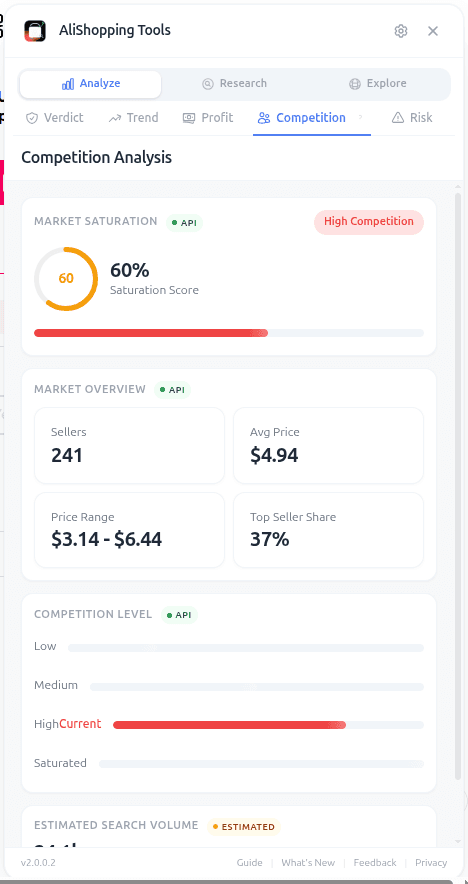
Low competition density. The specific product variation or angle has moderate, not extreme, competition. You can validate this with the Competition Tab, which shows the saturation score for any product's market — and read our dropshipping competition analysis guide for the full saturation workflow.
Frequently Asked Questions
What is a realistic profit margin for AliExpress dropshipping?
Most successful dropshippers target 25-35% net margin after all costs. Margins above 40% are achievable in categories like health accessories, beauty tools, and pet products where perceived value is high relative to sourcing cost. Below 20% is risky because ad cost fluctuations can quickly turn profitable orders into losses.
Why do my margins seem lower than expected even with low-cost products?
The most common culprits are advertising costs and payment processing fees. A product that costs $4 with a $25 selling price looks like 84% margin on paper, but after shipping ($2-3), platform fees ($0.60-0.90), payment processing ($1+), ad spend ($8-15), and returns (5-7%), your real margin drops to 25-40%. Use AliShopping Tools' Profit Simulator to see the full breakdown instantly.
Are high-margin products harder to sell than low-margin ones?
Not necessarily. High-margin products typically succeed because they solve a specific problem or trigger an emotional response, which makes them easier to market with compelling ad creative. The key is perceived value: a low-cost product that genuinely solves a visible problem (back pain, clutter, a pet annoyance) tends to sell without much price resistance because the buyer is paying for the outcome, not the raw materials.
How do I maintain margins when ad costs increase over time?
Build in a margin buffer from the start. Calculate your profitability at both your current CPA and a scenario 40-50% higher. If the product remains profitable at the pessimistic CPA, you have resilience. Additionally, invest in organic content (TikTok, Instagram Reels) to reduce dependence on paid ads over time.
Which product categories look high-margin but usually aren't?
Three patterns show up repeatedly in dropshipping-margin research: fashion and apparel (30-40% gross markup, but return rates of 30-40% — well above the roughly 16-20% dropshipping-wide average — erode most of the advantage), heavy or bulky items (dimensional-weight shipping pricing can push a single order's freight cost into the $80-300+ range), and health/wellness devices (the lowest median gross markup, ~63%, among high-margin categories, per ProductLair, plus stricter ad-platform health-claim rules). See the Margin Traps section above for the sourced detail on each.
Is the "45-65% margin" figure commonly quoted for these categories realistic?
It depends which number is being quoted. Gross sourcing markup (source cost vs. sell price) of 60-80%+ is well documented for categories like Sports & Outdoors and pet tech in third-party research. Realistic net margin — after shipping, platform fees, payment processing, ad spend, and returns — is a different, lower number; industry-wide, dropshipping's average net margin is commonly cited around 10-30%, not 45-65%. Treat any category-level margin percentage as a marketing-copy simplification and calculate the real per-product number yourself before committing ad spend.
Stop Guessing. Start Calculating.
Finding high-margin products on AliExpress is not about luck. It is about knowing which categories to look in, running the real numbers (not the fantasy version), and accounting for every cost that sits between a customer's payment and your actual profit.
The five categories above — health accessories, pet products, home gadgets, tech accessories, and beauty tools — are where the margins live. But a category alone does not guarantee profit. You need to calculate each product individually, stress-test the numbers against rising ad costs, and validate that the market is not already saturated.
AliShopping Tools does all of this for you. The Profit Simulator breaks down every cost, calculates your real margin, projects monthly earnings, and even suggests pricing strategies — all in seconds, no account required. Pair it with the Competition Tab to check market saturation and the Verdict Tab to get an AI-powered overall assessment, and you have a complete product validation workflow that replaces hours of spreadsheet work with a few clicks. See the Profit Calculator walkthrough for the full setup.
Pair the Profit Simulator with Competition and Verdict tabs to stress-test margins against market saturation before you commit.