Dropshipping Break-Even ROAS Formula — Full 2026 Guide
AliShopping Tools
See live AliExpress data in your browser.
Seller trust score, 90-day price history, and live promo codes — on every AliExpress product page. No account, free.
Product Tracker Miễn phí
Theo dõi giá thật, đơn hàng, tồn kho & đánh giá của bất kỳ sản phẩm AliExpress nào trong 180 ngày. Dữ liệu không nói dối.
Before you buy
Is this deal real? Check the price history before you buy.
Prices often spike just before a “sale.” See 180-day price history and fake discount detection — free, no account needed.
Verify on AliShopping Deals →Sẵn sàng tìm sản phẩm thắng?
Thử AliShopping Tools — 15 công cụ AI miễn phí cho nghiên cứu sản phẩm.
Giải đáp nhanh
Câu hỏi thường gặp
1What is break-even ROAS for dropshipping?
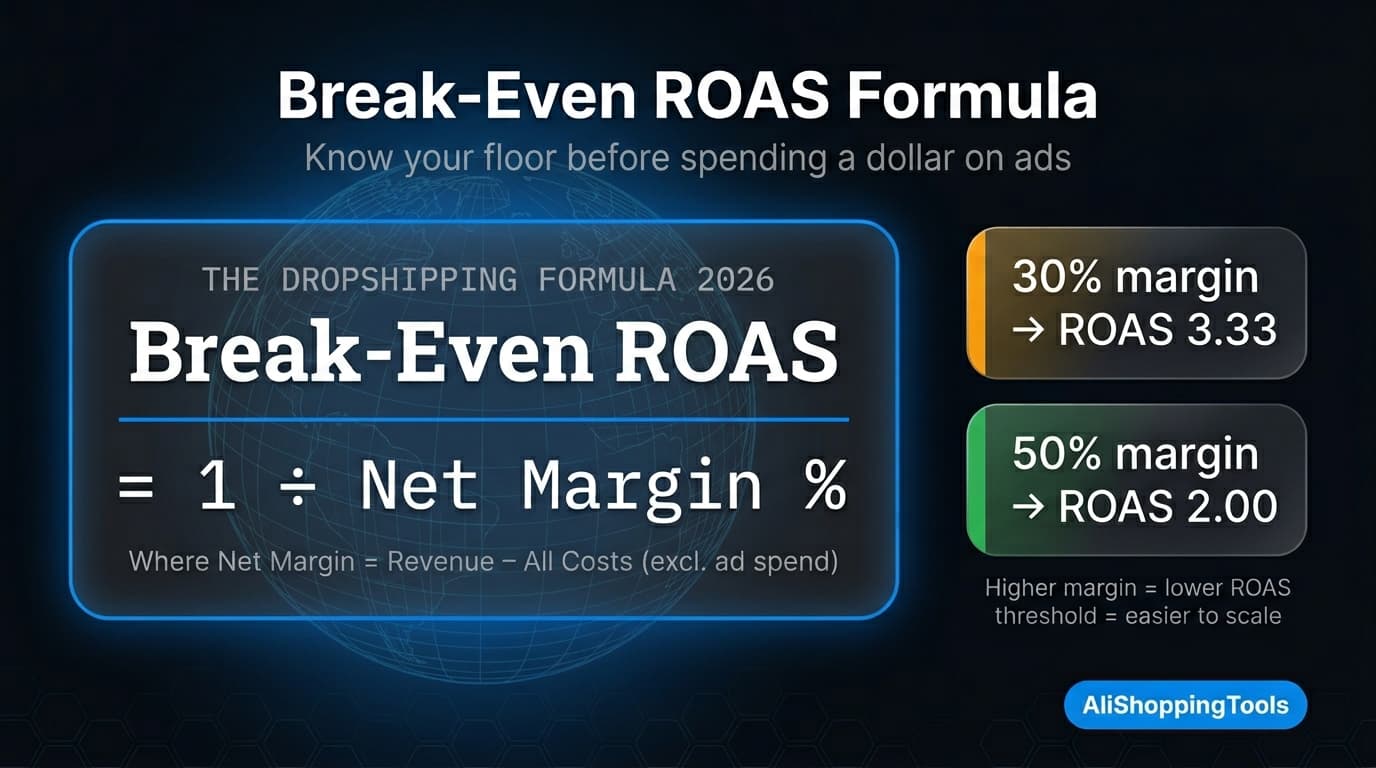
Break-even ROAS is the minimum return on ad spend required for ads to not lose money.
Formula: Break-Even ROAS = 1 ÷ net margin %.
At 30% net margin, break-even ROAS is 3.33.
At 45% net margin, it is 2.22.
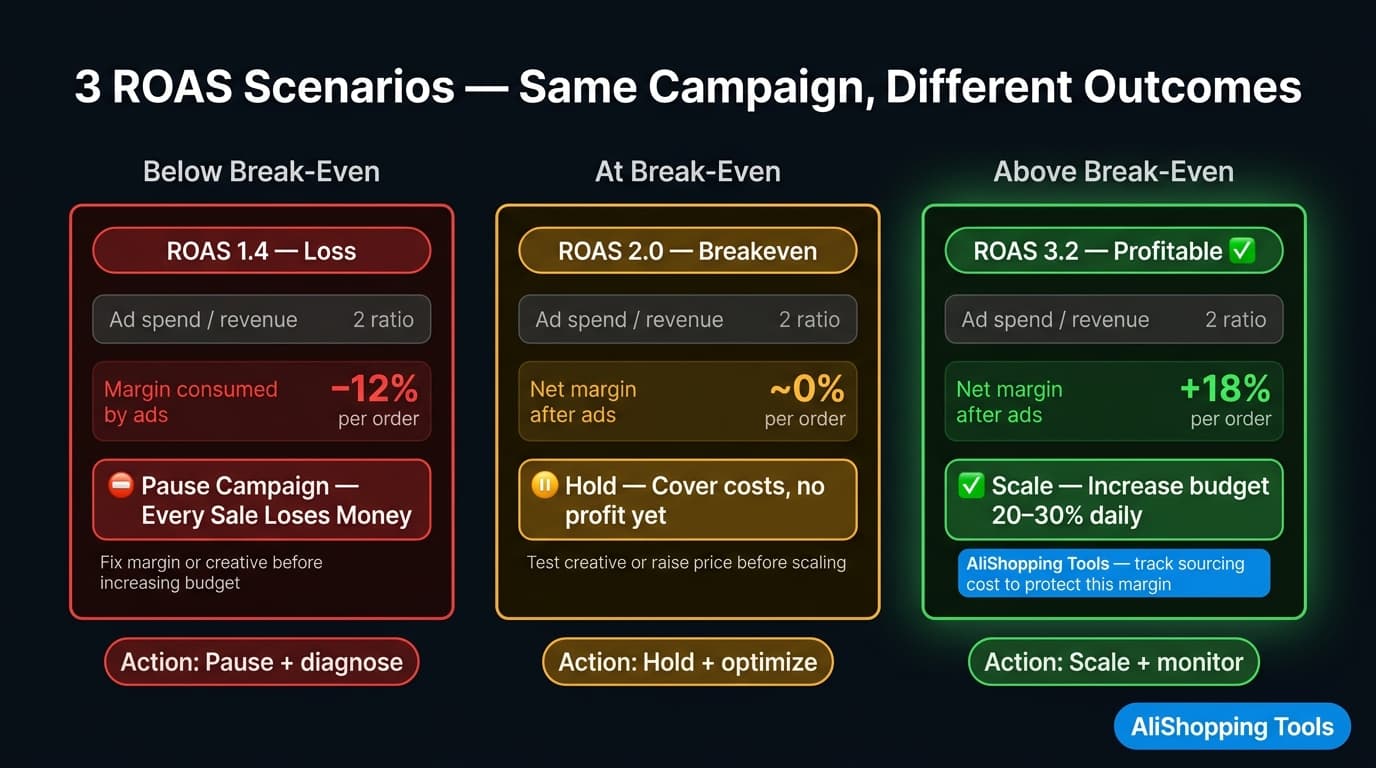
Any ROAS below your break-even threshold means ad-attributed sales are generating a net loss, even if revenue is positive.
2How do I calculate break-even ROAS for my dropshipping store?
Three steps:
- 1Calculate net margin by subtracting AliExpress cost, shipping, platform fee, payment processing, and return reserve from your selling price, then divide by selling price.
- 2Apply the formula: Break-Even ROAS = 1 ÷ net margin %.
- 3Set your target ROAS at 1.5× the break-even for actual profit. Example: at 40% net margin, break-even ROAS = 2.5, target ROAS = 3.75.
3What is a good ROAS for dropshipping ads in 2026?
A good ROAS depends entirely on your niche margin.
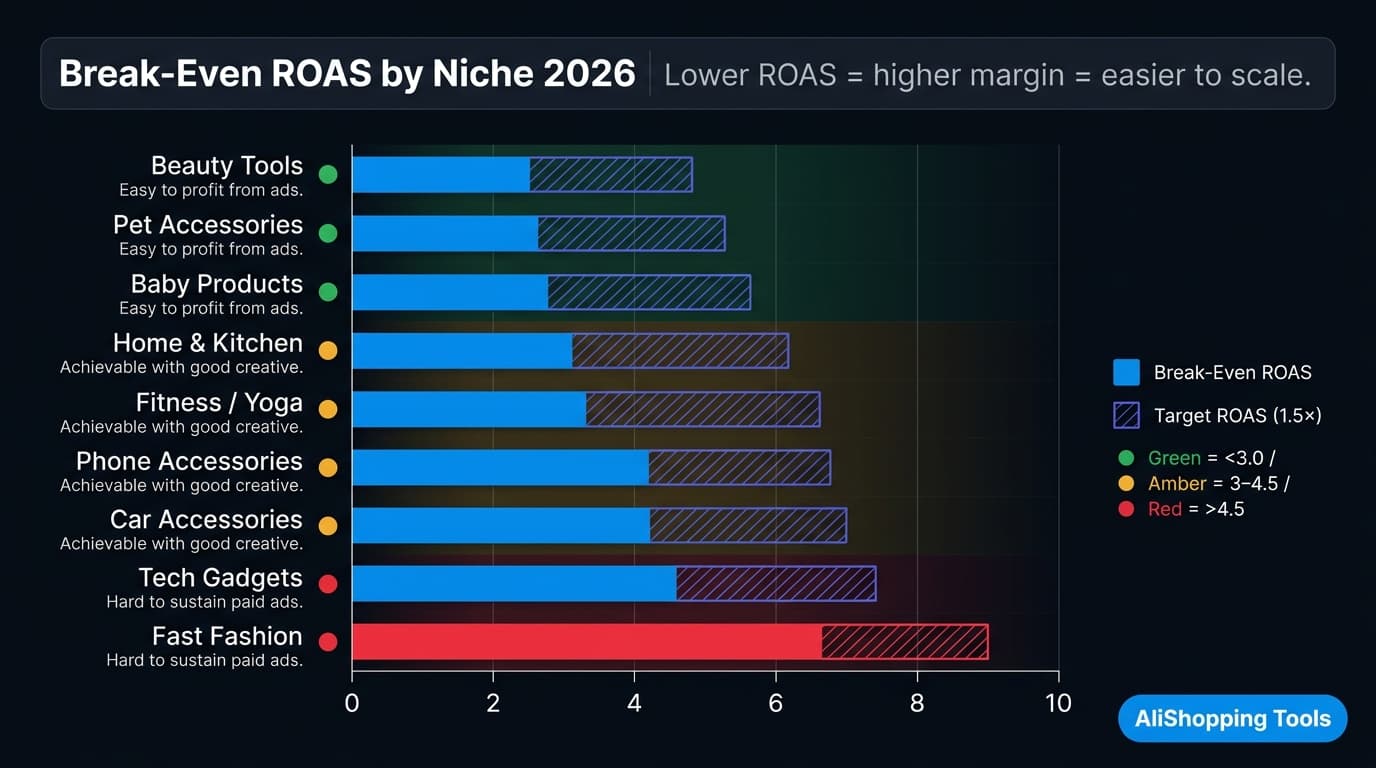
High-margin niches (beauty tools, pet accessories at ~38–40% net margin) are profitable at 3.0–4.0 ROAS.
Low-margin niches (tech gadgets at ~22% net margin) need 4.5+ ROAS to be profitable.
The break-even ROAS formula gives you the exact threshold for your specific store — a generic 3.0 benchmark is not meaningful without knowing your margin.
4What is the ROAS formula in dropshipping?
ROAS = Revenue ÷ Ad Spend.
If you spent $150 on ads and generated $525 in revenue, your ROAS is 3.5.
To determine if this is profitable, calculate your break-even ROAS (1 ÷ net margin %) and compare.
At 30% net margin, break-even is 3.33, so a ROAS of 3.5 is slightly profitable.
At 20% net margin, break-even is 5.0, so 3.5 ROAS represents a significant loss.
5Why is break-even ROAS different by niche?
Break-even ROAS varies by niche because net margins differ significantly across product categories.
High-margin niches like beauty tools (40%+ net margin) have a low break-even ROAS of 2.5, making ads much easier to run profitably.
Low-margin niches like fast fashion (15% net margin) have a break-even ROAS of 6.67 — nearly impossible to sustain with typical Meta or TikTok ad performance, which averages 2.5–4.0 ROAS for most dropshipping campaigns.
6How do I improve my dropshipping ROAS when ads are not profitable?
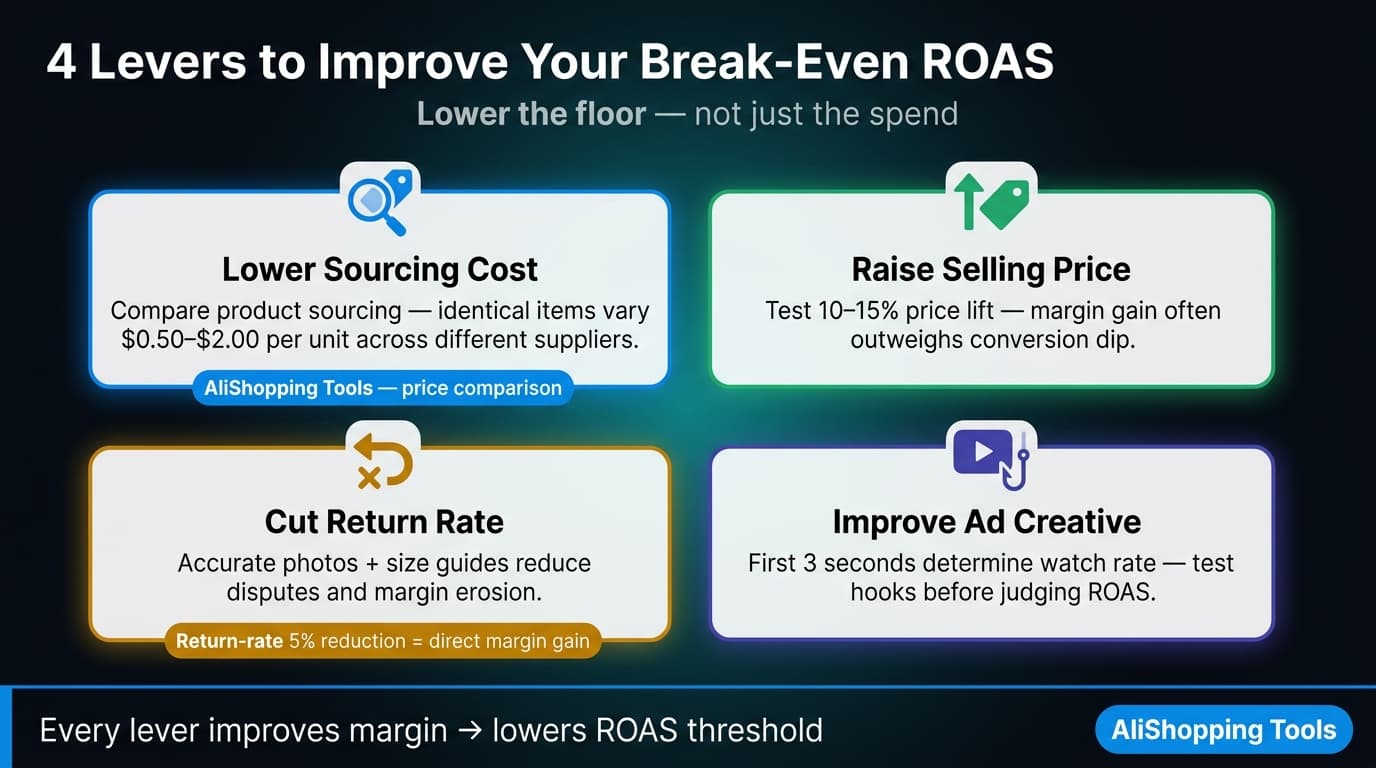
If ads are below break-even ROAS, address four levers in order of impact:
- 1Reduce AliExpress sourcing cost by comparing suppliers with AliShopping Tools — same products can vary $0.50–$2.00 across sellers.
- 2Test a 10–15% price increase if your product has strong reviews.
- 3Improve ad creative — test new hooks and UGC-style content, since the first 3 seconds determine watch rate.
- 4Reduce return rates through accurate product photos and proactive order tracking communication.
7How do I factor average shipping costs into my break-even ROAS calculation for a $30 product in 2026?
To factor average shipping costs into your break‑even ROAS, add the shipping expense to the total cost per acquisition before applying the ROAS formula.
For example, a $30 product with a $18 supplier cost leaves $12 gross profit; if average shipping from AliExpress is $5, net profit drops to $7, giving a net margin of 23.3 %.
The break‑even ROAS is then 1 ÷ 0.233 ≈ 4.3, meaning you need $4.30 in revenue for every $1 spent on ads to break even.
Updating this calculation each time shipping rates shift keeps your ad budget realistic.
8What frequency should I use to recalculate break-even ROAS when I run weekly flash sales?
For stores running weekly flash sales, recalculating break-even ROAS after each promotion ends is a reasonable cadence, since product cost, shipping, and ad-spend inputs can shift week to week.
Pull the last 7 days of performance data, recompute your cost and margin inputs, and update your ROAS target accordingly.
AliShopping Tools doesn't currently have a dashboard feature that automates this weekly refresh for you — a simple spreadsheet template you update each week works just as well.
9How does a 20% increase in ad CPC affect the break-even ROAS for a niche with a 35% profit margin?
A 20 % increase in cost‑per‑click (CPC) raises the break‑even ROAS by the same proportion for a niche with a 35 % profit margin.
The baseline break‑even ROAS is 1 ÷ 0.35 ≈ 2.86; after a 20 % CPC hike, the required ROAS becomes 2.86 × 1.20 ≈ 3.43.
This means you must generate $3.43 in revenue for every $1 spent on ads to stay profitable.
Monitoring CPC trends weekly and adjusting bids or creative spend accordingly helps you stay above the new threshold without sacrificing volume.
10Can I use AliShopping Tools to automatically adjust my break-even ROAS when supplier prices fluctuate?
AliShopping Tools doesn't integrate with ad platforms to automatically rewrite ROAS targets or pause campaigns via API — it's a product-research and Shopify-import tool, not an ad-management platform.
What it can do is help you check a supplier's current price on AliExpress so you can manually recalculate your break-even ROAS (1 ÷ net margin %) whenever costs change, and then update your own ad-platform targets or bid caps yourself.
11What is the difference between gross ROAS and net ROAS after fees, and which should I use for break-even analysis?
Net ROAS, which subtracts platform fees, shipping, and transaction costs, is the metric you should use for break‑even analysis.
Gross ROAS only measures revenue divided by ad spend, ignoring the hidden costs that erode profit; for a $25 product with a 30 % margin, gross ROAS of 3.0 looks healthy, but after a 2 % payment fee and $4 shipping, net margin falls to 18 %, pushing the break‑even ROAS to 1 ÷ 0.18 ≈ 5.6.
Using net ROAS ensures you set realistic ad‑budget goals, compare campaigns on an apples‑to‑apples basis, and avoid overspending on ads that appear profitable on paper but lose money in practice.
Bài viết liên quan
- Dropshipping Profit Margins by Niche — 2026 Full Guidedropshipping
- How to Calculate Dropshipping Profit Margin (Free Calculator + Formula)dropshipping
- How to Find Products with High Profit Margins on AliExpress (2026)misc
- Free AliExpress Dropshipping Tools 2026: The $0 Stackcompare
- Best Free Shopify Spy Tools in 2026: Analyze Competitor Stores Without Payingdropshipping
- AliExpress vs All Platforms 2026: Ultimate Comparisoncompare
Công cụ liên quan
Bài viết khác
Dropshipping Profit Margins by Niche — 2026 Full Guide
Yes — but only in 4 niches. We analyzed 6 months of AliExpress orders. Here are the real margins by category before you start.
Free AliExpress Dropshipping Tools 2026: The $0 Stack
Build a complete dropshipping research and fulfillment stack for $0. AliShopping Tools, DSers free tier, CJ Dropshipping, Google Trends, and more — compared honestly.
Best Free Shopify Spy Tools in 2026: Analyze Competitor Stores Without Paying
Compare the best free Shopify spy tools in 2026. AliShopping Tools offers unlimited free app detection, while Koala Inspector raised prices 120%. Here's what each tool actually does.