
How to Scale Dropshipping from $0 to $5K/Month 2026
Quick answer: Reaching $5,000/month in dropshipping revenue is achievable in 2026 — most stores that hit this milestone take 3–6 months and progress through three distinct stages: validation (no ad spend, organic testing), first wins (small paid tests, supplier confirmation), and active scaling (ad budget expansion, AOV lift tactics). The bottleneck at each stage is different, and treating them as one continuous process is the most common scaling mistake. Install AliShopping Tools on the Chrome Web Store →
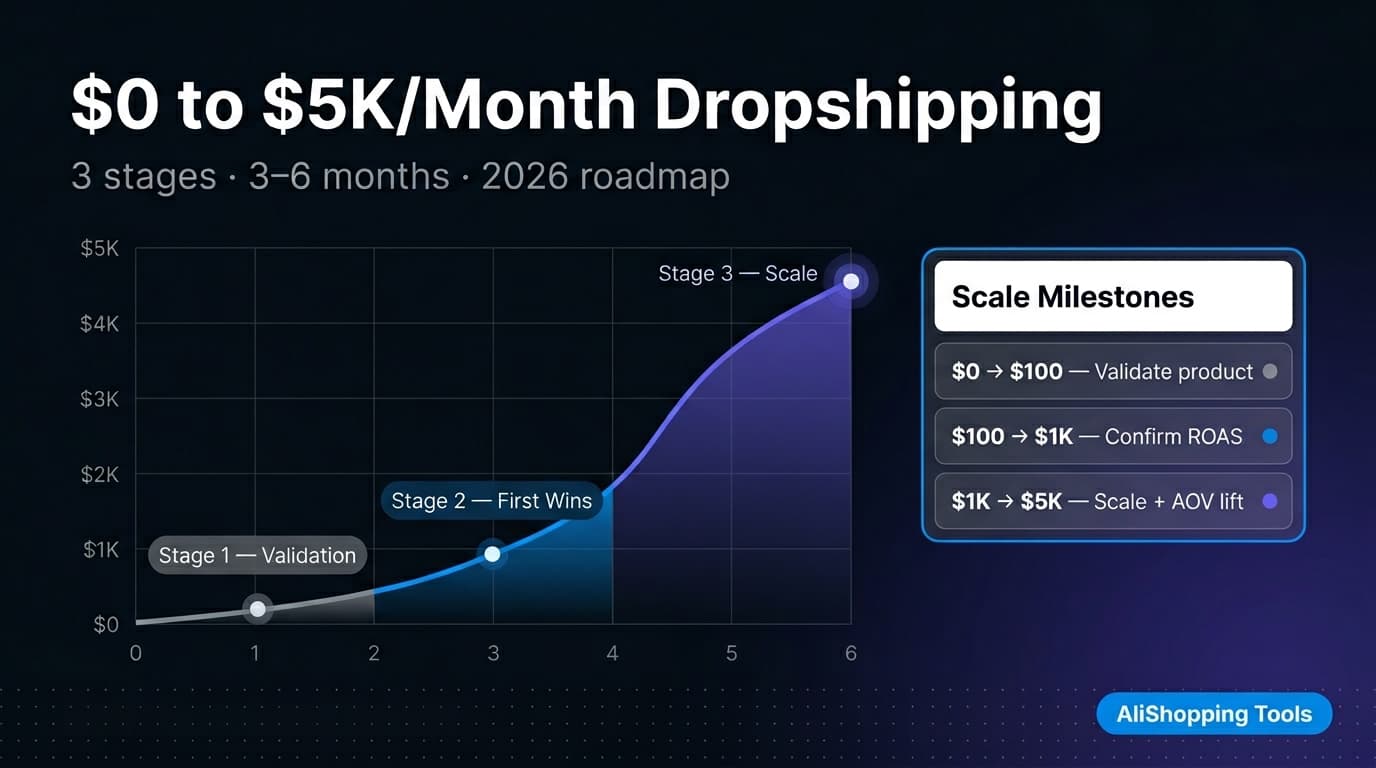
Most dropshipping guides tell you to "find winning products and run ads." That advice skips three months of context. Getting from $0 to $5,000/month requires solving a different problem at each revenue stage — and the mistake that kills stores at $800/month is not the same mistake that kills stores at $3,000/month.
This guide gives you a concrete stage-by-stage roadmap with the specific actions, tools, and benchmarks that move you forward at each milestone.
Is $5K/Month Dropshipping Achievable in 2026?
$5,000/month in dropshipping revenue is achievable in 2026, but requires realistic benchmarks on what it actually takes.
What $5K/month looks like in practice:
At an average order value (AOV) of $35, $5,000/month means roughly 143 orders per month, or about 5 orders per day. With a 20% net margin, that is $1,000/month in profit — meaningful side income but not financial independence on its own.
At a $60 AOV (achievable with upsells and product bundling), you need 84 orders/month, or 3 orders per day. At 25% net margin, that is $1,250/month in profit.
The path to $5K/month is real. It requires:
- A niche with gross margins above 35% (see dropshipping profit margins by niche)
- Ad spend that achieves break-even ROAS or better (see break-even ROAS formula)
- A supplier on AliExpress with stable pricing and reliable fulfillment
- 3–6 months of consistent testing and iteration
What $5K/month does NOT require in 2026: a large startup budget (you can start with $200–$500), a custom-built website, or a warehouse. The infrastructure barrier is genuinely low. The execution barrier is where most stores fail.
Stage 1 — $0 to $100: Validation
Goal at this stage: Prove that someone will buy your product before you spend a dollar on ads.
The Stage 1 bottleneck is not traffic — it is product-market fit. Most new dropshippers run ads immediately and interpret "low ROAS" as an ad targeting problem when the actual problem is that the product does not convert anyone at any cost.
What to do in Stage 1:
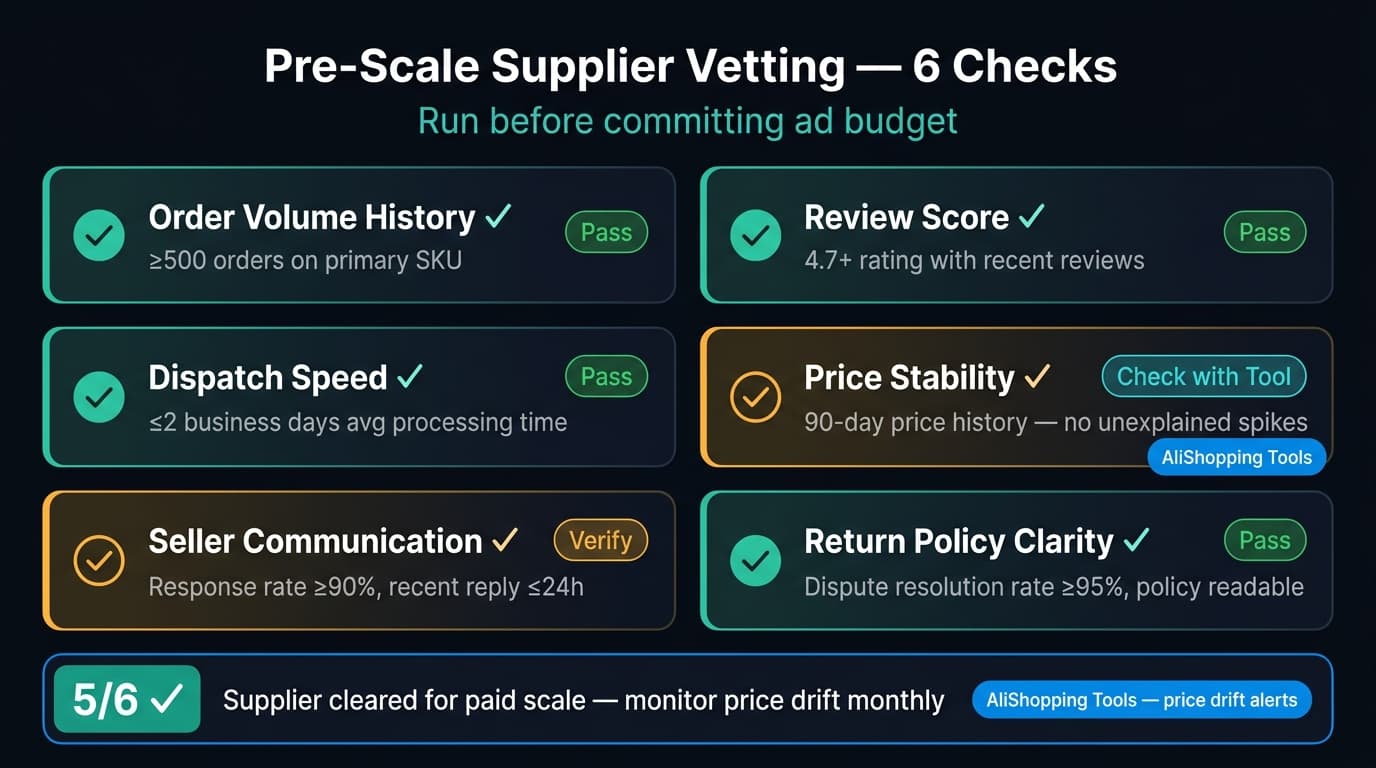
Select 1–3 products, not 20. Wide product catalogs at Stage 1 split your focus and make signal-reading impossible. Choose 1–3 products that meet these criteria: gross margin above 40%, not available on Amazon at a similar price, verifiable AliExpress supplier with 4.7+ star rating, product has been selling on AliExpress for at least 6 months (not a new listing).
Use AliShopping Tools to check the 90-day price history of your candidate products before selecting a supplier. A supplier that has been raising prices over the past 90 days will compress your margin as soon as you start scaling orders.
Drive organic traffic first. Before spending on ads, create 3–5 TikTok or Instagram Reels videos about the product. Simple formats work: unboxing, problem-solution demonstrations, before/after. Post consistently for 2–3 weeks. If you get zero engagement across 10+ posts on a product that should appeal to your target audience, the product is likely not compelling. If you see organic engagement, you have early proof of interest.
Use organic channels to validate: Reddit AMAs in niche communities, Pinterest product pins, and Facebook Groups are underutilized at Stage 1. You are not trying to make sales — you are trying to see if people react positively to the product concept.
Stage 1 success benchmark: At least 1–3 organic sales or strong engagement signals (saves, shares, direct questions about where to buy). If you reach $100 in revenue — even partially organic — you have validated a product and earned the right to move to Stage 2.
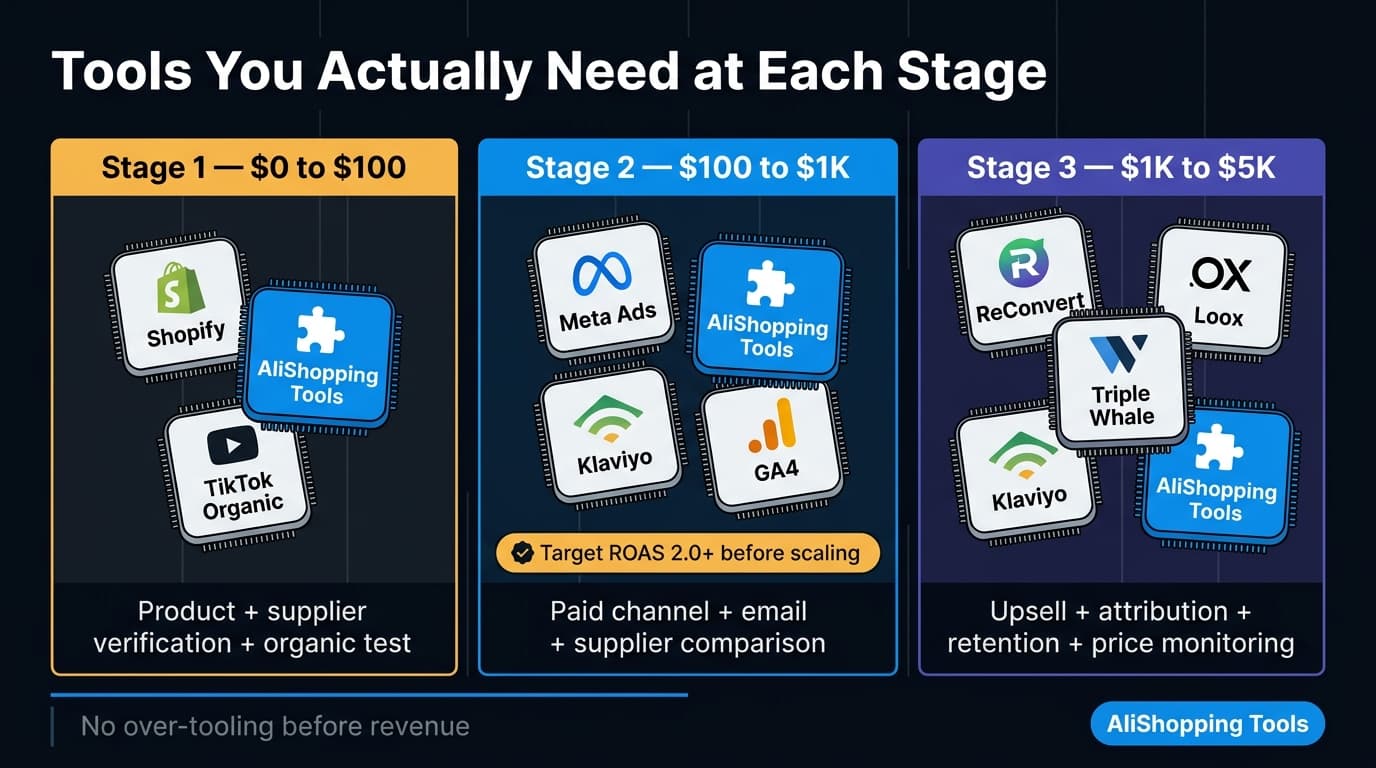
Tools at Stage 1:
- Shopify (basic plan)
- AliShopping Tools (supplier price history verification)
- TikTok or Instagram (organic content)
- Canva (product creative)
Stage 2 — $100 to $1,000: First Wins
Goal at this stage: Find a paid traffic channel that achieves break-even ROAS or better, and lock in a reliable supplier.
The Stage 2 bottleneck is ad efficiency. You have product-market fit signals but you need to find a scalable acquisition channel. Most dropshippers try to skip this stage by scaling ad spend too fast — spending $500/day before confirming that a $30/day budget is profitable.
What to do in Stage 2:
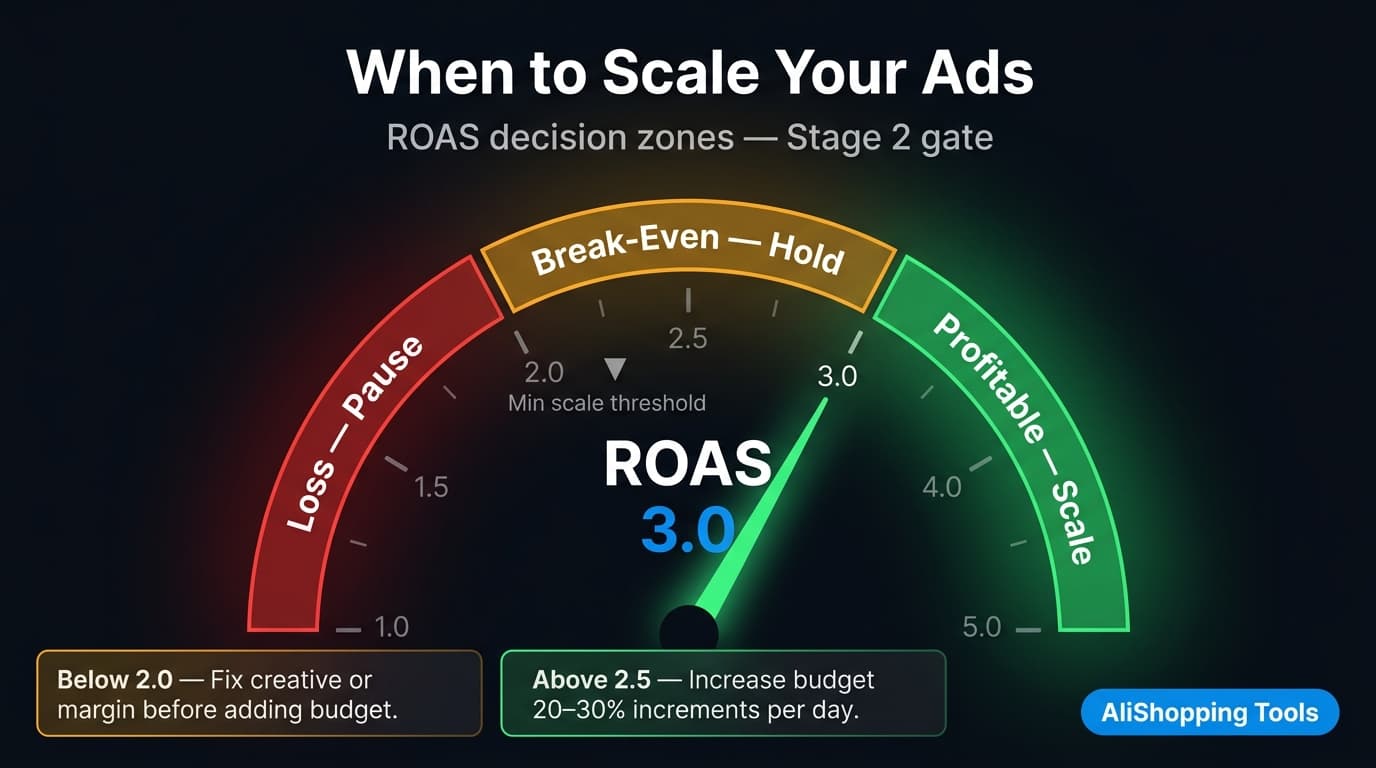
Start paid tests small. Set a daily budget of $20–$30 on Meta (Facebook/Instagram) or TikTok Ads. Run 3–5 ad creative variants on the same audience. Let each creative run for 3–5 days before evaluating. Kill creatives with ROAS below 1.5 (losing money). Keep creatives above 2.0 ROAS. If nothing achieves 2.0 ROAS after $150–$200 in total spend, evaluate whether the issue is creative, audience, landing page, or product price.
Calculate your break-even ROAS before you start. Knowing your break-even ROAS (the ROAS at which ad spend exactly equals margin) tells you whether a campaign is profitable or not at a glance. At 30% gross margin, your break-even ROAS is approximately 3.33. At 45% gross margin, it drops to 2.22. (Full formula: break-even ROAS guide.)
Lock in your supplier. By the time you hit $500 in revenue, you should have placed 15–20 orders with your primary AliExpress supplier. Evaluate: are orders processing within 24 hours? Are tracking numbers updating within 3–5 days? Are customers receiving orders that match the product photos? If any of these are inconsistent, find an alternative supplier before you scale. Use AliShopping Tools to compare pricing across sellers for the same product — a $0.50/unit difference becomes significant at 100+ orders/month.
Build your first repeat-buyer asset. Set up a post-purchase email sequence with at least 2 emails: a shipping confirmation (automated) and a follow-up at day 7–10 suggesting a complementary product. Even a 5–10% repeat purchase rate meaningfully reduces your effective customer acquisition cost at scale.
Install AliShopping Tools on the Chrome Web Store →
Stage 2 success benchmark: Achieving $1,000/month in revenue with at least one ad creative running at or above break-even ROAS. You should have a confirmed primary supplier with 20+ fulfilled orders and a basic email automation active.
Tools at Stage 2:
- Meta Ads Manager or TikTok Ads Manager
- AliShopping Tools (supplier comparison + price monitoring)
- Klaviyo or Omnisend (email automation)
- Google Analytics 4 (conversion tracking)
Stage 3 — $1,000 to $5,000: Scaling
Goal at this stage: Multiply revenue by expanding ad spend on proven creatives, increasing average order value, and building retention mechanics.
The Stage 3 bottleneck is margin management. Most stores that stall between $1,000 and $5,000/month are either: (a) scaling ad spend faster than margin allows, causing cash flow issues, or (b) not increasing AOV, so every new dollar of revenue costs the same to acquire as the first.
What to do in Stage 3:
Scale winning ad campaigns methodically. Once a creative achieves consistent 2.5+ ROAS over 7–10 days, increase daily budget by 20–30% increments — not by 2x overnight. Aggressive budget increases reset the Meta/TikTok learning phase and can cause ROAS to drop sharply. A 20–30% daily increase maintains the campaign's delivery optimization while growing spend.
Introduce upsells and cross-sells to lift AOV. This is the highest-leverage move at Stage 3. If your AOV is $35 and you introduce a post-purchase upsell (a complementary product at $15–$25, displayed after checkout), and 15% of customers accept it, your revenue-per-customer increases by $2.25–$3.75 per order without any additional ad spend. At 100 orders/month, that is $225–$375 in added revenue from zero extra cost.
Diversify ad creatives to prevent fatigue. Any ad creative will experience audience saturation over time — engagement drops and CPM rises. At Stage 3, build a systematic creative pipeline: 3–5 new video variants per week. Test different hooks (the first 2–3 seconds of a video are the only thing that determines whether someone watches). Repurpose customer photos/reviews as UGC-style creative.
Build an email list aggressively. Email is the only channel where you own the relationship. A list of 2,000+ buyers with a 25% open rate and 3% purchase rate can generate $1,500–$2,500 per month from email alone — reducing your dependency on paid ads. Offer a lead magnet (buying guide, discount code) to capture non-buyer email addresses.
Monitor supplier pricing continuously. At 100+ orders/month, a $0.50 supplier price increase costs you $600/year. Install AliShopping Tools and check price history on your primary products monthly. If a supplier starts raising prices, negotiate directly or switch to an alternative supplier before the margin impact accumulates.
Stage 3 success benchmark: $5,000/month in revenue with a minimum 2.5x ROAS on primary ad campaigns, AOV above your initial baseline by at least 15% (from upsells), and email list with at least one automated revenue-generating sequence.
Tools at Stage 3:
- ReConvert or CartHook (upsell/cross-sell)
- Loox or Judge.me (social proof / UGC)
- AliShopping Tools (ongoing supplier price monitoring)
- Triple Whale or Northbeam (advanced ROAS tracking across channels)
- Klaviyo (mature email flows: welcome, abandoned cart, win-back)
What Do Most Dropshippers Get Wrong When Scaling to $5K?
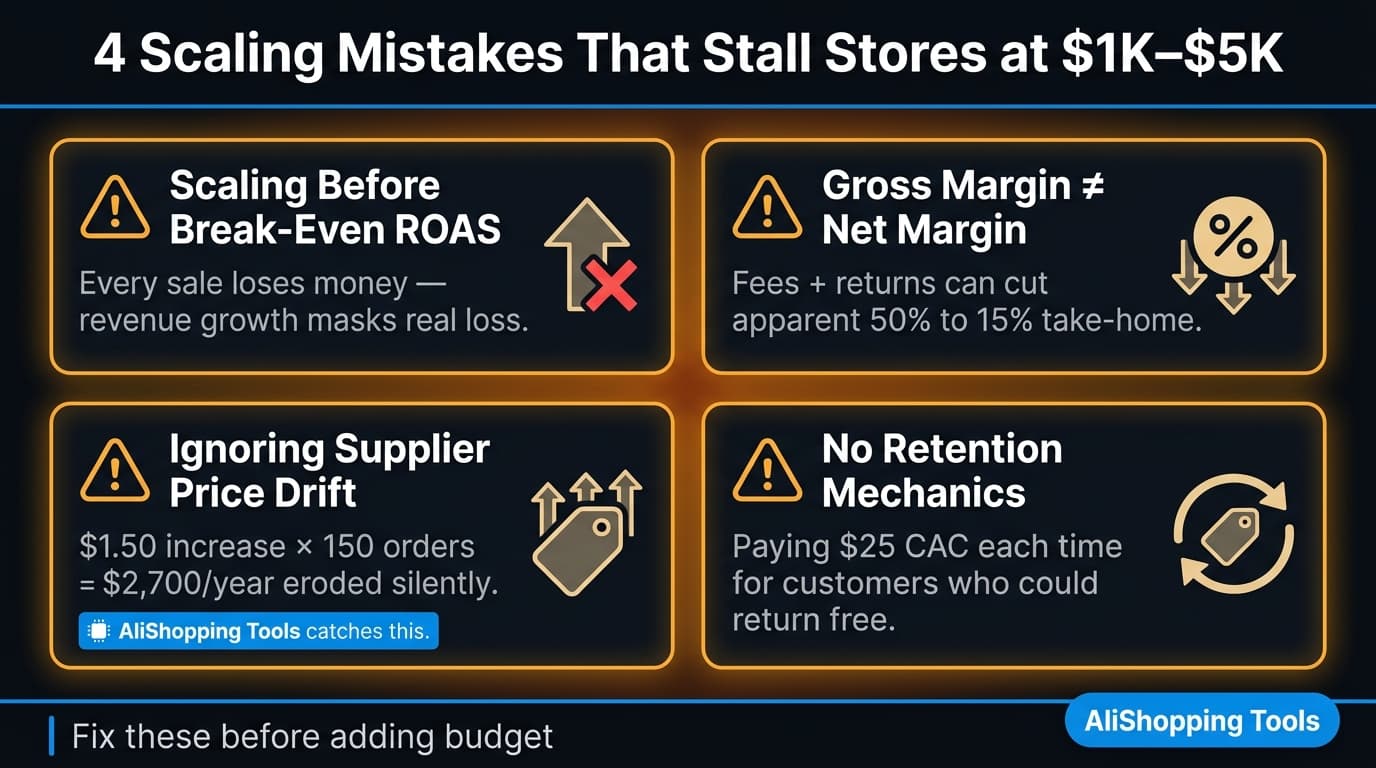
These are the four mistakes that stall the most stores between $1,000 and $5,000/month:
1. Scaling ad spend before confirming profitability. Investing $500/day in ads before you have confirmed that a $50/day budget is profitable does not accelerate learning — it accelerates losses. The rule: never scale a campaign that has not achieved break-even ROAS for at least 5 consecutive days.
2. Treating all margin as profit. Gross margin is not profit. After ad spend, platform fees, payment processing, and returns, the actual take-home from a "50% margin" product is often 15–20%. Build your projections on net margin, not gross.
3. Ignoring supplier price drift. An AliExpress supplier raising prices by $1.50 over 90 days may seem minor. At 150 orders/month, that is $225/month in extra cost — $2,700/year — that never shows up as a single line item in your P&L. AliShopping Tools' price history charts make this drift visible before it compounds.
4. Not investing in customer retention. The average AliExpress dropshipping customer acquisition cost via paid social is $15–$35 depending on niche and competition. A repeat buyer costs essentially nothing to acquire again if you have their email. Stores that build retention mechanics at Stage 2 have significantly lower effective CAC by Stage 3.
FAQ
How long does it take to scale dropshipping to $5,000 per month?
Most stores that reach $5,000/month achieve it in 3–6 months from first sale. The timeline depends heavily on niche margin and ad channel efficiency. Stores in high-margin niches (beauty tools, baby products) with strong TikTok creative can hit $5K/month in 8–10 weeks. Stores in lower-margin, high-competition niches (phone accessories, tech gadgets) typically take 5–9 months.
How much money do I need to start dropshipping in 2026?
A realistic starting budget for AliExpress dropshipping in 2026 is $200–$500: approximately $30/month for Shopify Basic, $100–$200 for initial paid ad tests in Stage 2, and $50–$100 for domain and basic tools. Many successful stores validated their first products entirely through organic TikTok and Instagram before spending anything on ads. A large starting budget is not a substitute for good product selection.
What is the best dropshipping niche for scaling to $5K/month?
Niches with high gross margins (40%+), low return rates (<5%), and identifiable enthusiast audiences scale most effectively. Based on AliShopping Tools user data, beauty tools, pet accessories, and baby products show the best scaling characteristics in 2026. See the dropshipping profit margins by niche guide for a full comparison.
How do I scale Facebook ads for dropshipping without losing ROAS?
Scale winning campaigns by 20–30% daily budget increments — not 2x jumps — to avoid resetting the Meta learning phase. Once a campaign achieves consistent 2.5+ ROAS for 5+ days, you can safely increase budget incrementally. Simultaneously, maintain a fresh creative pipeline (3–5 new variants/week) to prevent audience saturation from eroding ROAS as you scale.
Can I reach $5K/month dropshipping with TikTok organic only?
Yes, but it requires a product with strong organic content potential (visually demonstrable, shareable, trend-adjacent) and consistent posting volume (1–2 videos/day minimum). Organic TikTok stores that hit $5K/month typically have at least one video that achieved 200K+ views before crossing the $1K/month threshold. It is slower and less predictable than paid ads but has zero ad cost — which means net margins are significantly higher.
What tools do I actually need to scale a dropshipping store?
Stage 1: Shopify + AliShopping Tools (supplier verification) + TikTok/Instagram (organic). Stage 2: Meta or TikTok Ads Manager + Klaviyo (email) + AliShopping Tools (supplier comparison). Stage 3: Upsell app (ReConvert/CartHook) + advanced analytics (Triple Whale) + social proof app (Loox) + AliShopping Tools (ongoing supplier price monitoring). Each tool adds incremental leverage; avoid tool proliferation before you have revenue to justify the cost.
AliShopping Tools
See live AliExpress data in your browser.
Seller trust score, 90-day price history, and live promo codes — on every AliExpress product page. No account, free.
Ready to find winning products?
Try AliShopping Tools — 15 free AI tools for product research.
Quick answers
Frequently Asked Questions
1How do I scale dropshipping from zero to 5000 a month?
Scale dropshipping to $5,000/month through three stages: Stage 1 ($0–$100) is organic validation with 1–3 products and no ad spend.
Stage 2 ($100–$1,000) is paid ad testing with $20–$30/day budgets until you find a creative achieving 2.0+ ROAS.
Stage 3 ($1,000–$5,000) is scaling ad spend 20–30% daily on winning campaigns while adding upsells to increase average order value.
2How long does it take to scale a dropshipping store to $5K per month?
Most dropshipping stores reach $5,000/month in 3–6 months from their first sale.
High-margin niches (beauty tools, baby products) with strong TikTok creative can hit this milestone in 8–10 weeks.
Lower-margin, higher-competition niches (phone accessories, tech gadgets) typically take 5–9 months.
Timeline depends primarily on niche margin, ad efficiency, and consistency of product testing.
3How much money do I need to start dropshipping in 2026?
A realistic starting budget is $200–$500: $30/month for Shopify Basic, $100–$200 for initial paid ad tests, and $50–$100 for domain and basic tools.
Many stores validate their first products entirely through organic TikTok before spending on ads.
You do not need a large startup budget — strong product selection and consistent content creation matter more than capital at Stage 1.
4What ROAS should I target when scaling dropshipping ads?
Your minimum target ROAS depends on your gross margin.
At 30% gross margin, break-even ROAS is approximately 3.33.
At 45% gross margin, it is approximately 2.22.
Only scale ad spend on campaigns that have held at or above break-even ROAS for 5+ consecutive days.
A useful rule: never scale a campaign that has not been profitable at your current daily budget first.
5How can I increase average order value in my dropshipping store?
Post-purchase upsells are the highest-leverage AOV tactic — showing a complementary product immediately after checkout, when the buyer is still in purchase mode.
Typical acceptance rates are 10–20%, adding $15–$30 per accepted upsell with zero additional ad cost.
Product bundles, quantity discounts at the cart level, and cross-sell email sequences are secondary AOV levers.
Increasing AOV from $35 to $50 reduces your effective customer acquisition cost significantly.
6Is dropshipping to scale guide 2026 still relevant with Temu and Shein?
Yes.
Temu and Shein primarily compete in commodity categories: generic clothing basics, unbranded gadgets, and low-ticket accessories.
Dropshipping stores that focus on differentiated niches — beauty tools, pet accessories, baby products, car accessories — face much less direct competition from Temu and Shein.
The key is avoiding the commodity segments where platform pricing undercuts AliExpress dropshipping economics, and instead targeting niches with higher perceived value and lower Temu/Shein catalog overlap.
7Which low‑competition product niches are most profitable for dropshipping in 2026?
Low-competition niches with strong perceived value — eco-friendly home gadgets, pet-tech accessories, niche fitness equipment — tend to hold better margins than saturated commodity categories because you're not competing purely on price.
Use AliExpress's own filters and AliShopping Tools' Competition tab to check seller count and saturation before committing.
Validate demand with a small ad test before locking in a supplier, and revisit revenue-per-product monthly rather than assuming a fixed ramp-up curve — actual results vary a lot by niche and execution.
8How can I automate order fulfillment on AliExpress to scale without hiring staff?
Full order automation — the tool automatically placing an AliExpress order the moment a customer pays on your Shopify or WooCommerce store — is not a shipped AliShopping Tools feature; it's listed as a 2026 H2 roadmap item, not something available today.
Until it ships, order fulfillment on AliExpress still requires either manual ordering or a dedicated fulfillment-automation tool like DSers or AutoDS.
Set up rule-based pricing and daily inventory checks manually in the meantime to reduce out-of-stock errors as you scale.
9What tax and legal considerations should I plan for when scaling my dropshipping store to $5,000 per month?
When scaling to $5,000 a month, you need to address tax residency, sales tax collection, and import duties — the specifics depend heavily on where you and your customers are located.
In the US, check whether you've triggered sales tax nexus in any state and configure your platform's tax settings accordingly.
For EU customers, the One-Stop Shop (OSS) simplifies VAT reporting, but you still need to charge the correct rate based on the buyer's country.
Keep detailed invoices from your AliExpress suppliers, since customs may request proof of value for shipments.
Budget for tax software or professional advice as your volume grows — the right amount depends on your jurisdiction and complexity, so consult a professional rather than a fixed number.
10How can I leverage TikTok organic videos to boost my dropshipping sales while staying under a $2,000 ad budget?
To boost dropshipping sales with TikTok organic videos while keeping ad spend low, create short-form product demos that highlight a single benefit and post consistently — several times per week is a common cadence.
Use trending sounds and a clear call-to-action linking to your store's bio.
Source the featured product on AliExpress.
Many creators find TikTok organic converts well relative to paid Facebook traffic for visually demonstrable products, though the exact lift varies by niche and creative quality — track your own UTM data rather than assuming a fixed multiplier.
Reinvest early organic wins into paid campaigns once you have a proven creative.
11Which post‑purchase metrics should I track beyond ROAS to ensure sustainable scaling to $5K/month?
Beyond ROAS, track post-purchase metrics such as repeat purchase rate (RPR), customer lifetime value (CLV), and average fulfillment time to gauge whether your growth is sustainable.
Healthy benchmarks vary by niche, but generally you want CLV to comfortably exceed your customer acquisition cost — not just cover it.
Monitor fulfillment time, since slower shipping tends to increase churn and hurt reviews.
Use your own order data to calculate true product cost versus revenue over time, and set your own alert thresholds based on what you observe in your store rather than a generic industry number.
More from the blog
Dropshipping Profit Margins by Niche — 2026 Full Guide
Dropshipping profit margins by niche in 2026. Top niches earn 40–65% gross margin. See which niches are declining and how to calculate your real net margin.
AliExpress Shipping to the UK: Delivery Times, VAT & Customs (2026)
How long AliExpress takes to reach the UK, how 20% VAT and post-Brexit customs work, and which shipping method is fastest for UK shoppers in 2026.
AliExpress Shipping to the USA: Delivery Times, Customs & Duty (2026)
How long AliExpress takes to the USA, what import duty you pay after the 2026 de minimis change, and which shipping method is fastest. Realistic estimates.