
Dropshipping Break-Even ROAS Formula — Full 2026 Guide
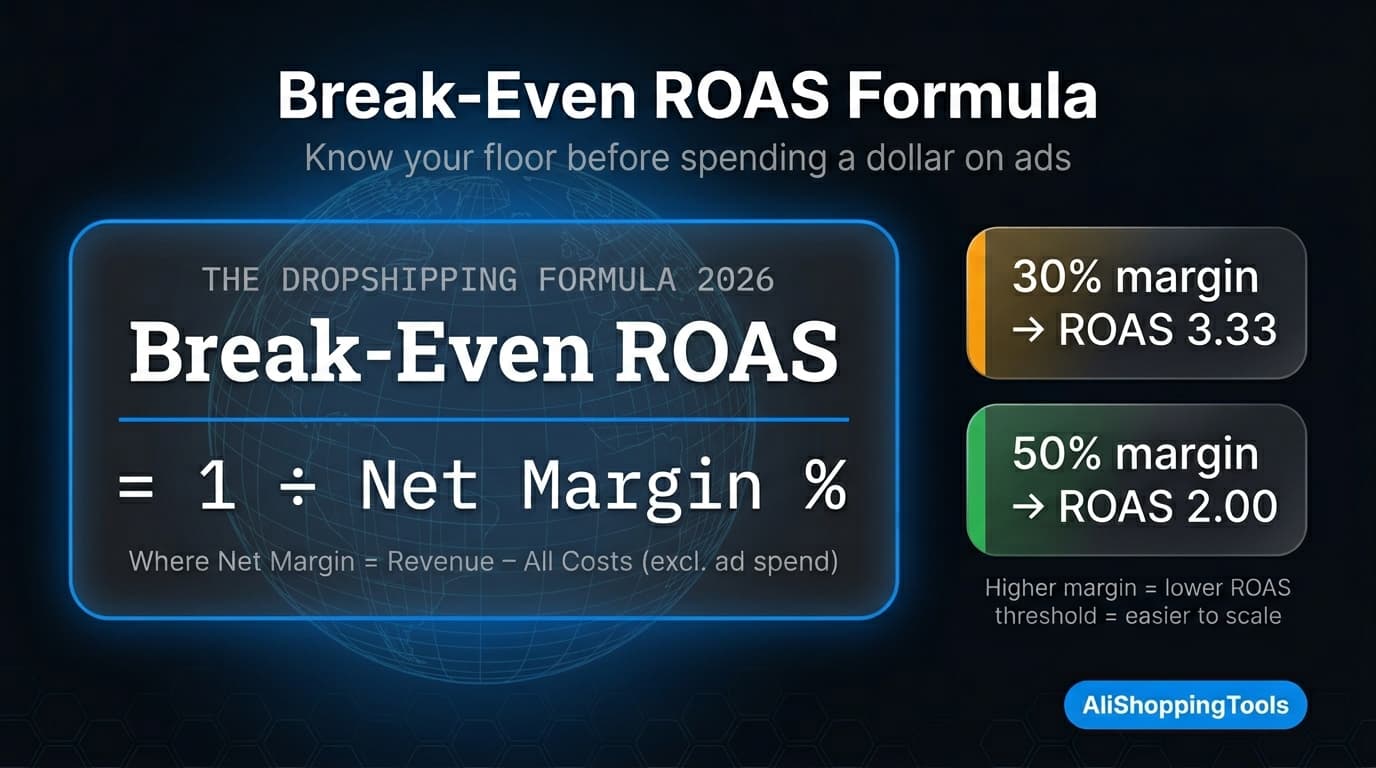
Quick answer: Break-even ROAS = 1 ÷ net margin %. If your net margin is 30%, your break-even ROAS is 3.33. If your ROAS falls below this number, your ads are losing money — not breaking even, not "almost profitable." Every percentage point of margin you protect lowers your break-even ROAS and makes ads easier to run profitably. Install AliShopping Tools on the Chrome Web Store →
ROAS (Return on Ad Spend) is the most-used metric in dropshipping, and the most-misunderstood. Seeing a ROAS of 2.5 and calling a campaign "profitable" is a common mistake — because 2.5 might be well below your break-even point, depending on your margin.
This guide gives you the exact formula, shows you how to calculate it for your store in three steps, and provides niche-level benchmarks so you know whether your current campaigns are actually profitable.
What Is ROAS and Why Does It Matter for Dropshipping?
ROAS measures how much revenue you generate for every dollar you spend on advertising. A ROAS of 3.0 means you earn $3.00 in revenue for every $1.00 spent on ads.
ROAS alone does not tell you whether a campaign is profitable. A ROAS of 4.0 is excellent for a low-margin product but might still be a loss-maker if your margin is thin enough. A ROAS of 2.0 can be genuinely profitable on a high-margin niche. The number only becomes actionable when compared against your break-even threshold.
For AliExpress dropshippers, ROAS is typically tracked at the campaign or ad set level in Meta Ads Manager or TikTok Ads Manager. Revenue is reported when a purchase is attributed to the ad click (usually a 7-day click, 1-day view attribution window for Meta).
ROAS formula:
ROAS = Revenue Generated ÷ Ad Spend
A campaign that generated $450 in sales from $150 in ad spend has a ROAS of 3.0.
What Is Break-Even ROAS?
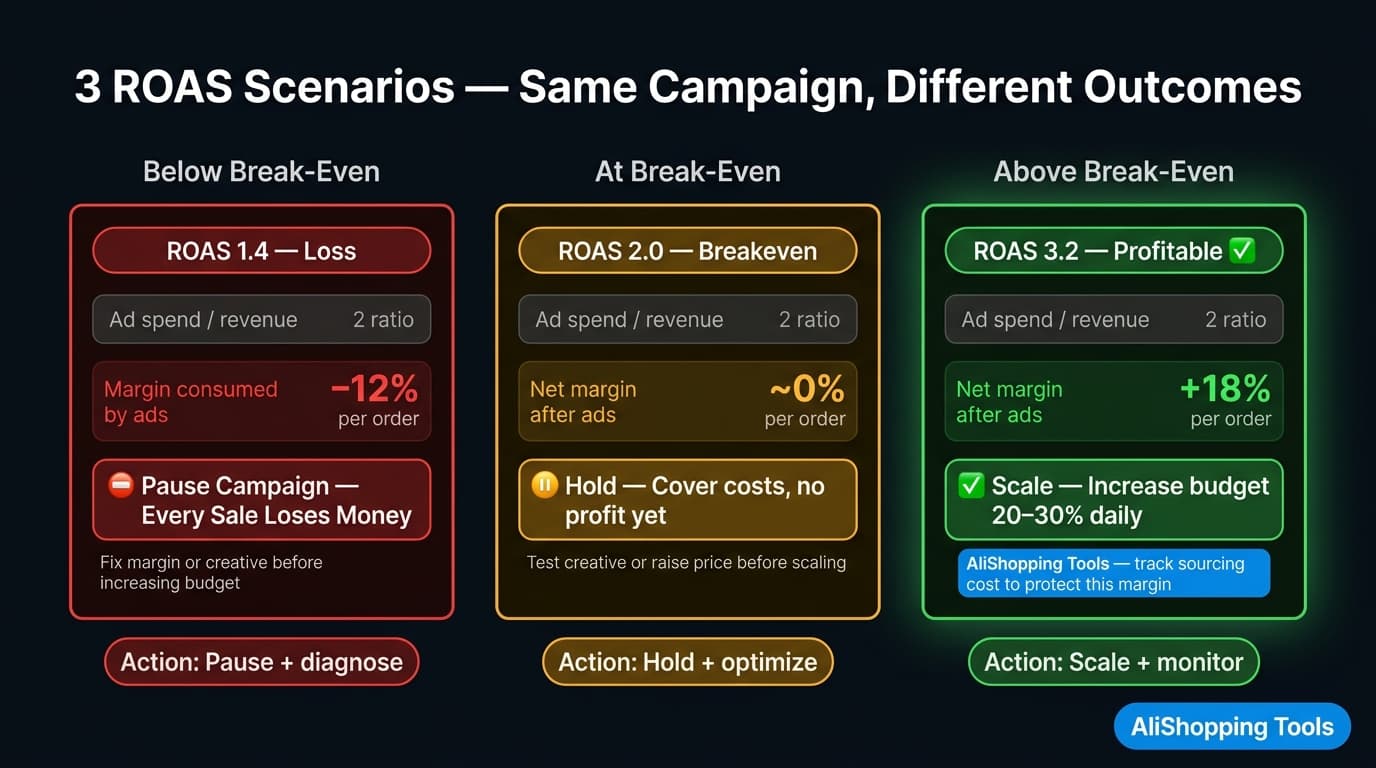
Break-even ROAS is the minimum ROAS your ads must achieve for your total revenue to exactly cover all costs — including the ad spend itself. Below break-even ROAS, every sale loses money. Above it, every sale is profitable.
Break-even ROAS depends entirely on your net margin — the percentage of revenue that remains after deducting product cost, shipping, platform fees, payment processing, and returns. The higher your net margin, the lower your break-even ROAS, and the easier it is to run profitable ads.
Why this matters: Many dropshippers look at a ROAS of 2.8 and think "close enough." But if their break-even ROAS is 3.33, a ROAS of 2.8 means they are losing money on every sale that came through ads — not making a small amount, actually losing. Over 100 orders, that is a meaningful loss even if gross revenue looks healthy.
The Break-Even ROAS Formula
Break-Even ROAS = 1 ÷ Net Margin %
Where Net Margin % = (Revenue − All Costs) ÷ Revenue
All costs to include:
- AliExpress product cost
- AliExpress shipping cost
- Platform fee (Shopify: ~2%; Amazon: 8–15%; eBay: 12–13%)
- Payment processing (~3%)
- Return reserve (2–5% depending on niche)
Do NOT include ad spend in the net margin for this calculation — ad spend is what you are evaluating.
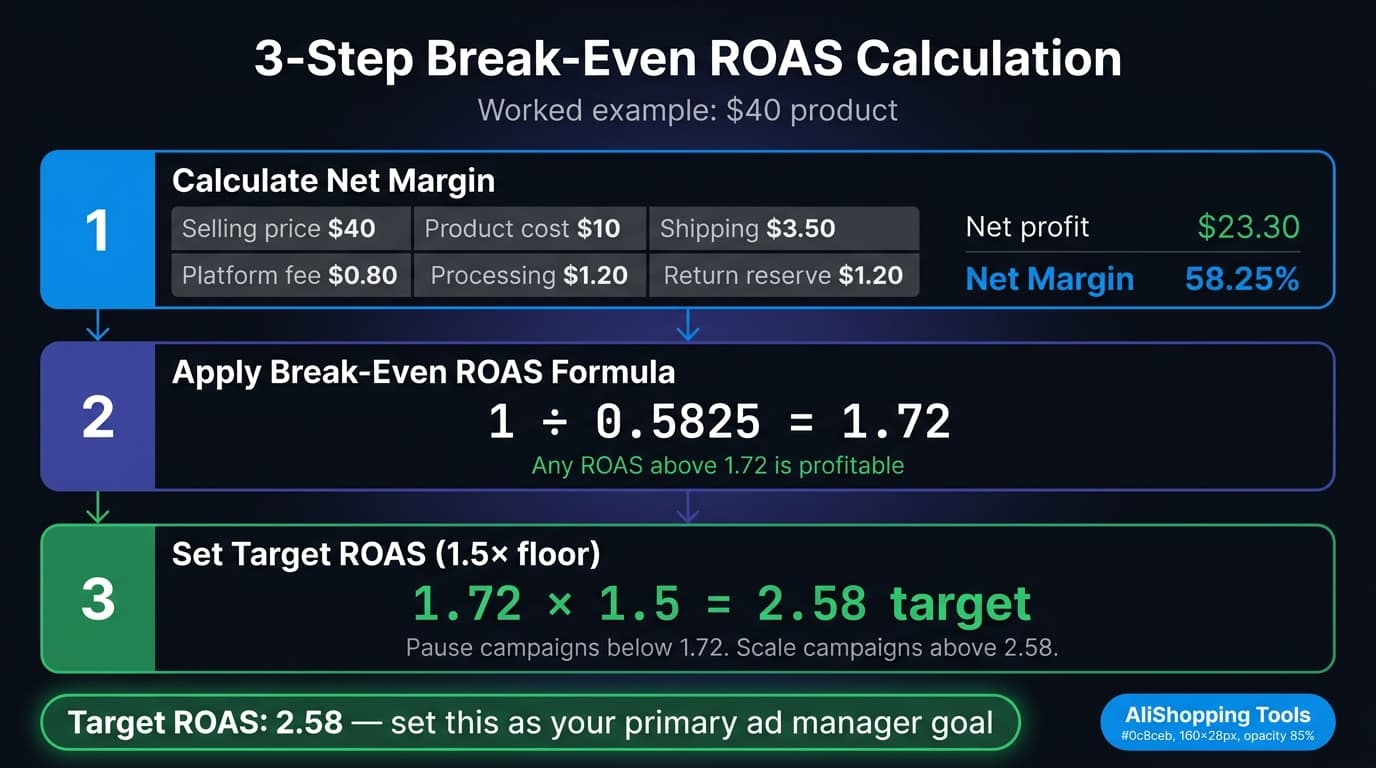
Step 1: Calculate Your Net Margin
Start with a single product example.
| Component | Amount |
|---|---|
| Selling price | $40.00 |
| AliExpress product cost | −$10.00 |
| AliExpress shipping | −$3.50 |
| Shopify transaction fee (2%) | −$0.80 |
| Payment processing (3%) | −$1.20 |
| Return reserve (3%) | −$1.20 |
| Net profit before ad spend | $23.30 |
| Net margin | 58.25% |
This 58.25% net margin is your "pre-ad" margin. It is the proportion of revenue available to cover ad spend AND generate profit.
Step 2: Calculate Break-Even ROAS
Apply the formula:
Break-Even ROAS = 1 ÷ 0.5825 = 1.72
This means: for every $1 you spend on ads, you need to generate at least $1.72 in revenue. Any ROAS above 1.72 is profitable; any ROAS below is a loss.
At this margin, even a ROAS of 2.0 generates profit:
- Revenue: $2.00 per $1 ad spend
- Costs (58.25% margin leaves 41.75% for costs including ads): $0.4175 × $2.00 = $0.84 in other costs
- Ad spend: $1.00
- Profit per $1 spent: $2.00 − $0.84 − $1.00 = $0.16
The higher your net margin, the more forgiving your ads can be.
Step 3: Set Your Target ROAS
Break-even ROAS tells you the floor — the minimum to not lose money. Your target ROAS should be higher to ensure actual profit.
A common rule of thumb: set your target ROAS at 1.5–2.0× your break-even ROAS.
| Net Margin | Break-Even ROAS | Target ROAS (1.5×) |
|---|---|---|
| 20% | 5.0 | 7.5 |
| 25% | 4.0 | 6.0 |
| 30% | 3.33 | 5.0 |
| 40% | 2.5 | 3.75 |
| 50% | 2.0 | 3.0 |
| 58% | 1.72 | 2.58 |
If your campaigns consistently miss your target ROAS, you have three levers: increase margin (better supplier cost, higher price), reduce costs (better platform deal, lower return rate), or improve ad performance (better creative, better audience).
Break-Even ROAS by Niche
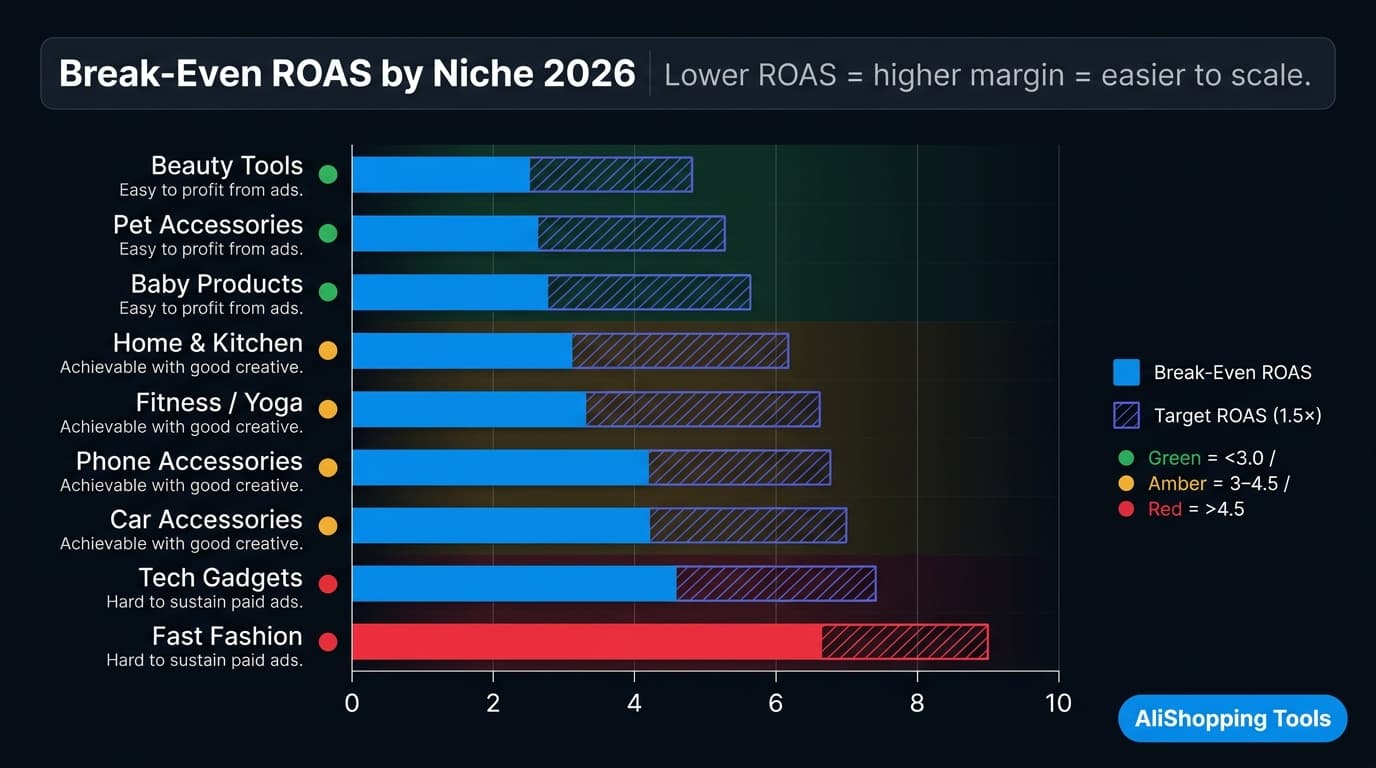
The table below shows estimated break-even ROAS for common AliExpress dropshipping niches, using typical gross margin ranges (from the dropshipping profit margins by niche guide) and standard cost deductions.
| Niche | Avg Net Margin | Break-Even ROAS | Target ROAS |
|---|---|---|---|
| Beauty / skincare tools | ~40% | 2.5 | 3.5–4.0 |
| Pet accessories | ~38% | 2.63 | 3.5–4.0 |
| Baby products | ~37% | 2.7 | 3.5–4.0 |
| Home & kitchen gadgets | ~32% | 3.13 | 4.0–4.5 |
| Fitness / yoga | ~30% | 3.33 | 4.5–5.0 |
| Phone accessories | ~27% | 3.7 | 5.0–5.5 |
| Car accessories | ~30% | 3.33 | 4.5–5.0 |
| Tech gadgets | ~22% | 4.55 | 6.0–7.0 |
| Fast fashion | ~15% | 6.67 | 8.0–10.0 |
Net margin estimated after deducting shipping, platform fee (~2%), payment processing (~3%), return reserve (2–5% by niche). Source: industry-reported estimates + AliShopping Tools user data.
Key insight: Fast fashion's break-even ROAS of 6.67 is extremely difficult to achieve with paid Meta or TikTok advertising — most dropshipping ad accounts average 2.5–4.0 ROAS. This is a primary reason why fast fashion is a challenging niche despite sometimes high gross margins.
How to Improve Your Break-Even ROAS
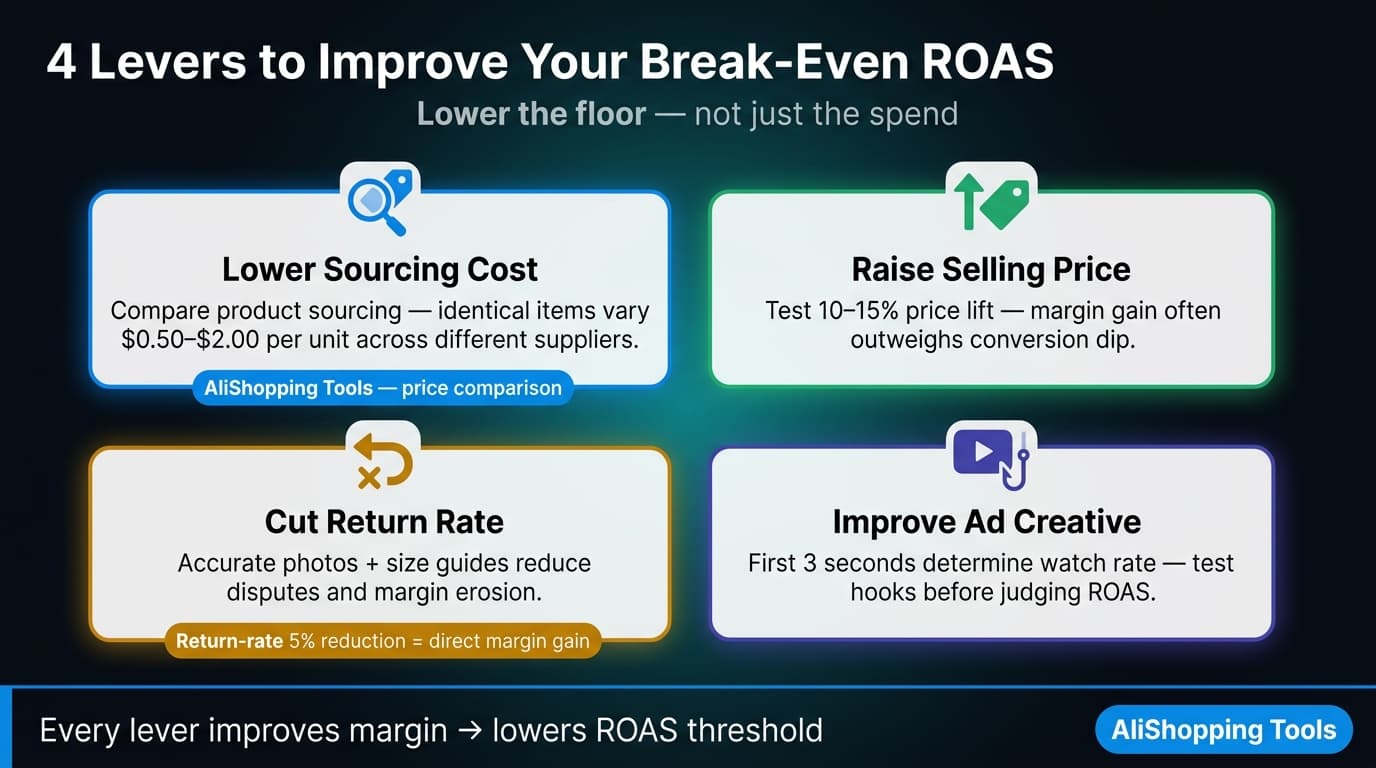
If your ads are running near or below break-even, there are four levers:
1. Lower your AliExpress sourcing cost. A $1.00 reduction in product cost on a $35 product improves your margin by ~2.9 percentage points, which lowers break-even ROAS. Use AliShopping Tools to compare supplier pricing for the same product across multiple AliExpress sellers — identical products can vary by $0.50–$2.00 per unit. At scale, this difference is significant.
2. Increase your selling price. Many dropshippers underprice from fear of losing customers. If your product has strong reviews and unique positioning, test a 10–15% price increase. Even if conversion rate drops slightly, the margin improvement can more than compensate. Run an A/B test on price if your platform supports it.
3. Reduce return rates. Returns eat margin without generating revenue. Accurate product photos, detailed size guides (for apparel), and proactive shipping update emails reduce dispute rates. A 5% return rate reduction directly improves effective net margin.
4. Improve ad creative to raise ROAS above break-even. If your break-even ROAS is 3.3 and your best creative achieves 2.8, you have a creative or audience problem — not a product problem. Test new hooks, different video formats, and UGC-style content. The first 2–3 seconds of a video ad determine whether someone watches; the rest determines whether they buy.
Install AliShopping Tools on the Chrome Web Store →
For a complete breakdown of margin ranges by niche, see the dropshipping profit margins by niche guide. For the full scaling roadmap from $0 to $5K/month, see the dropshipping scale guide.
FAQ
What is break-even ROAS in dropshipping?
Break-even ROAS is the minimum return on ad spend required for your advertising to not lose money. It is calculated as 1 ÷ net margin %. At a 30% net margin, your break-even ROAS is 3.33. A ROAS below this threshold means every ad-attributed sale is generating a net loss, even if revenue is growing. Break-even ROAS is the single most important benchmark for evaluating whether a dropshipping ad campaign is profitable.
How do I calculate my dropshipping ROAS formula?
ROAS = Revenue ÷ Ad Spend. If you spent $200 on ads and generated $700 in revenue, your ROAS is 3.5. To determine if this is profitable, compare it to your break-even ROAS (1 ÷ net margin). At a 30% net margin, break-even ROAS is 3.33, so a ROAS of 3.5 is barely profitable. At a 40% net margin, break-even ROAS is 2.5, so 3.5 ROAS generates meaningful profit.
What is a good ROAS for AliExpress dropshipping?
A good ROAS for AliExpress dropshipping depends on your niche margin. For high-margin niches (beauty tools, pet accessories at ~38–40% net margin), a ROAS of 3.0–4.0 is profitable. For lower-margin niches (tech gadgets at ~22% net margin), you need 4.5+ ROAS to be profitable. As a general benchmark, a ROAS of 3.0 is often cited as a minimum target for dropshipping, but this only applies if your net margin is above 33%.
What happens if my ROAS is below break-even?
If your ROAS is below break-even, your ads are generating a net loss on every sale attributed to them. The revenue looks positive in your dashboard, but after deducting product cost, shipping, platform fees, and ad spend, you are spending more to acquire customers than those customers return. The correct response is to pause the campaign, evaluate whether the issue is margin (low product price or high costs) or ad performance (low ROAS), and fix the root cause before scaling spend.
How does net margin affect break-even ROAS?
Net margin and break-even ROAS have an inverse relationship — higher margin means lower break-even ROAS. A niche with 50% net margin has a break-even ROAS of 2.0; a niche with 20% net margin has a break-even ROAS of 5.0. This is why niche selection is so important for ad-dependent dropshipping stores: choosing a higher-margin niche gives you more room to run profitable ads even when ROAS fluctuates, which it always does.
How can I lower my break-even ROAS as a dropshipper?
Lower your break-even ROAS by increasing your net margin. Four ways to improve net margin:
- 1Reduce AliExpress sourcing cost by comparing suppliers with AliShopping Tools — identical products vary $0.50–$2.00 across sellers.
- 2Increase selling price by 10–15% if your product has strong positioning.
- 3Reduce return rates through accurate photos, detailed descriptions, and proactive order tracking.
- 4Lower platform fees by using Shopify Payments instead of third-party processors to reduce transaction fees.
AliShopping Tools
See live AliExpress data in your browser.
Seller trust score, 90-day price history, and live promo codes — on every AliExpress product page. No account, free.
Ready to find winning products?
Try AliShopping Tools — 15 free AI tools for product research.
Quick answers
Frequently Asked Questions
1What is break-even ROAS for dropshipping?
Break-even ROAS is the minimum return on ad spend required for ads to not lose money.
Formula: Break-Even ROAS = 1 ÷ net margin %.
At 30% net margin, break-even ROAS is 3.33.
At 45% net margin, it is 2.22.
Any ROAS below your break-even threshold means ad-attributed sales are generating a net loss, even if revenue is positive.
2How do I calculate break-even ROAS for my dropshipping store?
Three steps:
- 1Calculate net margin by subtracting AliExpress cost, shipping, platform fee, payment processing, and return reserve from your selling price, then divide by selling price.
- 2Apply the formula: Break-Even ROAS = 1 ÷ net margin %.
- 3Set your target ROAS at 1.5× the break-even for actual profit. Example: at 40% net margin, break-even ROAS = 2.5, target ROAS = 3.75.
3What is a good ROAS for dropshipping ads in 2026?
A good ROAS depends entirely on your niche margin.
High-margin niches (beauty tools, pet accessories at ~38–40% net margin) are profitable at 3.0–4.0 ROAS.
Low-margin niches (tech gadgets at ~22% net margin) need 4.5+ ROAS to be profitable.
The break-even ROAS formula gives you the exact threshold for your specific store — a generic 3.0 benchmark is not meaningful without knowing your margin.
4What is the ROAS formula in dropshipping?
ROAS = Revenue ÷ Ad Spend.
If you spent $150 on ads and generated $525 in revenue, your ROAS is 3.5.
To determine if this is profitable, calculate your break-even ROAS (1 ÷ net margin %) and compare.
At 30% net margin, break-even is 3.33, so a ROAS of 3.5 is slightly profitable.
At 20% net margin, break-even is 5.0, so 3.5 ROAS represents a significant loss.
5Why is break-even ROAS different by niche?
Break-even ROAS varies by niche because net margins differ significantly across product categories.
High-margin niches like beauty tools (40%+ net margin) have a low break-even ROAS of 2.5, making ads much easier to run profitably.
Low-margin niches like fast fashion (15% net margin) have a break-even ROAS of 6.67 — nearly impossible to sustain with typical Meta or TikTok ad performance, which averages 2.5–4.0 ROAS for most dropshipping campaigns.
6How do I improve my dropshipping ROAS when ads are not profitable?
If ads are below break-even ROAS, address four levers in order of impact:
- 1Reduce AliExpress sourcing cost by comparing suppliers with AliShopping Tools — same products can vary $0.50–$2.00 across sellers.
- 2Test a 10–15% price increase if your product has strong reviews.
- 3Improve ad creative — test new hooks and UGC-style content, since the first 3 seconds determine watch rate.
- 4Reduce return rates through accurate product photos and proactive order tracking communication.
7How do I factor average shipping costs into my break-even ROAS calculation for a $30 product in 2026?
To factor average shipping costs into your break‑even ROAS, add the shipping expense to the total cost per acquisition before applying the ROAS formula.
For example, a $30 product with a $18 supplier cost leaves $12 gross profit; if average shipping from AliExpress is $5, net profit drops to $7, giving a net margin of 23.3 %.
The break‑even ROAS is then 1 ÷ 0.233 ≈ 4.3, meaning you need $4.30 in revenue for every $1 spent on ads to break even.
Updating this calculation each time shipping rates shift keeps your ad budget realistic.
8What frequency should I use to recalculate break-even ROAS when I run weekly flash sales?
For stores running weekly flash sales, recalculating break-even ROAS after each promotion ends is a reasonable cadence, since product cost, shipping, and ad-spend inputs can shift week to week.
Pull the last 7 days of performance data, recompute your cost and margin inputs, and update your ROAS target accordingly.
AliShopping Tools doesn't currently have a dashboard feature that automates this weekly refresh for you — a simple spreadsheet template you update each week works just as well.
9How does a 20% increase in ad CPC affect the break-even ROAS for a niche with a 35% profit margin?
A 20 % increase in cost‑per‑click (CPC) raises the break‑even ROAS by the same proportion for a niche with a 35 % profit margin.
The baseline break‑even ROAS is 1 ÷ 0.35 ≈ 2.86; after a 20 % CPC hike, the required ROAS becomes 2.86 × 1.20 ≈ 3.43.
This means you must generate $3.43 in revenue for every $1 spent on ads to stay profitable.
Monitoring CPC trends weekly and adjusting bids or creative spend accordingly helps you stay above the new threshold without sacrificing volume.
10Can I use AliShopping Tools to automatically adjust my break-even ROAS when supplier prices fluctuate?
AliShopping Tools doesn't integrate with ad platforms to automatically rewrite ROAS targets or pause campaigns via API — it's a product-research and Shopify-import tool, not an ad-management platform.
What it can do is help you check a supplier's current price on AliExpress so you can manually recalculate your break-even ROAS (1 ÷ net margin %) whenever costs change, and then update your own ad-platform targets or bid caps yourself.
11What is the difference between gross ROAS and net ROAS after fees, and which should I use for break-even analysis?
Net ROAS, which subtracts platform fees, shipping, and transaction costs, is the metric you should use for break‑even analysis.
Gross ROAS only measures revenue divided by ad spend, ignoring the hidden costs that erode profit; for a $25 product with a 30 % margin, gross ROAS of 3.0 looks healthy, but after a 2 % payment fee and $4 shipping, net margin falls to 18 %, pushing the break‑even ROAS to 1 ÷ 0.18 ≈ 5.6.
Using net ROAS ensures you set realistic ad‑budget goals, compare campaigns on an apples‑to‑apples basis, and avoid overspending on ads that appear profitable on paper but lose money in practice.
More from the blog
Dropshipping Profit Margins by Niche — 2026 Full Guide
Dropshipping profit margins by niche in 2026. Top niches earn 40–65% gross margin. See which niches are declining and how to calculate your real net margin.
AliExpress vs All Platforms 2026: Ultimate Comparison
AliExpress vs Alibaba, Temu, DHgate, CJ Dropshipping, Zendrop, and Shein: 2026 guide to shipping, pricing, dropshipping, and which platform wins your use case.
AliExpress vs CJ Dropshipping 2026: Full Comparison
AliExpress vs CJ Dropshipping 2026: catalog size, shipping speed, pricing, and Shopify integration compared. Choose the right sourcing platform for your store.