Tại sao dropshipper mới tưởng biên 50% mà thực tế 15–20%?
Giải thích của bài: đa số người mới chỉ trừ giá vốn khỏi giá bán rồi coi phần còn lại là lãi.
Giống như tính lương mà không trừ thuế, thuê nhà, tiền ăn.
Total cost thật trong dropshipping gồm ít nhất 6 nhóm — giá vốn, ship, phí platform, phí thanh toán, ad spend, dự phòng hoàn — cộng khoản nhỏ như chuyển đổi tiền tệ và app subscription.
Sau khi trừ đủ, biên 50% danh nghĩa thường về 15–20%, và một số dropshipper thực sự đang lỗ/đơn mà không biết.
2
Công thức tính biên lợi nhuận là gì?
Hai công thức từ bài.
Lãi/đơn vị = Giá bán − Total Cost.
Profit Margin (%) = (Lãi ÷ Giá bán) × 100. Điểm bẫy là "Total Cost" — bài ví dụ sản phẩm AliExpress 8,50 USD với ship tiêu chuẩn về Mỹ 2,80 USD, phí giao dịch Shopify ~0,60 USD trên 29,99 USD, cộng Stripe 2,9% + 0,30 USD, cộng CPA và dự phòng hoàn.
Napkin math bỏ qua các đầu vào đó cho ra biên là hư cấu.
3
Sáu nhóm chi phí bài nêu trong tính biên dropshipping thật?
Theo bài: 1) giá vốn / COGS — giá trả cho supplier, 2) chi phí ship — sát thủ biên ngầm vì ePacket hiếm khi thật sự miễn phí, 3) phí platform — Shopify Basic 39 USD/tháng cộng phí giao dịch/đơn, 4) phí thanh toán — Stripe/PayPal khoảng 2,9% + 0,30 USD/giao dịch bên trên phí platform, 5) chi phí ads (CPA)/đơn, và 6) dự phòng hoàn.
Ship nhanh có thể 5–12 USD thay vì baseline 2–3, làm đổi con số mạnh.
How to Calculate Dropshipping Profit Margin (Free Calculator + Formula)
Quick Answer: Real dropshipping profit margin = (Selling Price − Total Costs) ÷ Selling Price × 100, where Total Costs = product cost + shipping + platform fees + payment processing (2.9% + $0.30) + ad spend + 5–10% returns allocation. A healthy net margin is 25–35%. Below 15% is high-risk. Use AliShopping Tools' Profit tab to run this calculation automatically on any AliExpress product page.
Here is a number that should scare you: most beginner dropshippers think they are making 50% profit margins. The reality, once you account for every cost, is usually closer to 15-20%. Some are actually losing money on every sale without realizing it.
The difference between "I think I am profitable" and "I know I am profitable" comes down to one skill: calculating your real dropshipping profit margin. Not the napkin math version. The version that includes every cost that eats into your revenue.
This guide gives you the exact formula, walks you through a real cost breakdown with actual numbers, and shows you a free calculator that automates the entire process. By the end, you will never have to guess your margins again.
The Dropshipping Profit Margin Formula
Let us start with the fundamentals. There are two formulas you need to know.
Profit per unit:
Profit = Selling Price - Total Costs
Profit margin percentage:
Profit Margin (%) = (Profit / Selling Price) x 100
Simple enough on the surface. The part that trips people up is "Total Costs." Most beginners only subtract the product cost from their selling price and call the rest profit. That is like calculating your salary without subtracting taxes, rent, or food. The number looks great, but it is fiction.
Your true total costs in dropshipping include at least six categories. Let us break each one down.
The Complete Dropshipping Cost Breakdown
1. Product Cost (COGS)
This is the price you pay the supplier on AliExpress or wherever you source. It is the most obvious cost and the one everyone remembers to include.
Example: You buy a product for $8.50 from a supplier on AliExpress.
2. Shipping Cost
Shipping is often the silent margin killer. ePacket and AliExpress Standard Shipping might be "free" from the supplier, but someone is paying for it — and that cost is usually baked into the product price. If you use faster shipping methods (which your customers increasingly expect), the cost goes up dramatically.
Example: Standard shipping to the US costs $2.80. Faster options can run $5-12.
3. Platform Fees
Your selling platform takes a cut. Shopify charges $39/month for its Basic plan (roughly $1.30/day), and you also pay transaction fees. If you sell on TikTok Shop, Amazon, or eBay, each platform has its own fee structure.
Example: Shopify transaction fee of approximately $0.60 per order on a $29.99 product.
4. Payment Processing Fees
Stripe and PayPal charge roughly 2.9% + $0.30 per transaction. This is separate from Shopify fees and applies to every single order.
Example: On a $29.99 sale, payment processing costs about $1.17 (2.9% of $29.99 + $0.30).
5. Advertising Cost per Acquisition (CPA)
This is the big one. If you are running Facebook Ads, TikTok Ads, or Google Ads to drive traffic, your cost per acquisition is often your single largest expense. Beginners frequently forget this line item entirely when calculating margins.
Average CPAs vary wildly by niche, but a reasonable starting range for a new dropshipping product is $8-15 per sale. Some niches are higher, some lower.
Example: Your average CPA is $10.00 per sale.
6. Returns and Chargebacks
Industry average return rates for e-commerce sit around 5-10%. Every return costs you the original product cost, shipping, and often a restocking hassle. Chargebacks cost even more — payment processors charge $15-25 per dispute regardless of outcome.
To account for this in your per-unit calculation, multiply your total costs by a returns factor.
Example: At a 7% return rate, add roughly $1.75 per unit in return-related costs.
Worked Example: The Full Calculation
Let us put this all together with a real product. Say you are selling a trending LED desk lamp that you source from AliExpress.
Cost Category
Amount
Product cost (AliExpress)
$8.50
Shipping (ePacket to US)
$2.80
Platform fee (Shopify)
$0.60
Payment processing (Stripe)
$1.17
Ad cost per acquisition
$10.00
Returns allocation (7%)
$1.75
Total Costs
$24.82
Now let us say you price this product at $34.99.
Profit per unit = $34.99 - $24.82 = $10.17
Profit margin = ($10.17 / $34.99) x 100 = 29.1%
A 29.1% margin is workable. Not spectacular, but healthy enough to scale if your ad performance holds.
Now here is the scary part. If you had only subtracted the product cost ($8.50) from your selling price ($34.99), you would have calculated a "profit" of $26.49 — a 75.7% margin. That is how beginners end up confused about why their bank account is not growing despite "high margins."
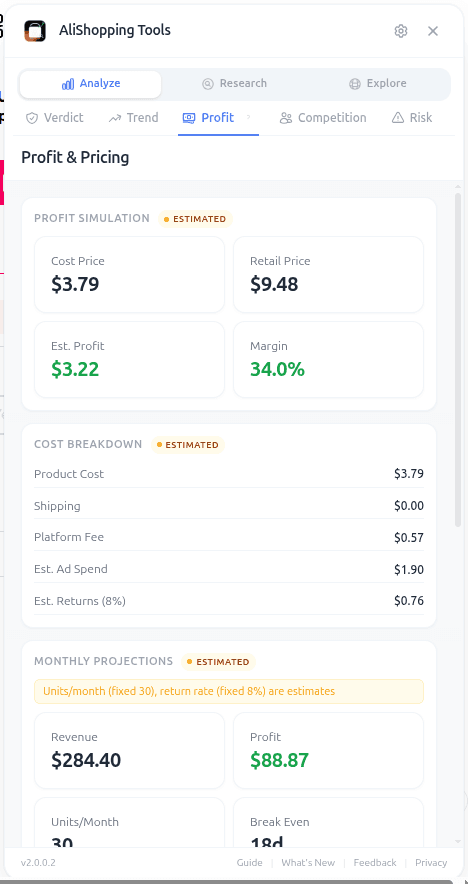
The Profit tab runs every line item — product cost, shipping, platform fee, payment processing, CPA, return reserve — so the margin you see is the margin you keep.
Monthly Projection: From Per-Unit to Real Revenue
Knowing your per-unit profit is step one. Step two is projecting monthly numbers.
Metric
Calculation
Result
Units sold per month
(estimate)
150
Monthly revenue
150 x $34.99
$5,248.50
Monthly total costs
150 x $24.82
$3,723.00
Monthly profit
150 x $10.17
$1,525.50
Break-even point
Fixed costs / profit per unit
~4 days
At 150 units per month with a 29.1% margin, you are netting $1,525.50. That is real, spendable profit after every cost is accounted for.
The Free Dropshipping Profit Calculator
Running these calculations manually for every product you evaluate gets tedious fast, especially when you are comparing multiple products to find a winner.
The Profit Tab in AliShopping Tools does this automatically for any product you view on AliExpress. When you open a product page with the extension installed, it pulls the supplier price, estimates shipping costs, factors in platform fees, applies advertising benchmarks for the product category, accounts for return rates, and outputs your profit per unit, margin percentage, and monthly projections.
It also calculates break-even timelines — how many days of sales you need before you recover your initial ad investment. All the math from the worked example above happens in seconds, with data pulled directly from the product page you are viewing. No spreadsheets, no manual entry. And it is completely free.
For someone evaluating 10-15 products per research session (which you should be doing), having a profit simulation run automatically on each one saves hours and eliminates calculation errors.
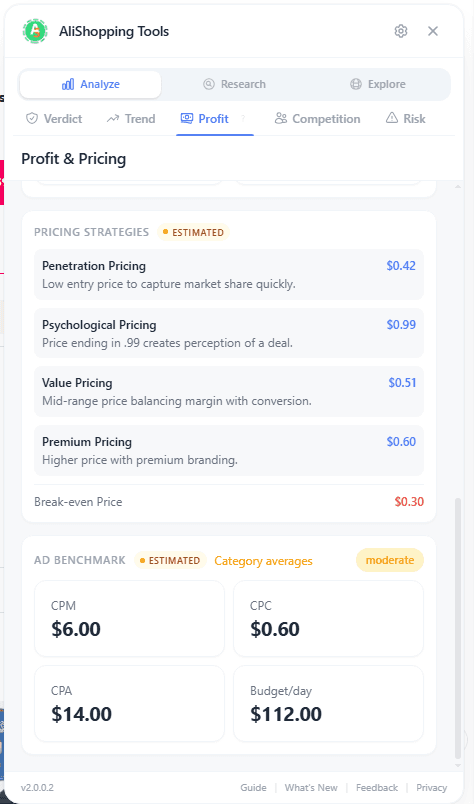
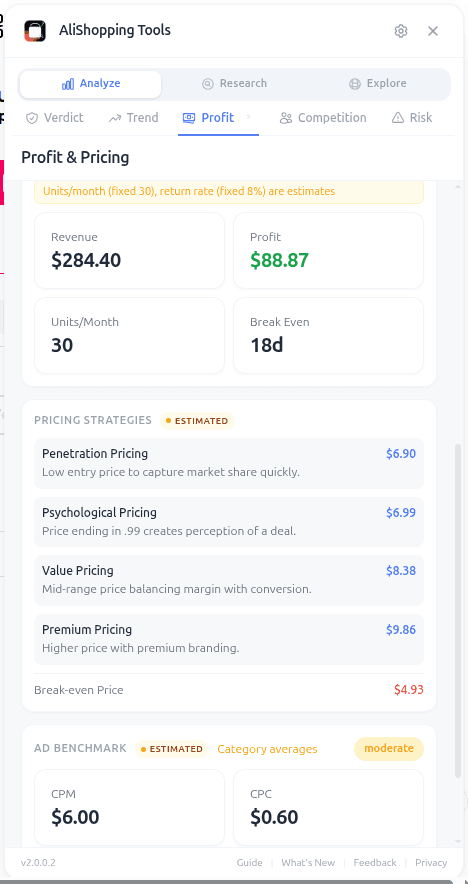
Monthly projections, break-even timeline, and pricing strategies surface next to the core margin number — no spreadsheet needed.
Four Pricing Strategies That Affect Your Margins
Your selling price is not arbitrary. The right pricing strategy depends on your goals, your market, and your competition. The AliShopping Tools Profit Tab analyzes your product and suggests strategies with recommended price points. Here are the four main approaches:
Penetration Pricing
Set your price lower than competitors to grab market share fast. Margins are thinner (15-25%), but volume compensates if the product has high demand.
Best for: Entering a competitive market, building reviews quickly, or products with high reorder potential.
Example: Competitors sell a similar LED lamp at $39.99. You price at $29.99 to undercut and capture traffic.
Psychological Pricing
Use prices that feel lower than they are: $29.99 instead of $30, $19.97 instead of $20. This works because buyers process left-digit anchoring — they register "$29" before their brain catches the ".99."
Best for: Almost every scenario. This is the baseline strategy most dropshippers should default to.
Value-Based Pricing
Price based on the perceived value to the customer, not your costs. A desk lamp that claims to reduce eye strain is worth more to a customer than a generic desk lamp, even if they cost the same to source.
Best for: Products with a clear benefit narrative, products you can differentiate through branding or bundling.
Example: Same LED lamp, but your store focuses on "work from home ergonomics." You price at $44.99 with a detailed product page explaining blue light reduction and adjustable color temperatures. Margin jumps to 43%.
Premium Pricing
Set your price significantly above the market and justify it through branding, packaging, and customer experience. This is harder to execute in dropshipping because you have less control over the product, but it works in certain niches.
Best for: Beauty, wellness, pet products, and categories where customers willingly pay more for a brand they trust.
Each strategy produces a different margin profile. The key is to model all of them before committing. A product that barely works at penetration pricing might be highly profitable with a value-based approach and the right ad creative.
Five Common Margin Mistakes That Kill Profitability
1. Forgetting Ad Costs Entirely
This is the most common and most devastating mistake. You calculate "profit" as selling price minus product cost, then wonder why your PayPal balance shrinks every month. Advertising typically represents 30-40% of your total costs. Leave it out and your margin calculations are meaningless.
2. Ignoring Payment Processing Fees
That 2.9% + $0.30 per transaction from Stripe or PayPal adds up. On a $29.99 product, it is $1.17 per order. Sell 500 units and you have quietly lost $585 you were not tracking.
3. Not Accounting for Returns
Hope is not a returns strategy. Even a well-run store has a 5-7% return rate. Each return costs you the product cost, the original shipping, and sometimes a refund on shipping you charged the customer. If you are not building a returns allocation into your per-unit calculation, your margin is overstated.
4. Calculating Margin on Revenue Instead of Correctly
Some beginners calculate margin as (Profit / Cost) x 100 instead of (Profit / Selling Price) x 100. The first formula gives you markup, not margin. A product you buy for $10 and sell for $30 has a markup of 200% but a margin of 66.7%. Mixing these up leads to inflated confidence in products that may not actually be as profitable as they appear.
5. Using a Fixed CPA When It Fluctuates
Your cost per acquisition is not static. It changes with ad creative fatigue, seasonality, competition in the ad auction, and targeting adjustments. A product that was profitable at a $10 CPA becomes a loss-maker at $15 CPA. Build in a buffer — calculate your margin at both your current CPA and a pessimistic scenario 30-50% higher. If the product is still profitable at the higher CPA, you have a resilient winner.
What Is a Good Dropshipping Profit Margin?
There is no single "correct" margin, but here are general benchmarks:
Margin Range
Assessment
Notes
Below 15%
Risky
One bad ad week or spike in returns wipes out profit
15-25%
Acceptable
Workable if volume is high and CPA is stable
25-35%
Healthy
The sweet spot for most dropshipping products
35-50%
Strong
Usually requires value-based or premium pricing
Above 50%
Exceptional
Rare in competitive niches; validate that costs are complete
If your calculated margin is below 15%, revisit your pricing strategy, look for cheaper shipping options, or find a different product. No amount of ad optimization will fix a product with fundamentally broken unit economics.
Putting It All Together: Your Margin Checklist
Before you commit to any dropshipping product, run through this checklist:
Calculate all six cost categories. Product, shipping, platform fees, payment processing, ad cost, and returns. Miss one and your margin is fiction.
Use the correct formula. Margin = (Profit / Selling Price) x 100. Not markup.
Model multiple pricing strategies. Penetration, psychological, value-based, and premium. See which one gives you the best margin-to-volume ratio.
Stress-test with a higher CPA. If your margin survives a 40% increase in ad costs, the product is resilient.
Project monthly, not just per-unit. A 30% margin means nothing if you can only sell 10 units per month.
Automate the process. Use a dropshipping profit margin calculator so you can evaluate 10+ products per session without spreadsheet fatigue.
Frequently Asked Questions
What is the difference between profit margin and markup?
Markup is calculated as (Profit / Cost) x 100, while margin is (Profit / Selling Price) x 100. A product you buy for $10 and sell for $30 has a 200% markup but only a 66.7% margin. Always use margin for business decisions because it tells you what percentage of revenue you actually keep.
How do I estimate my ad cost per acquisition before running ads?
Research average CPMs and CPCs for your product category on Facebook Ads Manager or TikTok Ads. As a starting benchmark, expect $8-15 CPA for most dropshipping products. AliShopping Tools includes ad benchmarks by category in its Profit Tab, giving you estimated CPA before you spend anything.
Should I include returns in my profit calculation even if I have not had any yet?
Yes. Industry-standard return rates for e-commerce are 5-10%. Building a 5-7% return allocation into every product calculation ensures your margin projections reflect reality. Stores that skip this step consistently overestimate their profitability.
What selling price multiplier should I use for dropshipping?
A common rule is 3x to 5x your product cost (including shipping from the supplier). However, the right multiplier depends on your niche, competition, and perceived value. Instead of using a fixed multiplier, calculate your actual costs and work backward from your target margin of 25-35%.
Skip the Spreadsheet
You now have the formula, the cost breakdown framework, and the benchmarks. The math is not complicated — but doing it manually for every product you research is tedious, and tedium leads to shortcuts, and shortcuts lead to missed costs and overstated margins.
AliShopping Tools automates this entire process. Install the free Chrome extension, open any product on AliExpress, and click the Profit Tab. You get your full cost breakdown, margin percentage, monthly projections, break-even timeline, and pricing strategy recommendations — all calculated in seconds, all completely free.
No account required. No credit card. No trial period.
Stress-test the margin against CPM, CPC, and CPA benchmarks so you know the product survives a 30–50% ad cost spike.
Install AliShopping Tools and calculate your real profit margins before you spend another dollar on ads.