Is This Product Worth Selling? 7 Signs of a Winning Dropshipping Product
Is This Product Worth Selling? 7 Signs of a Winning Dropshipping Product
Quick answer: A winning dropshipping product shows all 7 signs: growing order velocity (a rising trend momentum score), 25%+ realistic net margin, a supplier with a 4.7+ rating and 2+ years of operation, a market that is not already crowded, a clearly solved pain point, a natural review distribution with photo reviews, and at least one small ad test with a viable CPA.
You found a product on AliExpress. It looks good. The photos are clean, the price seems right, and a couple of TikTok videos already went viral with something similar.
So you add it to your store, run some ads, and... nothing. Crickets. Maybe a few orders trickle in, but the margins are so thin you're basically paying for the privilege of working.
Sound familiar? You're not alone. Roughly 90% of dropshipping products fail — not because the sellers are lazy, but because they picked the wrong product in the first place.
The good news: winning products leave clues. There are specific, measurable signs that separate a future best-seller from a money pit. Once you know what to look for, you stop gambling and start making informed decisions.
Here are the 7 signs, backed by data, that tell you whether a product is actually worth selling.
The 7 signs at a glance
| Sign | What good looks like | How to check |
|---|---|---|
| Strong demand trend | Rising momentum score, not a stale spike | Trend tab, AliShopping Tools |
| Real profit margin | 25 percent plus after all costs | Profit Simulator tab |
| Trusted supplier | Good or Excellent trust, 2 plus years age | Risk tab |
| Manageable competition | Not already crowded — few sellers, room to position | Competition tab |
| Solved-problem positioning | Product addresses a named pain point | Manual research |
| Verified reviews | Natural distribution, photo reviews | Fake-review guide + extension |
| Ad testable | Small ad test yields viable CPA | External — run the test |
Sign 1: Strong Demand Trend (Not Just a Spike)
A product with 10,000 orders sounds impressive. But if those orders happened six months ago and sales are now flat, you're late to the party.
What you want is growing demand — a product that's gaining momentum right now, where order velocity is climbing but the market isn't crowded yet.
How to check it:
Look at order velocity over time, not just total order count. A product with 2,000 orders and accelerating weekly growth is far more promising than one with 50,000 orders and a declining curve.
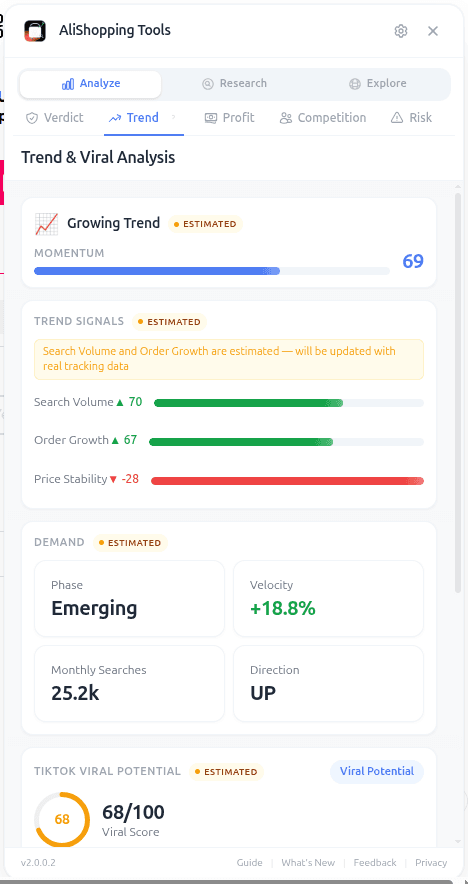
With AliShopping Tools, you can see this instantly. Open any AliExpress product page and the Trend tab shows you a momentum score from 0 to 100 built from where the order and review velocity is heading. A high, rising momentum score means demand is still building — that's your window.
Real example: A portable blender with a few thousand orders and a high, rising momentum score tells you demand is real and still accelerating. Compare that to a fidget toy with a huge lifetime order count but a low, falling momentum score — the wave already passed.
The rule: Chase momentum, not milestones. A rising tide beats a high-water mark.
Sign 2: Healthy Profit Margins (After ALL Costs)
This is where most beginners get burned. They see a product for $3 on AliExpress, plan to sell it for $25, and assume they'll pocket $22 per sale.
They forget about shipping ($2-5), platform fees (2-5%), payment processing (2.9% + $0.30), ad spend ($5-15 per acquisition), returns and refunds (5-10%), and packaging or branding costs.
A winning product needs to survive all those deductions and still leave you with a margin worth your time. As a general rule, aim for at least 30% net margin after every cost is accounted for.
How to check it:
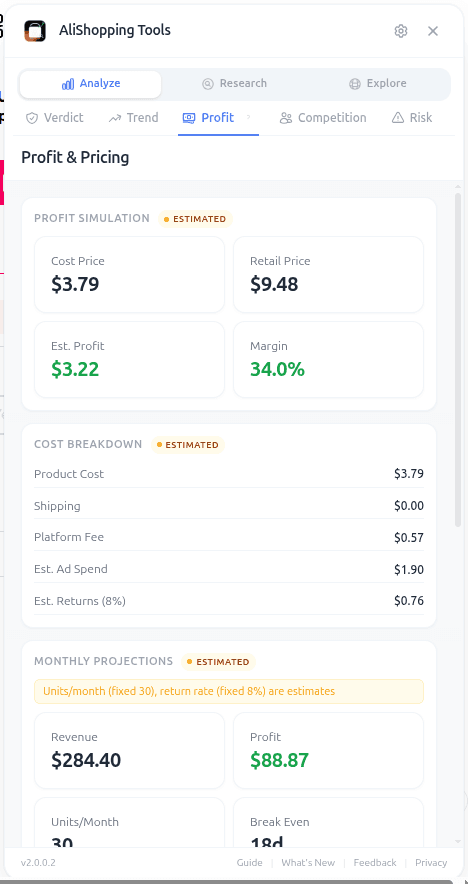
You need a profit simulator, not a calculator. A proper simulation accounts for product cost, shipping, platform fees, ad spend benchmarks for your category, and projected return rates.
AliShopping Tools has a Profit Simulator built right into the product page. It breaks down every cost line by line, shows you profit per unit, monthly projections based on realistic order volumes, and even suggests pricing strategies — like whether a penetration price of $19.99 or a premium price of $34.99 would yield better overall returns.
Real example: A silicone kitchen tool costs $2.80 on AliExpress. The profit simulator shows that at a $16.99 retail price, after shipping ($2.10), platform fees, and estimated ad spend ($6.50 CPA for the kitchen category), net profit per unit is $3.12 — an 18% margin. Tight, but workable at volume. At $21.99, margin jumps to 31%. Now you know your minimum viable price.
The rule: If you can't see at least 30% margin after all costs, either find a higher price point or move on.
Sign 3: Low Market Saturation
Here's a truth nobody talks about enough: a great product in a saturated market is a bad product for you.
When hundreds of sellers are already running the same item, you're competing on price — which kills margins. You're also fighting for the same audience with the same ad creative, which drives up your cost per click.
The ideal scenario is a product where demand is rising but the number of active sellers is still relatively low. That's your blue ocean.
How to check it:
You need saturation data: how many sellers are offering this product, what the price range looks like, and how concentrated sales are among top sellers.
AliShopping Tools gives you a Competition read right on the product page. You'll see the seller count, average price, price range, and how much market share the top sellers hold — the real crowding signals. There is no single auto "saturation percent," and ad saturation in particular is a manual read; you weigh the signals together.
Real example: You're looking at a LED desk lamp. The Competition tab shows a large seller pool with the top few sellers owning most of the orders and prices bunched tightly together — a crowded, contested market. That's a red flag. An adjustable monitor stand in the same home-office category shows a much smaller seller pool with no dominant player and a wide price spread — wildly different opportunity.
The rule: Few sellers + rising demand = your best shot at standing out. Avoid markets where you'll be one of hundreds of identical listings.
Sign 4: Reliable Supplier (Low Risk Score)
You can find the perfect product, price it right, and nail your marketing — and still fail if your supplier ships late, sends defective items, or disappears after your first bulk order.
Supplier quality is the invisible foundation of every successful dropshipping business. A bad supplier means chargebacks, negative reviews, account suspensions, and weeks of customer service headaches.
How to check it:
Look beyond the star rating. Check whether the supplier has a verified business license, how long they've been on the platform, their dispute rate, and their response time. A 4.7-star supplier with a verified license and 3+ years on the platform is very different from a 4.8-star supplier who just opened last month.
AliShopping Tools runs a Risk Assessment on every product page. It gives you a risk score from 0 to 100 with specific flags — things like "new seller," "high dispute rate," or "no business license." The seller trust score tells you at a glance whether this is someone you can build a business with. Excellent, Good, Average, or Poor — no ambiguity.
Real example: Two suppliers sell the same yoga mat. Supplier A has a 4.6 rating but a "Poor" trust score — no verified license, 2 risk flags including high dispute rate. Supplier B has a 4.5 rating but an "Excellent" trust score — verified license, 4 years on platform, zero flags. The rating difference is 0.1 stars. The actual reliability gap is enormous.
The rule: Never skip the supplier check. One bad supplier can cost you months of progress.
Sign 5: Visual Appeal (The TikTok Test)
In 2026, if your product can't perform in a short-form video, it has a serious disadvantage. TikTok, Instagram Reels, and YouTube Shorts are where product discovery happens. Your product needs to pass what we call "the thumb-stop test" — can it make someone stop scrolling in under 2 seconds?
Products with strong visual appeal share certain traits: they have a clear before/after transformation, they look satisfying to use, they come in eye-catching colors, or they solve an obvious problem in a way that's instantly understandable without sound.
How to check it:
Ask yourself: can I demonstrate this product in a 15-second video with no voiceover and still make people want it? If the answer is yes, you have visual appeal.
Run the product through the same checklist a scroller applies in two seconds: clear before/after, satisfying to watch, eye-catching, or an obvious problem solved on sight. If you can picture three different 15-second hooks — emotional ("POV: your shower just became a rave"), benefit ("this upgrade makes your bathroom look like a spa"), and curiosity ("why is everyone on TikTok buying this?") — the product has the visual legs to test.
Real example: A color-changing shower head is easy to demo — the transformation is instant and satisfying on camera, and the hooks write themselves. A plain phone-cable clip is not; nothing about it stops a scroll. Same price band, very different odds on short-form video.
The rule: If it doesn't look good on camera, it doesn't sell in 2026. Judge the visual hook before you commit ad spend.
Sign 6: It Solves a Real Problem
The most resilient dropshipping products aren't novelties — they're solutions. A product that solves a genuine, everyday frustration has built-in demand that doesn't depend on trends or viral moments.
Problem-solving products also have a natural advantage in marketing: the ad practically writes itself. "Tired of [problem]? This fixes it." That formula works because the viewer immediately relates to the pain point.
How to check it:
Look at the product reviews on AliExpress. When customers describe how the product fixed a specific problem in their life, that's your signal. Phrases like "finally found something that works," "wish I bought this sooner," or "solved my problem with [specific issue]" are gold.
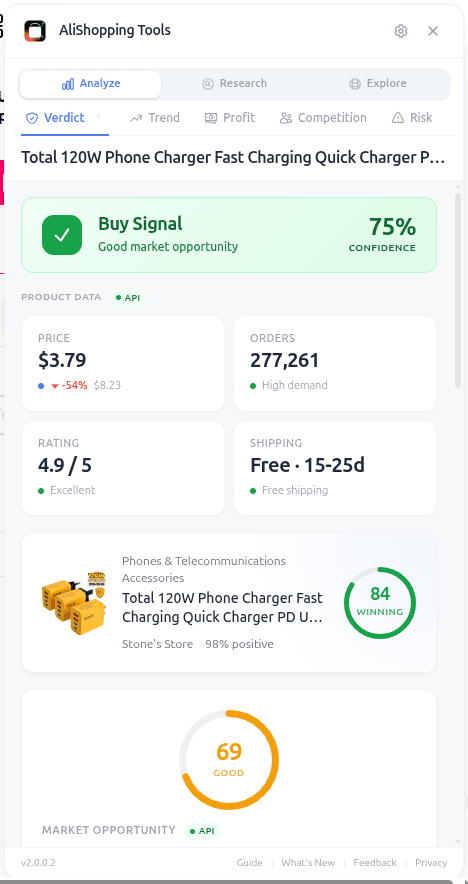
Then cross-reference with AliShopping Tools' opportunity (Winning) score. Products that solve real problems tend to score higher on the demand sub-score (people actively search for solutions) and carry strong ratings (satisfied customers). A relatively high opportunity score backed by HIGH_DEMAND and GOOD_RATING signals is a strong indicator that the product delivers real value.
Real example: A magnetic cable organizer earns a strong opportunity score and a Buy verdict — its supporting signals lean on real demand (people hate tangled cables) and solid ratings (customers confirm it works). Compare that to a decorative LED sign that scores low: it's cute, but nobody needs it. When ad costs go up, the cable organizer survives because the demand is functional, not just aesthetic.
The rule: Trend products make fast money. Problem-solving products make lasting money. The best winning products are both.
Sign 7: Reasonable Shipping Time
Nothing kills a dropshipping business faster than 45-day shipping times. Your customer ordered on impulse, and by the time the package arrives, they've forgotten about it — or worse, filed a chargeback.
In 2026, customers expect delivery within 7 to 15 days for international orders. Anything beyond 20 days and you're looking at increased refund requests, negative reviews, and payment processor flags.
How to check it:
Check the shipping options on AliExpress. Look for ePacket or AliExpress Standard Shipping to your target market. Ideally, you want estimated delivery under 15 business days to the US or Europe.
Also check whether the supplier offers warehouse shipping from the US, EU, or your target country. Products available from local warehouses can ship in 3 to 7 days, which dramatically improves customer satisfaction and repeat purchase rates.
AliShopping Tools surfaces shipping details in its product analysis, so you can compare shipping options and costs without opening multiple tabs. Factor the shipping cost into your profit simulation to make sure your margins still hold up after choosing the faster (and usually more expensive) option.
Real example: A posture corrector is available from a China warehouse (18-25 days, $1.20 shipping) and a US warehouse (5-8 days, $3.80 shipping). The faster option costs $2.60 more per unit. If your retail price is $24.99, the profit simulator shows margin drops from 34% to 27% with US warehouse shipping — still healthy, and your refund rate will be much lower. Worth the trade-off every time.
The rule: Fast shipping isn't optional anymore. If you can't get it there in under 15 days, your return rate will eat your profits.
The Quick Checklist
Before you add any product to your store, run through these seven checks:
- Demand trend: Is the momentum score rising (not stalling or falling)?
- Profit margin: Does it clear 30% net after ALL costs?
- Competition: Is the market uncrowded enough to enter — few sellers, room to position?
- Supplier quality: Is the seller trust score Good or Excellent?
- Visual appeal: Can you picture three scroll-stopping short-form hooks?
- Problem-solving: Does it fix a real, relatable pain point?
- Shipping time: Can you deliver in under 15 days?
If a product hits 5 out of 7, it's worth testing. If it hits all 7, you've got a potential winner on your hands. If it fails on margin or supplier quality, walk away no matter how exciting the other signals look.
Stop Guessing. Start Validating.
The difference between dropshippers who make money and those who don't isn't luck, capital, or even experience. It's product selection. And product selection comes down to asking the right questions — then having the data to answer them.
Every sign on this list can be checked in under 60 seconds when you have the right tool open. No spreadsheets, no guesswork, no "I have a feeling about this one."
AliShopping Tools puts these checks on a single screen, right on the AliExpress product page you're already browsing. Opportunity (Winning) score, trend momentum, profit simulation, competition signals, supplier-risk assessment, and price history — all free, no account required.
Install AliShopping Tools — Free on Chrome Web Store
Your next winning product is one install away. Stop scrolling and start validating.
AliShopping Tools
See live AliExpress data in your browser.
Seller trust score, 90-day price history, and live promo codes — on every AliExpress product page. No account, free.
Sẵn sàng tìm sản phẩm thắng?
Thử AliShopping Tools — 15 công cụ AI miễn phí cho nghiên cứu sản phẩm.
Giải đáp nhanh
Câu hỏi thường gặp
17 dấu hiệu của một sản phẩm dropshipping thắng lợi là gì?
Bảy dấu hiệu trong bài gồm: nhu cầu đang tăng (không phải đi ngang hay giảm), biên lợi nhuận ròng trên 30% sau mọi chi phí, mức độ bão hòa thị trường thấp đến trung bình, supplier có trust score Good hoặc Excellent, sức hút thị giác đủ mạnh để vượt "thumb-stop test" trên video ngắn, sản phẩm giải quyết một vấn đề thật trong đời sống, và thời gian giao hàng dưới 15 ngày. Đạt ít nhất 5/7 là đáng test; đủ 7 là ứng viên winner.
2Biên lợi nhuận ròng mục tiêu cho sản phẩm dropshipping là bao nhiêu?
Nhắm tối thiểu 30% ròng sau khi trừ giá vốn, phí ship (~2–5 USD), phí platform (2–5%), phí thanh toán (2,9% + 0,30 USD), chi phí quảng cáo (5–15 USD/đơn), dự phòng hoàn 5–10%, cộng phí đóng gói/brand.
Markup gộp rất dễ đánh lừa — sản phẩm 3 USD bán 25 USD nghe như lãi 22 USD nhưng thực tế dưới 20% ròng sau khi trừ đủ.
Không đạt 30% ròng thì tăng giá hoặc bỏ sản phẩm.
3Bão hòa bao nhiêu là xấu trên AliExpress?
Bài viết coi saturation trên khoảng 70% là High/Saturated — cờ đỏ vì bạn phải cạnh tranh giá với hàng trăm seller, bóp biên và đẩy chi phí quảng cáo lên.
Bão hòa thấp cộng nhu cầu đang tăng là tình huống blue ocean lý tưởng.
Tab Competition của AliShopping Tools hiển thị chỉ số 0–100 cùng số seller, giá trung bình, và thị phần top seller.
Bài viết khác
How to Find Winning Dropshipping Products in 2026 (Step-by-Step Guide)
Learn how to find winning dropshipping products in 2026 using data-driven research, AI scoring, and trend analysis. Free step-by-step guide for beginners.
Winning Products August 2026: 12 Back-to-School Peak Categories
12 dropshipping categories for August 2026 — back-to-school peak (first two weeks), dorm setup, and the early-fall transition — plus how to vet any candidate with AStools before you spend.
Winning Products July 2026: 12 Post-618 Categories
12 dropshipping categories for July 2026 — post-618 restock, back-to-school prep, summer peak — plus how to vet any candidate with AStools before you spend.