AliExpress Trust Issues 2026: The Complete Operator's Hub
AliExpress Trust Issues 2026: The Complete Operator's Hub
Quick Answer: AliExpress trust issues fall into 4 categories: misleading product descriptions, manipulated or AI-generated photos, fake/incentivized reviews, and supplier-level risk (late shipping, dispute history, store disappearance). Each requires a different detection method — this hub routes you to the dedicated deep guide for each category.
AliExpress is the largest product sourcing platform in dropshipping — and also the one where trust failures cost the most. A single listing can simultaneously show an inflated description, a borrowed photo set, thousands of fake reviews, and ship from a store that vanishes after payment. The platform does not verify any of those signals upfront. The buyer does.
This hub consolidates the four trust categories operators actually ask about. Each section summarises the core pattern, links to the dedicated deep guide for the topic, and points to the free tooling that automates most of the detection work. If you are new to trust verification on AliExpress, read this page top-to-bottom. If you already know which category you need, jump directly to the deep guide.
Why trust verification matters more in 2026
Three shifts since 2024 have raised the stakes:
- Review farming is cheaper. Automated review-generation pipelines and cross-border review farms mean a seller can add thousands of five-star reviews for a modest cost relative to the sales they unlock. The incentive to inflate has grown, not shrunk.
- AI-generated product photos are mainstream. Listings now routinely include AI-rendered lifestyle shots that look photographically real but do not depict the actual product. The eye alone catches fewer and fewer of these.
- Dispute rates directly penalise store reputation. Platforms (Shopify, Stripe, payment processors) now flag high-dispute merchants faster, which means a single bad sourcing decision can shut down a store's payment processing — not just refund one order.
For operators sourcing 20 or more products a week, trust verification is no longer optional hygiene. It is a structural input to survival.
The four trust failure categories
1. Misleading and inaccurate descriptions
Descriptions lie in specific, repeatable ways: material swaps ("genuine leather" in the title, "PU" in the specs), size mismatches ("large" with no centimetre figure), translation drift ("waterproof" in English, "water-resistant" in the original Chinese), and silent spec changes after launch (battery capacity quietly upgraded without old reviews being purged).
Core detection habit: scroll past the marketing copy and read the specifications table. When the table disagrees with the title or description, the specifications table is usually the truth.
A sixth pattern worth checking separately: shipping time claims that do not match store history. The listing might promise "free shipping, 7 to 12 days," while reviews from the last 90 days say "took 28 days." The shipping promise is a listing-level claim; actual shipping is a store-level pattern sellers rarely update. Skim the 20 most recent reviews for shipping-time mentions — if a consistent pattern of "took X days" is roughly double the advertised range, trust the reviews over the listing.
2. Manipulated and borrowed product photos
Five distinct photo-manipulation patterns show up in 2026: borrowed brand-website photos (Apple, Dyson, Nike lifestyle shots repurposed for unbranded knockoffs), photo theft between AliExpress sellers, foreground-prop scale manipulation (coffee cups placed close to the camera to make the product look larger), colour grading that does not survive daylight, and AI-generated renders that do not match any real unit.
Core detection habit: reverse-image-search the main listing photo (Google Images, Yandex, TinEye) and compare listing photos to customer review photos filtered to "with photos only." If the colour, scale, or quality differs, the listing photos are staged.
3. Fake and unverified reviews
Reviews are the single most persuasive trust signal on AliExpress, which makes them the most worth manipulating. Four review-farm patterns are reliably detectable in 2026: rating distributions that are too clean (95% five-star and near-zero three-star is artificial), near-identical template text ("great product, fast shipping" across fifty reviews), templated or recycled photo reviews, and unnatural review velocity (thousands of reviews dated within a two-week window).
Core detection habit: sort reviews by newest first, filter to photo reviews only, and read 10 to 15 in sequence. If they all sound the same and none mention a specific feature or complaint, the reviews are template-generated.
Deep guide: AliExpress Fake Reviews: Seven Red Flags That Still Work in 2026 — the dedicated review-analysis guide covering all seven patterns with worked examples.
4. Supplier and store-level risk
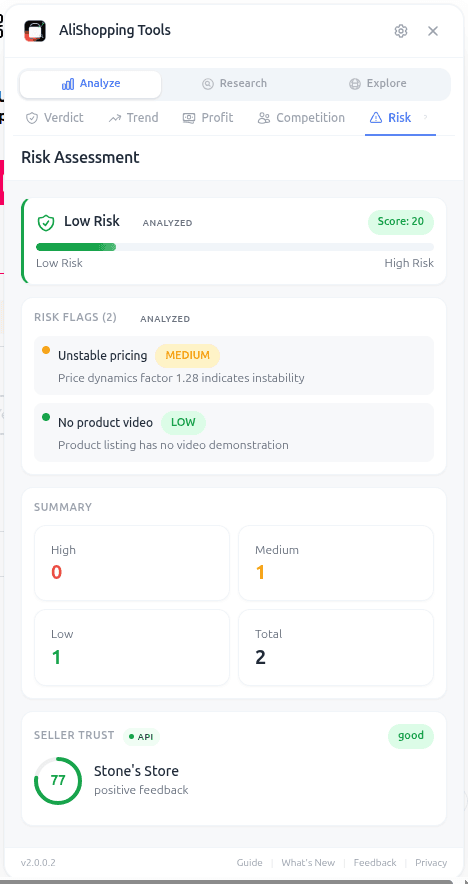
A listing can pass all three content tests (description, photos, reviews) and still fail at the supplier level. Store-level failures include: shops that quietly change their product after the order is placed, shops with repeated shipping delays that never show up on the product page, shops with high dispute rates that were hidden by recent positive reviews, and shops that close the store once enough disputes accumulate and re-open under a new name.
Core detection habit: check store age, store-wide rating (not just product rating), and store history of shipping promise versus delivered. A three-month-old store selling a high-volume product is a statistical outlier — usually not a good one.
Related reading: AliShopping Tools' supplier risk scoring (see "How free tools automate most of this" below) flags these store-level patterns automatically. For a dropshipper-focused deep dive on the seven supplier red flags, see the AliExpress Supplier Trust Checker. For general buyer-side dispute protection, see is AliExpress safe? buyer guide, and for checking an individual seller specifically, see how to check if an AliExpress seller is trustworthy.
Are AliExpress reviews fake or incentivized?
This is the single most-searched AliExpress trust question in 2026 — and the honest answer is yes, both happen at scale. Two distinct failure modes are worth separating:
Fake reviews are reviews that don't represent a real purchase or a real opinion. They're farmed at low cost from a pool of accounts that exist primarily to leave five-star ratings, and they're detectable through pattern signals — clean rating distributions (95%+ five-star and near-zero three-star is artificial), templated text ("great product, fast shipping" repeated across hundreds of reviews), and unnatural velocity (thousands of reviews dated within a two-week window).
Incentivized reviews are reviews left by real buyers in exchange for a discount, free product, or platform credit. They're real purchases but biased — buyers know the seller is watching, so they leave inflated ratings even when the product disappoints. Incentivized reviews are common across AliExpress and harder to detect than pure fakes because the underlying purchase exists.
Based on pattern analysis by AliShopping Tools users across high-volume listings, a significant share of reviews on popular products show signals consistent with fake or incentivized submissions — clustered posting dates, no photos, generic text, and suspiciously uniform 5-star ratings. The product can still be legitimate — but the rating average is structurally inflated, and reviews left after a dispute are routinely buried by the seller's review-velocity boosting.
How to detect both: sort reviews by newest first, filter to photo reviews only, read 10-15 in sequence. Real reviews mention specific features or complaints. Fake reviews are generic. Incentivized reviews are positive but vague. The free AliExpress Fake Reviews Guide walks through the seven signals.
Why are AliExpress product descriptions misleading?
The "aliexpress product descriptions misleading" and "aliexpress product descriptions inaccurate" search cluster reflects a real and structural problem. Sellers gain measurably more sales from descriptions that overstate product specifications, and the platform's review system is too slow to penalize misleading descriptions before they convert dozens of buyers.
Five specific patterns drive misleading descriptions in 2026:
- Material swap — "genuine leather" in the title, "PU" or "synthetic leather" in the specifications table. The title sells; the specs are technically truthful.
- Size mismatch — "large" with no centimetre figure in the title, then a tiny diagram in the specs that shows it's actually small by Western sizing standards. The product technically matches the description but the buyer's mental model doesn't.
- Translation drift — "waterproof" in the English description, "water-resistant" in the original Chinese listing. AliExpress's auto-translation can subtly inflate claims.
- Silent spec changes — battery capacity quietly upgraded after launch (or downgraded, more commonly), with old reviews referring to the original spec. Reviews from six months ago reference a 2000mAh battery; the current listing says 800mAh.
- Variant confusion — the "from $5.99" hook applies to the smallest, simplest variant; the product photo shows a different, more expensive variant. The seller technically lists from $5.99 but the average actual order is $25.
How to detect: scroll past the marketing copy and read the specifications table. When the table disagrees with the title, the table is usually the truth. Cross-check measurements (weights, dimensions, capacities) against title claims. If you can't find a specifications table at all, the listing is structurally low-trust.
What about AliExpress photo manipulation and misleading product photos?
The "aliexpress misleading product photos reviews" cluster reflects the photo-trust problem specifically. AliExpress listing photos are routinely manipulated in five ways:
- Brand-website theft — Apple, Dyson, Nike lifestyle shots repurposed for unbranded knockoffs. Reverse-image-search catches most of these in 10 seconds.
- Photo theft between AliExpress sellers — the same product photographed once gets repurposed across 50 listings, none of which sourced the photo. The "lowest price" listing rarely has the original photo.
- Foreground-prop scale manipulation — a coffee cup placed close to the camera makes the product appear larger than its actual specifications.
- Color grading that doesn't survive daylight — high-saturation studio lighting produces vibrant listing photos that look dull and gray when the product arrives.
- AI-generated renders — increasingly common in 2026. Lifestyle shots that don't depict any real unit. Hands holding the product with subtly wrong finger counts. Indoor scenes with impossible lighting.
How to detect: filter customer reviews to "with photos only" and compare those photos to the listing photos. If the colour, scale, or quality differs substantially, the listing photos are staged, graded, or AI-generated. Customer review photos are the reality.
AliExpress product quality variability — what dropshippers actually see
The "aliexpress product quality variability" / "aliexpress product quality inconsistent reviews" cluster reflects a structural reality dropshippers learn the hard way: AliExpress products from the same listing can vary substantially batch-to-batch. The reasons are operational, not deceptive:
- Multi-factory sourcing. A single listing might be fulfilled from 3-5 different factories depending on stock and shipping zone. Each factory has its own quality control.
- Material substitutions. When a primary material is out of stock, factories substitute. The listing isn't updated. Buyer A gets cotton; Buyer B gets a polyester blend.
- Quality drift over time. A product launched at premium quality often drops material grades quietly as the seller competes on price. Old reviews reference the original quality; new orders get the cost-reduced version.
- Shipping-zone batching. US-bound orders sometimes get higher-quality batches than EU-bound orders (or vice versa) because of platform return-rate signals.
Why this matters for dropshippers: if you order a sample, validate quality, and scale, your customers might receive a different batch with different quality. The 5-star reviews from your sample don't transfer.
How to mitigate: order multiple samples spaced 2-4 weeks apart from the same listing. If quality differs across samples, the supplier's QC is inconsistent and you should expect customer complaints at scale. Stick with sellers whose multiple samples all match — that's the quality signal that survives scaling.
How free tools automate most of this
Doing all four trust checks manually for every product takes 15 to 20 minutes per listing. For one product that is fine. For researching 30 products a week it is unsustainable, and the boredom alone causes corners to be cut. Free tools in 2026 automate most of the pattern detection so you spend the saved time on decisions, not data collection.
AliShopping Tools (Chrome extension)
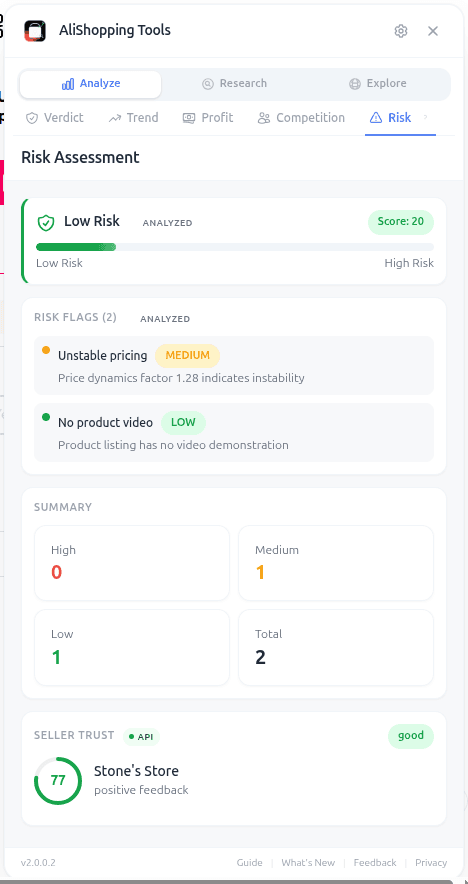
When you open any AliExpress product page, AliShopping Tools surfaces the trust signals automatically:
- Supplier risk scoring — a composite score that flags stores with repeated shipping delays, dispute rates above a threshold, or suspiciously new accounts running high-volume products
- Review distribution analysis — the rating histogram and velocity patterns displayed as a single trust score, so unnatural spikes are visible immediately
- Supplier compare — finds the same product across multiple sellers; if photos match across stores, you can see which store originally posted them
- Demand-trend read (Trend tab) — surfaces the order-velocity and demand direction for a product (products at the top of their demand cycle attract review farming most aggressively)
- AI verdict — synthesises the risk signals into a Buy or Skip call
The extension runs locally, requires no account, and is free forever.
Install AliShopping Tools from the Chrome Web Store — runs the three-check trust audit on every AliExpress page you visit, no signup required.
Reverse image search (Google Images, Yandex, TinEye)
For the photo-borrowing check specifically, browser-based reverse image search is still the best tool. Install a right-click reverse-search extension so one click runs the query against multiple engines. Ten seconds per listing catches the most egregious photo-theft cases.
Specifications table reading
No tool fully replaces the five-minute habit of scrolling past the marketing copy to the specifications table. Every listing has one. The difference between "leather" and "PU leather," between "25cm" and "50cm," between "2000mAh" and "200mAh" is almost always visible there.
The 2026 trust audit workflow
For operators researching 20+ products a week, a repeatable workflow beats ad-hoc checking. This is the one most of our power users converge on:
- Automated pre-filter (30 seconds with AliShopping Tools). Extension loads on the AliExpress page, shows trust score, supplier risk, and AI verdict. If verdict is Pass, skip the product — you just saved 15 minutes.
- Reverse image check on main photo (10 seconds). If photos match a brand website for a different product, pass.
- Specifications table scan (60 seconds). Material, dimensions, capacity. Cross-check against title and description. Disagreements = pass or at least sample first.
- Review sample (90 seconds). Sort newest, filter to photo reviews, read 10. Generic template text or review photos that look like cropped listing shots = pass.
- Store check (60 seconds). Store age, store-wide rating, shipping-promise history. A three-month-old store selling high volume is suspicious.
Five minutes per candidate. Products that clear the audit get a 3 to 10 USD sample ordered before any ad budget. That five-minute audit plus a 10 USD sample prevents most sourcing mistakes that would otherwise show up three months later as dispute rates and processor warnings.
Related clusters on this site
Trust verification is the sourcing-side workflow, but most dropshippers also need adjacent tooling:
- For product research more broadly (winner discovery, margin simulation, trend scoring), see our AliExpress Product Research hub.
- For competitor intelligence on the Shopify side (what theme they use, which apps they run, what their catalogue looks like), see our Shopify Stack Intelligence hub.
- For paid-tool alternatives (Sell The Trend, Pexgle, Dropship.io, Niche Scraper comparisons), see the alternatives cluster including Pexgle alternative and best AliExpress product research tools.
FAQ
What are the main trust issues on AliExpress in 2026?
Four categories: misleading or inaccurate descriptions (material swaps, size mismatches, translation drift, silent spec changes), manipulated or borrowed product photos (brand theft, scale manipulation, AI-generated renders), unverified reviews (clean distributions, template text, velocity spikes), and supplier-level risk (store age, dispute rate, shipping-promise history). A single listing can fail all four simultaneously, which is why checking each category separately matters.
Can I trust the star rating on AliExpress?
Not on its own. A 4.9-star product with 4,000 reviews can be legitimate or can be the output of a review farm. The rating distribution (what percentage of reviews are three-star and below), the review velocity (steady accumulation versus spiked), and the photo-review authenticity are better signals than the average rating. See our fake review guide for the seven signals we use.
How do I know if AliExpress product photos are real?
Reverse-image-search the main photo first. If the top result is a brand website for a different product, the photos are borrowed. Then compare listing photos to customer review photos filtered to "with photos only." If the colour, scale, or quality differs substantially, the listing photos are either graded, staged, or AI-generated while the customer photos show reality.
What is the fastest way to check if an AliExpress listing is trustworthy?
Install AliShopping Tools — the extension surfaces supplier risk, review trust score, and AI verdict on every AliExpress product page automatically. That gives you the 30-second pre-filter. If the product clears, add a 10-second reverse image search and a 60-second specifications-table scan. Five minutes total per candidate replaces what would be a 20-minute manual audit.
Does AliExpress remove misleading listings?
AliExpress removes egregious listings after buyer disputes and reports, but enforcement is reactive rather than preventive. Listings reported multiple times are usually taken down or demoted; listings that have not yet been reported stay visible. Trust verification remains the buyer's responsibility at the listing level — the platform does not do it for you upfront.
Should I order a sample before committing ad spend?
Yes, especially for products you plan to scale. A 3 to 10 USD sample surfaces trust failures the listing hid — wrong material, wrong size, wrong colour, wrong build quality. Sampling is the cheapest insurance in dropshipping and the one step experienced operators skip last. Products that pass the automated trust audit plus a physical sample have dramatically lower dispute rates in the scale phase.
Is AliExpress still worth sourcing from despite these trust problems?
Yes, for most operators it remains the best sourcing platform by pricing, product variety, and shipping logistics. The trust problems are real but detectable — operators who build verification into their research workflow have a significant edge over operators who source on surface signals alone. The platform is viable; the default approach to it is not.
What free tools do you recommend for trust verification?
AliShopping Tools for the automated supplier + review + AI verdict layer (free Chrome extension, no account, runs locally). Browser-based reverse image search (Google Images, Yandex, TinEye) for the photo-borrowing check. And specifications-table reading — which is not a tool but a habit, and the one that catches the most material and size misrepresentations for zero cost.
Honest recommendation
If you are a beginner: install the AliShopping Tools Chrome extension, read this hub end-to-end, and practice the five-minute audit on your next ten product candidates. Muscle memory on the workflow beats theoretical knowledge of the red flags.
If you are scaling: treat trust verification as a required input in your research pipeline, not a nice-to-have. Automate the pre-filter with the extension, batch reverse-image-search the survivors, and sample every product that clears the audit. The 10 USD per sample is the smallest line in your budget and the one that most directly protects your store's payment processing and long-term customer reputation.
If you are an agency: codify the audit steps as a standard operating procedure with a checklist your operators tick on every candidate. Operational discipline is what separates agencies that scale past six figures monthly from those that get shut down by dispute rates three months in.
The wrong move for everyone is trusting AliExpress listings on surface signals alone.
Try it free: Install AliShopping Tools on the Chrome Web Store.
Disclosure: This hub is published by the AliShopping Tools team and routes to our deeper cluster content. Detection patterns and red flags are based on our review of AliExpress listings as of April 2026. Tactics evolve — we update cluster guides as new failure patterns emerge. If you notice a pattern we should cover, email us via the contact page.
AliShopping Tools
See live AliExpress data in your browser.
Seller trust score, 90-day price history, and live promo codes — on every AliExpress product page. No account, free.
Ready to find winning products?
Try AliShopping Tools — 15 free AI tools for product research.
Quick answers
Frequently Asked Questions
1What are the main trust issues on AliExpress in 2026?
Four categories: misleading or inaccurate descriptions (material swaps, size mismatches, translation drift, silent spec changes), manipulated or borrowed product photos (brand theft, scale manipulation, AI-generated renders), unverified reviews (clean distributions, template text, velocity spikes), and supplier-level risk (store age, dispute rate, shipping-promise history).
A single listing can fail all four simultaneously, which is why checking each category separately matters.
2Can I trust the star rating on AliExpress?
Not on its own.
A 4.9-star product with 4,000 reviews can be legitimate or can be the output of a review farm.
The rating distribution (what percentage of reviews are three-star and below), the review velocity (steady accumulation versus spiked), and the photo-review authenticity are better signals than the average rating.
See our fake review guide for the seven signals we use.
3How do I know if AliExpress product photos are real?
Reverse-image-search the main photo first.
If the top result is a brand website for a different product, the photos are borrowed.
Then compare listing photos to customer review photos filtered to "with photos only." If the colour, scale, or quality differs substantially, the listing photos are either graded, staged, or AI-generated while the customer photos show reality.
4What is the fastest way to check if an AliExpress listing is trustworthy?
Install AliShopping Tools free — the extension surfaces supplier risk, review trust score, and AI verdict on every AliExpress product page automatically.
That gives you the 30-second pre-filter.
If the product clears, add a 10-second reverse image search and a 60-second specifications-table scan.
Five minutes total per candidate replaces what would be a 20-minute manual audit.
5Does AliExpress remove misleading listings?
AliExpress removes egregious listings after buyer disputes and reports, but enforcement is reactive rather than preventive.
Listings reported multiple times are usually taken down or demoted; listings that have not yet been reported stay visible.
Trust verification remains the buyer's responsibility at the listing level — the platform does not do it for you upfront.
6Should I order a sample before committing ad spend?
Yes, especially for products you plan to scale.
A 3 to 10 USD sample surfaces trust failures the listing hid — wrong material, wrong size, wrong colour, wrong build quality.
Sampling is the cheapest insurance in dropshipping and the one step experienced operators skip last.
Products that pass the automated trust audit plus a physical sample have dramatically lower dispute rates in the scale phase.
7Is AliExpress still worth sourcing from despite these trust problems?
Yes, for most operators it remains the best sourcing platform by pricing, product variety, and shipping logistics.
The trust problems are real but detectable — operators who build verification into their research workflow have a significant edge over operators who source on surface signals alone.
The platform is viable; the default approach to it is not.
8What free tools do you recommend for trust verification?
AliShopping Tools for the automated supplier + review + AI verdict layer (free Chrome extension, no account, runs locally).
Browser-based reverse image search (Google Images, Yandex, TinEye) for the photo-borrowing check.
And specifications-table reading — which is not a tool but a habit, and the one that catches the most material and size misrepresentations for zero cost.
More from the blog
AliExpress Product Research Tool 2026: Free 5-Step Workflow
Product research on AliExpress has a 5-step workflow in 2026. This hub walks through each step, the free tools that cover it, and where paid tools still matter.
How to Do Product Research for Dropshipping: 7-Step Framework (Free Tools, 2026)
A repeatable 7-step product research framework for dropshippers in 2026 — from idea sourcing to live testing, using only free tools. No Ecomhunt subscription needed.
AliExpress vs All Platforms 2026: Ultimate Comparison
AliExpress vs Alibaba, Temu, DHgate, CJ Dropshipping, Zendrop, and Shein: 2026 guide to shipping, pricing, dropshipping, and which platform wins your use case.