AliExpress Product Research Tool 2026: Free 5-Step Workflow
AliExpress Product Research Tool 2026: Free 5-Step Workflow
Quick answer: AliExpress product research in 2026 follows a repeatable 5-step workflow: AI verdict check (30-second pre-filter), trend phase analysis, profit simulation, competition scan, and trust audit. Free tools cover 80–90% of what paid tools offer for the per-product decision workflow — this hub walks through all five steps with the specific methods and free tools operators use to find winners without paying $200/month.
"Best AliExpress product research tool" is the most Googled dropshipping tool query of 2026, and most of the top results are paid tools paying affiliates to rank. The honest answer is that in 2026 the free stack has caught up with paid tools from 2022 for the per-product decision workflow. An operator researching 20 products a week with free tools can make the same quality decisions as an operator paying 200 USD a month — they just have to know the workflow.
This hub is the workflow. Five steps, free tools for each, and direct links to the deep guide when you want more detail. If you are new to structured product research, read top-to-bottom. If you already know the parts, skip to the step you are weakest on.
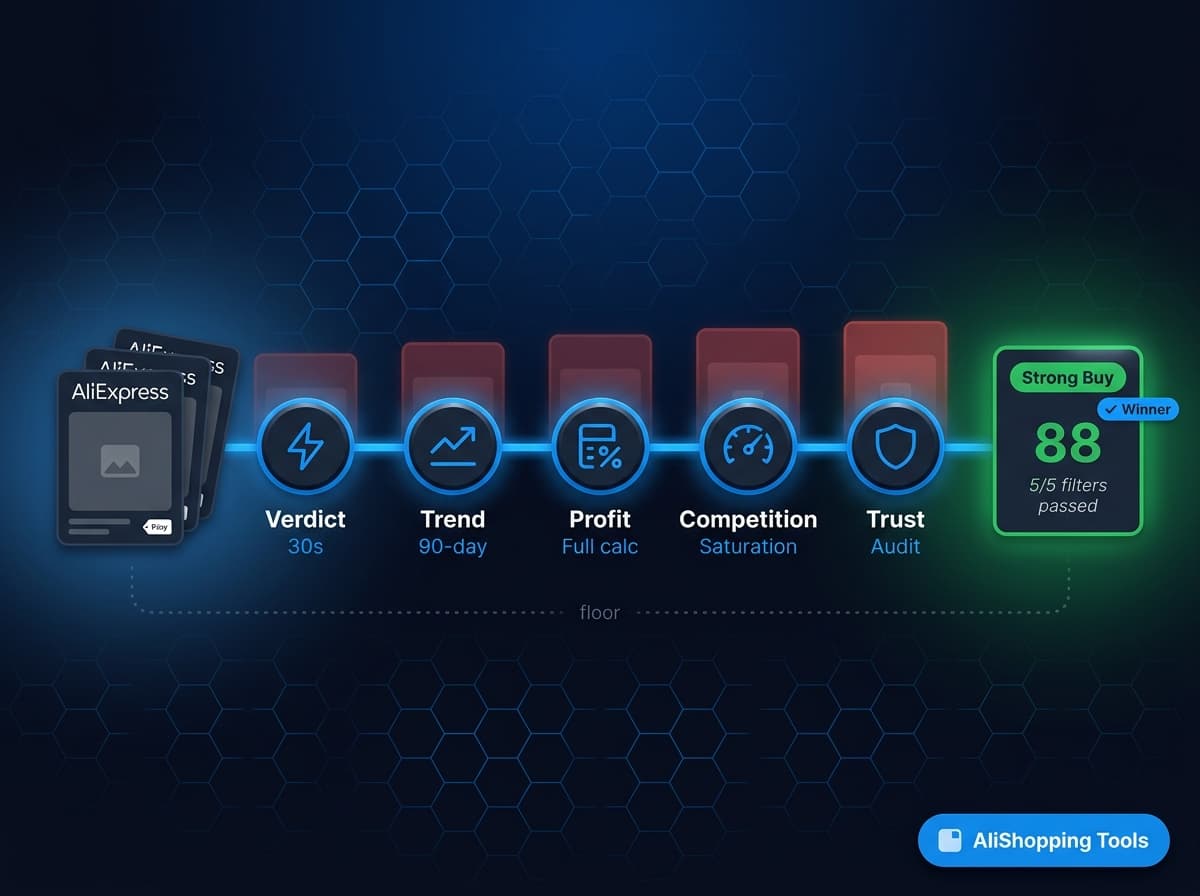
The 2026 product research workflow (5 steps)
Every structured research session collapses into these five steps in order. Skip any one and the failure rate on the products you source goes up measurably.
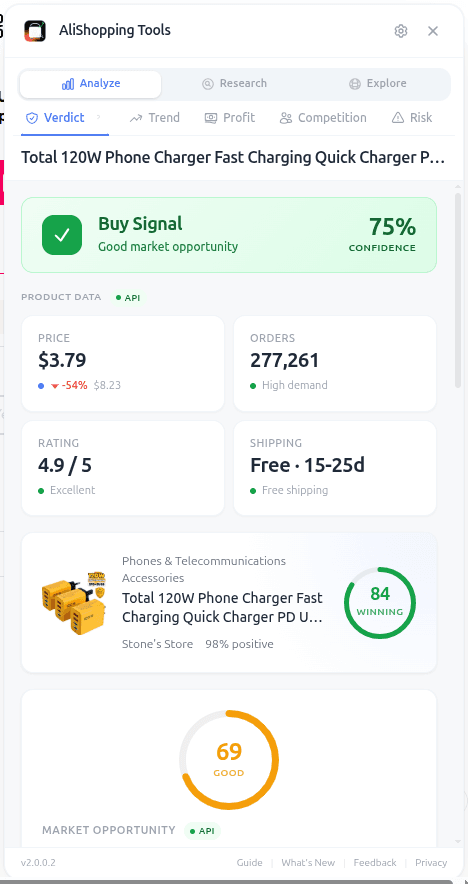
Step 1 — AI verdict (the 30-second pre-filter)
Before doing any manual analysis, run a single-number verdict check on the candidate product. Does this product look like a Strong Buy, a Buy, a Hold, or a Pass based on combined scoring across demand, margin, competition, trend, and supplier risk?
The verdict is not the final answer. It is the filter that decides whether to spend 15 more minutes on the product or move to the next candidate. Operators who skip this step spend hours deep-diving products that would have been filtered at the 30-second mark.
Free tool: AliShopping Tools' AI Verdict tab runs seven scoring algorithms on any AliExpress product page and surfaces a single verdict (Strong Buy / Buy / Hold / Pass) plus the underlying score dimensions. Zero account, runs locally in-browser.
When you still need a paid tool: if you want the verdict delivered across a monitoring dashboard of 500+ products continuously rather than per-page on demand, paid monitoring tools scale better.
Step 2 — Trend phase analysis
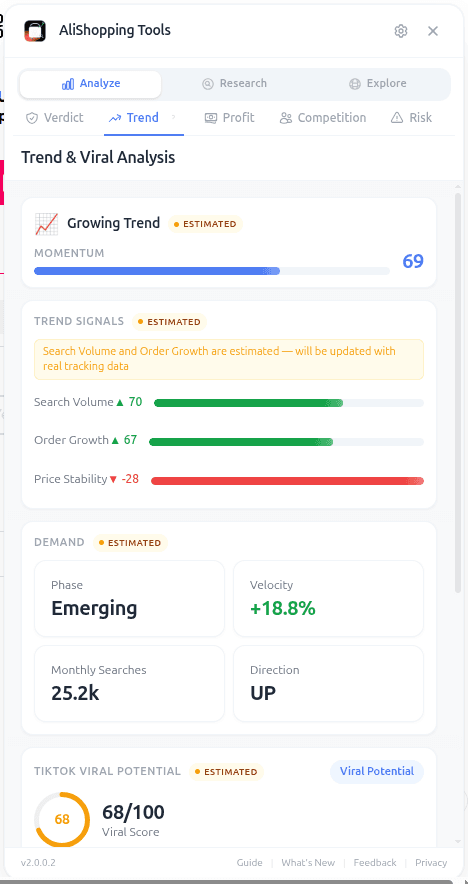
A product's position on its trend curve — Emerging, Growing, Peak, Declining — determines most of your downstream decisions. An Emerging product has low competition but unproven demand. A Growing product has validated demand and rising traffic. A Peak product has maximum demand but also maximum review-farming and saturation. A Declining product has falling demand — typically a pass even if the price looks great today.
Getting the trend phase right is the difference between a winning product and a winning product six months too late.
Free detection method:
- Check AliExpress order velocity for the product (7-day versus 30-day versus 90-day order counts)
- Check Google Trends for the product name or category search term (24-month view)
- Cross-check TikTok Creative Center for any viral video volume in the past 60 days
- Check if competitor Shopify stores are running the product right now (our Shopify Stack Intelligence hub covers the detection method)
Combining the four signals gives a reliable phase classification. AliShopping Tools automates this in the Trend tab — it also includes TikTok viral potential scoring which is the 2026-specific signal most worth paying attention to.
Step 3 — Profit simulation
A product that cannot earn positive margin after realistic ad costs is not a winning product, no matter how good the trend phase looks. Profit simulation means working out: product cost + shipping cost + platform fees + estimated ad spend per unit = margin per unit. Then multiplying by realistic conversion rate and volume to project monthly profit.
Most operators skip this step because it requires spreadsheet math. The operators who do it beat the ones who don't — because they pass on high-revenue, low-margin products that would have wiped out their working capital.
Free tool: AliShopping Tools' Profit Tab does this math in-context on the AliExpress product page. It pulls the product cost and shipping, lets you set retail price and estimated ad spend, and shows margin per unit and projected monthly profit at different volume scenarios. No spreadsheet needed.
Manual version: if you prefer a spreadsheet, the columns are: product cost, shipping to customer, retail price, platform fees (2.9% + 0.30 USD is typical for Shopify Payments), ad cost per purchase (typically 15 to 25 percent of retail for paid traffic), refund rate (typically 5 to 10 percent), and gross margin per unit. Multiply by daily volume for daily profit.
Step 4 — Competition scan
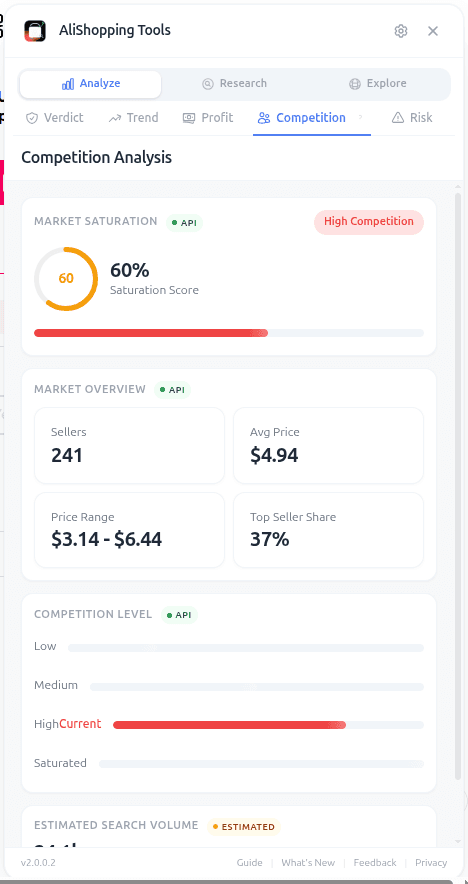
How many other dropshippers are already selling this product, and at what retail price? If 50 stores are running the same product at the same price, the market is saturated. If 5 stores are running it with inconsistent pricing, there is room. If 0 stores are running it, the market is either undiscovered or unworkable.
Competition scan is the step most beginner operators skip, and it is the one that would have saved them most of their early failures.
Free detection method:
- Google the product name plus "shop" or "buy online" — count the ads and the top organic results
- Check Facebook Ad Library for active ads running the product image — count the advertisers
- Check our Shopify Stack Intelligence hub workflow to see which competitor stores run the product
- Reverse-image-search the main AliExpress photo — how many Shopify stores come up using the same image?
AliShopping Tools' Competition tab automates steps 1, 3, and 4 — showing competitor store count, competitor pricing distribution, and saturation tier (Low / Medium / High / Over-Saturated) directly on the AliExpress page.
Step 5 — Trust audit
A product that passes verdict, trend, profit, and competition can still be the wrong product to source if the supplier, reviews, or description are unreliable. The trust audit is the final step: verify the listing's description, photos, reviews, and supplier are trustworthy enough that the physical product will match what the listing claims.
Trust failures downstream show up as dispute rates, refund requests, and payment-processor warnings — all of which can shut down a store faster than any ad spend issue.
Free tool: AliShopping Tools' supplier risk scoring and review distribution analysis cover most of this automatically. For the full manual audit methodology including reverse-image search and specifications-table reading, see our AliExpress Trust hub.
Tool comparison: free versus paid in 2026
All pricing and feature claims below come from publicly advertised tool listings as of April 2026. This is the honest breakdown.
| Tool | Price | Per-page decision | Monitoring at scale | FB ad-spy | AI verdict | Profit simulation | Trust audit |
|---|---|---|---|---|---|---|---|
| AliShopping Tools | Free forever | Yes (excellent) | No | No | Yes (7 algorithms) | Yes | Yes |
| Sell The Trend | 39.97 to 79.97 USD/month [Source: sellthetrend.com/pricing, apr 2026] | Yes | Yes | Partial | Limited | Partial | No |
| Pexgle Pro | 39.95 USD/month (list 99.95) [Source: pexgle.com/pricing, apr 2026] | Yes | Yes (250 stores) | Yes | Partial | No | No |
| Niche Scraper | 37.95 USD/month [Source: nichescraper.com/pricing, apr 2026] | Yes | Limited | Partial | Limited | No | No |
| Dropship.io | 29 to 99 USD/month [Source: dropship.io/pricing, apr 2026] | Yes | Yes | Limited | Partial | No | No |
Feature parity snapshots age fast. If something changes with a tool release the article will drift — we update this comparison quarterly and note "last verified" in the footer.
For deep paid-versus-free analyses see our dedicated alternatives guides, including the Pexgle alternative and related posts in the alternatives cluster, and the best AliExpress product research tools comparison.
Step-by-step walkthrough with AliShopping Tools
With the extension installed, the workflow on a candidate product is:
- Open the AliExpress product page — extension auto-loads four tabs (Verdict, Trend, Profit, Competition).
- Verdict tab (30s) — Strong Buy / Buy → continue. Hold → reality-check niche. Pass → close.
- Trend tab (60s) — Emerging / Growing + TikTok potential is the 2026 sweet spot. Declining = pass.
- Profit tab (60s) — set retail + realistic ad cost; if margin after refunds is not positive, pass.
- Competition tab (60s) — Over-Saturated = pass unless you have a clear differentiation angle.
- Trust audit (2m) — supplier risk + review shape + reverse-image check on main photo.
- Sample (3-10 USD) — order one. Only products that clear research AND the sample get ad spend.
Total time per candidate: 4 to 6 minutes. That's the workflow that finds winners in 2026.
Common mistakes in product research
Sourcing from surface signals alone
"It has 10,000 orders and 4.9 stars" is not research. Order count and rating are inputs to the verdict, not substitutes for it. Surface-signal sourcing is how beginners end up with saturated products at peak trend with inflated reviews — the exact losing combination.
Skipping profit simulation
A product with 80 USD retail, 10 USD product cost, and 60 USD ad spend per purchase has 10 USD gross per unit before refunds. After 8 percent refund rate and processing fees, that is roughly breakeven — not a winner. Operators who do the math kill products that operators who skip the math scale. Outcome diverges by thousands of dollars of ad spend.
Confusing "lots of competitors" with "bad product"
A saturated product at low competition tier was once an undiscovered winner. Saturation is a signal the market validated the product; the question is whether there is still room. Differentiation angles (bundle, premium positioning, specific audience, geographic tier) can turn a saturated product into a winner for a specific slice of the market. Competition is a context input, not an automatic pass.
Trusting AliExpress reviews without audit
Reviews drive most of the visible trust signal and are also the most worth manipulating. See our trust hub and fake review guide for the audit methodology — skipping it is how operators end up scaling products that were never real winners.
Not sampling before scaling
A 10 USD sample is the cheapest line in your sourcing budget. Skipping it to save 10 USD and going straight to 1,000 USD of ad spend is the exact pattern behind most "I lost all my money" forum posts.
Signals that matter (and signals that don't)
Not every data point that looks useful actually correlates with whether a product will win. This is the shortlist of what matters in 2026.
High-signal inputs (pay attention):
- AI verdict score (synthesises multiple dimensions)
- Trend phase + TikTok viral potential
- Projected profit margin per unit at realistic ad cost
- Supplier risk score (low supplier trust kills otherwise-good products)
- Competition tier (Low to Medium, with differentiation available)
- Review distribution shape (not just the star average)
Low-signal inputs (deprioritise):
- Raw order count on AliExpress (without velocity context)
- Star rating average (without distribution breakdown)
- "Number of days shipping" in the listing (often inaccurate)
- Seller years in business (can hide store resets under new name)
- "Best seller" badges (algorithmic, not quality-guaranteed)
Operators who train themselves to weight the first list and discount the second list make better decisions faster. Most beginner research tutorials do the opposite — they emphasise order counts and star ratings because those numbers are easy to show, not because they are reliable predictors.
Related clusters
- For trust verification of any candidate product (the step 5 deep-dive), see our AliExpress Trust hub and the fake review guide.
- For Shopify competitor intelligence (the step 4 deep-dive for saturation scanning), see our Shopify Stack Intelligence hub and the spy on Shopify stores for free guide.
- For paid-tool alternatives with detailed comparisons, see Pexgle alternative and best AliExpress product research tools.
- For the methodology-focused spoke guide, see our AliExpress product research guide.
FAQ
What is the best free AliExpress product research tool in 2026?
AliShopping Tools is the most complete free tool for the five-step workflow — AI verdict, trend phase, profit simulation, competition scan, and supplier trust all on any AliExpress product page with no account. It covers 80 to 90 percent of what paid tools like Pexgle, Sell The Trend, and Niche Scraper offer at the per-product decision level. Paid tools still win on continuous monitoring at 500+ store scale and dedicated Facebook ad-spy.
Is there a free alternative to Sell The Trend and Pexgle?
Yes. AliShopping Tools covers the per-product workflow those tools charge 40 to 80 USD a month for. Gaps: Facebook ad-spy (pair with the free Facebook Ad Library) and agency-scale continuous monitoring. For solo operators and lean teams the free stack is sufficient; see our Pexgle alternative for the detailed comparison.
How do I research AliExpress products in 2026?
Run the five-step workflow on every candidate: verdict (30s) → trend (60s) → profit (60s) → competition (60s) → trust audit (2m). Products that clear all five get a 3 to 10 USD sample before any ad spend. 4 to 6 minutes per candidate with the right tools; 20 to 30 minutes manually.
Can I find winning products without any paid tool?
Yes. The 2026 free stack (AliShopping Tools + Facebook Ad Library + Google Trends + TikTok Creative Center + browser reverse-image search) matches 2022-era paid tools on the per-product decision workflow. The operators who find winners run the workflow consistently — discipline beats subscription cost.
What makes a product a "winner" on AliExpress?
A winner clears all five filters: Strong Buy / Buy verdict, Emerging / Growing / Peak trend phase with TikTok potential, positive margin at realistic ad cost, Low-to-Medium competition with a differentiation angle, and trust audit passed. Products meeting all five are rare — a week of research might produce 1 to 3 candidates. That rarity is the feature: filtering most products out is the core skill.
How long should product research take per candidate?
4 to 6 minutes with the extension and the five-step workflow, versus 20 to 30 minutes manually. The operators who train themselves to the fast version research 5 to 10x more candidates per week — and top-of-funnel volume is what converts into finding winners, because most candidates get filtered out.
Do I need to order samples of every product I research?
Only the ones that clear the full five-step workflow. A 10 USD sample on a product that already failed verdict or profit is wasted money. But for products that clear all five filters, sampling is not optional — it is the one thing the research workflow cannot verify from the page, and skipping it at scale is how operators end up with dispute rates that shut down their payment processing.
Honest recommendation
If you are a beginner: install AliShopping Tools free and practice the five-step workflow on 20 products this week. Do not skip steps, do not shortcut, do not scale a single product before you have the muscle memory on the workflow. The tool stack you pay for matters less than the discipline of the workflow.
If you are scaling: you are already past the beginner tools debate. Add the free extension as the per-page decision layer inside whatever larger stack you run. The verdict, trend, profit, and trust scoring on every AliExpress page saves enough minutes per week to be worth installing even if you are also paying for Pexgle, Sell The Trend, or Niche Scraper.
If you are an agency: codify the five-step workflow as a standard operating procedure with a checklist your operators follow on every candidate. Add a paid monitoring tool for the continuous store tracking layer if you scale past 50 client-competitor stores. The free stack handles the per-product decisions; the paid stack handles the monitoring scale.
The wrong move for everyone is paying for tools before building the workflow discipline. The tools amplify a good workflow; they do not substitute for one.
Try it free: Install AliShopping Tools on the Chrome Web Store.
Disclosure: This hub is published by the AliShopping Tools team and routes to our deeper cluster content. Feature and pricing claims are based on publicly advertised information as of April 2026 (pricing verified on each vendor's pricing page on 2026-04-22). We update this comparison quarterly — if you notice anything out of date, email us via the contact page.
AliShopping Tools
See live AliExpress data in your browser.
Seller trust score, 90-day price history, and live promo codes — on every AliExpress product page. No account, free.
Ready to find winning products?
Try AliShopping Tools — 15 free AI tools for product research.
Quick answers
Frequently Asked Questions
1What is the best free AliExpress product research tool in 2026?
AliShopping Tools is the most complete free tool for the five-step workflow — AI verdict, demand trend, profit simulation, competition scan, and supplier trust all on any AliExpress product page with no account.
It covers 80 to 90 percent of what paid tools like Pexgle, Sell The Trend, and Niche Scraper offer at the per-product decision level.
Paid tools still win on continuous monitoring at 500+ store scale and dedicated Facebook ad-spy.
2Is there a free alternative to Sell The Trend and Pexgle?
Yes.
AliShopping Tools covers the per-product workflow those tools charge 40 to 80 USD a month for.
Gaps: Facebook ad-spy (pair with the free Facebook Ad Library) and agency-scale continuous monitoring.
For solo operators and lean teams the free stack is sufficient; see our Pexgle alternative for the detailed comparison.
3How do I research AliExpress products in 2026?
Run the five-step workflow on every candidate: verdict (30s) → trend (60s) → profit (60s) → competition (60s) → trust audit (2m).
Products that clear all five get a 3 to 10 USD sample before any ad spend. 4 to 6 minutes per candidate with the right tools; 20 to 30 minutes manually.
4Can I find winning products without any paid tool?
Yes.
The 2026 free stack (AliShopping Tools + Facebook Ad Library + Google Trends + TikTok Creative Center + browser reverse-image search) matches 2022-era paid tools on the per-product decision workflow.
The operators who find winners run the workflow consistently — discipline beats subscription cost.
5What makes a product a "winner" on AliExpress?
A winner clears all five filters: Strong Buy / Buy verdict, rising demand with TikTok potential, positive margin at realistic ad cost, Low-to-Medium competition with a differentiation angle, and trust audit passed.
Products meeting all five are rare — a week of research might produce 1 to 3 candidates.
That rarity is the feature: filtering most products out is the core skill.
6How long should product research take per candidate?
4 to 6 minutes with the extension and the five-step workflow, versus 20 to 30 minutes manually.
The operators who train themselves to the fast version research 5 to 10x more candidates per week — and top-of-funnel volume is what converts into finding winners, because most candidates get filtered out.
7Do I need to order samples of every product I research?
Only the ones that clear the full five-step workflow.
A 10 USD sample on a product that already failed verdict or profit is wasted money.
But for products that clear all five filters, sampling is not optional — it is the one thing the research workflow cannot verify from the page, and skipping it at scale is how operators end up with dispute rates that shut down their payment processing.
8What is the quickest way to gauge seasonal demand for a product on AliExpress using free tools?
Combine the free AliShopping Tools trend chart with Google Trends' own seasonality view: pull the past 12 months of interest for the product keyword and note which months rise above the recent baseline.
Cross-check that against AliExpress order-volume patterns for the same item.
Doing this consistently across candidates is faster than manual spreadsheet tracking, though exact time-to-insight varies by how many products you check.
9How much profit margin can a solo dropshipper realistically expect when following the 5‑step free workflow?
Net margin for solo dropshippers commonly lands in the 20-35% range after product cost, shipping, and ad spend, but the exact number depends heavily on your niche, price point, and ad efficiency — treat any fixed percentage as a rough planning benchmark, not a guarantee.
Use AliShopping Tools' profit calculator with your own real shipping and ad-cost estimates rather than a generic industry figure.
10Can I set up automatic alerts for price drops or stock changes on AliExpress without paying for a premium monitor?
Yes — you can add a product to a watchlist and get notified of price or stock changes using AliShopping Tools' price-tracking feature or AliExpress's own Wish List alerts, without a paid monitoring subscription.
Exact refresh frequency and notification timing are platform-dependent, so treat alerts as a helpful heads-up rather than a guaranteed instant signal.
11What steps should I take to verify that a product on AliExpress is not a counterfeit before adding it to my store?
Check the seller's verification badge, compare the product photos against the brand's official images or website (a reverse image search can help spot mismatches), and read recent buyer reviews for authenticity complaints.
Ordering a sample before committing to inventory remains the most reliable way to confirm material quality and packaging.
There's no single fixed timeline for this — build in enough time for a sample to arrive before you list the product.
12How do I import AliExpress product data into Shopify using only free resources, and how long does the import usually take?
You can export product data from AliShopping Tools (CSV) and import it into Shopify via Shopify's built-in Products → Import wizard, which maps common fields like title, price, and images automatically.
Import time scales with catalog size and image count, so treat any specific per-batch time estimate as approximate rather than a fixed benchmark.
More from the blog
How to Do Product Research for Dropshipping: 7-Step Framework (Free Tools, 2026)
A repeatable 7-step product research framework for dropshippers in 2026 — from idea sourcing to live testing, using only free tools. No Ecomhunt subscription needed.
AliExpress Trust Issues 2026: The Complete Operator's Hub
AliExpress listings hide 4 trust failures — fake descriptions, manipulated photos, review fraud, supplier risk. The 2026 detection hub routing you to each fix.
Winning Products Singapore 2026: 10 Top Picks
10 dropshipping product categories for Singapore 2026 — calibrated to year-round heat, HDB space constraints, and the multicultural calendar (CNY, Hari Raya, National Day, Deepavali), plus how to vet each candidate in AStools.