












How to Do Product Research for Dropshipping: 7-Step Framework (Free Tools, 2026)
How to Do Product Research for Dropshipping: 7-Step Framework (Free Tools, 2026)
Quick answer: Use this 7-step filter pipeline before committing any ad spend: source 20–50 candidates from TikTok, Amazon Movers, and competitor stores; then filter by demand (1,000+ orders), competition, price history, supplier quality (4.7+ rating, 12+ months old), profit math (40%+ margin), and a small live ad test — AliShopping Tools covers steps 2–6 for free.
Most dropshipping courses tell you to "find a winning product." Almost none tell you exactly how — what to check, in what order, with what numbers. This guide is the missing framework. Seven steps, each one a filter, all running on free tools. By the end you will have a repeatable system that catches winners earlier and rejects losers before they drain your ad budget.
Why Most Dropshippers Skip Proper Product Research (And Fail)
Three patterns cause the vast majority of dropshipping failures: choosing products on gut feeling instead of verified demand, sourcing items that already peaked on TikTok 6 weeks ago, and skipping the profit math until after the first ads run. Each one is preventable with a 20-minute research checklist. The framework below is exactly that checklist.
The 7-Step Product Research Framework
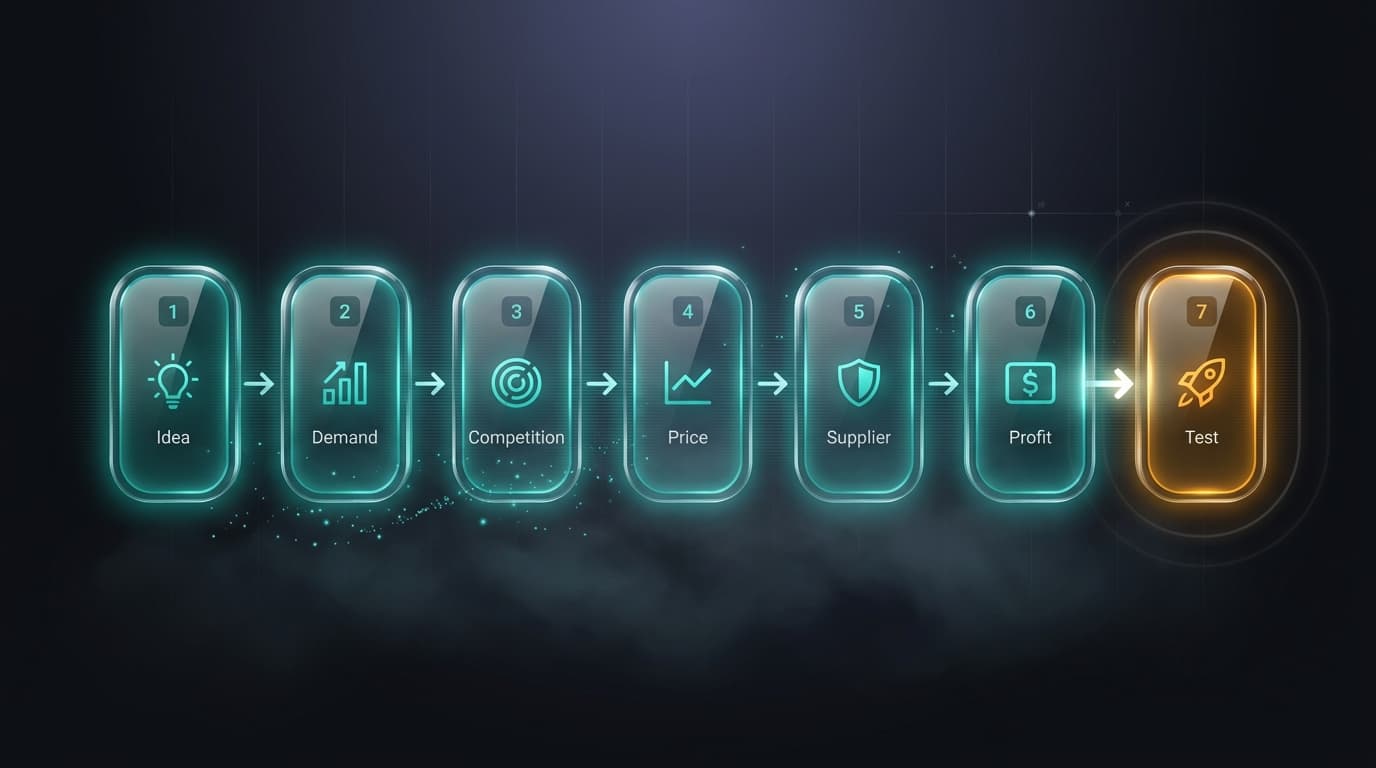
Here is the full pipeline at a glance. Each step is a filter — products that fail at any stage get rejected before you waste time on the next stage.
- Idea Sourcing — where to find candidates
- Demand Validation — is anyone actually buying it?
- Competition Check — is the market saturated?
- Price History Check — is the supplier stable?
- Supplier Vetting — can this seller actually ship?
- Profit Math — does the unit economics work?
- Small Test Before You Scale — do real customers respond to ads?
Each step has a single decision: pass or reject. Be ruthless. The whole point is filtering 50 candidates down to 1-2 testable winners.
Step 1 — Idea Sourcing
You need a candidate pool of 20-50 products to start filtering. Three free sources outperform any paid product-database subscription in 2026:
- TikTok FYP search. Search hashtags like
#tiktokmademebuyit,#amazonfinds,#dropshippingproducts. Sort by recent. Look for videos with 100K+ views posted in the last 2-4 weeks. Don't chase products that already have a million-view organic video — that train left the station. - Amazon Movers & Shakers. Free page at
amazon.com/gp/movers-and-shakers— updated hourly, shows products with the biggest sales-rank jumps in the last 24 hours. Filter by category. Cross-reference with AliExpress. - Competitor Shopify stores. Find 10-15 active dropshipping stores in your niche (look at TikTok ads, Facebook ad library). Note their hero products. Tools like Shopify Spy (free tier available) or just browsing
/collections/best-sellersworks.
Skip paid product databases like Ecomhunt for this step. By the time a product hits a curated list, hundreds of dropshippers are testing it. Source 1 week earlier than the curated lists do.
Output of Step 1: a candidate list of 20-50 product names + AliExpress links.
Step 2 — Demand Validation
Now filter the candidate list to products with proven demand. The single best signal on AliExpress is order count over the last 6 months.
What numbers to look for:
- 1000+ orders in 6 months — proven demand, safe to investigate further
- 5000+ orders — strong signal, but check competition (Step 3) carefully
- Under 500 orders — either too new or too niche; only proceed if TikTok signals are exceptional
- Recent sales velocity: are orders accelerating in the last 30 days, or has the product peaked?
The AliShopping Tools Winning Score consolidates the listing's public signals into a single 0-100 number, weighting seven of them: demand potential (21%), price attractiveness (17%), product rating (17%), social proof (17%), visual appeal (17%) and shipping quality (11%). It sorts into three bands — High Potential at 75+, Medium Potential 50-74, Low Potential below 50. Use High Potential to prioritise your queue, and treat Low Potential as a signal that the listing has little public evidence either way. The score does not read competition or margin, so Steps 3 and 6 below still have to happen.
Output of Step 2: filter your 20-50 candidates down to 10-15 with verified demand.
Step 3 — Competition Check
A winning product with 50 competing dropshippers is not a winning product for you. Check saturation across three surfaces:
- AliExpress seller count. Search the product on AliExpress — how many sellers offer the same SKU? 5-15 is healthy. 50+ means it is already commoditised.
- Google Shopping. Paste the product image into Google Lens or search the product name. If 20+ Shopify stores already rank, you are late.
- Facebook Ad Library. Search the product name. If hundreds of active ads exist, the market is saturated. If 10-30 active ads exist, demand is verified and competition is manageable.
The AliShopping Tools competition tab summarises seller count and price spread on the product page itself — you can rule out saturated products in 5 seconds.
Output of Step 3: drop to 6-10 candidates with verified demand AND manageable competition.
Step 4 — Price History Check
Suppliers running constant "limited-time" sale prices are a red flag. If the product has been at "$5.99 (was $19.99)" for the last 90 days, the $19.99 was never real — and worse, the supplier is desperate enough to fake prices, which usually correlates with shipping instability and stock-outs.
Check the 90-day price chart with AliShopping Tools price history (free, on every product page). What to look for:
- Stable price over 60-90 days — healthy listing, supplier has steady margin
- Genuine flash sales (1-3 day dips) — normal AliExpress behavior
- Permanent "discount" pricing — fake; skip
- Price climbing steadily — supplier is losing margin; expect stock-out within weeks
Output of Step 4: drop to 5-8 candidates with healthy price stability.
Step 5 — Supplier Vetting
A great product from a bad supplier becomes refund tickets, chargebacks, and 1-star reviews. Vet the seller before you commit:
- Seller rating ≥ 4.7 out of 5 (anything under 4.5 is high-risk)
- Store age 12+ months (new stores can be excellent, but you cannot verify shipping reliability without history)
- Recent positive feedback on shipping speed — read the last 20 reviews specifically
- Dispute rate under 2% — visible on advanced AliExpress filters
The AliShopping Tools Risk Assessment flags suppliers with elevated late-shipment rates, high dispute counts, or rapid quality drops — green/yellow/red traffic-light system. Green flags only.
Output of Step 5: 3-5 candidates that pass demand, competition, price stability, AND supplier reliability.
Step 6 — Profit Math
Now the unit economics. The math is simple, but most beginners skip it and discover they were running ads at a loss.
Real profit per sale = Sell price − (Product cost + Shipping + Ad cost per sale + Transaction fees + Refund reserve)
Worked example:
| Line item | Amount |
|---|---|
| Sell price | $34.99 |
| Product cost (AliExpress) | $7.50 |
| Shipping to customer | $4.20 |
| Ad cost per sale (target CPA) | $12.00 |
| Stripe/PayPal fees (2.9% + $0.30) | $1.31 |
| Refund reserve (5% of sell) | $1.75 |
| Real profit per sale | $8.23 |
| Margin | 23.5% |
The 40% gross-margin rule: target a sell-price-to-cost-of-goods ratio where product cost + shipping is no more than 30% of sell price, leaving at least 40% gross margin before ads. Below that, scaling on paid traffic is mathematically painful.
The AliShopping Tools Profit Calculator runs this math on-page — enter your target sell price, it shows ad-cost breakeven and margin in real time. Free, no signup.
Output of Step 6: 2-3 candidates with viable unit economics.
Step 7 — Small Test Before You Scale
Never order bulk inventory or commit a large ad budget before a live test. The test rig:
- 3-5 ad variants per product (different hooks, different creatives)
- $10-20/day per ad set for 3-5 days
- Measure: CPC (under $1.50 for most niches), CTR (above 1.5%), ROAS (above 1.0 in cold traffic = potential winner, above 1.5 = scale candidate)
Only products that hit positive ROAS in the small test get scaled. Everything else gets cut. This is the single rule that separates dropshippers who survive from those who burn their first $2,000 ad budget on hope.
Output of Step 7: 1-2 validated winners ready to scale.
Free Tools for Each Step
| Step | Free Tool | What It Does |
|---|---|---|
| 1. Idea Sourcing | TikTok FYP, Amazon Movers, Facebook Ad Library | Surface fresh candidate products |
| 2. Demand Validation | AliShopping Tools Winning Score | Order volume, price, rating, reviews, visuals, commission and shipping in one number |
| 3. Competition Check | AliShopping Tools competition tab, Facebook Ad Library | Saturation check |
| 4. Price History | AliShopping Tools price history | 90-day price chart |
| 5. Supplier Vetting | AliShopping Tools Risk Assessment | Green/yellow/red supplier flags |
| 6. Profit Math | AliShopping Tools Profit Calculator | Real-time margin breakdown |
| 7. Small Test | Facebook Ads Manager, TikTok Ads Manager | Live ROAS validation |
Steps 2 through 6 all run inside the AliShopping Tools Chrome extension on the same AliExpress product page — no tab-switching, no account signups, no monthly fee.
Common Mistakes to Avoid
Even with the framework, four mistakes ruin beginner research:
-
Sourcing too late. By the time a product is on Ecomhunt or a YouTube "winning products" video, hundreds of dropshippers are already running ads. Source 1 week earlier from raw TikTok FYP, not from curated lists.
-
Ignoring shipping times. A 30-day shipping window kills conversion. Filter for AliExpress Direct or sellers with US/EU warehouse stock — under 14 days delivery is the modern baseline.
-
Choosing fashion or beauty first. These categories have the highest return rates, the lowest unit profit, and the most saturated competition. Beginners should start in niches with lower return rates: pet accessories, kitchen gadgets, car accessories, home organization.
-
No testing budget set aside. Plan to spend $200-500 testing 3-5 products before finding one that works. Going all-in on a single product without testing is gambling, not dropshipping.
A Real Product Research Example (Walk-Through)
Let's run a hypothetical product — Magnetic Phone Car Mount — through all 7 steps:
- Step 1 (Idea): Spotted on TikTok FYP, 340K-view video posted 3 weeks ago, hashtag #cargadgets. Pass.
- Step 2 (Demand): AliExpress listing shows 8,400 orders in 6 months, velocity accelerating last 30 days. AliShopping Tools Winning Score: 84/100 — High Potential band. Pass.
- Step 3 (Competition): 23 AliExpress sellers offer the same SKU. Facebook Ad Library shows 18 active ads — manageable. Pass.
- Step 4 (Price History): Stable at $4.80 ± $0.30 for 75 of last 90 days. Healthy. Pass.
- Step 5 (Supplier): Seller rating 4.8, 19 months old, recent reviews praise 12-day shipping to US. Risk Assessment: green. Pass.
- Step 6 (Profit Math): Target sell $24.99. Cost $4.80 + shipping $3.50 = $8.30. After ads ($8 CPA target) + fees + refund reserve = $7.20 net per sale. Margin 28.8%. Below the 40% gross threshold — tight, but workable if CPA stays under $8. Conditional pass.
- Step 7 (Test): Run 4 ad variants at $15/day on TikTok Ads for 4 days. Best variant hits ROAS 1.6, CPC $0.90, CTR 2.1%. Scale candidate confirmed.
Total research time: ~25 minutes for steps 1-6, plus 4 days for step 7's live test. Total testing spend: $240.
FAQ
How long does dropshipping product research take?
Steps 1 through 6 take 20-30 minutes per product candidate with a free Chrome extension like AliShopping Tools doing the data lookup. Step 7 (the live ad test) takes 3-5 days and $150-300 in ad spend. Plan to research 10-15 candidates to find one validated winner.
Do I need paid tools for product research?
No. In 2026 every step of the framework can be run on free tools. TikTok FYP, Amazon Movers, Facebook Ad Library, and the AliShopping Tools Chrome extension cover steps 1-6 at zero cost. Paid tools like Ecomhunt save curation time but charge for data that is already free on AliExpress.
How many products should I test?
Plan to test 3-5 products before finding one that scales. Set aside $200-500 in test ad budget per product candidate. Most dropshippers find their first winner on attempt 4 or 5 — patience and ruthless filtering separate winners from the 95% who give up after one failure.
What's a good winning score for dropshipping?
On the AliShopping Tools 0-100 scale there are three bands: 75 or higher is High Potential, 50-74 is Medium Potential, and below 50 is Low Potential. High Potential means the listing is strong across most of its seven weighted signals — real order volume, a solid rating, a substantial review base, a well-built page. It does not mean the product will be profitable: margin and competition are not in the score at all, which is why Step 3 (competition) and Step 6 (profit math) stay mandatory regardless of the band.
Run Steps 2-6 in One Click with AliShopping Tools
The 7-step framework runs in your browser. The AliShopping Tools free Chrome extension surfaces the Winning Score, competition data, 90-day price history, supplier risk flags, and profit calculator directly on every AliExpress product page — no tab-switching, no account signup, no monthly fee. The framework that previously required juggling 5 paid subscriptions now runs in one extension.
AliShopping Tools
See real delivery time to your country.
Per-seller shipping estimates and trust signals on every AliExpress product page. No account, free.
Product Tracker Free Beta
Track any AliExpress product’s real price, orders, stock & rating for 180 days. Data doesn’t lie. But discounts can.
Before you buy
Is this deal real? Check the price history before you buy.
Prices often spike just before a “sale.” See 180-day price history and fake discount detection — free, no account needed.
Verify on AliShopping Deals →Ready to find winning products?
Try AliShopping Tools — 15 free AI tools for product research.
Quick answers
Frequently Asked Questions
1How long does dropshipping product research take?
Steps 1 through 6 take 20–30 minutes per product candidate with a free Chrome extension like AliShopping Tools doing the data lookup.
Step 7 (the live ad test) takes 3–5 days and $150–300 in ad spend.
Plan to research 10–15 candidates to find one validated winner.
2Do I need paid tools for dropshipping product research?
No.
In 2026 every step of the framework can be run on free tools.
TikTok FYP, Amazon Movers, Facebook Ad Library, and the AliShopping Tools Chrome extension cover steps 1–6 at zero cost.
Paid tools like Ecomhunt save curation time but charge for data that is already free on AliExpress.
3How many products should I test for dropshipping?
Plan to test 3–5 products before finding one that scales.
Set aside $200–500 in test ad budget per product candidate.
Most dropshippers find their first winner on attempt 4 or 5 — patience and ruthless filtering separate winners from the 95% who give up after one failure.
4What is a good Winning Score for dropshipping?
The AliShopping Tools 0–100 scale has three bands: 75 or above is High Potential, 50 to 74 is Medium Potential, and below 50 is Low Potential.
High Potential means the listing scores well across most of its seven weighted signals — demand potential, price attractiveness, product rating, social proof, visual appeal and shipping quality.
There is no cutoff beyond those bands, and the score does not measure your margin or your competition, so a competition check and profit calculation are still required whatever the band.
5What free method can I use to spot emerging product trends on TikTok before they go viral?
Watch the For You Page (FYP) for niche-specific hashtags and note products that keep reappearing across multiple creators' videos in a short window — that's a sign organic interest is building.
Cross-check the item in AliShopping Tools to see real order volume and Winning Score on AliExpress; a rising order count paired with a decent Winning Score suggests the product is still early rather than already saturated.
6How do I verify that an AliExpress supplier has a stable inventory and won’t run out of stock after I launch?
Check the supplier's overall order history and rating for the specific product, not just the storefront average — a healthy, established listing with consistent positive feedback about shipping and quality is a better bet than a brand-new one with no track record.
Placing a small test order before committing to bulk is the most reliable way to confirm a supplier can actually deliver at the volume and speed you need.
7What is the recommended ad spend and duration for the small‑scale test before scaling a dropshipping product?
Run a modest, time-boxed test — a small daily budget over roughly a week is enough to gather a meaningful signal without overspending.
Watch cost-per-click and cost-per-acquisition trends rather than fixating on a single target number, since acceptable ad costs vary a lot by niche and price point.
Feed the real results into the AliShopping Tools profit calculator to confirm the math actually works before committing a larger budget.
8How can I use Amazon’s Movers & Shakers list to find low‑competition dropshipping products?
Products that just entered Amazon's Movers & Shakers list with a still-low review count are often earlier in their lifecycle than already-established bestsellers — worth cross-referencing on AliExpress for price and availability.
Use AliShopping Tools to check real order volume and Winning Score on the AliExpress listing before treating it as validated demand rather than just a passing Amazon trend.
9What profit margin should I aim for after accounting for shipping, ad costs, and platform fees to keep my dropshipping business sustainable?
Add up all your real costs — product price, shipping, ad spend, and any platform or payment-processing fees — and compare the total against your retail price rather than eyeballing gross margin alone.
Use the AliShopping Tools profit calculator to run a few pricing scenarios; if the margin looks too thin across most of them, that's a signal to renegotiate supplier cost or adjust your retail price before scaling ad spend.
Related Articles
- AliExpress Product Research Tool 2026: Free 5-Step Workflowproducts
- AI Product Scoring for Dropshipping: How It Works (2026)guides
- How to Tell If an AliExpress Product Will Sell — Dropshipper's Checklist (2026)guides
- Ecomhunt Free in 2026: Is There a Real Free Tier? (+ The Free Alternative That Actually Works)compare
- Free PPSpy Alternative That Shows Accurate Data (2026)compare
- Best EcomHunt Alternative 2026: Free AliExpress Research Tool vs. EcomHuntcompare
Related Tools
More from the blog
AliExpress Product Research Tool 2026: Free 5-Step Workflow
Product research on AliExpress has a 5-step workflow in 2026. This hub walks through each step, the free tools that cover it, and where paid tools still matter.
AI Product Scoring for Dropshipping: How It Works (2026)
How AI product scoring evaluates dropshipping opportunities across four dimensions — product fundamentals, profit potential, market saturation, and risk — to produce a verdict before you spend money.
How to Tell If an AliExpress Product Will Sell — Dropshipper's Checklist (2026)
A 9-signal checklist to evaluate any AliExpress product before you list it. Order velocity, margin math, review quality, trend timing, and more.