
AliExpress Product Research: 2026 Guide (Tools + Checklist)
AliExpress Product Research: The Complete Guide for Dropshippers (2026)
Quick Answer: AliExpress product research means evaluating each candidate across five dimensions — trend trajectory, profit margin, market saturation, supplier reliability, and content potential — to find the 3 products worth testing out of 100 million listings. The fastest method in 2026 is a free Chrome extension that runs all five analyses on any AliExpress page in 30 seconds.
There are over 100 million products on AliExpress. You need to find three that will actually sell.
That gap between "100 million options" and "3 winners" is where most dropshippers get stuck. They scroll for hours, open dozens of tabs, copy whatever their competitor is selling, and hope for the best. Then they spend money on ads, wait two weeks for shipping samples, and realize the product was a dud all along.
Sound familiar? You are not alone. Most new dropshipping stores never reach consistent profitability in their first year, and the most common reason operators cite is poor product selection — choosing what to sell before validating whether it can actually margin.
The good news: AliExpress product research does not have to be a guessing game. In 2026, the tools and methods available to you are better than ever. This guide walks you through every step of the process, from identifying product opportunities to validating profitability before you spend a single dollar.
AliExpress Research: 5 Best Practices That Find Winning Products
Effective AliExpress research follows a repeatable five-step process that filters 100 million products down to three testable winners:
- Generate 10-15 ideas from AliExpress Hot Products, TikTok trends, and competitor stores — quantity first, filtering second.
- Score each product across five dimensions: trend trajectory, profit margin, market saturation, supplier reliability, and content potential.
- Compare your top 3 finalists side by side using a scoring matrix; let the data pick the winner, not intuition.
- Vet the supplier — store rating above 4.5, verified business license, and a sample order before any ad spend.
- Test with a small budget ($50-100) over 3-5 days; set a clear cost-per-acquisition target and kill fast if the product does not hit it.
Tools like AliShopping Tools run all five analyses free on any AliExpress product page — no spreadsheet required.
Why Most AliExpress Product Research Fails
The traditional approach to researching products on AliExpress looks something like this: browse the platform, sort by "Orders," pick something with a lot of sales, and list it on your store.
The problem is obvious once you think about it. If a product already has 50,000 orders visible to everyone, hundreds of other dropshippers have already found it. The market is saturated, margins are compressed, and you are late to the party.
Effective AliExpress dropshipping research requires you to evaluate products across multiple dimensions simultaneously: demand trends, profit margins, supplier reliability, competition levels, and viral potential. Doing this manually is possible, but painfully slow.
What to Look for in a Winning Product
Before diving into the research process, you need a clear framework for what makes a product worth selling. Here are the criteria that separate winners from duds:
Demand signals. Is the product trending upward, or has it already peaked? You want products in the "emerging" or "growing" phase, not "declining."
Healthy margins. After accounting for product cost, shipping, platform fees, ad spend, and returns, can you still make 30%+ profit per unit? Many beginners skip this calculation and discover they are losing money on every sale.
Low-to-medium competition. A saturation score above 70% means too many sellers are already fighting for the same customers. Look for niches where demand exists but supply has not caught up yet.
Reliable suppliers. A great product from a bad supplier will destroy your business with late shipments, quality issues, and chargebacks. Supplier vetting is not optional.
Content potential. In 2026, most dropshipping sales come through short-form video. If a product is not visually interesting or demo-friendly, it will be hard to market regardless of the numbers.
Step 1: Generate Product Ideas
Start broad. There are several reliable sources for AliExpress product ideas:
AliExpress itself. The "Hot Products" and "Super Deals" sections surface products with strong current demand. The key is to use these as starting points for research, not as your final picks.
TikTok and Instagram Reels. Watch what creators are promoting. Products that are going viral on social media often have a 2-4 week window before the market gets crowded.
Competitor stores. Browse successful Shopify stores in your niche. What are they selling? What are their best-sellers? Tools like AliShopping Tools let you spy on any Shopify store for free to see their full product catalog, detect which apps they use (from a database of 200+ Shopify apps), and even track live sales in real time.
Niche communities. Reddit, Facebook groups, and forums in your target niche reveal what problems people are trying to solve. Products that solve real problems tend to outperform novelty items.
Aim to generate a list of 10-15 product ideas before moving to the next step. Quantity matters here because most will not survive the validation process.
Step 2: Analyze Each Product with Data
This is where AliExpress product analysis gets serious. For each product on your list, you need to evaluate it across five dimensions.
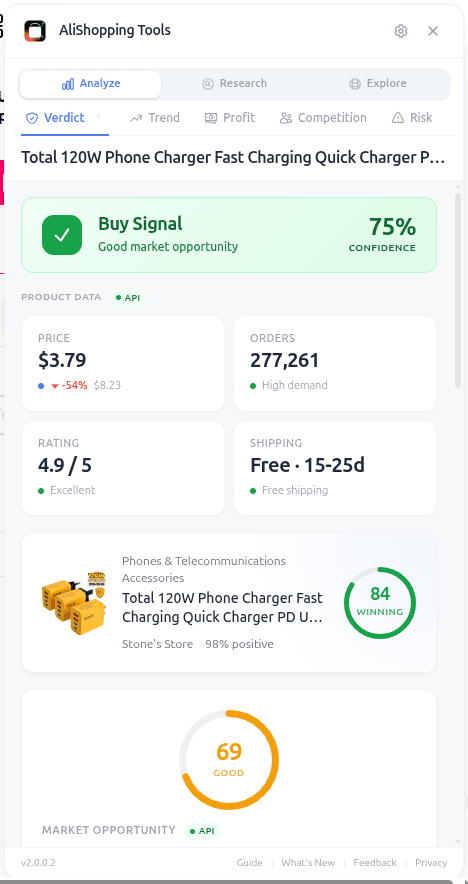
If you are using AliShopping Tools, this entire process happens automatically when you open any AliExpress product page. The extension runs 7 scoring algorithms simultaneously and delivers a verdict within seconds. But whether you use a tool or do it manually, here is what to assess:
Trend analysis. Is this product emerging, growing, peaking, or declining? Check search volume trends, order velocity, and price movement. A product with growing search volume and accelerating orders is in a sweet spot. One with declining searches and falling prices is on its way out.
Profit simulation. Calculate your true profit per unit. This means factoring in the product cost, shipping to your target market, platform fees (Shopify, Stripe, PayPal), estimated ad cost per acquisition, and a return rate of 5-10%. A tool like the AliShopping Profit Simulator breaks this down automatically, including monthly revenue projections and break-even timelines.
Competition check. How saturated is this market? How many sellers are offering the same or similar products? What is the average price, and what share does the top seller control? If the top 3 sellers own 80% of the market, breaking in will be expensive.
Risk assessment. Evaluate the supplier specifically. Check their store rating, years in business, whether they hold a verified business license, and read what the recent buyer reviews actually say. A supplier with a 4.2 rating and verified credentials is very different from one with a 3.8 rating and no license.
Viral potential. For TikTok and social media marketing, estimate how well this product would perform in short-form video. Products with strong visual appeal, a clear before/after transformation, or a "wow factor" score higher. AliShopping's TikTok Viral Score is a separate, data-driven read on the same question — it scores how fast the product's demand is actually moving (0-100 scale, banded Low Viral / Viral Potential / Highly Viral at 50 and 75) and suggests three ad angles with specific hook types (emotional, visual, curiosity).
Step 3: Compare Your Top Picks Side by Side
After analyzing your list, narrow it down to your top 3 contenders. Now compare them directly.
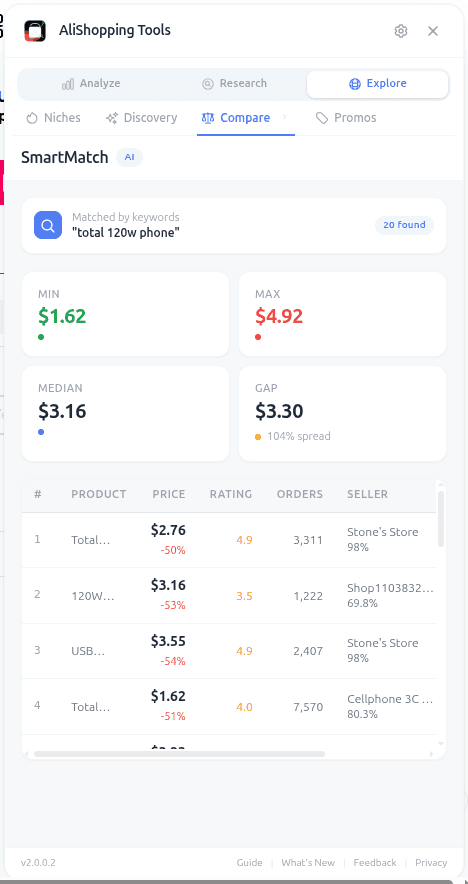
Create a comparison table with these columns: winning score, profit margin, saturation level, supplier trust score, trend direction, and viral score. The product that scores highest across the most dimensions is your best bet.
AliShopping Tools has a built-in Compare feature that lets you save up to 3 products while browsing and then view them side by side with an auto-highlighted winner. You can even export the comparison as a branded PNG image for your records or to share with a business partner.
The key here is to resist the temptation to pick based on gut feeling. Let the data decide. A product with a 65/100 winning score, healthy margins, and low competition will almost always outperform a product you personally find exciting but the numbers do not support.
💡 Researching products? Get the tool this guide is based on — free on Chrome. AliShopping Tools runs all 6 steps automatically on every AliExpress page you open. One permission, no signup.
Step 4: Vet the Supplier Thoroughly
You have your product. Now make sure the supplier will not ruin your business.
Check the basics. Store rating should be 4.5 or above. Look for "Top Brand" or verified business license badges — AliExpress documents how its Buyer Protection and seller ratings work on its official help pages. Check how long the store has been active. New stores (under 1 year) carry more risk.
Read reviews strategically. Do not just look at the star rating. Filter by 1-star and 2-star reviews to find recurring complaints. If multiple buyers mention the same issue (wrong color, poor packaging, slow shipping), that is a red flag.
Order a sample. Always. No exceptions. Order the product yourself and evaluate the quality, packaging, and shipping time. This costs you $10-30 but can save you thousands in chargebacks and refunds.
Test communication. Message the supplier with a question. How quickly and professionally do they respond? Suppliers who take 3+ days to reply will be even slower when you have problems.
AliShopping's Risk Assessment tab automates the first part of this process, assigning a risk score of 0-100 with specific flags for issues like unverified licenses or quality concerns. Reading the reviews stays a manual job — what the extension adds there is a Reviews tab that breaks the ratings into the 1-to-5 star spread, filters down to the reviews that carry buyer photos, opens those photos full-size, and exports the set to CSV, JSON, TXT or XLSX if you want to work through them outside the browser. It hands you the evidence; the judgement is yours. And the sample order step is something no tool can replace.
Step 5: Validate with Small-Scale Testing
Before going all-in, test your winning product with a small ad budget.
Set a test budget. Allocate $50-100 for your first test. Run ads for 3-5 days across 2-3 audiences. If you are selling on TikTok, create 3 different video hooks using the ad angles from your research.
Define success metrics. For a test to be "passing," you want a cost per purchase under 40% of your product's retail price. If your product sells for $29.99, your target CPA should be under $12.
Kill fast. If you spend $30 with zero add-to-carts, the product or the creative is not working. Move to your next pick. This is exactly why you identified 3 top products, not just 1.
Step 6: Monitor Trends and Iterate
Product research is not a one-time activity. Markets shift, trends change, and competition evolves.
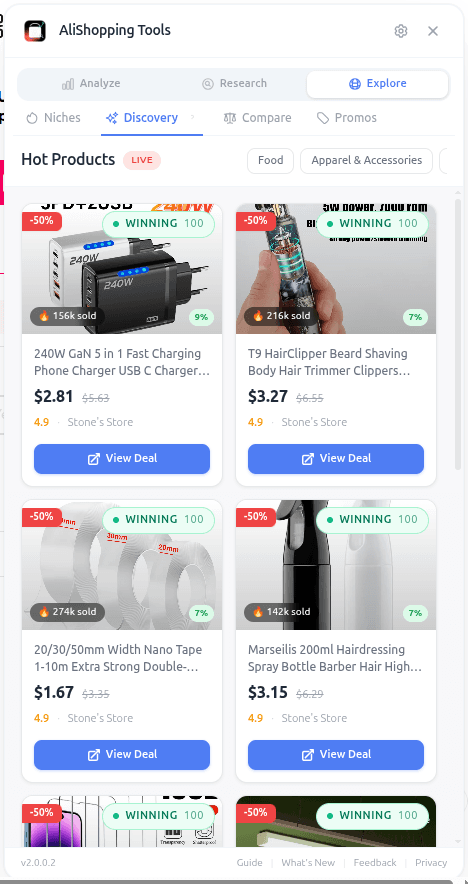
Build a weekly habit of checking for new product opportunities. Use a hot products discovery feed to spot emerging winners before they become obvious to everyone. Monitor the saturation level of products you are already selling. If competition is rising fast, start researching your next product before margins compress.
AliShopping Tools makes this easy with its Discovery tab, which surfaces trending products with live demand signals and winning badges. You can filter by category and see real-time sales velocity. Think of it as a product research radar that runs continuously in the background.
Common Mistakes to Avoid
Copying competitors blindly. By the time you see a competitor selling a product successfully, they have likely been at it for weeks or months. You are entering a race that is already underway.
Ignoring shipping times. A product with amazing margins but 30-day shipping will generate chargebacks and unhappy customers. Filter for products with shorter delivery windows, ideally under 15 days to your target market.
Skipping the profit calculation. "It costs $5 and I can sell it for $25" is not a profit calculation. Factor in every cost. AliExpress product research without profit validation is just window shopping.
Researching forever without testing. Analysis paralysis is real. Set a deadline. If you have been researching for more than a week without testing a product, you are overthinking it. Pick the best option from your data and test it.
Using too many tools. Juggling five different browser tabs and three paid subscriptions creates friction and slows you down. Consolidate your research workflow into as few tools as possible.
What Tools Do You Need for AliExpress Research in 2026?
The landscape of AliExpress dropshipping research tools has changed dramatically. A few years ago, you needed separate subscriptions for product research, supplier analysis, competition tracking, and Shopify spying.
In 2026, all-in-one solutions have caught up. AliShopping Tools, for example, combines AliExpress intelligence, Shopify store analysis, AI-powered scoring, TikTok viral detection, profit simulation, and content export in a single free Chrome extension. No account required, no credit card, no trial period. For a curated shortlist, see the best AliExpress product research tools, and for the social-trend angle read how to find TikTok winning products.
Whatever tools you choose, make sure your research process covers all five dimensions we discussed: trend, profit, competition, risk, and content potential. Skipping any one of them significantly increases your chance of picking a losing product.
Frequently Asked Questions
How many products should I research before picking one to sell?
Aim to generate 10-15 product ideas, then narrow to your top 3 through data analysis. Researching fewer than 10 means you are not seeing enough options. Researching more than 20 without testing anything means you are stuck in analysis paralysis.
What is the most important metric when researching AliExpress products?
Profit margin after all costs. A product can be trending with low competition, but if the margin is below 20% after ad spend, shipping, and returns, it will not build a sustainable business. Always run the full cost breakdown before committing.
How do I know if an AliExpress product is already too saturated?
Check how many active sellers list the same or very similar products, and look at the price range. If dozens of sellers cluster within a narrow price band, the market is in a price war. AliShopping Tools provides a saturation score (0-100%) on any product page to make this assessment instant.
Should I order samples before listing a product?
Always. No exceptions. A $10-30 sample order lets you verify product quality, packaging, and shipping time firsthand. Skipping this step is the most common cause of chargebacks and bad reviews that kill new stores.
Start Researching Smarter Today
AliExpress product research is the single most important skill in dropshipping. Get it right, and everything else (ads, store design, customer service) becomes easier. Get it wrong, and no amount of marketing spend will save a bad product.
The framework in this guide gives you a repeatable, data-driven process. Follow the steps, trust the numbers over your gut, and test quickly.
If you want to accelerate the process, give AliShopping Tools a try. It puts all the data you need directly on the AliExpress product page you are already browsing, with AI-powered verdicts, profit simulations, risk flags, and trend analysis built in.
AliShopping Tools
See live AliExpress data in your browser.
Seller trust score, 90-day price history, and live promo codes — on every AliExpress product page. No account, free.
Ready to find winning products?
Try AliShopping Tools — 15 free AI tools for product research.
Quick answers
Frequently Asked Questions
1How do I research winning products on AliExpress?
The post frames it as a five-dimension evaluation per candidate: trend analysis (emerging/growing vs peaking/declining), profit simulation including product cost, shipping, platform fees, CPA, and 5–10% return rate, competition check with saturation score and top-seller market share, supplier risk assessment (rating + business license + years on platform), and viral potential scored 0–100 for short-form video.
Generate 10–15 ideas, analyze each on those five axes, then narrow to your top three for side-by-side comparison.
2Why does sorting AliExpress by Orders fail as a research method?
The post's point is visibility = saturation.
If a product already has 50,000 orders visible to everyone, hundreds of other dropshippers have already found it — so margins are compressed and you are late.
Most new dropshipping stores never reach consistent profitability in year one, and poor product selection (often this same copy-the-top-seller approach) is the reason operators cite most.
Effective research evaluates multiple dimensions simultaneously instead of keying on a single metric.
3What are good sources for AliExpress product ideas?
The post lists four: AliExpress's own Hot Products and Super Deals sections as starting points (not final picks), TikTok and Instagram Reels to spot products in their 2–4 week pre-saturation window, competitor Shopify stores — tools like AliShopping Tools reveal their full catalog, which apps they use (from a database of 200+), and live sales, and niche communities on Reddit or Facebook where people describe real problems they want solved.
Aim for 10–15 ideas before validating.
4How can I evaluate supplier risk on AliExpress using the AliShopping Tools scoring system?
Check the Supplier Risk score AliShopping Tools shows on the product page, which rolls up supplier-level signals like order fulfillment history, shipping reliability, and dispute patterns into a single trust read.
Favor suppliers the tool flags as low-risk, then verify independently: check recent order history, work through the listing's own reviews (the Reviews tab shows the star spread, filters to reviews with buyer photos, and exports them), and request a sample before committing to inventory.
5What profit margin should I target for a 2026 dropshipping product to stay competitive?
Aim for a net profit margin in the 30-45% range after advertising and shipping costs, using AliShopping Tools' profit calculator on the product page to model your specific wholesale price, shipping, and estimated ad cost.
Treat any margin projection as an estimate to validate with a real test, not a guaranteed return.
6How many product ideas should I generate before applying the 5‑step checklist to ensure a robust selection?
Generate a healthy batch of ideas — roughly 10-15, per the post's framework — before running them through the 5-step checklist, so you have enough candidates that a few clear the bar after scoring.
Score each on trend, demand, margin, competition, and supplier trust using AliShopping Tools directly on the AliExpress listing, then narrow to your top few for side-by-side comparison and sampling.
7How does the trend trajectory score help predict seasonal demand spikes for products?
AliShopping Tools' Trend tab shows demand-trend direction (rising, stable, or declining) based on recent order-growth patterns, which can help flag products entering a seasonal upswing.
Treat the direction as a signal to investigate further, not a guaranteed forecast — cross-check with Google Trends or category seasonality before committing inventory ahead of a suspected peak.
8Can I automate the entire 5‑step product research workflow with a browser extension, and what are the limitations?
Yes — the AliShopping Tools Chrome extension automates the data-gathering side of the workflow, surfacing trend direction, demand, margin, saturation, and supplier signals directly on the AliExpress product page so you don't have to pull each data point manually.
It cannot replace sampling, negotiating with suppliers, or verifying real-time shipping performance, so you still need to order a physical sample and confirm fulfillment before committing ad spend.
More from the blog
AliExpress Shipping to the UK: Delivery Times, VAT & Customs (2026)
How long AliExpress takes to reach the UK, how 20% VAT and post-Brexit customs work, and which shipping method is fastest for UK shoppers in 2026.
AliExpress Shipping to the USA: Delivery Times, Customs & Duty (2026)
How long AliExpress takes to the USA, what import duty you pay after the 2026 de minimis change, and which shipping method is fastest. Realistic estimates.
How to Do Product Research for Dropshipping: 7-Step Framework (Free Tools, 2026)
A repeatable 7-step product research framework for dropshippers in 2026 — from idea sourcing to live testing, using only free tools. No Ecomhunt subscription needed.