
The AliExpress Trust Problem: Misleading Descriptions, Fake Reviews, and Manipulated Photos in 2026
The AliExpress Trust Problem: Misleading Descriptions, Fake Reviews, and Manipulated Photos in 2026
Every AliExpress listing has three layers — the description, the photos, and the reviews. Each one is supposed to represent an honest claim about the product. In practice, each one fails in a different way, and a listing can pass one trust test while failing another.
A product can have a technically accurate description but photos that were shot of a different unit. A product can have accurate photos but a description that quietly changes the material from "leather" to "PU leather" after you look twice. A product can have 4,000 five-star reviews that were never written by real buyers. And very often the same listing fails all three at once.
This guide is the consolidated version of what we have learned from thousands of hours looking at AliExpress listings in 2026. It covers the four problems operators actually ask about: misleading descriptions, inaccurate descriptions, fake reviews, and manipulated photos — together with the red flags that still work in 2026 and the free tools that automate the checks so sourcing decisions stop depending on trust you cannot verify.
Why AliExpress listings fail trust tests
The incentive structure matters. AliExpress search ranking rewards listings that look good on the search results page: high review count, strong average rating, competitive price, compelling photos. Sellers who optimise those inputs get visibility; sellers who do not get buried. Over time this creates a market where misleading inputs outperform honest ones, because honesty does not rank.
Three incentive failures show up repeatedly:
- Description inflation pays. A description that says "genuine leather" converts better than one that says "PU synthetic leather," even if the product is the same. The cost of being caught is a dispute; the benefit is the sale.
- Photo borrowing is cheap. Lifestyle photos from brand websites, competitor stores, or other AliExpress listings can be reused for 0 USD. Shooting real photos of the actual product costs real time and money.
- Review farms are commoditised. Review volumes can be artificially inflated for a modest per-batch fee relative to the sales they unlock. When those reviews push a product from page three to page one, the return on investment is typically large enough that sellers treat inflation as a rational choice — which is exactly why the practice persists.
For dropshippers, the consequence is the same regardless of which trust signal fails: you source a product that does not match expectations, customers file disputes, your store reputation drops, and the ad spend is gone.
Trust failure #1: Misleading and inaccurate descriptions
Descriptions on AliExpress lie in specific, repeatable ways. Learn the patterns and you will catch most of them in under two minutes per listing.
Material swaps
The most common description manipulation is quietly changing the material in one part of the listing but not another. The title says "Genuine Leather Wallet." The main description says "Leather wallet, soft and durable." The specifications table — which buyers rarely read — says "Material: PU." All three are technically on the page, but only the specifications table is accurate.
How to detect: Scroll to the specifications table. Compare the material field to what the title and description claim. If they disagree, the title is the marketing claim; the specs table is usually the truth.
Size and dimension mismatches
"Large" in the title, "50cm" in the description, and "25cm" in the specifications. This pattern is especially common on home goods, clothing, and accessories. The photo shows the product next to a coffee cup for scale — the coffee cup is in the foreground, the product is further back, and the size looks doubled.
How to detect: Always check the specifications table for explicit centimetre or inch measurements. Ignore size adjectives (large, XL, family-size) — they are marketing, not spec.
Feature drift between translated listings
AliExpress auto-translates listings across languages. The English version says "waterproof." The original Chinese says "water-resistant." These are not the same. Similar drift happens on "wireless" versus "Bluetooth 2.0," "genuine" versus "premium-feel," "original" versus "OEM-style."
How to detect: If the English phrasing sounds aggressive (waterproof, indestructible, pure) and the price is suspiciously low, toggle the listing to the original language using browser translation tools and compare. Translation drift is a real signal.
Silent spec changes after launch
Sellers update listings quietly. A product that shipped with a 2000mAh battery six months ago now lists 3000mAh — but the reviews still reference the old battery life, because the reviews were written before the spec changed. The product on the shelf is either the new version, the old version, or a mix depending on supplier batch.
How to detect: Compare the specifications table to the oldest available reviews (sort by oldest first). If reviews from six months ago describe different specs than the current listing claims, the spec was updated quietly and current units may or may not match the new listing.
Shipping time claims that do not match store history
"Free shipping, 7 to 12 days" in the listing. Reviews from the last 90 days say "took 28 days." The shipping promise is a listing-level claim; actual shipping is a store-level pattern. Sellers update the promise but cannot update their warehouse or carrier.
How to detect: Skim the 20 most recent reviews for shipping-time mentions. If a pattern of "took X days" is consistent and X is double the advertised range, trust the reviews.
Trust failure #2: Manipulated and borrowed product photos
Photos are the single most persuasive element on an AliExpress listing, which makes them the most worth manipulating. There are five distinct patterns in 2026 and each one has a different detection method.
Borrowed lifestyle photos from brand websites
The seller takes high-quality lifestyle photos from a major brand's website (Apple, Dyson, Nike) and uses them to sell an unbranded knockoff. The photos look great because they were shot by a professional brand studio. The product that ships is not what is in the photos.
How to detect: Right-click the main listing photo and reverse-image-search it (Google Images, Yandex, TinEye). If the top result is a brand website for a different product, the photos are borrowed. This check takes 10 seconds per listing and catches the most egregious cases.
Photo sets borrowed from other AliExpress sellers
A less obvious version: Seller A shoots real photos of their product. Seller B copies those photos and lists the same product at a lower price. The photos are real — they just aren't Seller B's photos, and Seller B may be sourcing a lower-quality version of the product while using Seller A's honest photos.
How to detect: Reverse-image-search still catches this. If the top result is the same product on a different AliExpress store, run a supplier compare to see which seller is the original photo owner — usually the one with the longer store history and more reviews on that specific product.
Scale manipulation with foreground props
A coffee cup, a smartphone, or a hand is placed in the foreground next to the product to make the product look larger. Because the prop is closer to the camera, it appears smaller relative to the product. The product in real life is half the size it appears in the listing.
How to detect: Look for explicit centimetre dimensions in the specifications table, not in the photo. If the specs say 25cm and the photo shows the product looking the size of a laptop, trust the specs.
Colour grading that does not match reality
Fabrics, paints, and leather look different in real life than in studio lighting. Sellers often grade photos to boost saturation — a dull beige becomes a rich caramel, a dark grey becomes a warm charcoal. The product that arrives is the dull version.
How to detect: Check the customer review photos (filter reviews with photos). If the review photos show a different colour than the listing photos, the listing photos are graded. The review photos taken in normal lighting are more accurate than the studio shots.
Rendered or AI-generated photos that do not match the real product
Newer in 2026: sellers generate product photos with AI image tools, showing a product in ideal lighting, angles, and styling that cannot exist physically. These are getting harder to detect with the eye alone — look for telltale failures in fingers, text, reflections, and shadows.
How to detect: If the photos look too consistent, too perfect, and every angle is equally professional, compare to customer review photos. Real customer photos are inconsistent, poorly lit, and show scale in context — if they look dramatically different from the listing photos, the listing photos may be generated rather than shot.
Trust failure #3: Unverified reviews
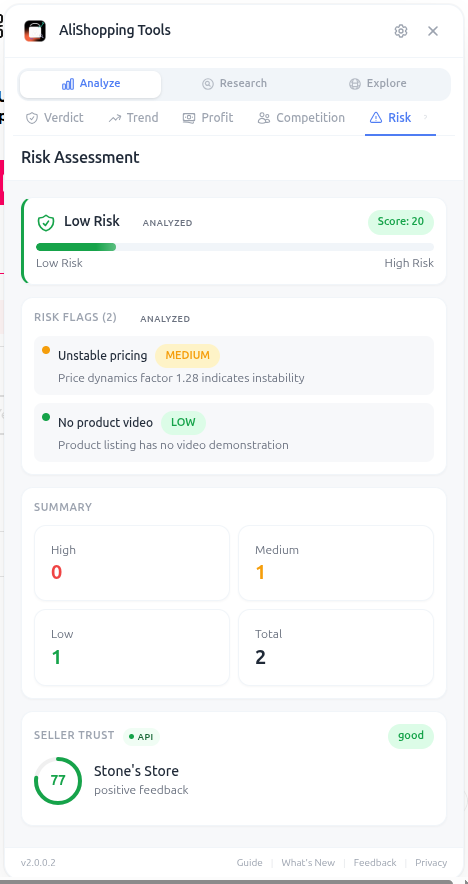
Reviews are the single most important trust signal on AliExpress, which is why they are the most worth manipulating. We have a dedicated AliExpress Review Analysis guide covering seven red flags in depth — this section summarises the core signals.
The rating distribution is too clean
A product with 4,000 reviews at an average of 4.9 stars should have some spread — 60% five-star, 30% four-star, 10% lower. If the distribution is 95% five-star and 5% four-star with almost no three-star or below, the distribution has been curated. Real products annoy someone.
How to detect: Look at the rating distribution bar chart. If four-star through one-star combined is less than 10% of the total, the distribution is too clean to be real.
Review text is generic and near-identical
"Great product, fast shipping, very happy." Fifty reviews with small variations on that sentence. Review farms generate text from templates — the phrasing is correct, the grammar is clean, the specifics are absent.
How to detect: Read 10 to 15 reviews in a row. If they all mention "great product, fast shipping" and none mention a specific feature, colour, use case, or complaint, the reviews are template-generated.
Photo reviews are missing or templated
Real photo reviews show the product in the buyer's home, in non-studio lighting, at weird angles. Review-farm photos are often the same stock photos used across different products, or cropped variants of the listing photos themselves.
How to detect: Filter reviews to "with photos only." Compare the review photos to the listing photos. If the review photos look like cropped versions of the listing photos, the reviews are not real.
Review velocity is unnatural
A product with 4,000 reviews should have acquired them over months or years. If 3,000 of the reviews are dated within the same two-week window, a review farm was used. Real review accumulation is lumpy but trends, not spikes.
How to detect: Sort reviews by newest first and scroll quickly through timestamps. Spikes of hundreds of reviews on the same day or within a narrow window are artificial.
How to automate all three trust checks
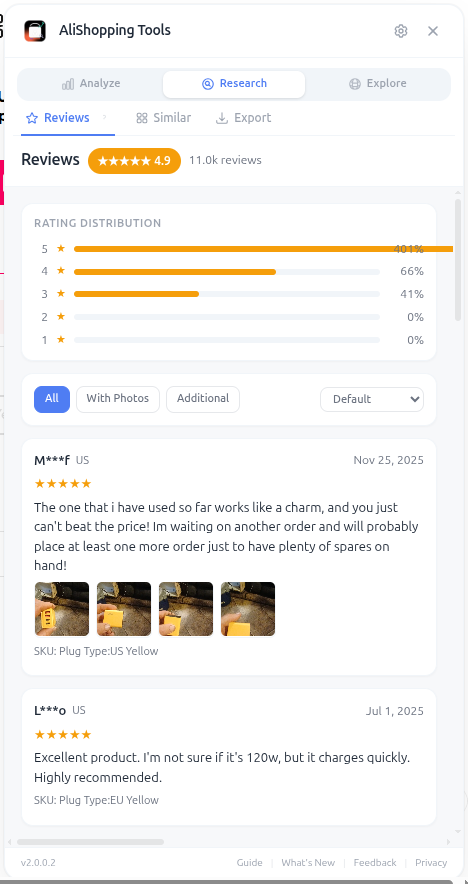
Doing all of the above manually for every product takes 15 to 20 minutes. For one product that is fine. For researching 30 products a week, it is unsustainable. Free tools in 2026 automate most of the pattern detection so you spend the saved time on decisions, not data collection.
AliShopping Tools (free Chrome extension)
When you open an AliExpress product page, AliShopping Tools surfaces the trust signals automatically:
- Supplier risk scoring — a composite score that flags stores with repeated shipping delays, dispute rates above a threshold, or suspiciously new accounts running high-volume products
- Review distribution analysis — the rating histogram and velocity patterns displayed as a single trust score, so unnatural spikes are visible immediately
- Supplier compare — finds the same product across multiple sellers; if photos match across stores, you can see which store originally posted them
- Trend phase classification — identifies whether a product is emerging, growing, at peak, or declining, which correlates with how likely it is to have inflated reviews (peak products attract review farming most aggressively)
- AI verdict — synthesises the risk signals into Strong Buy, Buy, Hold, or Pass
The extension runs locally, requires no account, and is free forever.
Install AliShopping Tools free from the Chrome Web Store — runs the three-check trust audit on every AliExpress page you visit, no signup required.
Reverse image search (Google Images, Yandex, TinEye)
For the photo-borrowing check specifically, browser-based reverse image search is still the best tool. Install a right-click reverse-search extension so one click runs the query against multiple engines. This catches the most egregious photo-theft cases in 10 seconds.
Specifications table reading
No tool replaces the five-minute habit of scrolling past the marketing copy to the specifications table. Every listing has one. The difference between "leather" and "PU leather," between "25cm" and "50cm," between "2000mAh" and "200mAh" is almost always visible there.
When a listing passes all three checks
A listing that clears the description-accuracy test, the photo-authenticity test, and the review-verification test is a candidate — not a guaranteed winner. Trust is necessary but not sufficient. You still need to validate demand, margin, and logistics independently.
What passing all three checks does is reduce sourcing risk: the product you receive will match what the listing claims, your customer reviews will be consistent with your ads, and your dispute rate stays low. Products that fail any of the three trust checks are going to cost you more in disputes and refunds than they save on margin. We tell new dropshippers: it is better to ship 10 honest winners than 50 products that pass listing review but fail real-world delivery.
FAQ
What are the biggest trust problems with AliExpress in 2026?
Three failures show up repeatedly: misleading or inaccurate descriptions (material and size swaps, translation drift, silent spec changes), manipulated or borrowed product photos (brand-website theft, scale manipulation, AI-generated renders), and unverified reviews (template text, clean distributions, spiked velocity). A single listing can fail all three at once, which is why checking each layer separately matters.
How can I tell if an AliExpress description is accurate?
Scroll to the specifications table — the row-by-row field list. Compare the specifications to the title, main description, and photos. When they disagree, trust the specifications table. Pay specific attention to material, exact dimensions in centimetres or inches, battery capacity in mAh, and shipping time promised versus reviewed.
How do I detect manipulated or borrowed AliExpress photos?
Reverse-image-search the main listing photo (Google Images, Yandex, TinEye). If the top result is a brand website for a different product, the photos are borrowed. Also compare listing photos to customer review photos filtered to "with photos only" — if the colour, scale, or quality differs, the listing photos are graded or staged while the review photos show reality.
How do I verify AliExpress reviews are real?
Look at four signals: rating distribution (should have 5-15 percent three-star or lower, not 95 percent five-star), text variety (real reviews mention specific features, colours, and complaints), photo authenticity (real photo reviews show the product in the buyer's environment, not cropped listing images), and velocity pattern (real reviews accumulate over time, not in two-week spikes). We cover all seven red flags in detail in our AliExpress fake review guide.
Can one tool check all three trust signals at once?
AliShopping Tools surfaces description consistency, supplier risk, and review distribution as a combined trust score on every AliExpress product page. It does not replace reverse image search for photo-borrowing detection — that remains a manual step — but it covers the description and review sides automatically. The free Chrome extension runs locally with no account required.
What if a listing passes all three checks but I still have doubts?
Order a sample. For 3 to 10 USD you get the actual product in your hands, and any trust failure the listing hid becomes obvious. For products you plan to scale, sampling is not optional — it is the cheapest insurance against sourcing a unit that does not match expectations. Most successful dropshippers sample every product before committing ad budget.
Does AliExpress do anything about misleading listings?
AliExpress removes egregious listings after buyer disputes and reports, but enforcement is reactive rather than preventive. Listings that have been reported multiple times are usually taken down or demoted; listings that have not yet been reported stay visible. Trust signals are the buyer's responsibility to verify at the listing level — the platform does not do it for you upfront.
Is AliExpress still a viable sourcing platform despite these trust problems?
Yes, for most dropshippers it remains the best sourcing platform by pricing, product variety, and shipping logistics. The trust problems are real but detectable — operators who build trust-verification into their research workflow (using tools, reverse image search, specifications reading, and sampling) have a significant edge over operators who source on surface signals alone. The platform is viable; the default approach to it is not.
Honest recommendation
If you are a beginner: start with the AliShopping Tools Chrome extension and spend 30 seconds per listing checking the trust score, the specifications table, and the rating distribution. For any product you are seriously considering, add a 10-second reverse image search on the main photo and a two-minute scan of the latest 20 reviews. That five-minute trust audit prevents most sourcing mistakes.
If you are scaling and testing 20 or more products a week: automate with AliShopping Tools' supplier compare and AI verdict, then batch reverse-image-search the five or six candidates that pass the automated checks. Sample every product that clears the audit before you put ad spend behind it. Sampling is the cheapest insurance in dropshipping and the one step experienced operators skip last.
If you are an agency running sourcing for multiple stores: build trust verification into your standard operating procedure. Every candidate product goes through the same three-check process before it enters the catalogue. The operational cost of enforcing this is small; the cost of not enforcing it shows up as dispute rates and refund requests three months later.
The wrong move for everyone is trusting AliExpress listings on surface signals alone. The platform is useful — the default approach to it is not.
Try it free: Install AliShopping Tools on the Chrome Web Store.
Disclosure: This article is published by the AliShopping Tools team. Detection patterns and red flags are based on our review of AliExpress listings as of April 2026. Tactics evolve — we update this article as new trust-failure patterns emerge. If you notice a pattern we should cover, email us via the contact page.
Ready to find winning products?
Try AliShopping Tools — 15 free AI tools for product research.
Quick answers
Frequently Asked Questions
What are the biggest trust problems with AliExpress in 2026?
Three failures show up repeatedly: misleading or inaccurate descriptions (material and size swaps, translation drift, silent spec changes), manipulated or borrowed product photos (brand-website theft, scale manipulation, AI-generated renders), and unverified reviews (template text, clean distributions, spiked velocity).
A single listing can fail all three at once, which is why checking each layer separately matters.
How can I tell if an AliExpress description is accurate?
Scroll to the specifications table — the row-by-row field list.
Compare the specifications to the title, main description, and photos.
When they disagree, trust the specifications table.
Pay specific attention to material, exact dimensions in centimetres or inches, battery capacity in mAh, and shipping time promised versus reviewed.
How do I detect manipulated or borrowed AliExpress photos?
Reverse-image-search the main listing photo with Google Images, Yandex, or TinEye.
If the top result is a brand website for a different product, the photos are borrowed.
Also compare listing photos to customer review photos filtered to 'with photos only' — if the colour, scale, or quality differs, the listing photos are graded or staged while the review photos show reality.
How do I verify AliExpress reviews are real?
Look at four signals: rating distribution (should have 5 to 15 percent three-star or lower, not 95 percent five-star), text variety (real reviews mention specific features, colours, and complaints), photo authenticity (real photo reviews show the product in the buyer's environment, not cropped listing images), and velocity pattern (real reviews accumulate over time, not in two-week spikes).
Can one tool check all three trust signals at once?
AliShopping Tools surfaces description consistency, supplier risk, and review distribution as a combined trust score on every AliExpress product page.
It does not replace reverse image search for photo-borrowing detection — that remains a manual step — but it covers the description and review sides automatically.
The free Chrome extension runs locally with no account required.
What if a listing passes all three checks but I still have doubts?
Order a sample.
For 3 to 10 USD you get the actual product in your hands, and any trust failure the listing hid becomes obvious.
For products you plan to scale, sampling is not optional — it is the cheapest insurance against sourcing a unit that does not match expectations.
Most successful dropshippers sample every product before committing ad budget.
Does AliExpress do anything about misleading listings?
AliExpress removes egregious listings after buyer disputes and reports, but enforcement is reactive rather than preventive.
Listings that have been reported multiple times are usually taken down or demoted; listings that have not yet been reported stay visible.
Trust signals are the buyer's responsibility to verify at the listing level — the platform does not do it for you upfront.
Is AliExpress still a viable sourcing platform despite these trust problems?
Yes, for most dropshippers it remains the best sourcing platform by pricing, product variety, and shipping logistics.
The trust problems are real but detectable — operators who build trust-verification into their research workflow (using tools, reverse image search, specifications reading, and sampling) have a significant edge over operators who source on surface signals alone.
More from the blog
AliExpress Product Research: 2026 Guide (Tools + Checklist)
AliExpress product research in 2026: free tool + 5-step checklist for trends, margin, supplier risk. Run scoring directly on AliExpress pages.
13 min read
How to Read a Risk Assessment on Any AliExpress Product (2026 Guide)
Master AliExpress supplier risk assessment: decode 6 risk dimensions, interpret red flags, and know exactly when to order a sample before you scale.
19 min read
How to Validate a Dropshipping Product Before Spending on Ads (Free Framework)
Stop burning $200–500 on untested products. This 6-step free validation framework tells you if a dropshipping product will sell before you spend a dollar on ads.
17 min read