












How to Validate a Dropshipping Product Before Spending on Ads (Free Framework)
How to Validate a Dropshipping Product Before Spending on Ads (Free Framework)
Quick answer: Validate any dropshipping product before ad spend using six free steps: check AliExpress order velocity and Winning Score, audit Google Trends, scan TikTok FYP for organic demand signals, review Meta Ad Library for competitive saturation, vet the supplier quality, and confirm the margin works — this takes under 10 minutes and eliminates most products that would waste $200–500 in failed ad tests.
The average failed dropshipping product test costs $200–500 in ad spend before the seller admits it isn't working. Multiply that by the three, five, or ten products most new dropshippers test before finding a winner, and you're looking at $1,000–5,000 flushed before the business even gets off the ground.
That is not a money problem. It is a validation problem.
The products were never validated. They were vibed. Someone saw a TikTok, liked the look of the product, opened a Shopify store, set up a Facebook ad, and hoped. Hope is not a strategy — and in dropshipping, hope is expensive.
This guide gives you a systematic, free, six-step framework to validate any AliExpress product before you spend your first dollar on ads. If a product passes all six steps, you have real evidence it can sell. If it fails any of the hard red flags, you walk away in under 10 minutes and save yourself weeks of wasted effort.

Why Most Dropshippers Validate Products Wrong (and What It Costs Them)
Most product "research" looks like this: scroll TikTok, see a cool product with 500k views, check AliExpress, see the price looks low enough, and list it in the store. Done.
That is not validation. That is wishful thinking dressed up as research.
The problem is that viral TikTok views do not equal dropshipping demand. A product can trend on social media and still be impossible to sell profitably because:
- The market is already saturated with 400 sellers offering it on AliExpress
- The actual cost with shipping destroys any viable margin
- The supplier quality is so poor that refund rates will eat all profit
- The trend already peaked three months ago
Real validation answers four questions before you commit a single dollar:
- Is there genuine, current demand for this product?
- Is the competition at a level you can compete with?
- Can you actually make money on it, after all costs?
- Is the supplier capable of fulfilling orders at scale?
The six steps below answer all four. Together they form what we call the 4-Point Validation Score: Demand Signal + Competition Level + Margin Viability + Supplier Quality. Every step feeds one of these four pillars.
The 4-Point Validation Framework (Overview)
Before diving into each step, here is the full picture at a glance:
| Pillar | Steps That Feed It | What You're Measuring |
|---|---|---|
| Demand Signal | Step 1, Step 5 | Real buyers exist right now |
| Competition Level | Step 2, Step 5 | Can you carve out space? |
| Margin Viability | Step 3 | Will you actually profit after all costs? |
| Supplier Quality | Step 4, Step 6 | Can you fulfill reliably? |
Each pillar can be a green light, a yellow flag, or a hard disqualifier. If any pillar produces a hard disqualifier, you stop. No exceptions. The goal is to spend 10 minutes eliminating bad products — not to talk yourself into them.
Step 1: Demand Signal — AliExpress Dropshipping Center + Google Trends
Your first job is to confirm that real people are actively buying this type of product right now. Not six months ago. Now.
AliExpress Dropshipping Center
Go to dropshipping.aliexpress.com (free, no account required). In the "Product Analysis" tab, paste the product URL or AliExpress product ID. The Dropshipping Center will show you:
- Order volume: Total orders in the last 30 and 90 days
- Order trend: Is volume climbing, flat, or dropping?
- Supplier reliability score: Specific to dropshipping use cases
What you want: order volume above 500 in the last 30 days with a climbing or stable trend line. Avoid products where the 90-day chart shows a clear spike that has now crashed — that is a product that was viral and is now dead.
Google Trends
Go to trends.google.com and search the product category (not the specific product name — use the general term). Set the time range to 12 months and your target market's geography.
What you want: a trend line that is rising, stable at a high point, or seasonal in a predictable cycle that is about to peak. A 12-month trend that is flat or declining is a warning sign. A trend that shows a massive spike followed by a crash is a saturated trend you have likely missed.
Red flag: Google Trends shows below 20/100 for the past 6 months. This indicates low search intent — people are not actively looking for this type of product.
Green flag: Google Trends score is above 60/100 and rising over the past 3 months, combined with AliExpress Dropshipping Center showing climbing order volume.
Step 2: Competition Check — How Many Sellers, Price Range, Who's Advertising
Demand without competition context is useless. A product everyone wants but 2,000 sellers are already flooding with cheap listings is nearly impossible to break into profitably.
On AliExpress:
Search the product name (not just browse the one listing you found). Filter by "Most Orders" and count how many individual sellers have:
- More than 1,000 orders
- A Good or Excellent rating
- Been selling for more than 1 year
If there are fewer than 20 established sellers, the market is fragmented and you have room. If there are 100+ established sellers all selling the same product at similar prices, saturation is extreme.
Also check the price range. If the lowest price is already at $4.99 and a dozen sellers are fighting to be the cheapest, the race to the bottom is already happening. You cannot win that fight on price.
On Google Shopping:
Search the product name and look at who is advertising. Are there branded stores? Generic dropship stores? Established retailers? If you see major retailers or highly-branded stores dominating, the acquisition cost to compete will be punishing.
Red flag: More than 80 AliExpress sellers with 1,000+ orders each, combined with a price race already in progress at the low end. This is a fully saturated product — entry margins are gone.
Green flag: Fewer than 30 established sellers, price range is spread (not compressed at the bottom), and no single dominant brand has locked up search intent.

Step 3: Margin Math — Run the Full Cost Model Before Anything Else
This is where most beginners skip the hard part. They see a product at $8 on AliExpress and a $29.99 price point on competitor stores and think "that's a $22 margin." It is not. Run the real math:
Full cost model:
| Cost Item | Example | Your Number |
|---|---|---|
| Product cost (AliExpress) | $8.00 | $_____ |
| Shipping to customer | $4.50 | $_____ |
| Payment processing (3%) | $0.90 | $_____ |
| Platform fee (Shopify, etc.) | $0.50 | $_____ |
| Return/refund buffer (5%) | $1.50 | $_____ |
| Total COGS | $15.40 | $_____ |
| Sell price | $29.99 | $_____ |
| Gross margin before ads | $14.59 (48.6%) | $_____ |
Now subtract your expected ad CPA. If Facebook or TikTok ads in your niche typically cost $15–25 per conversion (a conservative estimate for 2026), and your gross margin before ads is only $14.59, you have zero room for paid traffic. The entire margin disappears in customer acquisition.
The margin viability rule: Your gross margin before ads must be at least 2x your expected ad CPA to leave room for profit. If you expect a $20 CPA, you need a $40+ gross margin. That means selling at a price where you pocket $40+ after COGS, before ad spend.
See real delivery time to your country.
Per-seller shipping estimates and trust signals on every AliExpress product page. No account, free.
How to hit that margin: Focus on products with a perceived value well above the AliExpress price. Problem-solving gadgets, specialty accessories, and items with strong "before and after" marketing angles can support 3x–5x markups. Generic commodities cannot.
Red flag: Gross margin before ads is below 40%. At anything under 40%, profitable paid traffic is nearly impossible for a new store without an established audience.
Green flag: Gross margin before ads is 50%+, the product has a clear value angle that justifies the sell price, and similar products in the market are selling at your target price point without heavy discounting.
Step 4: Supplier Vetting — Orders, Rating, Response Time, Dispute Rate
Demand, competition, and margins can all look perfect — but if your supplier is unreliable, returns and disputes will destroy your profitability and your store's reputation.
What to check on every supplier:
- Total store orders: Prefer suppliers with at least 5,000 lifetime orders. Lower volumes mean less proven track record.
- Feedback rate: Should be above 95%. Anything below 93% is a significant warning sign.
- Store age: Prefer suppliers operating for 2+ years. Young stores have not been stress-tested.
- Response time: Message the supplier and ask a specific question about shipping time to your target country. Response within 24 hours is required. No response in 48 hours is an automatic disqualifier — if they cannot respond to a pre-sale inquiry, they will not handle post-sale problems either.
- Dispute rate: Check the "Seller's Detail Rating" section. A high dispute rate indicates systemic product quality or fulfillment problems.
Multiple supplier check: Search for the same product from at least 3 different suppliers. Compare pricing, ratings, and order counts. Having multiple viable suppliers protects you if your primary supplier goes out of stock or raises prices.
Red flag: Only one supplier on AliExpress carries this product, they have fewer than 1,000 orders, and their feedback rate is below 95%. Single-source dependency plus unproven fulfillment is a recipe for operational disaster.
Green flag: At least 3 suppliers carry the product with 95%+ ratings, 2+ years in operation, and a response to your inquiry within 12 hours.
Step 5: Social Proof Check — TikTok FYP + Meta Ad Library
At this point you know demand exists, competition is manageable, margins are viable, and you have a quality supplier. Now you need to answer a different question: is anyone already successfully selling this to customers with paid ads?
This sounds counter-intuitive. Isn't existing advertising a sign of competition? Yes — and it is also the strongest possible signal that the product converts. No one runs paid ads for months at a loss.
TikTok FYP:
Open TikTok (not logged in, or on a fresh account with no algorithm history) and search for the product name. Look for:
- Videos with 100k–2M+ views showing the product being used
- Multiple different creators posting (not just one viral video)
- Comments that show genuine purchase intent ("Where can I buy this?", "Just ordered!", "OMG I need this")
If you find 5+ independent creators posting about the same product with strong engagement, that is a green signal. If the only videos are from one account and it looks like an obvious brand account, the organic evidence is thin.
Meta Ad Library:
Go to facebook.com/ads/library, select "All Ads," and search for the product name or category. Filter by your target country.
Look for:
- Ads that have been running for more than 30 days (longevity = profitability)
- Multiple different advertisers running similar creatives
- Ad copy that speaks to a specific problem the product solves
Ads running for 60+ days are strong evidence the product is profitable for those sellers. Ads launched in the last 7 days could be anyone testing anything.
Red flag: Zero ads in Meta Ad Library for any similar product after searching 5+ variations of the product name. No ads means no one has found a profitable angle — which either means you've found an untapped opportunity (rare) or the product simply does not convert with paid traffic (common).
Green flag: 5–20 ads from different advertisers, several running for 45+ days, with varied creative angles — showing the market is active but not owned by a single dominant player.
Step 6: Winning Score Confirmation — Using AliShopping Tools for a Data-Driven Verdict
After completing all five manual steps, you have a strong qualitative picture. But you still have one blind spot: you are comparing data points in isolation, not as a weighted system. A product might have a decent order count but terrible trend momentum. It might have a great supplier but a saturated market. How do you weigh those factors together?
This is where a data-driven composite score becomes invaluable.
AliShopping Tools calculates a Winning Score (0–100) for every AliExpress product from seven weighted signals on the listing itself: demand potential (21%), price attractiveness (17%), product rating (17%), social proof (17%), visual appeal (17%) and shipping quality (11%).
Open the product on AliExpress with the extension installed. You get:
- Winning Score: the composite 0–100 rating and its band
- Factor breakdown: each of the seven factors with its own score and label — Strong (75+), Moderate (50+), Weak (25+), Very Weak below that
- Risk flags: a separate assessment that surfaces red flags the manual process might miss (counterfeit signals, price inconsistencies, shipping anomalies)
Note what this step does not do. The Winning Score reads the listing's public data only — it does not calculate your margin, count competing sellers, or estimate ad costs. Steps 1–5 above are where those get checked. This step is a consistency check on the listing itself, which is exactly why it comes last.
How to use the score in your validation:
Use it as a sixth opinion, not the only opinion. A product that passed your five manual steps and then lands in the Low Potential band is worth a second look — the listing may be newer or thinner than your manual pass suggested. Open the factor breakdown and find which factor is dragging before you commit ad spend.
The three bands:
| Winning Score | What it says about the listing |
|---|---|
| 75–100 (High Potential) | Strong across most of the seven weighted signals |
| 50–74 (Medium Potential) | Mixed — read the factor breakdown, the headline number tells you little here |
| 0–49 (Low Potential) | Weak on the majority of signals, often because the listing is new or thin |
There is no cutoff in the product beyond these three bands, and we are not going to invent one. Where you draw your own line depends on how much manual validation you are willing to do on a Medium Potential listing.
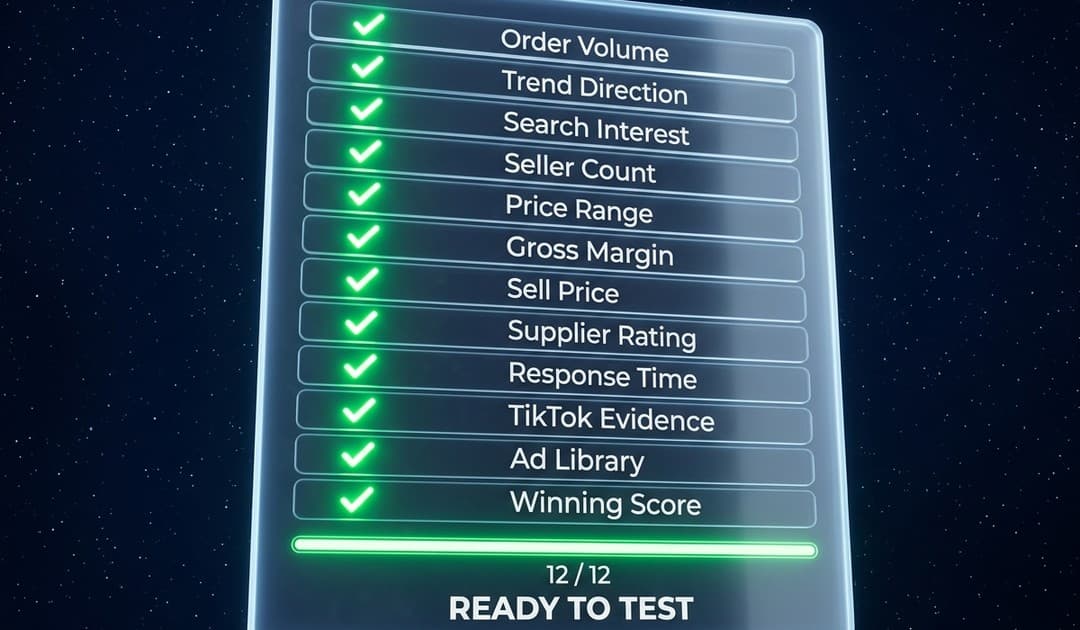
The 10-Minute Validation Checklist
Use this as your rapid-fire checklist every time you evaluate a product. If you cannot check a box, note why — do not skip it.
| # | Validation Check | Tool | Pass Threshold | Red Flag |
|---|---|---|---|---|
| 1 | 30-day order volume | AliExpress Dropshipping Center | 500+ orders | Below 200 |
| 2 | Order trend direction | AliExpress Dropshipping Center | Climbing or stable | Declining curve |
| 3 | Google Trends score | Google Trends | 60+ / 100 in target market | Below 20 for 6 months |
| 4 | Established seller count | AliExpress search | Under 30 with 1k+ orders | Over 80 sellers |
| 5 | Price compression | AliExpress search | Spread price range | Race to bottom |
| 6 | Gross margin before ads | Manual calculation | 50%+ | Below 40% |
| 7 | Viable sell price exists | Competitor stores | Price seen in market | Only heavily discounted |
| 8 | Supplier rating | AliExpress supplier page | 95%+ feedback | Below 93% |
| 9 | Supplier response time | Direct message | Reply within 24 hours | No reply in 48 hours |
| 10 | TikTok organic evidence | TikTok search | 5+ independent creators | Zero organic content |
| 11 | Meta Ad Library evidence | Facebook Ad Library | 5+ ads, 30+ day longevity | Zero ads found |
| 12 | Winning Score | AliShopping Tools | High or Medium Potential (50+) | Low Potential (below 50) |
Scoring guide: 12/12 green = strong test candidate. 10–11/12 = test with controlled budget. 8–9/12 = borderline, dig deeper. Below 8 = pass and move on.
Automatic Red Flags (Stop Immediately)
Regardless of how good other signals look, these are hard disqualifiers. If any one of these is present, stop and move to the next product. No exceptions.
- Counterfeit risk: Product name, packaging, or listing imagery references a recognizable brand name without authorization. Selling counterfeit goods will result in store shutdowns, payment processor bans, and potential legal liability.
- Dangerous product category: Anything with electrical safety implications (uncertified chargers, battery-operated devices without CE/FCC marks), anything ingestible without proper labeling, anything touching child safety. The liability and return rate will bankrupt you.
- Monopoly supplier: Only one supplier exists for the product globally. If that supplier raises prices, goes out of stock, or disappears, your business stops overnight.
- Negative review patterns: Recent reviews in the past 30 days specifically mention "not as described," "completely different from photo," or "arrived broken." This signals a quality issue that will become your customer service nightmare.
- Shipping time above 30 days to your target market: Modern customers will dispute before the package arrives. Shipping time is a non-negotiable.
Frequently Asked Questions
How long should the full validation process take?
With practice, all six steps take 10–15 minutes per product. The first time, allow 30 minutes while you familiarise yourself with each tool. The goal is not speed — it is thoroughness. A product you validate in 5 minutes but miss a red flag on will cost you far more than an extra 10 minutes of research.
What if a product passes all 6 steps but still fails in testing?
It happens. Validation reduces risk, it does not eliminate it. Some products have real demand but do not respond well to your specific creative angle, your target audience, or your pricing. Always start with a small test budget ($50–100) to gather data before scaling. Validation tells you a product is worth testing — your ad test tells you whether your execution works.
Can I use this framework for products outside AliExpress?
The supplier vetting step is AliExpress-specific, but steps 1, 2, 3, 5, and 6 work for any product source. If you are sourcing from a local supplier or a different marketplace, adapt the supplier vetting criteria accordingly — the core questions (reliability, capacity, quality) are universal.
What if there are zero ads in Meta Ad Library?
Zero ads is not automatically a killer. Some product categories (especially more private or health-adjacent products) advertise heavily on TikTok or Google rather than Meta. Check both platforms. If there is literally zero paid advertising evidence anywhere — not on TikTok, not on Meta, not on Google Shopping — that is a significant warning sign that the product has not converted for paid traffic.
How often should I re-validate a product?
Re-run at minimum the demand signal and competition checks every 30 days for any product you are actively selling. Markets shift fast in dropshipping. A product that was perfect in January can be saturated by March. Treat validation as an ongoing process, not a one-time gate.
AliShopping Tools
See real delivery time to your country.
Per-seller shipping estimates and trust signals on every AliExpress product page. No account, free.
Product Tracker Free Beta
Track any AliExpress product’s real price, orders, stock & rating for 180 days. Data doesn’t lie. But discounts can.
Before you buy
Is this deal real? Check the price history before you buy.
Prices often spike just before a “sale.” See 180-day price history and fake discount detection — free, no account needed.
Verify on AliShopping Deals →Ready to find winning products?
Try AliShopping Tools — 15 free AI tools for product research.
Quick answers
Frequently Asked Questions
1How do I validate a dropshipping product before spending on ads?
Run a 6-step free validation: check AliExpress Dropshipping Center for order data, verify search trend on Google Trends, check TikTok FYP for organic creator activity, review Meta Ad Library for active competitor ads, vet the supplier using AliShopping Tools risk score, and read the Winning Score as a final consistency check on the listing.
All six steps take under 10 minutes and replace $200 to $500 in untested ad spend.
2What Winning Score bands does the extension actually use?
There are three: 75 and above is labelled High Potential, 50-74 Medium Potential, and below 50 Low Potential.
Those are the only bands the extension defines — it does not publish a "minimum score worth testing", and we are not going to invent one.
Treat Low Potential as a reason to read the factor breakdown before spending anything, and remember the Winning Score reads the listing only: your margin, your competition and your ad costs are checked in steps 1 to 5, not here.
3Why do most dropshippers waste money on bad products?
Most dropshipping failures trace to selecting products based on intuition or copied lists rather than validating actual demand signals.
Running a 10-minute free validation framework before spending on ads filters out products with no real demand, poor supplier quality, or margins that cannot support ad acquisition costs.
The validation cost is 10 minutes; the alternative is $200 to $500 in wasted ad spend.
4What organic signals validate a dropshipping product before paid ads?
Organic validation signals include: TikTok videos for the product with strong engagement and no brand domination, Reddit threads in relevant communities with buyers asking where to find the product, Pinterest saves and boards featuring the product, and Etsy listings with reviews for similar items.
These signals confirm buyer intent independent of ad performance.
5How long does it take to complete the 6-step dropshipping validation framework?
You can complete the entire 6-step validation framework in under 10 minutes if you stay focused.
This rapid analysis involves checking Google Trends for search volume, scrolling the TikTok FYP for engagement, and analyzing the Meta Ad Library for competitor activity.
By integrating data from the AliExpress Dropshipping Center, you can assess supplier reliability simultaneously.
This speed allows you to evaluate multiple products daily without wasting time on extensive research, ensuring you only move forward with items that show immediate promise.
6Which free tools are essential for validating a dropshipping product idea?
The best free tools for identifying winning products include Google Trends for search data, TikTok for viral potential, and the Meta Ad Library for competitor insights.
These platforms provide the necessary data points to calculate a data-driven Winning Score without spending a dime.
Additionally, utilizing the AliExpress Dropshipping Center helps verify supplier reliability and shipping times.
Combining these resources creates a robust validation ecosystem that filters out low-potential items before you risk your budget on paid advertisements.
7How can I use the Meta Ad Library to check if a product is saturated?
You can use the Meta Ad Library to determine if a product is currently converting by checking for active ads running in the last 30 days.
Search for the product keyword to see how many different brands are advertising it and analyze their creative angles.
If you see multiple advertisers with active campaigns, it indicates market demand.
Cross-referencing these findings with AliExpress supplier data ensures the product is readily available.
This step confirms that others are making money, reducing your risk before you launch.
8What specific metrics should I check when vetting a supplier?
To properly vet a supplier, you should verify they have a feedback score of at least 4.8 stars and have fulfilled over 100 orders in the recent past.
High order volume indicates they can handle scaling, while good feedback minimizes refund risks.
You can easily find these metrics on AliExpress by reviewing the supplier’s performance history and customer comments.
Ensuring your partner is reliable is a critical step in the framework, preventing shipping delays that could ruin your ad campaign's profitability.
9How is the Winning Score calculated in this validation framework?
The Winning Score is computed by AliShopping Tools from seven weighted signals read off the AliExpress listing itself: demand potential (21%), price attractiveness (17%), product rating (17%), social proof (17%), visual appeal (17%) and shipping quality (11%).
Google Trends, TikTok engagement and the Meta Ad Library are not inputs to it — those are separate steps you run yourself, and they cover exactly what the score leaves out: your margin, your competition and your ad costs.
Read the factor breakdown rather than the headline number, since two listings can reach the same total for opposite reasons.
Related Articles
- The 20-Point Dropshipping Product Checklist Before You Order (2026)dropshipping
- The Complete Dropshipping Product Research Guide (2026)dropshipping
- How to Validate a Dropshipping Product Before You Sell It (2026 Guide)guides
- How to Calculate Dropshipping Profit Margin (Free Calculator + Formula)dropshipping
- How to Read a Risk Assessment on Any AliExpress Product (2026 Guide)guides
- How to Find Winning Dropshipping Products in 2026 (Step-by-Step Guide)guides
Related Tools
More from the blog
The 20-Point Dropshipping Product Checklist Before You Order (2026)
The definitive pre-order checklist for dropshippers: 20 checks across demand, margin, supplier quality, product risk, and competition. 16+ = green light.
The Complete Dropshipping Product Research Guide (2026)
Master product research with this step-by-step guide. Learn to find, validate, and launch winning dropshipping products using data-driven methods.
AI Product Scoring for Dropshipping: How It Actually Works in 2026
AI product scoring replaces gut-feel product research with data-driven composite metrics. Learn how tools like Winning Score and Verdict work, what data feeds them, where they fall short, and how to use scores without over-trusting them.