The 20-Point Dropshipping Product Checklist Before You Order (2026)
The 20-Point Dropshipping Product Checklist Before You Order (2026)
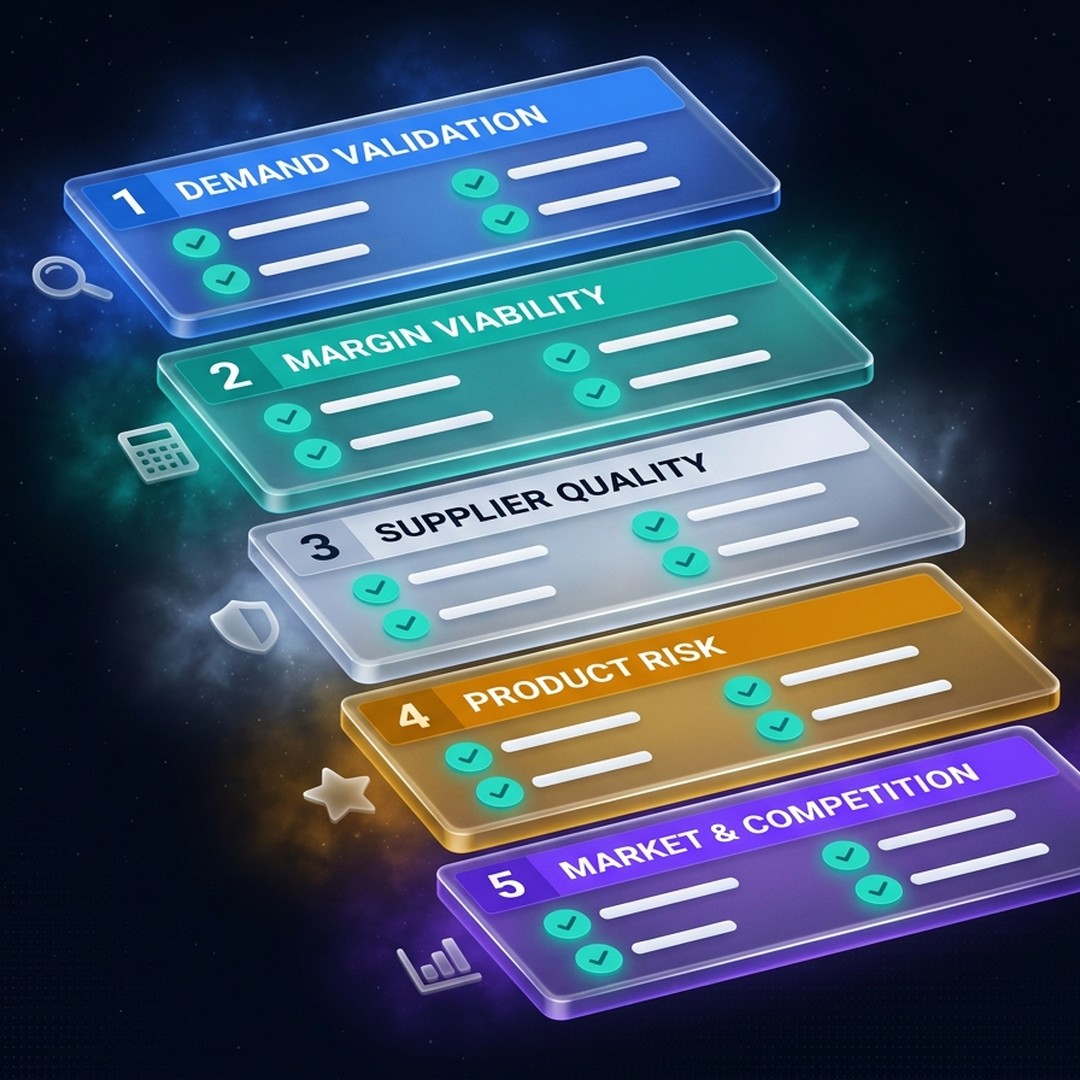
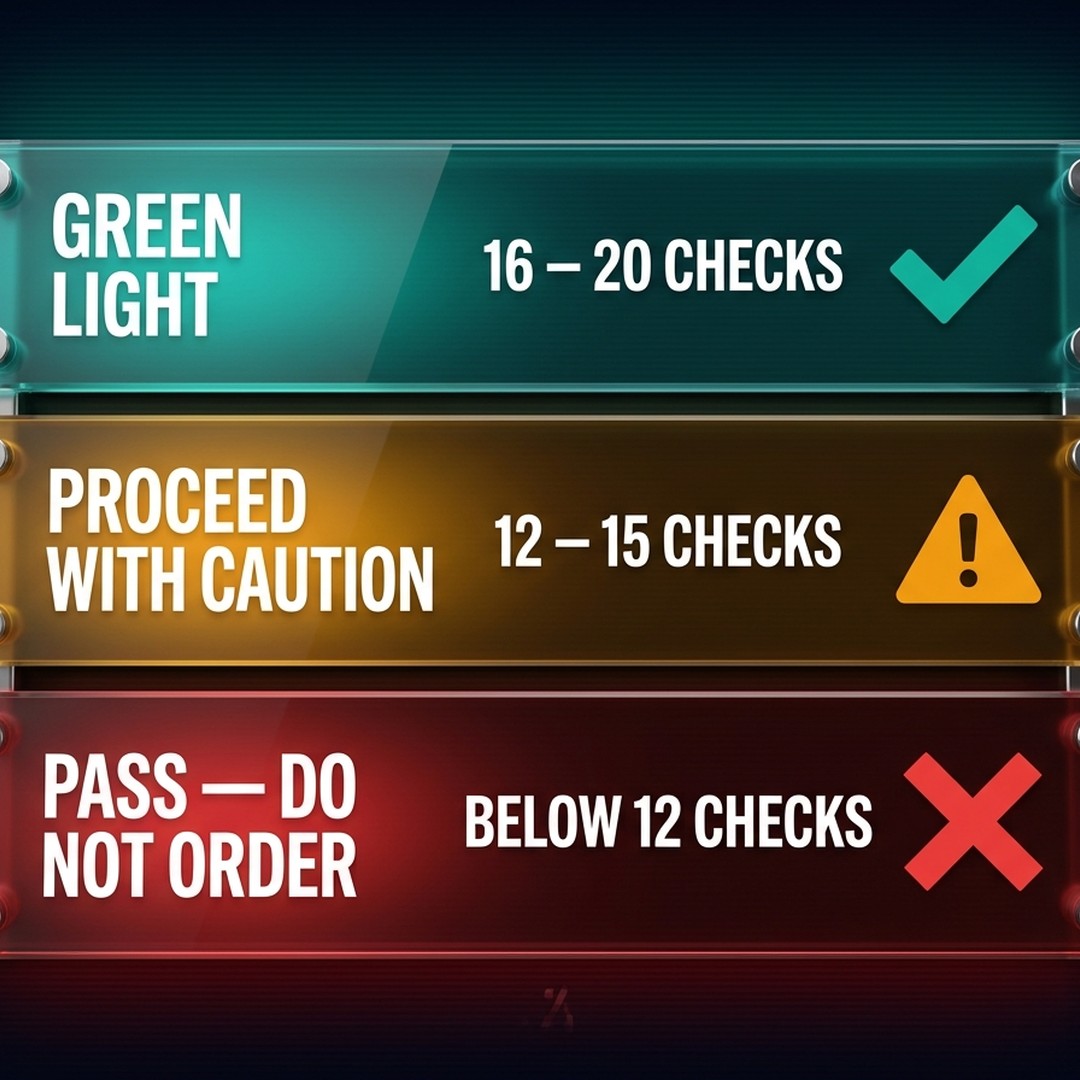
Quick answer: Before placing any dropshipping order, run 20 checks across 5 categories: demand validation, margin viability, supplier quality, product risk, and market competition. Score 16 or more for a green light; 12–15 requires a specific mitigation plan; below 12 means pass — no exceptions. This 20–30 minute checklist replaces months of painful post-launch learning.
The single most expensive mistake in dropshipping is not picking the wrong product. It is placing an order before you have verified it is the right one.
Wrong products get returns. Wrong suppliers generate disputes. Wrong markets run ads into negative ROI. Wrong timing means you enter a saturated niche at the exact moment the organic traffic is moving to the next thing. None of these mistakes are unpredictable — they are all checkable before you spend a dollar on inventory or ads.
This checklist is the third and final article in the Product Scoring Masterclass series. Part 1 covered what a Winning Score actually means and what constitutes a green-light threshold. Part 2 broke down the Risk Assessment and its six dimensions. This guide gives you the operational document that combines both into a 20-point pre-order verification system.
You should read this article the first time to understand why each check exists. After that, it becomes a reference. Copy the checklist, paste it into your product research spreadsheet, and run it on every product before a single supplier order goes out.
Why a Checklist Beats Intuition Every Time
Experienced dropshippers develop intuition. They can look at a product and have a sense of whether it will work. That intuition is valuable — but it is also the most common source of expensive mistakes.
The cognitive biases that affect product selection are well-documented:
Confirmation bias: Once you decide a product looks good, you start noticing signals that confirm your belief and dismissing signals that contradict it. You see the 10 positive reviews and skip over the 3 reviews mentioning wrong-item delivery.
Availability heuristic: Products that are visually striking or that you have seen recently feel more promising than they statistically are. A product that appeared in three TikToks you watched this week feels like it is "blowing up" even when order velocity data shows flat growth.
Sunk cost fallacy: After spending 2 hours researching a product, you are psychologically invested. You are more likely to proceed even when the data does not support it because stopping feels like wasting the 2 hours.
A checklist is a cognitive override. It forces you to evaluate each dimension independently and score it against a fixed standard — not against your current emotional state about the product. The checklist does not care that you love the product. It only cares whether the product passes the criteria.
The commercial case: Across a portfolio of 50 product tests, sellers who use structured pre-order evaluation consistently report 30–40% fewer failed tests than those who rely on intuition alone. Not because the checklist finds magic products — but because it filters out the obvious failures before they cost anything.
Category 1: Demand Validation
Demand validation answers one question: are real buyers actively looking for and purchasing this product right now?
Check 1: Order Velocity ≥ 50 Units per Month
Why it matters: Order velocity is the most direct signal of current demand. Total order count is misleading — 10,000 total orders means nothing if they happened over 3 years and current monthly velocity is 40. You want 50+ units per month at a minimum to confirm that demand is ongoing, not historical.
How to verify: Look at order velocity data on the product page. A product with 50+ monthly orders has enough throughput to suggest real ongoing demand. Products with 100–500 monthly orders are in strong demand territory. Above 500 orders per month means the product is established — evaluate saturation risk carefully before entering.
Pass threshold: ≥ 50 units/month, or a clear upward trend over the last 60 days even if not yet at 50.
Check 2: Google Trends — Not Declining Over 90-Day Window
Why it matters: AliExpress order data reflects past demand. Google Trends reflects current consumer interest — what people are actively searching for right now. A product with strong AliExpress order history but a declining Google Trends line is on the way out. You will enter just as organic demand contracts.
How to verify: Search the product's primary use case or name on Google Trends. Set the date range to 90 days. Evaluate the trendline direction. Flat is acceptable. Upward is ideal. Declining is a fail.
Pass threshold: Flat or upward trend over the 90-day window. A seasonal product is acceptable if the current date is before or during the peak season window.
Check 3: At Least 2 Platforms Showing Organic Demand
Why it matters: Single-platform demand is fragile. A product that is popular only on AliExpress might be oversupplied and underpromoted elsewhere — meaning you will need to generate all demand through paid ads with no organic amplification. A product with demand visible on TikTok and AliExpress, or AliExpress and Amazon, has cross-platform signal that indicates genuine consumer interest.
How to verify: Check TikTok search for the product category. Check Amazon Best Sellers in the relevant category. Check Pinterest trends if the product is visual. Any two platforms showing organic content creation or significant search volume is a pass.
Pass threshold: Evidence of organic demand on at least 2 platforms (AliExpress + one other).
Check 4: Winning Score ≥ 65/100
Why it matters: The Winning Score aggregates demand trend, order velocity, competition level, margin potential, and market timing into a single composite signal. It is the synthesis of most of the individual demand signals — seeing it in context of the other checks provides cross-validation.
How to verify: Open the product in AliShopping Tools and read the Winning Score from the overview panel.
Pass threshold: ≥ 65/100. Products scoring 75+ are strong candidates. Products scoring 50–64 require compensating factors (e.g., unusually strong margin or unique differentiation angle).
Category 2: Margin Viability
Margin validation answers one question: if this product sells at your intended price, does the economics work?
Check 5: Gross Margin ≥ 40% at Intended Retail Price
Why it matters: Gross margin is revenue minus the cost of goods sold (product cost + shipping to customer). At below 40% gross margin, the business arithmetic becomes very difficult. You have no buffer for returns, discounts, or unexpected cost increases. At 40%+, you have a margin structure that can absorb operational costs while leaving room for profit.
How to calculate: (Retail price - product cost - shipping cost) ÷ Retail price × 100. Example: retail price $29.99, product cost $8.50, shipping $4.00 = gross margin ($29.99 - $8.50 - $4.00) ÷ $29.99 = 58%. Comfortable.
Pass threshold: ≥ 40% gross margin. 50%+ is preferred for any product with meaningful competition.
Check 6: Net Margin ≥ 20% After Estimated Ad Spend
Why it matters: Gross margin does not pay the bills. Net margin, which deducts your estimated customer acquisition cost, is the actual profitability signal. A 55% gross margin product with a $15 CPA and a $20 retail price has a net margin of ($20 × 0.55 - $15) ÷ $20 = 2.5%. That is not a business.
How to calculate: Use a 2.5–3x ROAS assumption for cold traffic if you do not have historical data. If product cost + shipping = $12.50 and your retail price is $29.99, your gross margin is ~$17.50. At 2.5x ROAS, your ad spend per dollar of revenue is $0.40, meaning you spend $12.00 in ads per $29.99 sale. Net = $17.50 - $12.00 = $5.50, or ~18%. Borderline — check for organic channel opportunities to reduce reliance on paid.
Pass threshold: ≥ 20% net margin at 2.5–3x ROAS. Products with net margin below this require either organic traffic channels or a confirmed higher ROAS based on ad testing.
Check 7: Retail Price is 3–5x the Cost Price
Why it matters: The 3–5x rule is a proxy for whether your pricing can support paid acquisition. If retail is 3x cost, you have enough margin to run ads at the upper range of realistic e-commerce ROAS. If retail is below 3x cost (e.g., a $10 product you are selling for $19.99), you are in a margin-compressed market where even slight ROAS variation makes the unit economics negative.
How to verify: Cost price = product + shipping from supplier. Retail price = your intended sale price. Divide retail by cost.
Pass threshold: Retail price ÷ cost price is between 3.0 and 5.0. Above 5x is fine but check that the retail price is still realistic for the category.
Check 8: No Tariff Exposure for Your Target Market
Why it matters: US sellers targeting US buyers face import tariff exposure on goods shipped directly from China. The tariff landscape in 2025–2026 has created cost structures that make some previously profitable products non-viable for China-direct fulfillment. If your product has a significant tariff rate and no US warehouse alternative, your true landed cost is higher than the AliExpress listing price implies.
How to verify: Search the product's HTS code on the USITC tariff database. For most consumer goods from China, additional Section 301 tariffs range from 7.5% to 25%. Check whether the supplier offers US warehouse fulfillment as a realistic alternative (see the vetting guidance in Part 2 of this series).
Pass threshold: Either no significant tariff exposure, OR a verified US warehouse option at a price that still supports the margin thresholds in Checks 5 and 6.
Category 3: Supplier Quality
Supplier quality validation answers one question: can this supplier reliably deliver what they promise, at the speed customers expect?
Check 9: Supplier Rating ≥ 97% Positive Feedback
Why it matters: As covered in Part 2, the platform average for active stores is ~96.8%. Requiring 97% sets a bar slightly above average that filters out the statistically problematic suppliers without eliminating good-but-not-perfect ones.
How to verify: The supplier's store-level rating is displayed on their store page and in the Risk Assessment tab.
Pass threshold: ≥ 97% positive feedback over the last 6 months.
Check 10: Dispute Rate < 2%
Why it matters: Dispute rate is the most operationally dangerous supplier metric. Even 2% is elevated — the pass threshold is intentionally conservative here because dispute rate has a compounding effect on your payment processor relationship.
How to verify: Risk Assessment tab in AliShopping Tools, or supplier store metrics if visible.
Pass threshold: < 2% formal dispute rate. ≤ 1% is preferred.
Check 11: Store Open ≥ 12 Months
Why it matters: Twelve months of operating history provides enough data to evaluate trend-level performance. It also weeds out fly-by-night operations that open, collect orders, fulfill poorly, and close before the dispute wave arrives.
How to verify: Store opening date is shown on the supplier's AliExpress store page.
Pass threshold: Store age ≥ 12 months. New stores (6–11 months) are acceptable with compensating factors (very high rating on limited-but-growing order count, direct communication quality, sample confirmation).
Check 12: Response Time ≤ 24 Hours
Why it matters: Supplier communication speed is a leading indicator of operational responsiveness. A supplier who takes 72 hours to respond to a pre-order inquiry will take at least as long — and often longer — to respond when there is an actual problem: a wrong item shipped, a backorder situation, or a customs delay.
How to verify: Send the supplier a specific product question via AliExpress messaging. Note the response time and the quality of the response. Vague, copy-paste responses are a soft negative signal even if they arrive within 24 hours.
Pass threshold: Response received within 24 hours, with a substantive answer to your specific question.
Category 4: Product Risk
Product risk validation answers one question: is this specific product likely to create customer satisfaction problems, return exposure, or legal liability?
Check 13: Risk Assessment — No Red Flags
Why it matters: A clean Risk Assessment means all six dimensions (rating, dispute rate, fulfillment speed, photo authenticity, description accuracy, price stability) are in safe territory. Any single red flag requires a mitigation plan before proceeding.
How to verify: Risk Assessment tab. Green across all six dimensions = pass. Any red = identify the specific dimension and evaluate whether you have a credible mitigation.
Pass threshold: No red flags. Yellow flags require documented mitigation plans.
Check 14: Sample Ordered and Received (for Any Product Above $20 AoV)
Why it matters: All supplier claims — quality, dimensions, materials, function, packaging — are unverified until you hold the product. For any product where customers will be spending $20 or more, the sample order is non-negotiable. The cost of a sample is always less than the cost of a failed product launch with returns.
How to verify: Place a sample order to your own address. Evaluate against the listing claims. Document what you find.
Pass threshold: Sample received, evaluated, and confirmed to match listing specifications within acceptable tolerances.
Check 15: Product Photos Are Authentic
Why it matters: Stock or stolen product photos indicate a supplier who cannot photograph their own inventory — which is often a signal that they do not control the inventory directly. Counterfeit risk is highest when photos match branded products.
How to verify: Run the primary product image through Google Reverse Image Search or TinEye. Check whether results show the same image on branded websites or multiple unrelated suppliers.
Pass threshold: Photos are original or legitimately licensed. No results pointing to branded product pages or direct competitors using the same image.
Check 16: No IP/Trademark Issues
Why it matters: Selling products that infringe on registered trademarks or patents exposes you to DMCA takedowns, payment processor termination, Shopify store suspension, and in severe cases, legal liability. The risk is not theoretical — intellectual property enforcement actions against dropshippers have increased significantly in 2024–2026.
How to verify: Search the product name and any text or logos visible on the product at USPTO.gov (US), TMview.eu (EU), or via a basic Google search for "[product name] trademark." Also check whether the product's design is patented using Google Patents search.
Pass threshold: No registered trademarks or active patents that the product appears to infringe.
Category 5: Market and Competition
Market validation answers one question: is there room for you to enter this market and build a profitable position, given what is already there?
Check 17: Fewer Than 10 Active Shopify Stores Selling the Exact Same Product
Why it matters: Market saturation at the Shopify level — meaning the number of dropshipping stores already selling this exact product — is the most direct competition signal. More than 10 active stores means you are entering a crowded field where you will compete on price, creative, and audience targeting against established players who already have purchase data and optimized creatives.
How to verify: Use tools like Koala Inspector or Commerce Inspector to identify Shopify stores running the product. Alternatively, search Google for the product name and look for Shopify stores in the results. Check Facebook Ad Library for active ads featuring the product.
Pass threshold: Fewer than 10 clearly identified active Shopify dropshipping stores selling the same product SKU.
Check 18: No Saturated Market Signals
Why it matters: Saturation has a specific signature: the product appears repeatedly on "winning products" lists from multiple sources, 3+ months ago. If a product was featured in winning-product roundups in February and you are evaluating it in May, you are likely entering at or after the saturation point. Early entrants have already optimized their funnels, their creatives, and their audience targeting.
How to verify: Search "[product name] dropshipping" and "[product name] winning product" and check publication dates. Look for how many different dropshipping newsletters, YouTube channels, and tools are currently featuring the product.
Pass threshold: No pattern of the same product appearing across multiple sources from 3+ months ago. Recent mentions (last 4–6 weeks) are acceptable and suggest you are early rather than late.
Check 19: You Have a Clear Differentiation Angle
Why it matters: Even with low competition, you need an answer to the question: why would a customer buy from your store rather than finding the same product on AliExpress directly? That answer — your differentiation angle — determines your sustainable competitive advantage. Common differentiation angles include: bundling (product + complementary accessory), creative differentiation (better video, better lifestyle photography), niche audience targeting (the same product marketed specifically to pet owners vs. general consumers), or value-add content (a guide, a warranty, a superior unboxing experience).
How to verify: Write down your differentiation angle in one sentence. If you cannot, you do not have one.
Pass threshold: A written, specific differentiation angle. "Better ads" is not a differentiation angle. "Bundling with [accessory] for [specific audience]" is.
Check 20: Target Audience is Reachable With Your Ad Budget
Why it matters: Some products have obvious demand but are demographically difficult to reach with small budgets. If your CPM for the target audience is $35 and your minimum viable ad budget to generate useful data is $500, you will not get enough data to optimize before running out of budget. Understanding CPM before committing lets you plan your testing budget correctly.
How to verify: Use Facebook Ads Manager Audience Insights or TikTok Ads audience estimation to estimate the CPM for your target audience and geography. A CPM of $12–$20 is workable. A CPM of $35+ requires either a higher budget or a narrower, cheaper audience segment.
Pass threshold: CPM estimate is within your budget's ability to generate statistically meaningful data (typically 500+ clicks or 3,000+ impressions at your testing budget level).
The Full 20-Point Checklist (Copy-Ready)
Use this as your pre-order evaluation document. Check each item, then total your score.
Category 1: Demand Validation
- Check 1: Order velocity ≥ 50 units/month (or trending upward over 60 days)
- Check 2: Google Trends: not declining over 90-day window
- Check 3: At least 2 platforms showing organic demand (TikTok + AliExpress, or AliExpress + Amazon)
- Check 4: Winning Score ≥ 65/100
Category 2: Margin Viability
- Check 5: Gross margin ≥ 40% at intended retail price (after product + shipping cost)
- Check 6: Net margin ≥ 20% after estimated ad spend (2.5–3x ROAS assumption)
- Check 7: Retail price is 3–5x the cost price
- Check 8: No significant tariff exposure for your target market (or viable US warehouse alternative confirmed)
Category 3: Supplier Quality
- Check 9: Supplier rating ≥ 97% positive feedback
- Check 10: Dispute rate < 2%
- Check 11: Store open ≥ 12 months
- Check 12: Supplier response time ≤ 24 hours (send a test message)
Category 4: Product Risk
- Check 13: Risk Assessment: no red flags across all 6 dimensions
- Check 14: Sample ordered and received (mandatory for any product above $20 AoV)
- Check 15: Product photos are authentic (not stock or stolen brand imagery)
- Check 16: No IP/trademark issues (searched USPTO/TMview for product name and visible branding)
Category 5: Market and Competition
- Check 17: Fewer than 10 active Shopify stores selling the exact same product
- Check 18: No saturated market signals (not on multiple "winning products" lists from 3+ months ago)
- Check 19: Clear differentiation angle documented (bundle, creative, audience, value-add)
- Check 20: Target audience reachable within ad budget (CPM estimate within range)
How to Use the Scoring System
Count the number of checks you can mark as confirmed.
| Score | Decision | What it means |
|---|---|---|
| 16–20 checks | Green light — proceed | Strong product-market-supplier fit. Place the order. |
| 12–15 checks | Proceed with caution | Identify which checks failed and whether they are addressable. Document a mitigation plan for each gap. |
| Below 12 | Pass — do not order | Too many unresolved uncertainties. Move to the next candidate. |
The mitigation plan rule: A failed check is not automatically a disqualifying veto — it is a flag that requires a documented response. If Check 14 (sample not yet received) is the only incomplete item, you can conditionally proceed if all other 19 checks pass and you commit to ordering a sample before scaling above 20 units. If 6 checks are failing, the mitigation plan becomes too complex to be credible.
The 12-check floor is non-negotiable. Below 12 checks, you are taking on too many simultaneous uncertainties. Dropshipping failures are rarely caused by one big mistake. They are caused by three or four smaller problems compounding — a mediocre product with a high dispute rate supplier in a slightly saturated market with thin margins. The checklist catches each of those problems individually. Below 12 checks, too many of them remain unresolved.
The Checklist as a Recurring Habit
The first time you run this checklist, it will take 30–45 minutes. That is expected. You are building the habit and the reference lookups — where to find Winning Scores, how to run a reverse image search, how to look up dispute categories.
By the fifth product, the same checklist takes 15–20 minutes. By the tenth, experienced evaluators complete it in 10–12 minutes for most products, because they have learned where information lives and have built muscle memory for the evaluation steps.
The compounding benefit: After 20–30 product evaluations, you also start developing calibrated intuition — the kind that is actually reliable because it has been trained against a structured standard. When you see a product and immediately sense something is off, it is because your intuition has been trained by 30 structured evaluations to recognize the specific patterns that correlate with failure.
Running the checklist on active products: The checklist is not only for new product candidates. Run it on your existing active products every 90 days. Supplier performance changes. Market saturation evolves. Tariff situations shift. A product that scored 18/20 in January may score 13/20 in April if the supplier's dispute rate has climbed or a dozen new Shopify stores have entered the market. Catching that degradation at 90 days lets you proactively source alternatives before it affects your customers.
The team use case: If you work with a team — a VA, a sourcing partner, or a co-founder — the checklist creates a shared evaluation standard. Instead of debating whether a product "feels right," you review a checklist together. Each check is either confirmed or it is not. Disagreements become specific and resolvable rather than subjective and circular.

Frequently Asked Questions
Do I need to complete every single check before ordering?
Not necessarily — some checks are time-conditional. The sample order check (Check 14) cannot be complete until you have received the sample. For products you need to move on quickly, you can place a conditional order for sample quantities (5–10 units) while completing the remaining evaluation. The 16-check threshold should be met before scaling to meaningful volume (50+ units or significant ad spend).
What if a product only scores 14/20 but has a Winning Score of 85?
A high Winning Score improves the demand picture (Checks 1–4) but cannot offset failures in the other categories. A 14/20 product with a high Winning Score likely has strong demand but unresolved issues in supplier quality, product risk, or competitive positioning. Identify the specific gaps, document your mitigation plan, and proceed only if the failing checks are addressable within your timeline.
How do I verify the dispute rate without access to paid tools?
AliExpress does not display dispute rates publicly in a clean format, but some signals are visible. The store's "Disputes" section (when accessible) can show dispute percentages. Review content is a secondary signal — a high volume of "item not as described" and "wrong item" reviews in the 1–3 star range correlates with elevated dispute rates. The free AliShopping Tools Chrome extension surfaces dispute rate data directly on the product page.
Should I run this checklist for every product or only for new tests?
Both. For new product tests, run the full checklist before any order. For active products, run it quarterly. For products you are considering scaling significantly (tripling or more your order volume), run it fresh before committing the additional inventory or ad budget — scaling amplifies both successes and failures.
What is the biggest mistake dropshippers make when evaluating products?
Skipping Check 14 — the sample order — because they are impatient to launch. This is by far the most common expensive mistake. The sample order is the only check that converts all other assessments from "probably true" to "verified true." Suppliers can have perfect ratings and still ship a product that does not match the listing dimensions. Photos can look authentic and still represent a product that photographs well but feels cheap. The sample removes those uncertainties definitively.
Product Scoring Masterclass Series
- Part 1: What Is a Winning Score for Dropshipping Products?
- Part 2: How to Read the Risk Assessment on Any AliExpress Product
- Part 3: The Complete Pre-Order Checklist ← You are here
Ready to find winning products?
Try AliShopping Tools — 15 free AI tools for product research.
Quick answers
Frequently Asked Questions
1What should I check before placing a dropshipping supplier order?
Run 20 checks across five categories: demand validation, margin viability, supplier quality, product risk, and market competition.
Score 16 or more and you have a green light.
Score 12 to 15 and proceed only with a mitigation plan.
Score below 12 and pass — the product does not have a viable setup for dropshipping.
2What demand signals should I check before dropshipping a product?
Check AliExpress order velocity trend (7-day, 14-day, 30-day), TikTok creator activity for the product category, Google Trends for the search term, and whether Facebook Ad Library shows active ads for the product.
Multiple signals pointing in the same direction gives higher confidence than any single signal alone.
3What supplier quality checks are essential before dropshipping?
The non-negotiable supplier checks: product dispute rate under 2%, store age at least 2 years, rating 4.7 or above, response rate above 90%, and consistent shipping method availability.
For products above $20 average order value, request a sample before committing to the product.
4How long does the dropshipping product checklist take to complete?
The full 20-point checklist takes 20 to 30 minutes per product when done manually.
Using AliShopping Tools automates many of the data checks — supplier dispute rate, risk score, TikTok viral score, and demand-trend direction surface immediately on any product page — reducing the checklist time to 10 to 15 minutes per product.
5How do I interpret a score of 13 on the 20‑point dropshipping product checklist and what mitigation steps should I take?
A score of 13 signals a moderate green light that requires a targeted mitigation plan.
Within 7‑10 days, create a plan that tightens profit margin by 2‑5%, improves supplier reliability, and runs a limited test order of 20‑30 units.
Monitor key metrics such as return rate (keep under 3%) and shipping delays (target ≤14 days).
If any risk item remains red, replace the supplier or adjust pricing before scaling.
This focused approach turns a borderline score into a viable launch while keeping financial exposure low.
6Can I use the 20‑point checklist to evaluate products for a seasonal niche, and what adjustments are recommended?
Yes, the checklist works for seasonal niches, but you should weight demand signals higher and tighten timing constraints.
Increase the demand validation threshold to at least 75% of the peak Google Trends index for the target month, and require a minimum 30% profit margin to offset holiday price volatility.
Shorten acceptable supplier lead‑time to ≤14 days and verify that AliExpress stock levels can sustain a 2‑week surge.
Finally, add a competition check that ensures fewer than three direct rivals rank in the top 20 search results during the peak season.
7What automation tools, such as AliShopping Tools, can streamline the 20‑point dropshipping checklist process?
AliShopping Tools automates several of the data-gathering steps in the checklist — supplier dispute rate, risk score, TikTok viral score, and demand-trend direction surface directly on the AliExpress product page — which cuts down the manual research time per product.
It doesn't currently offer a batch mode that processes dozens of products at once with an auto-generated scorecard; each product is checked individually as you browse it.
8How often should I revisit and update the checklist items for an existing product to stay competitive?
Refresh the checklist every 30‑45 days for each active product to capture market shifts.
Schedule a quarterly deep‑dive where you re‑run demand and competition checks, adjust margin thresholds by ±3%, and verify supplier certifications.
During the review, update any risk factors such as new import regulations or changes in shipping costs.
If the product’s score drops below 16, implement a corrective action plan within two weeks.
Consistent monitoring ensures you stay ahead of price wars and maintain a healthy profit margin.
9What are the most common hidden costs that the checklist might miss, like customs duties or return fees, and how can I factor them into my margin calculations?
Hidden costs such as customs duties, insurance, and return processing can erode margins by 5‑12% if not accounted for.
Add a 7% buffer for potential duties based on the destination country’s tariff schedule, a 2% fee for shipping insurance, and reserve a 3% allowance for returns and warranty claims.
Incorporate these percentages into your net margin formula before finalizing the product score.
By building this safety net into the checklist, you avoid surprise losses and keep your profitability calculations realistic.
More from the blog
How to Read a Risk Assessment on Any AliExpress Product (2026 Guide)
Master AliExpress supplier risk assessment: decode 6 risk dimensions, interpret red flags, and know exactly when to order a sample before you scale.
19 min read
How to Validate a Dropshipping Product Before Spending on Ads (Free Framework)
Stop burning $200–500 on untested products. This 6-step free validation framework tells you if a dropshipping product will sell before you spend a dollar on ads.
17 min read
What Is a Winning Score for Dropshipping Products? (Complete Guide)
The Winning Score (0–100) ranks every AliExpress product across 5 dimensions. Learn what it measures, how each tier is interpreted, and when to buy, test, or pass.
17 min read