How to Spot Fake AliExpress Reviews in 30 Seconds (2026 Guide)
How to Spot Fake AliExpress Reviews in 30 Seconds (2026)
Quick answer: Fake AliExpress reviews show seven red flags: same-day burst posting, near-identical wording, no buyer photos, a perfect 5-star distribution, suspicious reviewer-country concentration, a review count that exceeds plausible orders, and high velocity on a new store. The free AliShopping Tools extension checks all seven automatically on every product page in seconds. Install AliShopping Tools on the Chrome Web Store →
Every AliExpress product listing tells two stories. The first is the listing itself: polished photos, a carefully worded title, a price that looks almost too good. The second story is in the reviews — and that story is supposed to be honest.
It often is not. Fake reviews are a structured industry on AliExpress, not an occasional edge case. Sellers pay for them, brokers arrange them, and entire networks of accounts exist solely to leave five-star feedback on products they have never touched.
The fastest solution for dropshippers: install AliShopping Tools free → — the extension's Supplier Risk tab auto-flags review anomalies on every AliExpress product page in seconds, no account needed. If you want to learn to read reviews manually too, this guide covers the 7 red flags investigators use.
Unverified reviews on AliExpress have become an industry of their own. For dropshippers and online sellers, this means the most important trust signal on the platform cannot be taken at face value.
This guide will teach you to read reviews like an investigator. You will learn why fake reviews exist, how to identify seven red flags, and how AliShopping Tools automates review analysis so you make confident decisions in under a minute.
Why Questionable Reviews Exist on AliExpress
Understanding the incentive structure is the first step to verifying review authenticity.
AliExpress search ranking heavily favors products with high review counts and strong average ratings. A product with 500 five-star reviews will appear far above a genuinely good product with 40 honest reviews. This creates an arms race where sellers who do not buy reviews get buried, and sellers who do get rewarded with more visibility and more sales.
The economics are straightforward. Review volumes can be artificially inflated for as little as $50 to $200 per batch. If those reviews push the product from page three to page one, the return on investment can be 10x within a single month.
For dropshippers, the consequences are serious. You select a product based on glowing reviews, list it in your store, and run ads. Then reality arrives: poor quality, wrong dimensions, slow shipping. Your customers file disputes. Your store reputation drops. The ad spend is gone — all because you trusted reviews that were never verified.
7 Red Flags That Expose Unverified AliExpress Reviews
The 7 red flags at a glance:
| Red flag | Severity | How to spot |
|---|---|---|
| Generic templated text | High | Vague phrases, no product specifics |
| 5-star only distribution | High | Missing 3 and 4 star reviews |
| Burst posting | High | Many reviews on same day |
| Missing photo reviews | Medium | High review count, low photo count |
| Country concentration | Medium | Unusual cluster of reviewer countries |
| Review-to-order mismatch | High | Review count exceeds plausible conversion |
| Young store + high volume | High | Sub-1-year store with thousands of reviews |
Train your eye on these patterns. Once you know what to look for, questionable reviews become surprisingly obvious.
1. Generic, Templated Text
Real buyers write like real people. They mention specific details: "The stitching on the left pocket came loose after two washes" or "Fits true to size, I ordered M and I'm 5'9." Unverified reviews read like they were written by someone who has never seen the product. They use vague, universally applicable phrases.
Watch for lines like: "Very good product, fast delivery, recommend," "Nice quality, will buy again," or "As described, thank you seller." These phrases could apply to literally any product on the platform. When you see the same generic language repeated across dozens of reviews, you are looking at a review farm.
2. Suspiciously Perfect Rating Distribution
Healthy products do not get 100% five-star reviews. They just do not. Even excellent products accumulate a natural distribution of ratings because some buyers have shipping delays, minor quality variations, or simply different expectations.
A genuine product with 500 reviews might show something like 78% five-star, 12% four-star, 5% three-star, 3% two-star, and 2% one-star. When you see a product with 400 reviews and 98% of them are five stars, that distribution is artificial. Real customer bases are never that uniformly satisfied.
3. Stock Photos Instead of Real Buyer Images
Real buyer photos look like they were taken by real people: kitchen tables, bedroom floors, uneven lighting, messy backgrounds. The product is shown in actual use.
Questionable review photos feature the product on white backgrounds or in professionally staged settings. Sometimes they are literally the same images from the product listing, re-uploaded as "customer photos." If the review photos look too clean or too similar to the listing images, they are almost certainly not from real buyers.
4. Date Clustering
Open the reviews and look at the dates. Real reviews trickle in over weeks and months, following the natural rhythm of orders, deliveries, and the time it takes a buyer to actually use the product and come back to leave feedback.
Unverified reviews arrive in batches. You will see 30 reviews all posted within the same three-day window, then nothing for two weeks, then another burst of 25. This clustering pattern is the fingerprint of a review purchase order being fulfilled. The broker delivers the batch, the accounts post their reviews, and the pattern repeats when the seller places another order.
5. Broken English with Consistent Patterns
AliExpress is a global platform, so reviews in imperfect English are completely normal. But there is a difference between the natural language variations of real international buyers and the consistent, systematic errors produced by review farms.
Review networks often use the same translation tools or the same small team of writers. The result is reviews that all contain the same unusual phrasing: "The goods is very excellent," "Delivery to my country very speed," or "Product corresponds to description." When multiple reviews share the same quirky sentence structures and word choices, they are coming from the same source.
6. No Photo Reviews at All
A product with 300 reviews and zero photos is a warning sign. AliExpress actively incentivizes buyers to leave photo reviews with bonus coupons and coins. A product that real people are buying will naturally accumulate photo reviews over time.
The absence of photos often means reviews were generated by accounts that never received the product. Creating an unverified text review takes seconds. Creating a convincing photo review requires sourcing images or actually buying the product — expensive at scale. Many review farms skip photos entirely.
7. Suspiciously Detailed Five-Star Reviews
This is the most sophisticated unverified review type, and it catches experienced buyers who have learned to look for the other red flags. These reviews are long, detailed, and enthusiastic. They read like miniature product advertisements.
"I was skeptical at first but this product exceeded all my expectations. The material is premium quality, the stitching is flawless, shipping took only 12 days to Europe, and the seller communicated at every step. I have already recommended it to three friends. Will definitely order more colors."
The giveaway is the combination of length, uniform positivity, and the total absence of any negative observation. Real detailed reviews almost always include at least one small complaint. Real buyers mention trade-offs. Paid reviewers are incentivized to sell, not to evaluate.
💡 Skip the manual check. The Verdict tab in AliShopping Tools runs all seven red flags above automatically on every AliExpress product page — rating distribution, photo review filter, reviewer-country clustering, review velocity anomaly detection. Free, one permission, no account. Install takes 30 seconds.
How do you use AliExpress review filters manually?
Before reaching for any tool, you can apply a few manual filtering techniques directly on the AliExpress product page.
Filter by star rating. Click on individual star ratings to isolate reviews. Read the one-star and two-star reviews first. These are almost never artificially generated — no seller pays for negative reviews. The complaints tell you what actually goes wrong with the product.
Filter by "with photos." Photo reviews are harder to fabricate. Check whether buyer photos match the listing images. Look for differences in color, size, and material quality.
Sort by most recent. Older reviews may reflect a different product version or a different seller entirely. Recent reviews are more relevant to what you will actually receive today.
Check buyer country diversity. A natural review profile shows buyers from multiple countries. If 90% of reviews come from a single country, that is worth noting.
These manual techniques work, but they are slow. Checking one product thoroughly takes 15 to 20 minutes. Multiply that across a research session of dozens of products, and you have lost an entire afternoon.
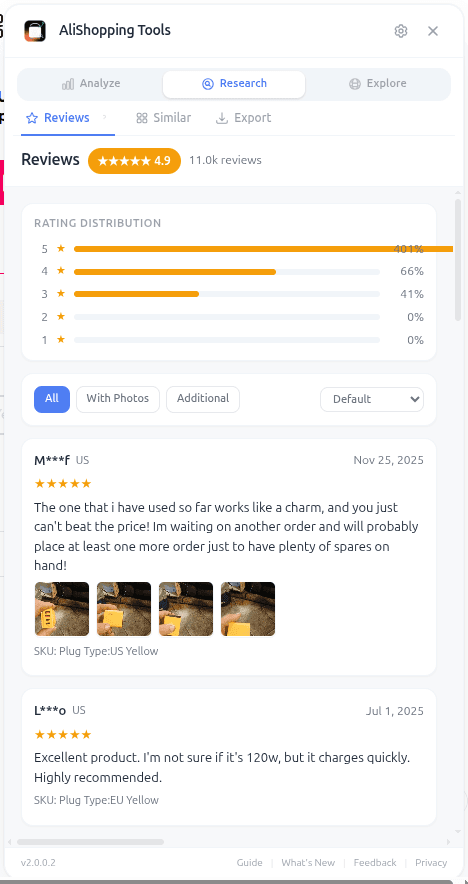
How AliShopping Tools Automates Review Analysis
AliShopping Tools is a free Chrome extension that runs directly on AliExpress product pages. When you open any product listing, the extension panel appears with analysis tools that make review evaluation dramatically faster.
Rating Distribution Chart
The extension visualizes the entire rating distribution in a clear chart. You can see at a glance whether the distribution looks natural or artificial — a spike at five stars with almost nothing else. This single visualization catches the most common questionable review pattern in seconds.
Photo Review Filter
Filter and browse only photo reviews, so you can quickly scan real buyer images without scrolling through pages of text-only feedback. Evaluate whether buyer photos match the listing and whether multiple buyers show consistent quality.
Buyer Country Breakdown
See where reviews are actually coming from. A healthy review profile shows geographic diversity that matches the product's shipping destinations. The extension surfaces this data so you can spot suspicious concentration patterns without manually reading hundreds of reviews and noting each buyer's flag icon.
Smart Sorting
Sort reviews by relevance, date, or rating faster than the native AliExpress interface. Jump to negative reviews to read real complaints, or sort by most recent to see current product quality.
Seller Trust Score
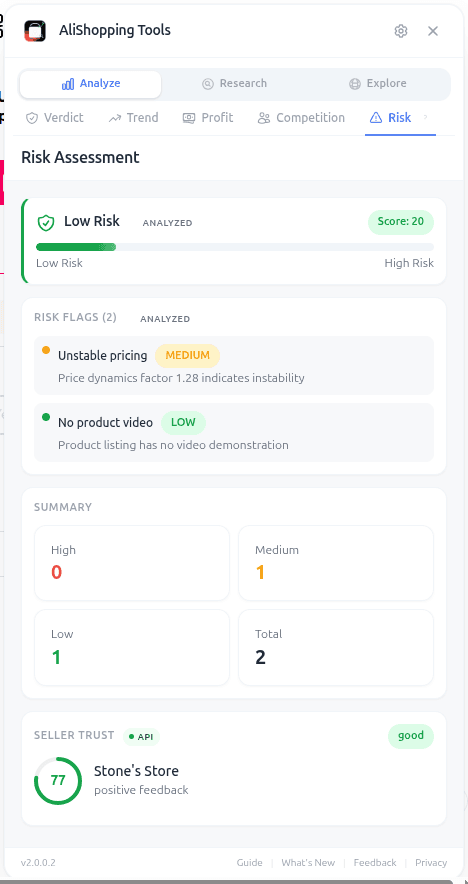
Beyond reviews, the extension provides a seller trust score based on store age, feedback rating, dispute rate, and verification status. A product can have mostly real reviews but still come from a seller with trust issues — this second layer of validation catches what review analysis alone cannot. For the full supplier-side audit, see the AliExpress supplier trust checker (7 red flags) and our guide to checking whether an AliExpress seller is trustworthy. Reviews are one trust layer; whether the discount itself is real is another — cross-check the listing's AliExpress price history before you trust a "70% off" badge. For the buyer's-eye overview of all of this, see Is AliExpress safe? A buyer's guide, part of the broader AliExpress trust hub.
What does a healthy review profile actually look like?
After examining thousands of AliExpress products, clear patterns emerge that distinguish genuinely good products from artificially inflated ones. Use this as your benchmark.
Rating distribution follows a natural curve. Expect 65-85% five-star, 8-15% four-star, 3-8% three-star, and small percentages of two-star and one-star. The exact numbers vary by category, but the key is seeing a distribution, not a spike.
Photo reviews exist and look authentic. At least 10-15% of reviews should include photos. Those photos should show the product in real-world settings with inconsistent lighting and backgrounds. Bonus: look for photos showing the product next to everyday objects for scale.
Review dates spread naturally. Reviews should appear steadily over weeks and months. Small spikes around sales events like 11.11 or Black Friday are normal. Huge unexplained clusters are not.
Negative reviews contain specific complaints. One-star and two-star reviews that mention specific issues (sizing problems, color mismatch, slow shipping to certain regions) are actually a good sign. They mean real people are buying and honestly reporting their experience. A product with zero negative reviews after hundreds of sales is less trustworthy than one with a few genuine complaints.
Language variety matches buyer geography. Reviews from buyers in France might include French phrases. Reviews from Brazil might mix Portuguese. This natural language diversity is nearly impossible to replicate at scale.
Frequently Asked Questions
What percentage of AliExpress reviews are unverified?
Estimates vary by category, but studies suggest 15-30% of reviews on competitive AliExpress product categories contain some form of manipulation, whether purchased reviews, incentivized feedback, or self-generated ratings. Categories with higher profit margins (electronics, beauty) tend to have more questionable reviews because the return on investment for buying them is greater.
Can I trust AliExpress products with thousands of reviews?
High review counts alone are not proof of quality. Look at the review distribution (is it suspiciously perfect?), the presence of photo reviews from real buyers, the date spread, and the specificity of review text. A product with 500 reviews showing a natural distribution with detailed complaints is more trustworthy than one with 5,000 generic five-star reviews.
How do I check if AliExpress review photos are real?
Real buyer photos have inconsistent lighting, everyday backgrounds (kitchen tables, bedroom floors), and sometimes show the product in actual use. If all review photos look professionally shot on white backgrounds or match the listing images exactly, they are likely not authentic. AliShopping Tools lets you filter photo-only reviews so you can scan them quickly.
Does AliExpress do anything to remove questionable reviews?
AliExpress has review verification systems and periodically purges suspicious reviews, but enforcement is inconsistent. The platform's ranking algorithm still heavily rewards review volume, which keeps the incentive to buy questionable reviews strong. Its official Buyer Protection program covers misdescribed items and non-delivery, but it does not vet review authenticity for you. As a dropshipper, assume the platform will not fully protect you and learn to analyze review quality yourself.
Related guides — go deeper on one signal
This guide is the full 7-red-flag reference. When you want to drill into a single sub-task, these companion walkthroughs each own one angle:
- Spot fake reviews in 30 seconds — the 4 fastest red flags — the quick-screen version: the four signals that fire fastest (burst, templated openings, country concentration, photo-absence) for screening a shortlist at scale.
- Read and analyze a 1,200-review corpus fast — the bulk/volume workflow: how to read the shape of a large review set instead of individual comments.
- Analyze AliExpress reviews free — the review-analyzer walkthrough — the free-tool angle: reading velocity, sentiment, authenticity signals, and recurring themes on the Reviews tab.
- Detect incentivized (gift-for-review) sellers — the incentivized sub-type: the five signals specific to refund/gift-for-5-star schemes.
The Bottom Line
Unverified reviews on AliExpress are not going away. As long as the platform's algorithm rewards high ratings and review volume, sellers will continue buying them. The question is whether you will make decisions based on surface data or verified signals.
The seven red flags in this guide give you a framework for manual detection. Generic text, perfect ratings, stock photos, date clusters, patterned broken English, missing photo reviews, and suspiciously detailed praise — once you train your eye to catch these signals, questionable reviews stop being invisible. Reviews are only one of three trust layers, though: descriptions and product photos fail in their own ways too, which is why the broader AliExpress trust hub pairs review analysis with description and photo checks.
But manual review analysis is slow, and time is money when you are researching products at scale. That is where tools make the difference. AliShopping Tools puts rating distribution charts, photo filters, buyer country data, and seller trust scores directly on the product page you are already viewing. No extra tabs. No subscriptions. No account required.
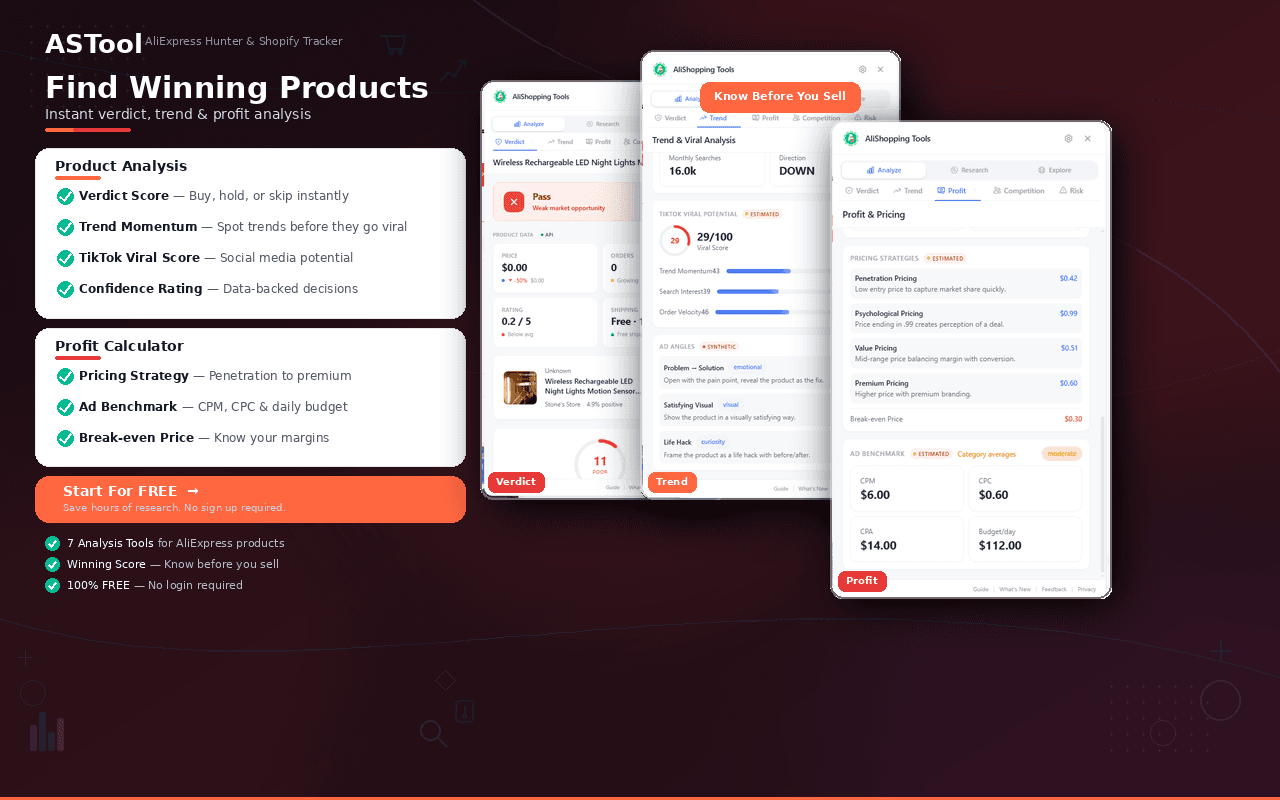
Install AliShopping Tools free from the Chrome Web Store and start analyzing reviews on your next AliExpress product page. Data decides, not guesswork.
AliShopping Tools
See live AliExpress data in your browser.
Seller trust score, 90-day price history, and live promo codes — on every AliExpress product page. No account, free.
Ready to find winning products?
Try AliShopping Tools — 15 free AI tools for product research.
Quick answers
Frequently Asked Questions
1Why are there so many fake reviews on AliExpress?
AliExpress search ranking heavily rewards products with high review counts and strong average ratings, so a listing with 500 five-star reviews appears far above a genuinely good product with 40 honest ones.
The post notes that review batches can be bought for as little as $50–$200 and can deliver 10x ROI within a month if they move the listing from page three to page one.
That economic incentive created an entire review-farm ecosystem around the platform.
2What rating distribution looks suspicious on AliExpress?
The post argues healthy products never reach 100% five-star because real customers always have shipping delays, minor quality differences, or expectation mismatches.
A genuine listing with 500 reviews typically shows a distribution like 78% five-star, 12% four-star, 5% three-star, 3% two-star, 2% one-star.
When a product with 400 reviews has 98% five-star, the distribution is artificial and you are almost certainly looking at inflated or purchased reviews.
3What are the main red flags for fake AliExpress reviews?
Watch for generic templated phrases ("very good product, fast delivery"), suspiciously perfect rating distributions, stock or listing-like photos instead of real messy buyer photos, date clustering (30 reviews in a three-day burst then nothing), consistent broken-English patterns across reviewers, complete absence of photo reviews (AliExpress incentivizes photos with coins), and long, uniformly positive detailed reviews with zero complaints.
Any two or three of these appearing together usually means the reviews are not real buyer feedback.
4Are incentivized AliExpress reviews fake?
Incentivized reviews — where a seller offers a refund, gift, or coupon in exchange for a 5-star rating — are not always literally fabricated (a real buyer may have received the product), but they are not trustworthy, because the incentive systematically removes the negative reviews from the pool.
The buyer who got a partial refund posts 5 stars; the buyer with a real defect opens a dispute instead.
The displayed rating is inflated even when each individual review is from a real account.
AliExpress policy prohibits the practice, but enforcement is inconsistent.
Treat a listing with incentivized-review signals (near-100% 5-star, date-burst posting, single-review reviewer profiles, templated wording) the same as a fake-review cluster, and weight the seller's dispute rate above the star average.
More from the blog
How to Do Product Research for Dropshipping: 7-Step Framework (Free Tools, 2026)
A repeatable 7-step product research framework for dropshippers in 2026 — from idea sourcing to live testing, using only free tools. No Ecomhunt subscription needed.
Free AliExpress Review Analyzer: Checker Tool Workflow (2026)
A free AliExpress review analyzer and checker: measure review velocity, sentiment, authenticity signals, and recurring buyer complaints on any product page — no account needed. Full Chrome extension workflow inside.
Winning Products August 2026: 12 Back-to-School Peak Categories
12 dropshipping categories for August 2026 — back-to-school peak (first two weeks), dorm setup, and the early-fall transition — plus how to vet any candidate with AStools before you spend.