



AliExpress Supplier Risk: How to Verify Reliable Sellers in 2026
AliExpress Supplier Risk: How to Verify Reliable Sellers in 2026
Quick Answer: A reliable AliExpress supplier passes 6 checks: store age 2+ years, trust rating 4.5+ stars on 500+ reviews, 90%+ on-time shipping, natural review distribution with photos, under 3% dispute rate, and response time under 24 hours. Suppliers failing 2 or more of these dimensions cause the majority of chargebacks and refund spikes. The AliShopping Tools Chrome extension pulls the seller-page metrics together in its Risk assessment on any AliExpress seller page, and lays out the review data on its Reviews tab — but judging whether a review distribution looks natural is a call it leaves to you.
A bad supplier can undermine your dropshipping business faster than a bad product. One unreliable supplier can mean weeks of customer disputes, chargebacks, a tanked store reputation, and money you will never see again. The worst part is that untrustworthy sellers on AliExpress are getting smarter. They know what legitimate stores look like, and they build convincing facades designed to trap inexperienced buyers.
This guide is your defense — the manual red-flags playbook: the most common supplier quality issues in 2026, the specific warning signs that give sellers away, and a step-by-step vetting process you can run by eye on any seller profile. If you would rather automate the same checks in one click, the companion tutorial how to check AliExpress supplier risk with the free Risk tab walks through the tool workflow; this article is the human-judgment checklist behind it. For the printable version, see the AliExpress supplier risk checklist.
The 6 supplier risk dimensions
| Dimension | Pass threshold | Red flag |
|---|---|---|
| Store age | 2 plus years | Under 6 months with high volume |
| Trust rating | 4.5 plus stars on 500 plus reviews | Under 4.0 or fewer than 100 reviews |
| Shipping reliability | 90 plus percent on-time | Under 70 percent or no data |
| Review quality | Natural distribution, photos present | All 5-star, no photos |
| Refund history | Under 3 percent dispute rate | 8 plus percent dispute rate |
| Communication | Responds under 24 hours | Takes 72 plus hours or ignores |
What Are the Most Common AliExpress Supplier Quality Issues in 2026?
Problematic sellers on AliExpress do not all operate the same way. Understanding the playbook helps you spot the patterns before you get burned.
1. Product Quality Discrepancies
The listing shows a premium-looking product with professional photos. What arrives is a lower-quality version made with inferior materials. The dimensions might be slightly off, the color faded, or the build quality noticeably worse. The photos were either sourced from other listings or shot with a sample that does not represent the bulk inventory.
This is the single most common issue on AliExpress, and it catches even experienced dropshippers who skip product verification.
2. Unfulfilled Orders
The seller lists a product with a large stated stock count and competitive pricing. You place an order. Days pass. Then weeks. Eventually the seller marks the order as "shipped" with tracking information that does not correspond to an actual shipment — it either never updates or tracks to a completely different package.
By the time you realize the product is never coming, your customer has already waited two weeks and filed a complaint.
3. Unverified Store Metrics
New stores that show thousands of orders and hundreds of five-star reviews within their first few months of operation. These metrics are purchased or artificially elevated. Review volumes and order counts can be artificially elevated through bulk self-orders and paid review services. The store looks established and trustworthy, but there is no real track record behind the numbers.
4. Suspiciously Low Pricing
A product that normally sells for $8-12 across multiple sellers is listed at $2.50 by one store. The price is designed to attract bargain-hunting dropshippers. What happens next varies: you might receive a garbage product, nothing at all, or a correct item the first time (to build trust) followed by junk on subsequent orders once you have committed to the supplier.
5. Short-Lived Store Accounts
The store operates normally for a few months, builds some legitimate order history, then vanishes. Orders placed in the final weeks go unfulfilled. The seller has already withdrawn their funds and moved on to open a new store under a different name.
Red Flags: What to Check Before You Order
Not every questionable listing is a scam, and not every legitimate seller looks perfect. But certain patterns are consistent warning signs. Here is what to look for.
Store Age vs. Order Volume
A store that opened three months ago with 15,000 orders and a 98% positive rating should raise immediate questions. Legitimate new stores grow gradually. Explosive growth in a brand-new store almost always indicates artificially elevated metrics.
What to check: Look at the store's opening date, then compare it to total order volume. A healthy ratio for a new store is a few hundred orders in the first three months, not thousands.
Unverified Product Images
If every product image looks like it came from a professional studio shoot but the store sells across dozens of unrelated categories (phone cases, kitchen tools, pet accessories, car parts), those are not their photos. Legitimate suppliers typically specialize in a few related product categories and use their own product photography, which is often decent but not magazine-quality.
What to check: Reverse image search the main product photo. If it appears across dozens of different stores, nobody owns those images and nobody is accountable for the product matching the photo.
Pricing That Defies Logic
Compare the product price against 5-10 other sellers offering the same item. If one seller is 50% or more below the average, something is wrong. They are either selling a lower-quality version, planning to not ship, or baiting you into a first order before switching products.
What to check: Search the product name on AliExpress and sort by orders. The average price across the top 10 sellers is your baseline. Anything dramatically below that baseline is suspect.
Communication Quality
Send the seller a message before ordering. Ask a specific question about the product, like material composition, exact dimensions, or shipping method for your country. Unreliable sellers either do not respond, respond with generic copy-paste answers that do not address your question, or respond with broken English that suggests an automated translation bot.
What to check: Legitimate suppliers will answer specific product questions with specific answers, usually within 24 hours.
Reviews That Read the Same
Open the reviews and read the actual text, not just the star count. If you see the same phrases repeated across multiple reviews ("very good quality," "fast shipping," "exactly as described") with no specific detail about the product itself, those reviews are likely not genuine. Real customers mention specific things: "the strap was a little short," "color is slightly darker than the photo," "my daughter loved it."
Check this seller before you buy.
Seller trust score and risk-flag scan on every AliExpress product page. No account, free.
What to check: Read the most recent 20 reviews and count how many include a specific, unique detail about the product. If almost none do, the review profile is likely inflated. There is no exact cut-off worth quoting — you are judging whether real people are visibly present in the text.
How Do You Vet an AliExpress Supplier Step by Step?
Before you commit to a supplier for your dropshipping store, run through this process. It takes about 10 minutes per supplier and can save you weeks of problems.
Step 1: Check store fundamentals. Note the store opening date, total feedback score, and positive feedback percentage. Look for at least 6 months of operation and a feedback score above 95%. These are minimum thresholds, not guarantees of quality.
Step 2: Examine the product catalog. A trustworthy supplier typically focuses on a specific niche or a few related categories. If a store sells everything from electronics to baby clothes to car accessories, they are likely a reseller with no quality control over their supply chain.
Step 3: Order a sample. Before committing to a supplier for your store, order one unit shipped to yourself. Inspect the product quality, packaging, and shipping speed. Compare what arrives to what the listing promised. This single step eliminates 90% of supplier risk.
Step 4: Test communication. Send a message asking about bulk order pricing, customization options, or specific product details. Gauge response time and quality. A supplier who will be handling your customer orders needs to be responsive and clear.
Step 5: Cross-reference pricing. Compare the supplier's price against at least 5 other sellers for the same product. If the price is within the normal range, that is a good sign. If it is suspiciously low, revisit your assessment.
Step 6: Run a risk assessment tool. This is where manual research meets automated intelligence. Tools exist that aggregate multiple risk signals into a single score, saving you from having to check each factor individually.
What AliShopping Tools Risk Assessment Shows You
The manual vetting process works, but it is time-consuming and easy to miss things. AliShopping Tools automates supplier risk analysis directly on the AliExpress product page, giving you a complete risk profile in seconds.
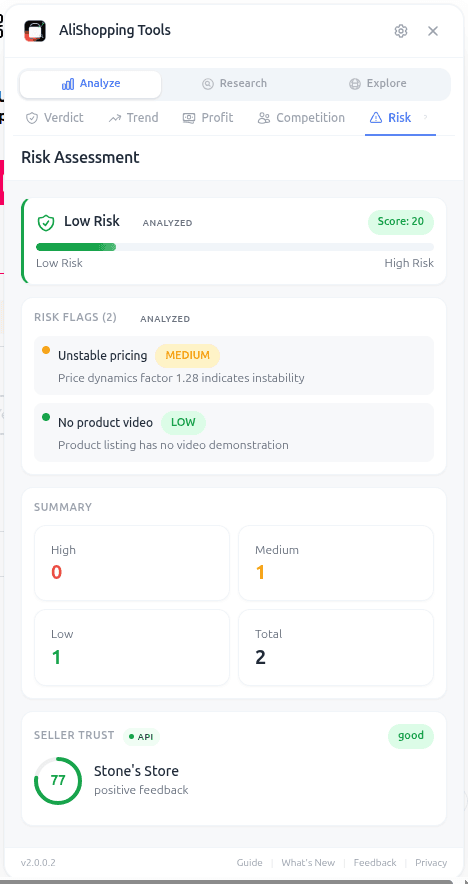
Here is exactly what the Risk Assessment tab shows:
Risk Score (0-100)
A single number that aggregates all risk factors into an overall severity level. The score maps to a visual gauge so you can see at a glance whether a supplier falls into safe, moderate, or high-risk territory. A score below 30 is generally low risk. Between 30-60 signals caution. Above 60 means serious red flags are present.
Risk Flags with Severity Levels
Each identified risk factor is broken out individually with a severity tag:
- High severity flags indicate deal-breakers: unreliable tracking patterns, new store with artificially elevated metrics, price anomalies that suggest product quality discrepancies, or a history of dispute escalations.
- Medium severity flags warrant caution: limited order history, inconsistent product descriptions across variants, shipping times that exceed stated estimates, or a feedback score trending downward.
- Low severity flags are informational: store is relatively new but growing normally, minor price fluctuations, or limited reviews on the specific product variant you are viewing.
The flag system means you do not have to interpret raw data yourself. Each flag comes with a plain-language explanation of what the risk is and why it matters to your business.
Seller Trust Score (0-100)
Separate from the overall risk score, the Seller Trust metric evaluates the supplier specifically. It considers store age, feedback consistency, response patterns, and order fulfillment history. The score maps to four levels:
- Excellent (80-100): Established seller with a strong, consistent track record.
- Good (60-79): Reliable seller with minor areas to watch.
- Average (40-59): Proceed with caution. Order a sample before committing.
- Poor (0-39): Avoid this supplier for dropshipping.
Business License Verification
AliExpress allows sellers to submit business license documentation. The Risk tab shows whether a seller's license has been verified or not, with a direct link to inspect the details. A verified business license does not guarantee a perfect supplier, but an unverified one means there is no accountable business entity behind the store. For dropshipping, where your reputation depends on your supplier's reliability, this distinction matters.
How to Use the Risk Data
The most effective approach is to combine the automated risk assessment with your own sample order. Use the Risk tab to filter out high-risk suppliers (high-severity flags, poor trust score, no business license). For the suppliers that pass the automated check, order a sample to verify product quality firsthand.
This two-step process — automated screening plus physical verification — gives you the highest confidence level with the least amount of wasted time.
What to Do If You Encounter a Bad Supplier
Even with careful vetting, you might encounter a bad supplier. Here is how to handle it and minimize the damage.
Open a dispute immediately. AliExpress has a Buyer Protection system that covers items that never arrive or do not match the description. If the product does not match the description, never arrives, or arrives damaged, open a dispute through the platform. Include photos comparing the listing to what you received. Do this within the buyer protection window, which is typically 15 days after the stated delivery date.
Gather evidence before contacting the seller. Take photos and screenshots of the listing, your order confirmation, the tracking information, and the product you received (if anything arrived). Having documentation organized before you escalate makes the dispute process faster.
Escalate if the seller does not cooperate. If the seller rejects your dispute or offers an inadequate resolution, escalate to AliExpress mediation. The platform generally sides with buyers who have clear photographic evidence of misrepresentation.
Warn other buyers. Leave an honest, detailed review with photos. This helps other dropshippers avoid the same supplier. Be specific about what went wrong so the review is useful, not just a star rating.
Cut your losses and move on. Do not continue ordering from a supplier who has already shown they are unreliable, even if they offer a discount or promise to "fix the issue." A supplier who has failed to deliver is unlikely to improve. Replace them and update your store listings accordingly.
Frequently Asked Questions
What is a safe seller rating on AliExpress for dropshipping?
Look for sellers with a feedback score of 95% or higher and at least 6 months of operation. A 4.5+ star rating with verified business license is the minimum baseline for low-risk sourcing. Below these thresholds, the probability of quality or shipping issues increases significantly.
How common are unreliable sellers on AliExpress in 2026?
Most AliExpress sellers are legitimate, but product quality discrepancies and inflated reviews are a known risk in popular dropshipping categories — particularly high-margin electronics and beauty items. The risk is manageable if you vet suppliers systematically using the red flags outlined above and tools like AliShopping Tools' Risk Assessment tab.
Should I use AliExpress buyer protection or PayPal for orders?
Use AliExpress buyer protection for individual orders since it covers non-delivery and items not matching descriptions. PayPal offers an additional layer if you need to escalate beyond the platform. For dropshipping, the built-in dispute system handles most issues effectively if you document everything with photos and screenshots.
How do I find backup suppliers for the same product?
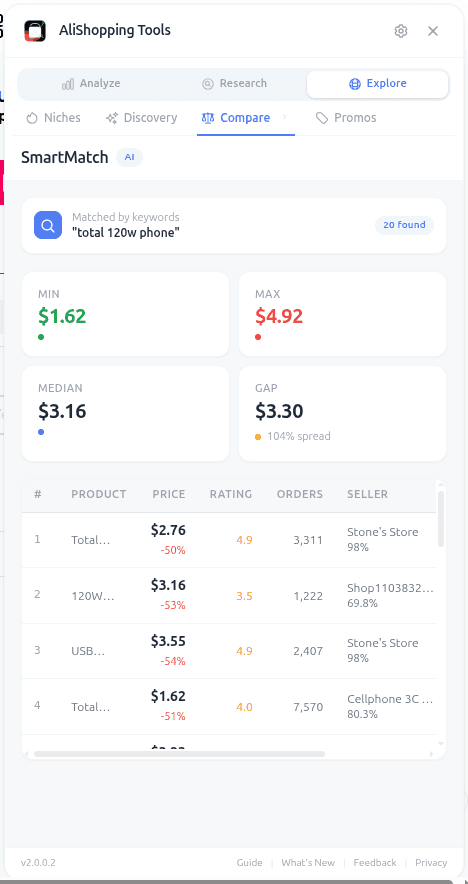
Search the product name on AliExpress and compare the top 5-10 sellers on price, ratings, shipping times, and review quality. Having 2-3 vetted backup suppliers protects you from stockouts and gives you negotiating leverage. AliShopping Tools' Compare tab helps you evaluate multiple sellers side by side, and you can find the AliExpress supplier of any product in one click to widen your shortlist.
Protect Your Business Before Problems Start
Supplier risk is one of the most underestimated threats in dropshipping. New sellers focus on finding winning products and setting up their stores, but the reliability of the person fulfilling your orders determines whether those products actually build your business or undermine it.
The smart approach is prevention. Spend 10 minutes vetting a supplier now, or spend 10 days dealing with disputes, refunds, and angry customers later. The math is not complicated.
AliShopping Tools puts supplier risk assessment directly on the AliExpress product page you are already browsing. No extra tabs, no separate dashboards, no subscriptions. Install the free Chrome extension and check the Risk tab on your next product page. One minute of checking saves weeks of problems.
AliShopping Tools
Check this seller before you buy.
Seller trust score and risk-flag scan on every AliExpress product page. No account, free.
Product Tracker Miễn phí
Theo dõi giá thật, đơn hàng, tồn kho & đánh giá của bất kỳ sản phẩm AliExpress nào trong 180 ngày. Dữ liệu không nói dối.
Before you buy
Is this deal real? Check the price history before you buy.
Prices often spike just before a “sale.” See 180-day price history and fake discount detection — free, no account needed.
Verify on AliShopping Deals →Sẵn sàng tìm sản phẩm thắng?
Thử AliShopping Tools — 15 công cụ AI miễn phí cho nghiên cứu sản phẩm.
Giải đáp nhanh
Câu hỏi thường gặp
1Những vấn đề chất lượng supplier AliExpress phổ biến nhất năm 2026 là gì?
Bài chỉ ra năm pattern lặp lại: chất lượng sản phẩm lệch với ảnh listing, đơn hàng không được fulfill với số tracking giả không cập nhật, chỉ số store bất thường — store mới mở đã có hàng ngàn đơn và trăm review 5 sao, giá rẻ bất thường thấp hơn 50% so với trung bình nhóm để dụ đơn đầu rồi đổi hàng rác, và store sống ngắn — hoạt động vài tháng rồi biến mất sau khi rút tiền.
2Những cờ đỏ nào cần kiểm tra trước khi đặt hàng từ supplier AliExpress?
So tuổi store với số đơn — store mở 3 tháng mà có 15.000 đơn thì gần như chắc chắn bơm ảo.
Reverse image search ảnh sản phẩm; nếu xuất hiện trên hàng chục store không liên quan thì không ai sở hữu ảnh đó.
So giá với 5–10 seller khác cùng sản phẩm — thấp hơn trung bình 50% là đáng nghi.
Gửi tin nhắn hỏi chất liệu hoặc kích thước cụ thể — supplier thật trả lời cụ thể trong 24 giờ. Đọc 20 review mới nhất, đếm xem bao nhiêu nhắc chi tiết riêng — gần như không có cái nào thì hồ sơ review nhiều khả năng bị bơm.
Không công cụ nào phán hộ bạn: tab Reviews của AliShopping Tools chỉ hiện tổng số review, phân bố 1–5 sao, bộ lọc có ảnh, ảnh người mua và bản export; phần đọc là của bạn.
3Mất bao lâu để vet một supplier AliExpress?
Khoảng 10 phút mỗi supplier.
Bài vạch quy trình có cấu trúc — kiểm tra cấp store (tuổi, feedback score, transaction volume), cấp listing (ảnh, chất lượng mô tả, variant), và ship/fulfillment (có ePacket không, warehouse đặt đâu). 10 phút vet giúp tiết kiệm hàng tuần tranh chấp, chargeback và tổn hại danh tiếng store khi đơn bắt đầu chạy.
Bài viết liên quan
- How to Do Product Research for Dropshipping: 7-Step Framework (Free Tools, 2026)guides
- AliExpress Find Similar Products — 5 Methods That Actually Work in 2026misc
- What Is a Winning Score for Dropshipping Products? (Complete Guide)dropshipping
- How to Read a Risk Assessment on Any AliExpress Product (2026 Guide)guides
- How to See TikTok Shop Data on AliExpress (Free Chrome Extension)misc
- دروبشيبينغ قطع غيار ومستلزمات السيارات من AliExpress في 2026dropshipping
Công cụ liên quan
Bài viết khác
How to Do Product Research for Dropshipping: 7-Step Framework (Free Tools, 2026)
A repeatable 7-step product research framework for dropshippers in 2026 — from idea sourcing to live testing, using only free tools. No Ecomhunt subscription needed.
AliExpress Find Similar Products — 5 Methods That Actually Work in 2026
Found a great product on AliExpress but want alternatives, a cheaper version, or a better supplier? This guide covers every method to find similar AliExpress products — built-in tools, image search, keyword strategies, and the AStools extension.
What Is a Winning Score for Dropshipping Products? (Complete Guide)
The Winning Score (0–100) rates every AliExpress product from six weighted signals on its listing. Learn what each factor measures, what the score does not measure, and how to read the three bands.