Instant AI Verdict
Get a Strong Buy, Buy Signal, Hold / Watch, or Pass AI recommendation in seconds for any AliExpress product. Includes Winning Score, Market Opportunity radar, and price history.
The Verdict tab is the executive summary of every AliExpress product. It collapses product quality, profit potential, market opportunity, and seller risk into a single colored badge, alongside a Winning Score from 0 to 100. If you only have ten seconds to evaluate a product, this is the tab to look at.
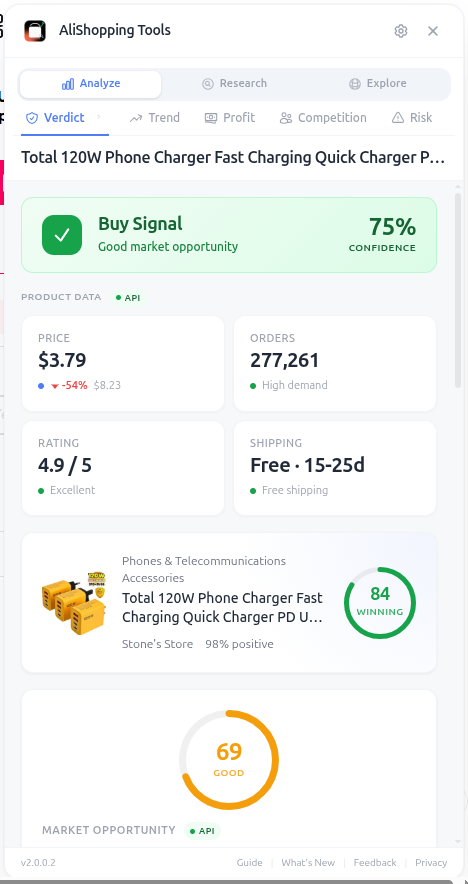
The badge at the top is one of four labels: Strong Buy, Buy Signal, Hold / Watch, or Pass. Each label corresponds to a Verdict score band, but the AI also considers qualitative factors that the raw score does not capture, like recent review sentiment swings or sudden price hikes.
Why It Matters
Most dropshippers rely on gut feel when picking products, which leads to over-investing in losers and missing winners that don't "look exciting." A scored verdict gives you a consistent yes/no filter that you can apply to hundreds of products per week. Think of it as the first interview round — products that fail Verdict don't deserve any more of your time.
What You'll See
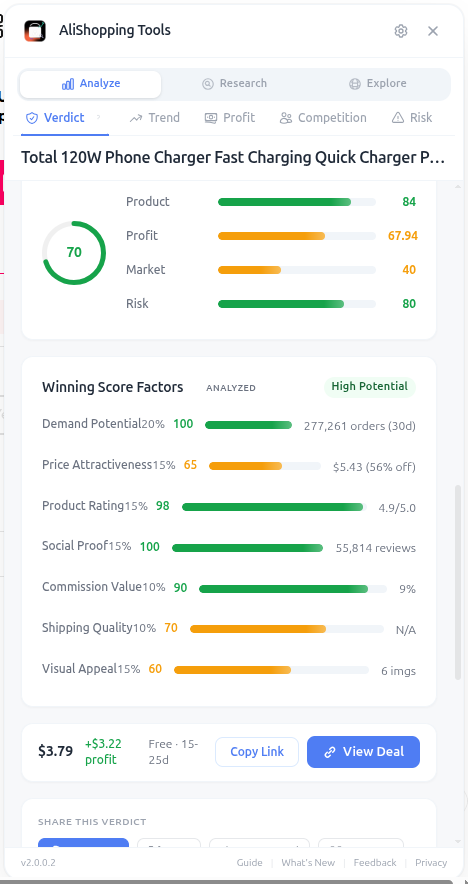
- Winning Score (0-100) — composite computed server-side from multiple product signals (proprietary formula, updated as our model improves)
- Verdict Badge — Strong Buy (80+), Buy Signal (60-79), Hold / Watch (40-59), or Pass (under 40)
- Market Opportunity Radar — six-axis chart covering demand, profit margin, competition, trend strength, supplier reliability, shipping speed
- Dropship Score — a focused score predicting dropshipping suitability specifically (filters out heavy/fragile items)
- Price History — 30/60/90-day sparkline so you can detect inflated "discounts"
- Seller Card — store age, feedback score, positive feedback %, follower count
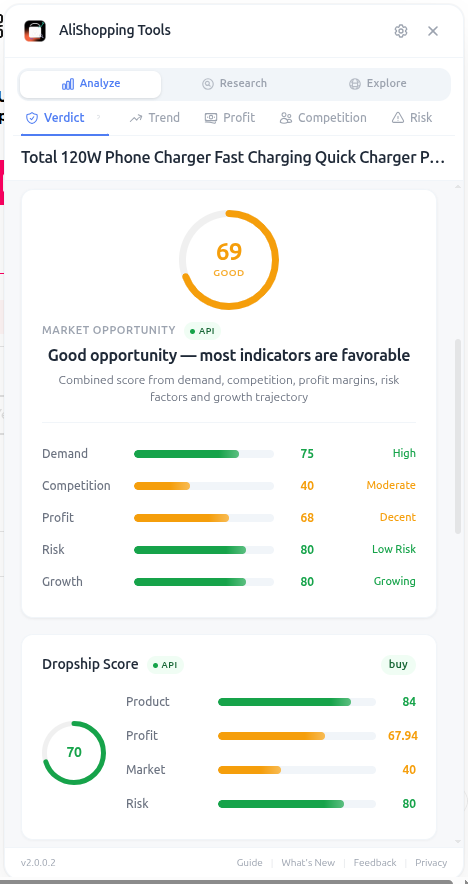
The radar chart is the most underused part of the tab. A product can have a high overall score but a single weak axis — say, very slow shipping — that disqualifies it for your specific market. Always glance at the radar shape, not just the number.
How to Use It
- Open any AliExpress product page in Chrome.
- The side panel auto-opens with the Verdict tab preloaded.
- Read the badge and Winning Score in the top card.
- Scan the radar chart for any axis that drops below 40 — that's a hidden weakness.
- Check the Dropship Score (separate from Winning Score) — products under 60 here are usually too fragile, heavy, or branded to dropship safely.
- Look at Price History for price spikes in the last 7 days that signal artificial inflation.
- Verify the Seller Card shows a store at least 12 months old with 95%+ positive feedback.
- If everything checks out, jump to Profit to confirm the unit economics.
Real Example
A LED makeup mirror priced at $8.50 shows a Verdict of "Buy Signal" with a Winning Score of 78. The radar reveals strong demand (92), decent margin (74), high competition (62 — borderline), and excellent supplier reliability (88). The Dropship Score is 81 because it's lightweight and unbreakable in well-padded packaging. The seller is 3 years old, 97.4% positive, with 12K followers. Price History shows a stable $8-9 range with no recent spike. Verdict: this passes the first round, time to check Profit.
Pro Tips
- Treat scores between 65 and 75 as "investigate further" rather than auto-buy. Use Risk and Compare tabs to break the tie.
- A Pass verdict on a trending product usually means thin margins or supplier risk — sometimes it's still worth checking the Profit tab to confirm.
- The Share Results button generates a clean snapshot you can drop into Slack or Notion when discussing products with a partner.
Common Mistakes
- Only reading the badge and skipping the radar — you will miss fatal weaknesses on a single axis.
- Trusting Verdict alone for high-priced products ($50+). Always cross-check with Risk and Compare.
- Ignoring the Dropship Score when sourcing fragile electronics or oversized items.
Related Guides
FAQ
Frequently Asked Questions
1What does the Verdict tab combine into a single score?
Per the guide, the Verdict tab collapses product quality, profit potential, market opportunity, and seller risk into a Winning Score 0–100 and one of four labels: Strong Buy (80+), Buy Signal (60–79), Hold / Watch (40–59), or Pass (under 40).
It also includes a Market Opportunity radar, a separate Dropship Score focused on dropshipping suitability (filters out heavy or fragile items), 30/60/90-day price history sparkline, and a seller card with store age and feedback.
2Why should I look at the Market Opportunity radar and not just the Winning Score?
Because a product can have a high overall score but one weak axis — for example very slow shipping — that disqualifies it for your market.
The radar surfaces that hidden weakness.
A product might score well overall but show a borderline competition axis or thin margin axis.
The radar shape matters more than the single number — always check each axis before committing.
3How is the Dropship Score different from the Winning Score?
The Dropship Score is a focused score predicting dropshipping suitability specifically — it filters out heavy, fragile, or branded items that a general Winning Score might still rate highly.
The guide recommends treating any Dropship Score under 60 as a pass regardless of Winning Score, because those products are usually too heavy, too fragile, or too trademark-risky to dropship safely even if demand looks strong.
Related Guides
Trend Analysis
See trend classification (Rising, Peaking, Stable, Declining), Momentum Score, and TikTok Viral potential for any AliExpress product. Free, updated daily.
Profit Simulator
Calculate full unit economics for any AliExpress product — product cost, shipping, processing fees, ad spend, net margin, and monthly revenue projections.
Competition
Assess market saturation, seller distribution, and monthly search volume for any AliExpress product. Know if a niche is open or crowded before spending on ads.
Risk Assessment
Identify risk flags, seller trust issues, and business license status before committing to a supplier. Avoid chargebacks, IP bans, and unreliable shipping.