
Real Cost of Dropshipping 2026: Every Line Item, by Stage
Real Cost of Dropshipping 2026: Every Line Item, by Stage
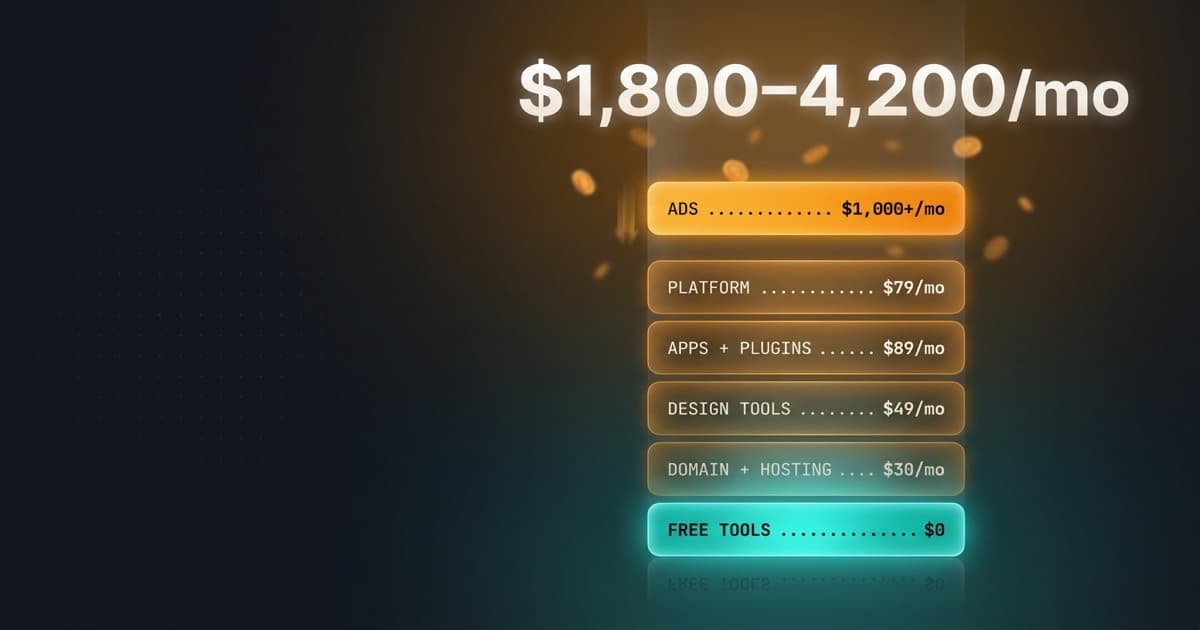
Quick answer: Dropshipping costs $0/month to validate an idea with free tools and organic content, $598-613 in month one to run a real Shopify store and a real paid test, $175-350/month as a lean operator testing products, and $1,650-4,100/month (excluding cost of goods) once you have a validated winner doing 20-100 orders a day. Ad spend and product testing — not software — are 70-80% of the bill at every stage past the first.
"How much does dropshipping cost?" produces wildly different answers online, and the reason is not that anyone is lying. It is that the question is missing a word: when. A guide that says $0-500/month and a guide that says $1,800-4,200/month can both be accurate — they are pricing an operator on day one and an operator in month six, and often they are not even counting the same line items.
This guide fixes that. Every number below is tagged with the stage it applies to and the scope it covers, so you can find your own row and budget against it.
Install AliShopping Tools — free product research for AliExpress →
This is a cost article, not a verdict article. If the question underneath your budgeting is really "should I do this at all," read is dropshipping still profitable in 2026 first — it covers margin reality, the categories that still work, and the failure modes. Come back here once you want the line items.
Why you see "$0-500" and "$1,800-4,200" for the same question
Both figures circulate widely. Both are defensible. They differ on two axes:
- Stage. Day-one validation and month-six scaling are not the same business. Ad spend at Stage 0 is zero because there are no paid ads; at Stage 3 it is the single largest line on the bill.
- Scope. Some breakdowns price only the tools and platform — the recurring software bill. Others price the whole monthly outflow — software plus ongoing testing plus ad spend. A "$0-500/mo" figure is almost always the first; a "$1,800-4,200/mo" figure is almost always the second.
Neither is wrong. Both are useless without the label. So here is the label:
| Stage | What you are doing | Tools + platform | Testing + ads | Total per month |
|---|---|---|---|---|
| 0 — Bootstrapped | Validating demand, no storefront | $0 | $0 (organic only) | $0 |
| 1 — Month one | First real store, first real paid test | $48-63 | $550 | $598-613 (one-off month) |
| 2 — Lean operator | Testing 1-3 products on paid ads | $26-46 | $150-300 | $175-350 |
| 3 — Validated winner | 20-100 orders/day, scaling | $148-484 | $1,500-3,600 | $1,650-4,100 (excl. COGS) |
Two things to notice before the detail. First, the software bill never becomes the problem — it tops out under $500/month even at scale. Second, the jump that actually hurts is Stage 1 to Stage 3, and almost all of it is advertising. Budget accordingly: most beginners do the exact opposite, buying tools and starving the ad test.
Earlier versions of this guide quoted the Stage 3 range as "$1,800-4,200/month." The line-by-line arithmetic below produces $1,648-4,084; we now quote the arithmetic rather than the rounding.
Same correction on Stage 1: earlier versions quoted "~$627" for month one, a figure inherited from an older line-up of prices that no longer matches the table. The current line items add to $598-613, so that is what we quote. An article whose thesis is "a figure quoted without its arithmetic is not a number you can budget against" has to hold itself to that standard first.
Stage 0 — the $0 bootstrapped test
Before you pay for anything, you can find out whether a product has demand at all.
| Item | Cost |
|---|---|
| TikTok Shop (no storefront) | $0 |
| AliShopping Tools (product research) | $0 |
| DSers free Basic (fulfilment) | $0 |
| Canva free / CapCut (creative) | $0 |
| TikTok organic content | $0 |
| Total | $0/mo |
TikTok Shop charges no monthly fee — it takes a platform commission (roughly 5-6%) on what you sell instead. That is the trade: no fixed cost, no owned storefront, no email list, no control over the customer relationship.
What Stage 0 can do: tell you whether people want the thing. Organic short-form video is a real demand signal, and it costs time rather than money.
What Stage 0 cannot do: build a brand, capture emails, survive a platform policy change, or produce data you can hand to a Meta or TikTok ad algorithm. It is a validation stage, not a business. Operators who stay here indefinitely usually do so because they have a content skill, not because it is cheaper.
Stage 1 — month one, the $598-613 floor
This is the cheapest defensible starting position with a real store and a real paid test. It contains no luxuries, and every line is there because removing it costs more than it saves.
Shopify Basic — $25-29/month
The storefront. Basic gets a working store, two staff accounts, basic reports, abandoned-cart recovery, and standard payment processing.
A pricing caveat worth more than the $4 it concerns: our two captures of Shopify's public pricing page disagree — $29 in April 2026, $25 in May 2026. Shopify's Basic price varies with billing term and with whatever promo is running (the $1-for-three-months offer has appeared repeatedly through 2026). Verify on the live pricing page before you budget, including against this article. We use the higher $29 in the month-one table so the floor is not optimistic.
Cheaper alternatives exist — WooCommerce on shared hosting, BigCommerce starter — and they are genuinely cheaper in dollars. They are not cheaper in hours, which is the resource that is actually scarce in month one.
Two essential apps — ~$30/month combined
- Reviews app (Loox or Judge.me): $9.99-15/month. Photo reviews on product pages. On a $30 AOV product the widget pays for itself at low volume.
- Tracking page app (Parcel Panel or AfterShip): $9-19/month. A self-service order status page. This matters more in dropshipping than in normal ecommerce because AliExpress shipping windows are 14-28 days and buyers start emailing on day 10.
Skipping these two does not save $30. It costs conversion rate and support hours.
Product testing budget — $300
The line item beginners underestimate most. Testing one product properly — ad spend, a sample order, creative production — costs $50-100. Testing the three to six you need to find one that converts costs $300-600. Plan $300 minimum and accept that part of it is tuition.
This is a genuine cost of doing business, not a subscription you can negotiate away. Operators who skip it test on $20 budgets, kill campaigns before the data arrives, and conclude the model does not work. The model works; testing on $20 does not.
Starter ad budget — $250 minimum
Below roughly $250 in month one there is not enough spend to learn anything. Meta and TikTok need conversion volume per ad set per week to optimise; underneath that threshold the algorithm is still exploring rather than buying you customer signal. $250 across a single ad set on a single product gets you to a decision within about two weeks.
You can spend less and stay in the game longer. You will not learn faster.
Stage 1 subtotal
[Source: Shopify public pricing page, April and May 2026. App pricing from Loox, Judge.me, Parcel Panel and AfterShip official listings, April 2026.]
| Line item | Month 1 cost |
|---|---|
| Shopify Basic | $29 |
| Reviews app (Loox/Judge.me) | $10-15 |
| Tracking app (Parcel Panel/AfterShip) | $9-19 |
| Product testing budget | $300 |
| Starter ad budget | $250 |
| Total | $598 to $613 |
That is the arithmetic, not a rounding: $29 + $10-15 + $9-19 + $300 + $250 = $598 at the low end, $613 at the high end, depending on which app tiers you pick. Catch a Shopify promo (or the $25 Basic price we captured in May 2026) and the low end drops to $594. This is the floor. Below it you are not testing seriously; you are spectating.
Stage 2 — the lean operator, $175-350/month
Month one is front-loaded. Once the store exists and the first test has run, the steady-state bill for an operator still hunting for a winner looks like this:
| Item | Monthly cost |
|---|---|
| Shopify Basic | $25-29 |
| Domain (amortised from $10-15/year) | ~$1 |
| AliShopping Tools (product research) | $0 |
| DSers free Basic or Advanced | $0-19.90 |
| Canva free | $0 |
| Ad spend | $150-300 (minimum viable testing) |
| Total | ~$176-350 |
This is the real minimum for running a Shopify-based operation with paid ads. The "$25 to start dropshipping" number you see elsewhere is the first row of this table presented as if it were the whole table.
Note what is still $0 here: research tooling, creative, email, support. Every one of those has a free tier that is sufficient at this volume, and every one of them is where beginners burn money instead.
Stage 3 — the validated winner, $1,650-4,100/month
Once a product converts and you scale, the stack expands. Some of the additions are real productivity; some are upsell traps. This is what an honest scaling stack looks like at month 3-6, running 20-100 orders/day on a single platform.
Shopify Basic or Shopify — $29-79/month
Under ~$20K monthly revenue, stay on Basic. The Shopify plan ($79) earns its keep above that threshold, mainly because the lower payment-processing rate through Shopify Payments (2.6% vs 2.9%) starts to outweigh the plan difference. Most operators upgrade too early.
Fulfilment — DSers or AutoDS, $0-66.90/month
DSers Basic is free for up to 3 stores with basic AliExpress fulfilment. DSers Advanced is $19.90/month and adds bulk automation rules. AutoDS Starter is $26.90/month and covers multi-platform fulfilment across Shopify, eBay, Amazon and Facebook.
For Shopify-only operators sourcing AliExpress exclusively, DSers wins on price and depth — our DSers vs AutoDS comparison breaks down which fits which workflow. The honest default: start free on DSers Basic, upgrade when volume crosses roughly 50 orders/day.
Email and SMS — Klaviyo, $20-150/month
Klaviyo's free tier covers 250 contacts. At 1,000-5,000 contacts — where a validated store usually lands by month 3 — pricing climbs to $45-150/month depending on contact count and SMS usage.
Email is the highest-ROI channel after paid acquisition. Cutting it to save $45/month at this stage is the wrong trade. Build the welcome, abandoned-cart and post-purchase flows before you scale ad spend, not after.
Reviews — Loox or Judge.me, $15-59/month
Free tiers cap features at low order volume. Loox at the $25 tier adds review import (essential when you list a product nobody has bought from you yet), photo reviews, and automated review requests. Judge.me Awesome at $15/month is the cheaper equivalent.
Tracking and post-purchase — Parcel Panel, $19-49/month
Higher tiers add a custom-domain tracking page, branded notification emails, and dropshipping mode. That last one earns the upgrade on its own: a buyer who sees "China Post" on a tracking page is a chargeback risk; a buyer who sees your store's branded fulfilment page is not.
Miscellaneous growth apps — $30-80/month
ReConvert for post-purchase upsells, a currency converter for international visitors, a free-shipping bar for AOV nudges. These accumulate quietly — three to five "small" apps at $9-25 each reaches $50-80/month before anyone notices.
Audit this line monthly. Any app whose dashboard you have not opened in 30 days is a cancellation candidate.
Cost of goods — variable, ~30-45% of revenue
At 20-100 orders/day and ~$30 average product cost, AliExpress order spend lands at $600-3,000/day, or $18,000-90,000/month. This is not part of the "stack" — it scales with revenue and is covered by revenue — but it dominates cash flow, and there is typically a 3-7 day gap between paying AliExpress and receiving your Shopify payout. Margin discipline here (supplier negotiation, faster suppliers, sample-then-scale) matters more than any subscription line. The math is in how to estimate dropshipping profit.
Ad spend — $1,200-3,000/month, or much higher
The largest variable and the one that determines profitability. At validated-winner stage, daily spend usually sits at $40-100/day per active product, rising as ROAS allows.
Stage 3 subtotal
| Line item | Monthly cost |
|---|---|
| Shopify Basic/Shopify | $29 to $79 |
| Fulfilment (DSers/AutoDS) | $0 to $66.90 |
| Email/SMS (Klaviyo) | $45 to $150 |
| Reviews (Loox/Judge.me) | $25 to $59 |
| Tracking (Parcel Panel) | $19 to $49 |
| Misc growth apps | $30 to $80 |
| Tools subtotal | $148 to $484 |
| Product testing budget (ongoing) | $300 to $600 |
| Ad spend (modest) | $1,200 to $3,000 |
| Total excluding COGS | $1,648 to $4,084 |
A leaner variant exists for a single-product operator who has not built out email and post-purchase: Shopify at $65, DSers Advanced at $19.90, Canva Pro at $12.99, Klaviyo at $20 — about $120/month in tools against $500-1,000 in ads. The shape of the conclusion does not change. Tools are roughly 5-15% of the bill; advertising and testing are 70-80%.
The hidden costs nobody puts on the spreadsheet
Everything above is the visible stack. The lines below are the ones that surprise operators in month two and three, and they are the difference between looking profitable on a surface P&L and being profitable.
Payment processing — 2.6-3.0% of revenue
Shopify Payments, Stripe and PayPal all charge 2.6-2.9% per transaction plus a fixed fee. International cards add 1-2 points. On $20K monthly revenue that is $520-600 gone before any other cost.
Chargebacks — 0.5-2% of revenue at scale
Dropshipping runs chargeback rates several times higher than a typical Shopify store: shipping windows are long, products sometimes arrive different from the listing photos, and some buyers dispute rather than contact support. At a 1% rate on $20K revenue that is $200 in disputed revenue plus roughly $15 per case in fees — call it $300-500/month all in.
Most of the trust failures behind chargebacks are detectable before you ever list the product — see our AliExpress trust hub on misleading descriptions, fake review patterns and manipulated photos.
Refund provision — 3-7% of revenue
Outside chargebacks, refund rates in dropshipping run 3-7% of orders. Model it as a standing P&L line, not a surprise. On $20K revenue that is $600-1,400/month.
Returns and refund logistics — $50-200/month
Most stores set no-return policies on AliExpress-sourced products because return shipping to China is uneconomical. The common alternative is a refund-without-return, which is cheaper than two-way freight but is not free. Plan $50-200/month at scale.
Ad account bans and recovery — $100-200/month contingency
Meta and TikTok enforce more aggressively than they used to. Options after a ban: appeal (free, slow, far from guaranteed), source a verified account through an agency partner ($100-500), or work with a media buyer using their own account (typically 10-20% of ad spend as a management fee). If you are scaling fast, hold a contingency.
Subscription drift — $50-150/month wasted
Entirely preventable, and almost universal. Free trials that converted, apps installed for one experiment, a video tool from a campaign that ended. Set a recurring monthly task to read every line on the card statement.
Hidden cost total at $20K monthly revenue
[Source: Shopify Payments, Stripe and PayPal published fee schedules, April 2026. Chargeback rate benchmarks from Chargebacks911 2025 industry report. Refund rate ranges estimated from AliExpress dropshipping operator surveys, 2025-2026. Treat the last as an estimate, not a measurement.]
| Hidden line | Monthly cost |
|---|---|
| Payment processing (2.6-3.0%) | $520 to $600 |
| Chargebacks (~1% at scale) | $300 to $500 |
| Refund provision (3-7%) | $600 to $1,400 |
| Returns / refund logistics | $50 to $200 |
| Ad account contingency | $100 to $200 |
| Subscription drift | $50 to $150 |
| Total hidden cost | $1,620 to $3,050 |
That is 8-15% of revenue at this scale. Narrowed to the three lines that behave like cost of goods — processing, chargebacks and returns logistics — it is roughly 4-7 percentage points added to your effective COGS. Whichever framing you use, the number belongs in the model before you set prices, not after.
Where free tools cut $130-400/month
Of every line in this guide, the one operators overspend on most is paid research tools — and it is also the only one that can go to zero without a trade-off.
[Source: Koala Inspector, SpySales, Sell The Trend and Pexgle official pricing pages, April 2026.]
| Tool | Typical monthly | What it does |
|---|---|---|
| Koala Inspector | $29 | Shopify store spy, app detection, theme detection |
| SpySales | $39 | Shopify sales spy, product trending data |
| Sell The Trend | $39 | Product research, trending products, supplier finder |
| Pexgle | $24 | Product research, FB ad spy, supplier compare |
| Total | $131/month | (operators stacking 5-6 tools reach $300+) |
The broader replacement table, for the tools most commonly stacked at each job:
| Paid tool | Monthly cost | Free alternative |
|---|---|---|
| Minea | $49-99 | AliShopping Tools + TikTok Creative Center |
| Dropispy | $29-79 | Same free stack |
| Koala Inspector Pro | $7.99 | AliShopping Tools Shopify spy |
| Commerce Inspector | $29+ | AliShopping Tools |
| Pexgle Pro | $39.95 | AliShopping Tools + free ad library |
AliShopping Tools is a free Chrome extension that covers the core jobs of those tools on every AliExpress and Shopify product page.
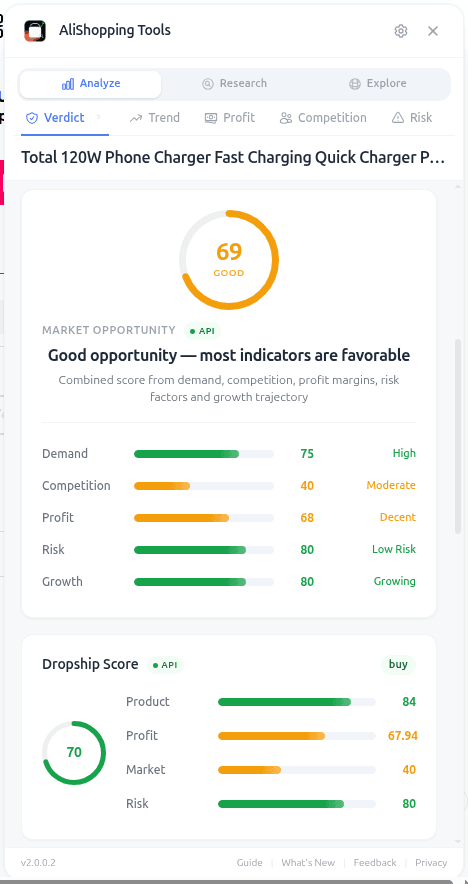
What it covers:
- Product research and verdict scoring — Winning Score, AI verdict, profit simulation, trend phase, supplier risk score
- Shopify store spy and app detection — open any Shopify store and see installed apps, theme, and product catalogue
- Supplier compare — the same product across multiple AliExpress sellers, side by side on margin and risk
- Review evidence you can read yourself — total review count, the 1–5 star breakdown, a photos-only filter, the customer photos, and export to CSV / JSON / TXT / XLSX. It shows you the reviews; it does not score them for you

The arithmetic: replacing three or four paid tools keeps $90-130/month in the budget, or $1,080-1,560 over a year. At Stage 1 pricing, $1,080 is roughly two extra full product tests — which is a materially better use of the money than a subscription. We go deeper in why you don't need paid research tools in 2026, with specific comparisons for Koala Inspector, SpySales and Sell The Trend.
The break-even math — month 3, 6 or 12
Stack cost only means something relative to revenue. Here is the honest arc.
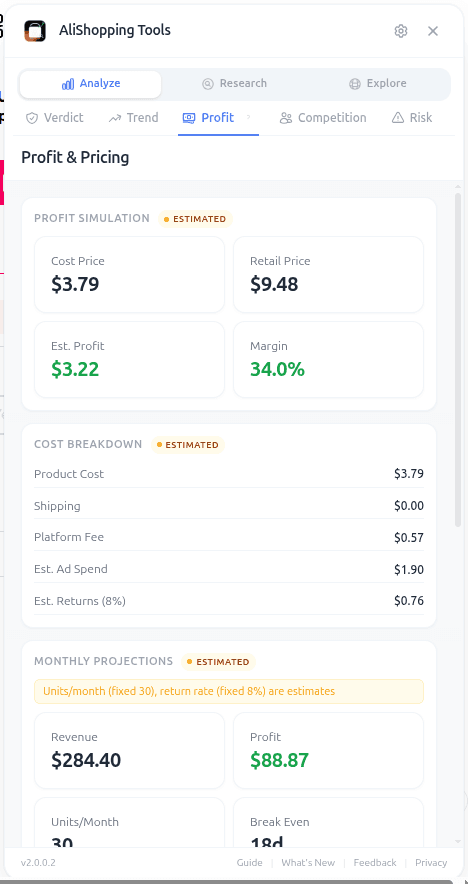
Getting to a winner (month 1-2)
A new operator running one product test at $30 AOV and ~50% gross margin has to find something that converts before the testing budget runs out:
- Test budget: $300
- Cost per click on cold traffic (Meta or TikTok): $0.40-0.80
- Conversion rate target: 2-3%
- Traffic needed for a real signal: 500-1,000 clicks
- Budget consumed per test: $200-800
If the first test fails — the normal outcome — the second begins. Disciplined operators typically find a converting product by test three to six, at $1,200-3,000 total spend. That is months one and two.
After a winner (month 3 onward)
A profitable scaling profile in 2026 looks roughly like this:
| Month | Revenue | Ad spend | COGS | Apps | Hidden | Net |
|---|---|---|---|---|---|---|
| 3 | $5,000 | $1,500 | $2,500 | $200 | ~$300 | +$500 — break-even crossed |
| 6 | $20,000 | $5,000 | $10,000 | $400 | $1,500 | +$3,100 |
| 12 | $50,000 | $12,000 | $25,000 | $500 | $4,000 | +$8,500 |
These are the disciplined-operator numbers, and they are a projection of the cost structure above — not an average of real stores, and not a promise. Most new operators do not follow this curve. They find no winner at all (the most common outcome, with heavy drop-off inside the first 90 days), or find one and mismanage cash flow when chargebacks and refund provisions land in month four, or find one that saturates within 60 days — the winning products that lose money pattern.
Disciplined operators break even around month 3-6; less structured ones take 9-12 months or never get there. The variable that moves that timeline most is validation discipline before the ad spend — checking trust signals, saturation and profit simulation on every candidate rather than after the budget is gone. That is what the free research-tool stack is for.
What most beginners overspend on
- Research tool subscriptions. Minea plus Dropispy plus Koala Inspector plus Commerce Inspector is $130-230/month before a single sale. The free stack covers the great majority of the same workflow.
- Shopify apps. Every "essential" app is $10-30/month. Ten of them is $150-300/month. Start at zero and add one only when you have a specific problem it solves.
- Courses. A $500-2,000 course teaches what is freely available on YouTube and in community forums. That $500 is one full product test.
- Upgrading Shopify early. Basic until roughly $20K monthly revenue. The higher plan pays for itself through processing rates, not features.
Run the audit yourself
Open Shopify admin → Settings → Billing → Bills, plus your Apps panel. Pull the last three months of charges and ask three questions of every line:
- Has the dashboard been opened in the last 30 days? If no — cancel.
- Is there a free alternative covering 80%+ of the use case? If yes — switch.
- Did it generate measurable revenue or save measurable hours? If you cannot answer in numbers — cancel.
A first pass through this typically cuts $80-200/month. Over a year that is $1,000-2,400, or one to two additional product tests at Stage 1 pricing.
The honest summary — what to budget
- Validating an idea: $0, on TikTok Shop with free tools and organic content. Time, not money.
- Month one with a real store: $598-613, of which $550 is testing and ads. Not less. Below this you are not testing seriously.
- Steady state while hunting a winner: $175-350/month.
- Month 3 once validated: $1,650-2,500/month total outflow excluding COGS — tools $150-250, ad spend $1,200-2,000, testing and hidden costs the rest.
- Month 6 at scale: $4,000-8,000/month outflow against $15,000-25,000/month revenue. The gap is your profit and your reinvestment fund.
Where cutting helps most: paid research tools (down to $0), subscription drift (audit monthly), early Shopify upgrades (stay on Basic). Where cutting hurts: testing budget, email and SMS, reviews app, tracking page. Where cutting is not an option: payment processing, refund provision, cost of goods.
For the line-by-line on a single product, our profit calculator workflow guide walks a real example end to end, and the dropshipping product research guide is the pillar tying stack-cost discipline to product-validation discipline — the two halves of the same equation.
Install AliShopping Tools free from the Chrome Web Store — research, supplier risk, profit simulation and Shopify spy on every AliExpress and Shopify page. No account, no credit card, no trial clock.
FAQ
What is the real cost of dropshipping in 2026?
It depends entirely on the stage. Validating an idea on TikTok Shop with free tools costs $0/month. Month one with a real Shopify store and a real paid test costs $598-613, of which $550 is testing and ad budget. A lean operator still hunting for a winner spends $175-350/month. A validated winner doing 20-100 orders a day spends $1,650-4,100/month excluding cost of goods. Any single "cost of dropshipping" figure quoted without naming the stage and stating whether it includes ad spend is not a number you can budget against.
What does a minimum viable dropshipping stack cost in month one?
$598-613, which is Shopify Basic ($29) + a reviews app ($10-15) + a tracking page app ($9-19) + a product testing budget ($300) + a starter ad budget ($250). That is the floor for running a test that produces a real decision. Below it, ad platforms never reach the conversion volume they need to optimise, so the money buys exploration rather than customer signal.
What does a realistic dropshipping stack cost at the validated-winner stage?
$1,648 to $4,084 per month excluding cost of goods — commonly rounded to $1,800-4,200. It breaks down as tools at $148-484 (Shopify, fulfilment, email, reviews, tracking, miscellaneous apps), ongoing product testing at $300-600, and ad spend at $1,200-3,000. Ad spend is the dominant variable and scales with revenue; software is the smallest part of the bill.
Can you start dropshipping for free?
You can validate for free: TikTok Shop charges no monthly fee (it takes roughly 5-6% commission on sales instead), and AliShopping Tools, DSers Basic, Canva free and CapCut all cost $0. What you cannot do for free is run paid traffic. The moment you want a branded Shopify storefront and an ad test, the floor is a Shopify plan plus a real ad budget — roughly $600 in month one.
What are the non-negotiable dropshipping costs?
Three: a storefront (Shopify Basic at $25-29/month, or a marketplace that takes commission instead), a domain ($10-15/year), and an ad budget if you intend to use paid traffic. Everything else — research tools, spy tools, automation, creative software, email, live chat — has a free tier that is adequate until real volume arrives.
How much should I budget for dropshipping ads in 2026?
A minimum of $250-300/month to test one product to a decision, and $300-1,000/month if you want to test three to five products simultaneously, which is what most operators need to find one that converts. At a $0.40-0.80 cost per click you need 500-1,000 clicks per product to read a conversion rate honestly. Spending under that threshold does not stretch the budget — it produces data too thin to act on.
What are the hidden costs of dropshipping?
Payment processing (2.6-3.0% of revenue), chargebacks (0.5-2%, higher than typical ecommerce because shipping windows are long), refund provision (3-7% of revenue), returns and refund logistics ($50-200/month), ad-account recovery contingency ($100-200/month), and subscription drift ($50-150/month in tools nobody uses). Together these run 8-15% of revenue at scale. Narrowed to processing, chargebacks and returns, they add roughly 4-7 percentage points to your effective cost of goods — which needs to be in the model before you set prices.
How much can free research tools actually save?
$130-400/month, depending on how many paid tools you replace. The four most commonly stacked (Koala Inspector $29, SpySales $39, Sell The Trend $39, Pexgle $24) total $131/month; operators stacking five or six reach $300 or more. Over twelve months that is $1,560-4,800 — enough to fund several additional product tests, which is where the money produces information and the subscription does not.
How long does it take to break even in dropshipping?
Disciplined operators typically break even around month 3-6; less structured ones take 9-12 months or never reach it. The usual sequence is one to two months finding a converting product across three to six tests ($1,200-3,000 in total spend), then a first profitable month around month three at roughly $5,000 revenue. The biggest determinant is validation discipline before the ad spend, not how much was saved on software.
Where do dropshippers overspend?
Paid research tools first ($130-400/month for capabilities free tools now cover), Shopify apps second (ten "essential" apps at $10-30 each reaches $150-300/month), courses third, and upgrading the Shopify plan before roughly $20K monthly revenue fourth. The pattern is consistent: overspending on fixed software and underspending on the ad testing that is the only thing that actually finds a winner.
Disclosure: this article is published by the AliShopping Tools team, and AliShopping Tools is one of the free tools recommended above. All pricing is from publicly advertised vendor sources on the dates cited (April-May 2026) — tool pricing changes frequently, so verify on each vendor's site before subscribing. Ranges labelled as estimates are estimates. This guide is educational and is not financial advice. All trademarks are the property of their respective owners. Feedback via the contact page.
Ready to find winning products?
Try AliShopping Tools — 15 free AI tools for product research.
Quick answers
Frequently Asked Questions
1What is the real cost of dropshipping in 2026?
It depends entirely on the stage.
Validating an idea on TikTok Shop with free tools costs $0 per month.
Month one with a real Shopify store and a real paid test costs $598 to $613, of which $550 is testing and ad budget.
A lean operator still hunting for a winner spends $175 to $350 per month.
A validated winner doing 20 to 100 orders a day spends $1,650 to $4,100 per month excluding cost of goods.
Any single cost-of-dropshipping figure quoted without naming the stage, and without stating whether it includes ad spend, is not a number you can budget against.
2What does a minimum viable dropshipping stack cost in month one?
$598 to $613, which is Shopify Basic ($29) plus a reviews app ($10 to $15), a tracking page app ($9 to $19), a product testing budget ($300) and a starter ad budget ($250).
That is the floor for running a test that produces a real decision.
Below it, ad platforms never reach the conversion volume they need to optimise, so the money buys algorithm exploration rather than customer signal.
3What does a realistic dropshipping stack cost at the validated-winner stage?
$1,648 to $4,084 per month excluding cost of goods, commonly rounded to $1,800 to $4,200.
It breaks down as tools at $148 to $484 (Shopify, fulfilment, email, reviews, tracking, miscellaneous apps), ongoing product testing at $300 to $600, and ad spend at $1,200 to $3,000.
Ad spend is the dominant variable and scales with revenue; software is the smallest part of the bill.
4Can you start dropshipping for free?
You can validate for free.
TikTok Shop charges no monthly fee (it takes roughly 5 to 6 percent commission on sales instead), and AliShopping Tools, DSers Basic, Canva free and CapCut all cost $0.
What you cannot do for free is run paid traffic.
The moment you want a branded Shopify storefront and an ad test, the floor is a Shopify plan plus a real ad budget, which is roughly $600 in month one.
5What are the non-negotiable dropshipping costs?
Three: a storefront (Shopify Basic at $25 to $29 per month, or a marketplace that takes commission instead), a domain ($10 to $15 per year), and an ad budget if you intend to use paid traffic.
Everything else — research tools, spy tools, automation, creative software, email, live chat — has a free tier that is adequate until real volume arrives.
6How much should I budget for dropshipping ads in 2026?
A minimum of $250 to $300 per month to test one product to a decision, and $300 to $1,000 per month if you want to test three to five products simultaneously, which is what most operators need in order to find one that converts.
At a $0.40 to $0.80 cost per click you need 500 to 1,000 clicks per product to read a conversion rate honestly.
Spending under that threshold does not stretch the budget; it produces data too thin to act on.
7What are the hidden costs of dropshipping?
Payment processing (2.6 to 3.0 percent of revenue), chargebacks (0.5 to 2 percent, higher than typical ecommerce because shipping windows are long), refund provision (3 to 7 percent of revenue), returns and refund logistics ($50 to $200 per month), ad-account recovery contingency ($100 to $200 per month), and subscription drift ($50 to $150 per month in tools nobody uses).
Together these run 8 to 15 percent of revenue at scale.
Narrowed to processing, chargebacks and returns alone, they add roughly 4 to 7 percentage points to effective cost of goods, which needs to be in the model before you set prices.
8How much can free research tools actually save?
$130 to $400 per month, depending on how many paid tools you replace.
The four most commonly stacked (Koala Inspector $29, SpySales $39, Sell The Trend $39, Pexgle $24) total $131 per month, and operators stacking five or six reach $300 or more.
Over twelve months that is $1,560 to $4,800 — enough to fund several additional product tests, which is where the money produces information and a subscription does not.
9How long does it take to break even in dropshipping?
Disciplined operators typically break even around month 3 to 6, while less structured ones take 9 to 12 months or never reach it.
The usual sequence is one to two months finding a converting product across three to six tests ($1,200 to $3,000 in total spend), then a first profitable month around month three at roughly $5,000 revenue.
The biggest determinant is validation discipline before the ad spend, not how much was saved on software.
10Where do dropshippers overspend?
Paid research tools first ($130 to $400 per month for capabilities free tools now cover), Shopify apps second (ten essential-looking apps at $10 to $30 each reaches $150 to $300 per month), courses third, and upgrading the Shopify plan before roughly $20,000 in monthly revenue fourth.
The pattern is consistent: overspending on fixed software and underspending on the ad testing that is the only thing that actually finds a winner.
More from the blog
AliExpress Shipping to the UK: Delivery Times, VAT & Customs (2026)
How long AliExpress takes to reach the UK, how 20% VAT and post-Brexit customs work, and which shipping method is fastest for UK shoppers in 2026.
AliExpress Shipping to the USA: Delivery Times, Customs & Duty (2026)
How long AliExpress takes to the USA, what import duty you pay after the 2026 de minimis change, and which shipping method is fastest. Realistic estimates.
Top TikTok Shop Products August 2026: 12 Specific Products Worth Sourcing
12 individually named TikTok Shop-adjacent products for August 2026 — dorm cleaning and laundry, back-to-campus tech and cable carry, study-focus desk sensory, and early-fall dorm kitchen — each anchored to a real AliExpress listing (title, price, product ID) pulled 2026-07-21, with how to source the equivalents.