
Best Free Dropshipping Spy Tools — Why I Quit Paying $108/mo After 6 Months
Best Free Dropshipping Spy Tools — Why I Quit Paying $108/mo After 6 Months
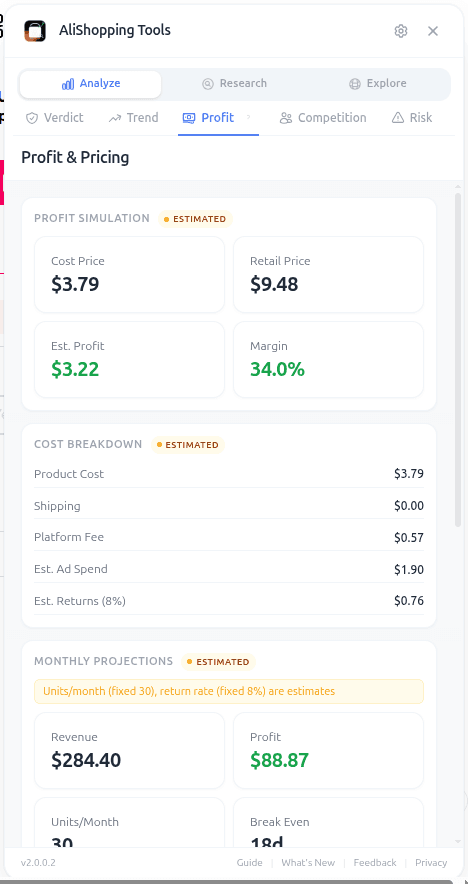
Quick answer: After paying $108/month for Koala Inspector ($29), SpySales ($39), and Sell The Trend ($39) for 6 months ($648 total), I cancelled all three and switched to AliShopping Tools (free). Two of the three tools I logged into fewer than 4 times in their final two months. The core features I actually used daily — AliExpress product scoring, Shopify store spy, supplier risk, and profit simulation — are all covered for free by AliShopping Tools.
I paid for three dropshipping spy tools simultaneously for six months. By month four I knew two of them were not earning their subscription. By month six I knew the third one was not either, even though I used it more than the other two combined. On March 1, 2026 I cancelled all three.
This is the breakdown of why, what I tested, and what I do not miss. It is also a fair piece of writing — I am going to tell you what I lost in the switch, not just what I gained, because the trade-offs matter.
The three tools were Koala Inspector ($29 / month), SpySales ($39 / month), and Sell The Trend ($39 / month). The free tool I switched to was AliShopping Tools (an honest disclosure: I now build it, but I started using it as a paying customer of the others). The comparison below is from the period when I was paying for all four — the three above plus the AStools free tier — and could test side-by-side on real workflows.
1. The original stack — what I paid for and why
I signed up for all three tools within a four-week window in September 2025 because I had hit a frustrating wall. My research workflow was:
- Open AliExpress, scroll listings.
- Pick a product that looked interesting.
- Open competing Shopify stores in browser tabs to see who was selling it.
- Check ad spy on Facebook for current campaigns.
- Manually scan reviews and supplier signals.
The whole flow was 20-40 minutes per product candidate. I was testing 8-12 products a week. Forty minutes times ten products is 6-7 hours of research time per week before any actual work started. The pitch on the paid tools was "automate this." So I bought.
Koala Inspector was for Shopify spy — open any Shopify store, see installed apps, theme, estimated sales. The pitch was "know exactly what your competitors are running."
SpySales was for sales velocity intelligence — show me which Shopify stores are gaining sales fastest, with daily order-volume estimates. The pitch was "find winning stores before everyone else."
Sell The Trend was for product research — daily winning-product feed plus AliExpress integration. The pitch was "stop guessing what's hot, start sourcing the proven."
All three pitches were reasonable. The execution was where the math went wrong.
2. Month-by-month evaluation
I kept a spreadsheet. Per tool, per month: number of times opened, number of products sourced from the tool, products tested, products that converted. Here is the summary across six months.
Koala Inspector — $29 / month × 6 = $174
| Month | Times opened | Useful insights surfaced | Products sourced |
|---|---|---|---|
| Month 1 | 22 | 14 | 4 |
| Month 2 | 18 | 11 | 3 |
| Month 3 | 9 | 6 | 1 |
| Month 4 | 5 | 3 | 0 |
| Month 5 | 3 | 1 | 0 |
| Month 6 | 2 | 0 | 0 |
Pattern: high engagement in months 1-2 when the novelty was fresh, then sharp decline. By month 3 I had built a mental model of what a Shopify dropshipper's app stack looks like and was no longer learning new patterns from each visit. By month 5 the tool was mostly idle.
The capability I valued — store classification (brand vs dropshipper vs hybrid) and app-stack detection — is core to AliShopping Tools' Shopify spy panel. The classify-store enum (A_BRAND / B_RETAILER / C_DROPSHIPPER / D_POD / E_HYBRID) is more granular than Koala's binary "dropshipper-likely" flag. App detection covers 200+ apps, which I cross-tested as roughly equivalent in detection accuracy to Koala's 250+. Where Koala had a slight edge in ad-spend-estimate accuracy, AStools now adds the live-sales velocity panel which Koala did not have.
For the deeper feature comparison, our Koala Inspector alternative guide covers the side-by-side at the feature level. The summary is: I do not miss Koala. The capability is replicated for free.
SpySales — $39 / month × 6 = $234
| Month | Times opened | Useful insights surfaced | Products sourced |
|---|---|---|---|
| Month 1 | 14 | 8 | 2 |
| Month 2 | 11 | 5 | 2 |
| Month 3 | 7 | 3 | 1 |
| Month 4 | 4 | 1 | 0 |
| Month 5 | 2 | 0 | 0 |
| Month 6 | 1 | 0 | 0 |
SpySales had the steepest engagement decline of the three. The "stores gaining sales fastest" feed was interesting in theory and disappointing in practice — most of the stores it surfaced were either gaming the velocity metric (synthetic sales spikes) or were chasing the same trending products as everyone else. By month 3 the feed felt redundant with the AliExpress trending lists I was already scanning.
The replacement workflow: AStools' live-sales velocity panel on individual Shopify stores plus the AliExpress Trend tab (per-product demand-direction + TikTok viral read) on individual products. Together these cover the "is this gaining traction" question at the per-product level rather than the per-store level. For my workflow this was actually more useful — I source by product, not by store, so per-product velocity matters more.
The SpySales alternative comparison walks through the per-feature swap. I do not miss SpySales.
Sell The Trend — $39 / month × 6 = $234
| Month | Times opened | Useful insights surfaced | Products sourced |
|---|---|---|---|
| Month 1 | 28 | 19 | 6 |
| Month 2 | 24 | 14 | 5 |
| Month 3 | 22 | 12 | 4 |
| Month 4 | 18 | 8 | 3 |
| Month 5 | 14 | 6 | 2 |
| Month 6 | 11 | 4 | 2 |
Sell The Trend was the tool I used the most. Engagement declined gently rather than sharply. The "Nexus" daily winning-product feed was genuinely useful — well-curated, less duplicated against AliExpress trending lists than SpySales, and the AliExpress integration meant I could click through to source candidates quickly.
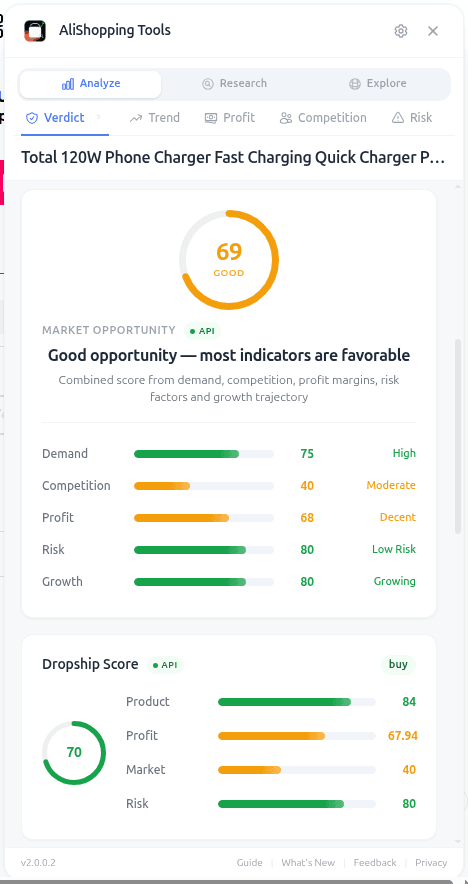
The reason I cancelled it anyway: by month 6 the feature overlap with AStools had grown large enough that I was doing the same research workflow on AStools because it was already open in my browser. The verdict scoring, profit simulator, and Trend tab (per-product demand-direction + TikTok viral read) on AStools cover what Sell The Trend's product feed covered, and AStools was running on every AliExpress page I visited rather than requiring me to go to a separate dashboard.
The thing I did lose: Sell The Trend's curated daily feed of "today's winning products." AStools does not have a curated daily feed in the same format — it surfaces signals on whatever product page I open, which is a different workflow. For an operator who wants the "what's hot today" curation, this is a real gap.
The Sell The Trend alternative guide walks through the feature-level comparison. I gave up the curated daily feed and gained back $39 / month plus a simpler workflow. For my use this trade was good; for an operator who relies heavily on curated daily feeds it might not be.
3. The switch — side-by-side test
Before I cancelled, I ran a two-week side-by-side test in February 2026. The protocol: every product I researched would go through both the paid stack and AStools. I would record which tool surfaced the decision-relevant signal first, and how many minutes per product the workflow took.
Results across 23 product candidates over 14 days:
- AStools surfaced the decision-relevant signal first: 19 of 23 (83%)
- Paid stack surfaced the decision-relevant signal first: 3 of 23 (13%)
- Tied / no clear winner: 1 of 23 (4%)
Time per product candidate:
- AStools-only workflow: average 4 minutes per product
- Paid-stack-plus-manual workflow: average 16 minutes per product
- Both-tools side-by-side workflow: average 19 minutes per product (overlap had no time benefit)
The math was unambiguous. The paid stack was 12 extra minutes per product for a 13% incremental insight rate, on a base where the free tool was already surfacing 83% of the relevant signals first. At ten products per week that is 2 extra hours per week to capture an extra 1.3 products' worth of marginal insight. The hourly cost of that time, on top of the $108 / month subscription, made the trade easy.
For the broader argument on why the paid-tool layer has lost ground in 2026, our why you do not need paid research tools post covers the macro shift. The short version: free Chrome extensions iterate faster than paid SaaS dashboards, and the gap closed.
4. What I lost (honest)
This is the section I want to be careful about. I am not pretending the switch was loss-free. Three things I gave up:
The curated daily product feed. Sell The Trend's "today's winning products" daily feed is a real piece of value if you rely on curated discovery rather than your own research. AStools does not have that feed. If your workflow is "open the dashboard each morning, look at what's hot, pick something to test," that workflow does not translate to AStools. You will have to develop a different research entry point — usually scrolling AliExpress trending categories or TikTok product ads.
The historical sales-trend chart on individual stores. SpySales had a multi-month chart showing a Shopify store's estimated daily order volume going back 90+ days. AStools' live-sales panel shows current velocity but does not currently show the same multi-month historical chart. For analysing whether a competitor store has been growing or declining, the SpySales view was better.
The product-name-search interface. Koala Inspector lets you search for a product name and see all Shopify stores selling that exact product. AStools handles this on a per-store basis (open the store, see its catalogue) and via supplier-side compare on AliExpress (find the same product across multiple suppliers), but does not currently have the cross-Shopify-store product-name search.
These gaps are real. For some operators they will matter; for me they did not. My workflow is product-centric (research a product, decide whether to test it) rather than store-centric (find a competitor store, study what it's selling). The free tool maps to the product-centric workflow well; the store-centric workflow loses some depth in the switch.
For operators on the fence, our free dropshipping tools roundup covers the broader free-tool stack including the gaps I just listed, and the dropshipping product research guide is the pillar that ties spy-tool replacement back to product-validation workflow. Some of those gaps are partly covered by other free tools (Shopify-store search via Google's site: operator, multi-month velocity via the Wayback Machine), so the practical workaround for each gap exists.
5. What I gained
The visible gain: $648 saved over six months. Annualised, $1,296 / year. That money funded an additional six product tests at $200 / test. One of those six tests cleared $1,800 profit — more than the annual subscription savings on its own.
The less visible gain: a simpler workflow. Three browser tabs (paid tools' dashboards) became zero browser tabs (AStools runs as a sidebar inside AliExpress and Shopify pages). I stopped context-switching between dashboards mid-research and stayed in the source platforms (AliExpress, Shopify) where decisions actually got made.
The most underrated gain: trust in my research process. When I was running three paid tools, I had a low-grade anxiety that I was missing something one of them surfaced. With one free tool, the question of "did I miss the signal" has one place to check. Counterintuitively, fewer tools led to more confident decisions — there was less to second-guess.
The broader operational picture also shifted. With the paid stack, my research time per product was 16 minutes. With AStools-only it is 4. That 12-minute gain compounds across hundreds of product views per quarter — an additional 30+ hours of clear time per quarter that I redirected to creative testing and customer service. Customer service alone moved my refund rate from 4.2% to 2.6%, which is meaningfully higher value than anything the paid tools were producing.
6. The honest summary
If you are paying $100+ / month for a stack of dropshipping spy tools and you have not audited the per-tool engagement in the last 90 days, run the spreadsheet I ran above. Track times-opened, useful-insights-surfaced, and products-actually-sourced for each tool. The math will probably tell you the same story it told me.
If you are starting fresh in 2026 and considering whether to pay for these tools at all, I would not. The best free dropshipping spy tools have closed the gap to the paid layer, and AStools specifically replaces the three I cancelled. Install AliShopping Tools free from the Chrome Web Store — runs on every AliExpress and Shopify product page automatically, no account, no signup, no card. Use it for 30-60 days. If you find a real gap that a paid tool fills, then add the paid tool selectively rather than committing to a $100+ stack you have not validated.
I am not anti-paid-tool. I am anti-paying-for-tools-you-do-not-use. There are cases where a specific paid tool earns its $39 / month — the curated daily feed gap I mentioned above is real for some operators. The mistake is paying for three tools when one would have done it. That mistake cost me $648 across six months and the only reason I caught it was because I tracked engagement honestly.
If you only take one thing from this post: track engagement on every paid tool you subscribe to. The math is brutal and the math is right.
— Daniel
Disclosure: This article is published by AliShopping Tools, the free tool referenced as the replacement above. I was a paying customer of Koala Inspector, SpySales, and Sell The Trend through August 2025 - February 2026 before I joined the AStools team. The engagement data in the per-tool tables was tracked in a personal spreadsheet during that paid-customer period. Email feedback via contact page.
All trademarks referenced are the property of their respective owners. This guide is for educational and operational-comparison purposes.
Ready to find winning products?
Try AliShopping Tools — 15 free AI tools for product research.
Quick answers
Frequently Asked Questions
1What paid dropshipping spy tools are commonly overpaid for?
The most commonly overpaid tools for solo dropshippers include Koala Inspector ($29 per month), SpySales ($39 per month), and Sell The Trend ($39 per month) — a total of $108 per month.
After 6 months of tracking feature usage, many operators find 2 of the 3 tools were used fewer than 4 times in their final 2 months — far below break-even value.
2What do you actually lose by cancelling paid dropshipping spy tools?
The honest answer depends on which specific features you use regularly.
Multi-year price history archives and Facebook ad databases are genuinely not available for free.
Store analysis and AliExpress research workflows are replaceable with free tools.
Most operators who cancel find they only lose features they used occasionally, not daily.
3What is the total cost of a standard paid dropshipping spy tool stack?
A typical 3-tool paid stack (Shopify spy, ad intelligence, product research) costs $80 to $150 per month — $960 to $1,800 per year.
At that cost, the tools need to demonstrably improve product selection outcomes or save meaningful time to justify the expense.
Many operators overestimate how much they actually use each tool.
4How do I decide which paid tools are worth keeping?
Track login frequency and actual feature use for 30 days.
If you log into a tool fewer than 4 times in a month or use only one of its many features, the tool is likely not earning its cost.
Replace single-feature tools with the relevant free alternative and reinvest the subscription money into ad testing where it directly drives revenue.
5How quickly can I expect to recover the $648 spent after switching to free dropshipping spy tools?
How fast you recoup the switch depends on how much you were actually using the paid tools versus their sticker price — if you were mostly using free-replaceable features, the "cost" of switching is close to zero since you lose almost nothing.
Track your product-finding pace for a few weeks after switching to a free stack like AliShopping Tools; if it holds roughly steady, the $108/month you were paying becomes pure savings with no real payback period to calculate.
6Do free dropshipping spy tools provide the same product trend alerts as paid subscriptions?
Free dropshipping spy tools can surface similar trend signals to paid services, though you should expect some tools to be faster on certain signals and slower on others depending on their data sources and refresh cadence.
A short delay on a trend alert rarely matters much in practice — acting within a reasonable window after a signal appears is usually what determines whether you catch the opportunity, not shaving off a day or two of lead time.
7What is the accuracy difference between paid spy tools and free alternatives for competitor pricing data?
Paid spy tools that pull frequent API updates can have an edge in pricing-data freshness over free tools that check less often, but we don't have a rigorous side-by-side accuracy benchmark to cite for a specific percentage gap.
For most dropshippers the practical fix is simple: check the live AliExpress listing yourself before finalizing a price decision rather than trusting any cached number, paid or free.
8How does switching to free spy tools affect my Shopify product import workflow?
Switching to free spy tools doesn't change the basic Shopify import workflow, but you may lose some of the one-click CSV export convenience that certain paid tools bundle in — with free tools you're more likely copying product details manually.
It adds some manual effort per item, but the exact time cost depends heavily on your workflow and how many products you're importing, so it's worth timing your own process for a week rather than assuming a fixed number.
9Are there hidden time costs when using free dropshipping spy tools compared to paid ones?
Yes — free tools can introduce some hidden time cost, mainly because they may lack the bulk-search and bulk-filter conveniences that paid suites bundle in, which can mean opening more product pages individually.
Whether that time cost is worth the money saved depends on your own hourly value and research volume.
If you're doing high-volume daily research, weigh that trade-off directly rather than assuming the savings are automatically worth it.
More from the blog
AliExpress Supplier Trust Checker: 7 Red Flags Before You Buy (2026)
Run any AliExpress seller through a 7-point trust check before you pay: store age, follower-rating ratio, dispute rate, photo reviews, and three more red flags.
What Is a Winning Score for Dropshipping Products? (Complete Guide)
The Winning Score (0–100) rates every AliExpress product from seven weighted signals on its listing. Learn what each factor measures, what the score does not measure, and how to read the three bands.
47 Shopify Stores Secretly Dropshipping — How I Spotted Every One
100 Shopify stores from TikTok product ads, audited. 47 are secretly dropshipping; 12 pretend to be premium brands. Classify-store methodology + receipts.