






Dropshipping Luggage & Bags from AliExpress in 2026: The Complete Category Guide
Dropshipping Luggage & Bags from AliExpress in 2026: The Complete Category Guide
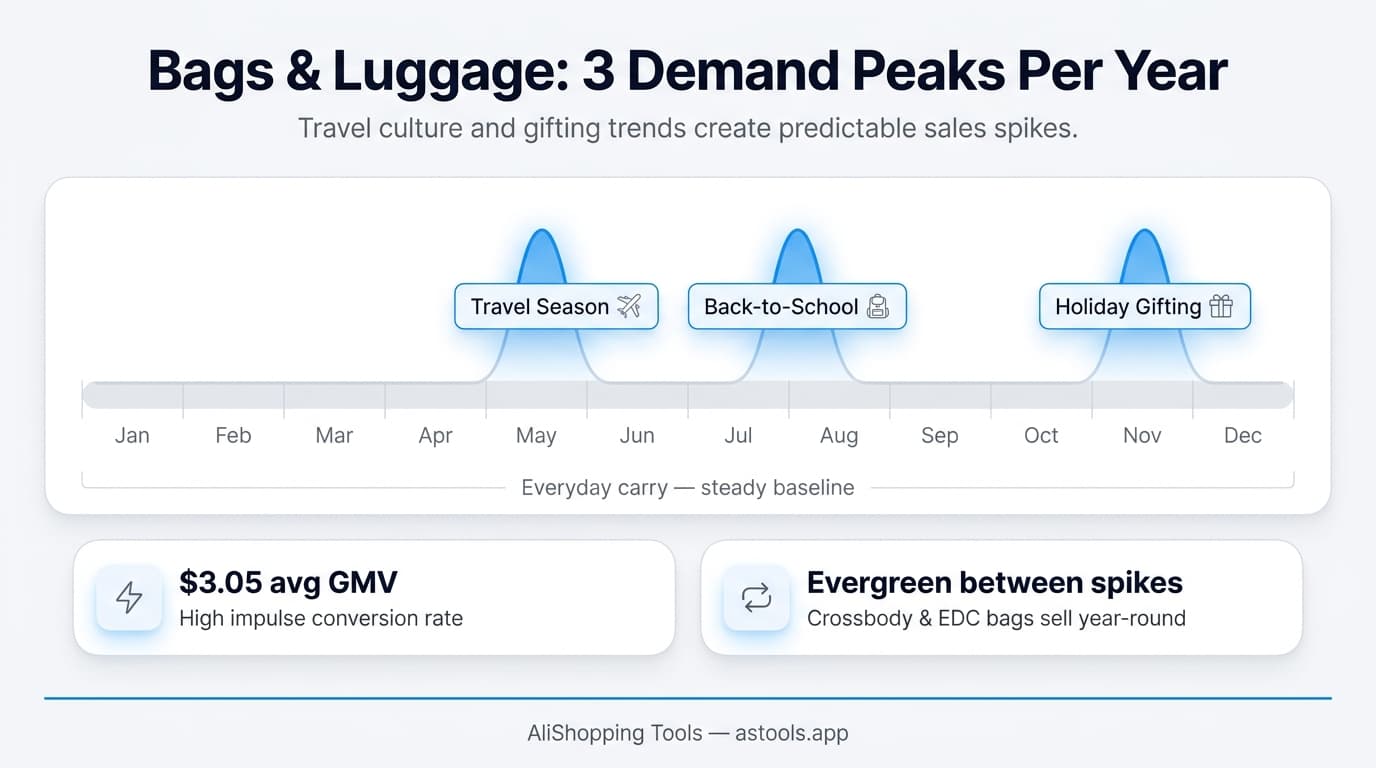
Quick answer: Luggage and bags is a year-round dropshipping category with three demand peaks — back-to-school (July–September), travel season (April–July), and holiday gifting (October–December) — best sub-niches are crossbody bags, backpacks, and travel organizers, where low ticket prices drive impulse purchases and zipper quality is the single biggest factor in preventing returns.
Most dropshippers think of luggage and bags as a low-margin commodity category. They see the $3.05 average GMV, compare it to high-ticket electronics or skincare, and move on. That is a mistake.
The bags category on AliExpress is one of the most durable, repeat-purchase-friendly niches in dropshipping. The low ticket price is not a weakness — it is the mechanism that drives impulse buys at scale. A customer who will hesitate for two days before buying a $79 gadget will complete the checkout for a $12 crossbody bag in under three minutes. Multiply that by a well-targeted audience and consistent seasonal tailwinds, and the math gets interesting fast.
This guide covers everything a dropshipper needs to work this category profitably in 2026: the sub-niches worth targeting, the seasonal patterns to build around, how to evaluate suppliers before your return rate blows up your margins, and how to use AliShopping Tools to validate each product before you spend a dollar on ads.
Why Bags and Luggage Sell Year-Round
Most product categories have a dominant season. Patio furniture sells in spring. Ugly sweaters sell in November. Sunscreen sells in June. These single-peak categories create cash flow problems: months of overhead with thin revenue, then a brief window to make it back.
Bags are different. The category has no dead months because the underlying demand is structural, not seasonal. People carry things everywhere, all the time, and they rotate their bags more often than most other accessories. A college student might own three to five bags for different purposes. A frequent traveler replaces luggage every two to three years and constantly adds packing accessories. A working professional carries a laptop bag daily and picks up a gym bag when they join a new routine.
This creates multiple recurring demand signals throughout the year:
- Back-to-school (July through September): Backpacks for kids and teenagers represent the highest annual demand spike in the entire category. Parents replace bags every year, sometimes every semester. The purchase is non-negotiable and time-bound.
- Travel season (April through July): Luggage sets, travel organizers, packing cubes, and neck pouches spike as flights and hotel bookings climb. Summer vacations drive a second wave in August.
- Holiday gifting (October through December): Bags are a perennially safe gift. They are practical, available in a wide range of price points, and gender-neutral enough to satisfy nearly any recipient list. Luxury-looking bags under $30 perform especially well as stocking fillers.
- New Year and fitness resolutions (January through February): Gym bags see a consistent January spike as people flood into gyms with fresh memberships and the desire to look the part.
The floor demand between these peaks is not zero, either. Crossbody bags and everyday carry pouches move consistently throughout the year because they are lifestyle purchases, not occasion-driven ones.
For dropshippers, this means inventory planning and ad creative can stay active twelve months per year, with budget allocation shifting rather than starting and stopping. Compare this to a category like Halloween costumes, where you have exactly six weeks to make your money back.
Best Sub-Categories in Bags and Luggage
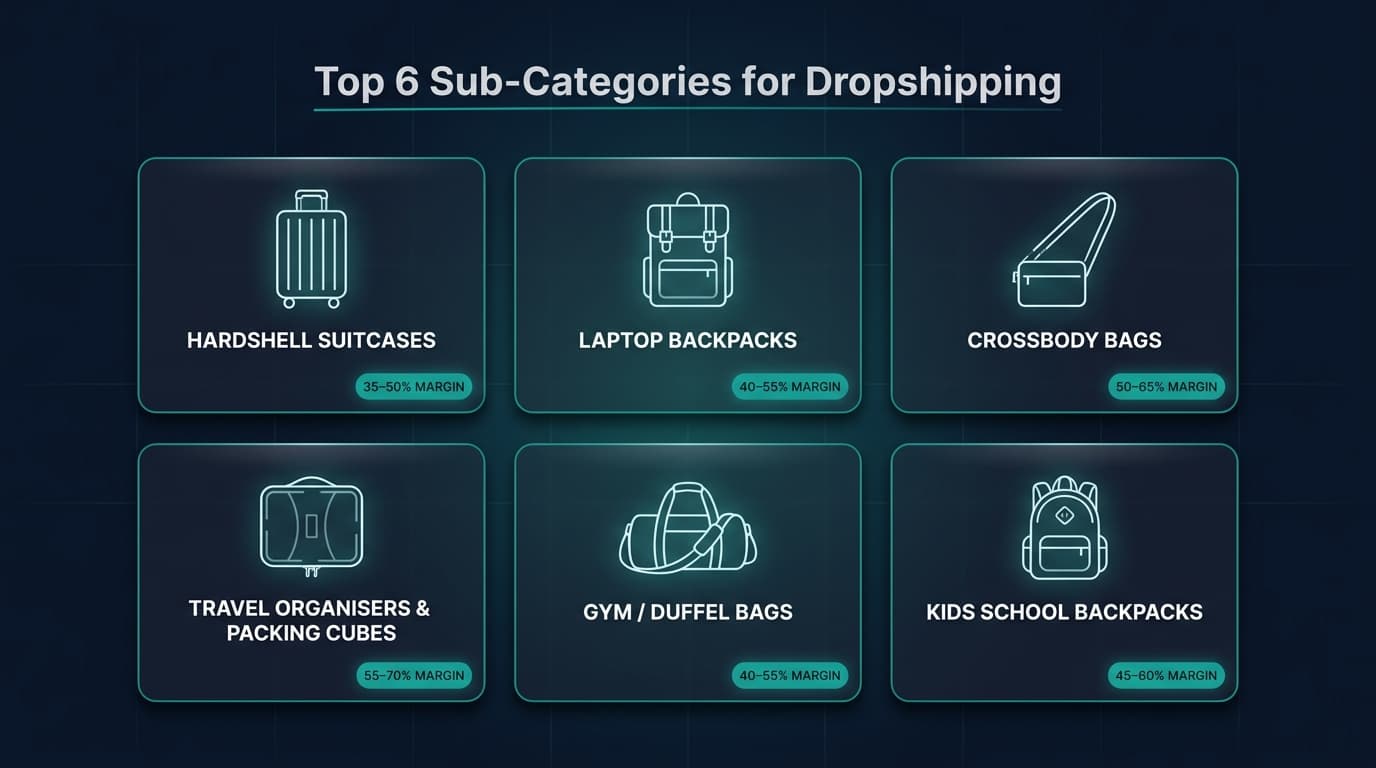
Not all bags are the same opportunity. Some sub-categories are over-saturated with low-quality generics. Others have strong demand but thin competition because most dropshippers overlook them. Here is an honest breakdown of the six sub-niches worth building around in 2026.
Crossbody Bags
Crossbody bags are the highest-velocity everyday item in the category. They convert fast because they are low-priced (typically $2.50 to $7 on AliExpress, sellable for $15 to $28), they photograph well for social ads, and the target audience — women aged 18 to 45 — is heavily represented on Facebook and Instagram.
The risk is saturation. Generic crossbody bags from generic photos against a white background will not stand out. The opportunity is in targeting specific aesthetics: minimalist structured bags for office commuters, bohemian woven-leather bags for festival-goers, or small zipper pouches marketed to travel nurses who need quick medication and ID access during shifts. Aesthetic specificity beats price on social platforms.
Backpacks
Backpacks split into three distinct markets, each with different margin profiles and competitive dynamics:
Kids and school backpacks have the clearest annual purchase trigger. Parents need them every August, they care about durability and size over brand prestige, and they respond well to themed designs (dinosaurs, space, unicorns for the 5-to-10 age group). AliExpress costs range from $3 to $9, and $18 to $35 is a normal retail range that customers accept without friction.
Hiking and outdoor backpacks attract a more discerning buyer, but also a buyer willing to pay more. A 20L daypack that costs $12 on AliExpress can sell for $39 to $55 when positioned for trail use with the right photography. The niche skews male and responds to Amazon-style spec sheets: weight, volume, number of compartments, strap padding.
Laptop and work backpacks are the most commoditized sub-niche. The good news is that buyers in this segment value organization features (USB charging port, anti-theft zipper, padded sleeve) over brand names, which means a well-specified AliExpress supplier can compete with mid-range branded options at roughly half the price.
Travel Organizers and Packing Accessories
This is the most underrated sub-niche in the entire category. Packing cubes, compression bags, flat-lay organizers, cable pouches, passport holders, and neck travel wallets are all small-ticket items ($1.50 to $4.50 on AliExpress) with strong impulse purchase dynamics and easy bundling potential.
The average order value on travel accessories is low per unit, but the bundle strategy changes the economics entirely. A "complete travel organizer set" that includes four packing cubes, a passport holder, a cable pouch, and a flat-lay toiletry bag can sell for $28 to $38 when presented as a curated kit. Your supplier cost might be $6 to $9. That is a margin structure that sustains paid acquisition without needing extreme volume.
Travel accessories also benefit from extremely low return rates. Unlike clothing or shoes, there is no fit issue. Unlike electronics, there is no functionality expectation that creates disappointment. A packing cube that arrives intact performs exactly as advertised, which keeps your customer service overhead low.
Gym Bags and Duffle Bags
Gym bags are January's gift to the dropshipping calendar. The new-year fitness wave creates a highly predictable demand spike, and unlike gym equipment (expensive to ship, frequent returns), gym bags are lightweight, inexpensive to fulfill, and have low return rates.
The differentiation angle here is branding and print. A generic black gym bag competes on price and loses. A gym bag with a motivational print ("Do Hard Things"), a specific sport reference (boxing gloves graphic), or a feminine design targeted at women in group fitness classes occupies a much cleaner competitive space. Custom print suppliers on AliExpress can deliver print-on-demand gym bags with consistent quality at $6 to $10 landed, which still leaves room for a $24 to $39 retail price.
Laptop Bags and Briefcases
Remote work is permanent, and the market for laptop bags reflects that. The category spans slim laptop sleeves ($2.50 to $5 on AliExpress), messenger-style laptop bags ($7 to $14), and structured briefcases ($12 to $22).
The professional buyer in this segment wants to look polished in video calls, co-working spaces, and client meetings. The product photography needs to reflect that aspiration — lifestyle shots in a café, a co-working space, or a well-lit home office convert dramatically better than flat-lay product shots.
Laptop bags also benefit from clear spec differentiation. Buyers search by screen size compatibility (13-inch, 15-inch, 16-inch), material (vegan leather, nylon, canvas), and organizational feature set. Meeting these search intents precisely in your product titles and descriptions drives both ad relevance and organic search traffic.
Kids Backpacks
Mentioned above within the backpack section, kids backpacks deserve their own emphasis because they are genuinely one of the most predictable repeat purchase cycles in all of consumer goods. Back-to-school is not a trend. It happens every August, and parents buy every August, often for multiple children.
The strategy here is character licensing (often expensive and complicated) versus original character design or abstract theme design. Abstract themes — geometric patterns, animal prints, color-blocking — avoid licensing fees entirely while still differentiating from the sea of identical basic backpacks. A parent buying for a six-year-old cares that it is cute, has a name label slot, and will not fall apart by October. Meeting those three requirements with a $4 supplier cost and a $19 retail price is extremely achievable.
Seasonality and Trend Timing for the Bags Category
Understanding when to push and when to pull back is the difference between profitable ads and wasted spend. The bags category has distinct windows that require different allocation strategies.
Build phase (March to April): Ad costs are relatively low before the travel and back-to-school peaks. This is the time to test creatives, build audiences, and identify which SKUs have organic traction. Launching in this window means your campaign data is battle-tested before the peak spending seasons.
Travel peak (May to June): Luggage accessories, travel organizers, and slim crossbody bags spike during this window as consumers plan summer trips. Scale budgets on proven creatives. Packing cube bundles and passport holders perform especially well in the two weeks before major travel holidays.
Back-to-school peak (July to September): The biggest annual demand window in the category. Kids backpacks, pencil cases, lunch bags, and school-themed accessories are actively searched and purchased. Bid competition rises during this window, but conversion rates are also at their highest, which typically keeps your ROAS intact even at higher CPMs.
Holiday gifting (November to December): Fashion-forward crossbody bags, luxury-look leather pouches, and travel set bundles all convert well as gift purchases. Buyers in this window are less price-sensitive than buyers in other seasons because they are purchasing for someone else.
Post-holiday fitness (January): Gym bags see their annual peak. Scale gym bag campaigns in the first two weeks of January and wind down by February when gym attendance normalizes.
Slow months (February, October): February and early October represent the lowest organic demand for bags. Use these months for product research, supplier evaluation, and creative production rather than aggressive paid acquisition.
Evaluating Bags and Luggage with AliShopping Tools
The biggest mistake dropshippers make in the bags category is choosing products based on visual appeal alone. A bag can look great in the AliExpress listing photos, have 4.8-star ratings, and still be a terrible dropshipping product — because the demand is declining, the competition is maxed out, or the margin after shipping and ads does not support profitable acquisition.
AliShopping Tools solves this by giving you data-driven evaluation for any AliExpress product in real time. Here is how to use each tab for bags and luggage specifically.
Verdict Tab
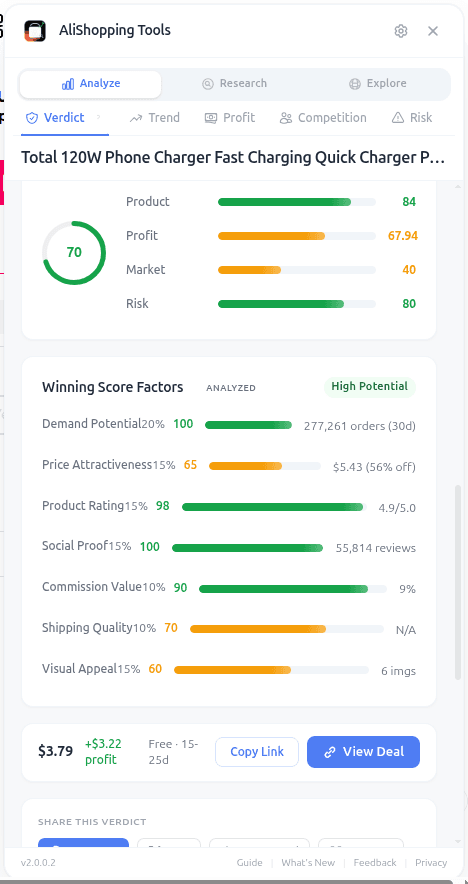
The Verdict tab runs an AI-powered scoring across eight dimensions and returns a single composite score from 0 to 100. For bags, pay close attention to the "Demand Signal" and "Market Saturation" sub-scores. A bag with a Verdict score above 70 is worth testing. Below 50, move on regardless of how good it looks.
The Verdict tab guide walks through how the scoring methodology works and what score thresholds mean for real ad spend decisions.
Trend Tab
The Trend tab shows you the demand trajectory for a product over the past 12 months. This is the single most important check before committing to a bags SKU, because the category has clear seasonality patterns and some products are in freefall while others are still in early growth.
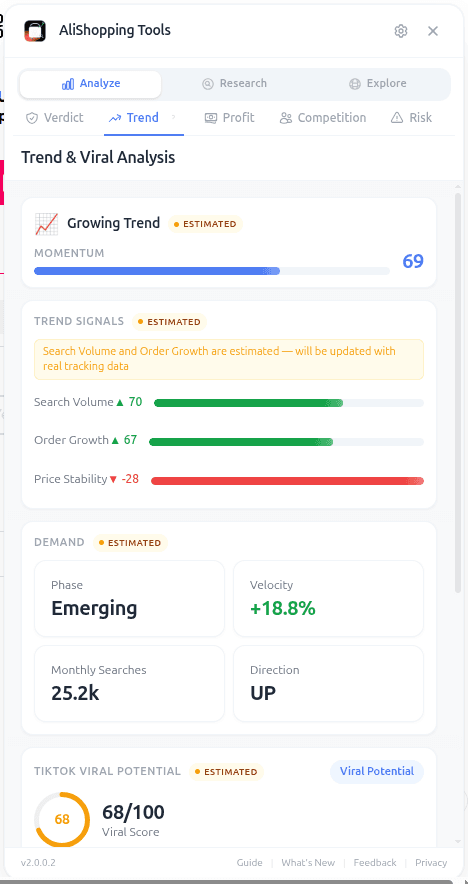
What you are looking for: a product with a rising or stable demand direction on its trend curve. If the trend line peaked eight months ago and has been declining since, you are entering a saturated market at the wrong time. The sweet spot is a product with three to six months of rising order volume that has not yet attracted mass competition.
Check the demand direction before committing ad spend — this is the step most dropshippers skip, and it is why they burn budget on saturated products that look viable on the surface.
Competition Tab
The Competition tab shows you how many sellers are actively listing the same or similar products, and gives you a saturation score. For bags, a saturation score above 75 is a serious red flag in a niche this crowded. Below 50 is the target zone.
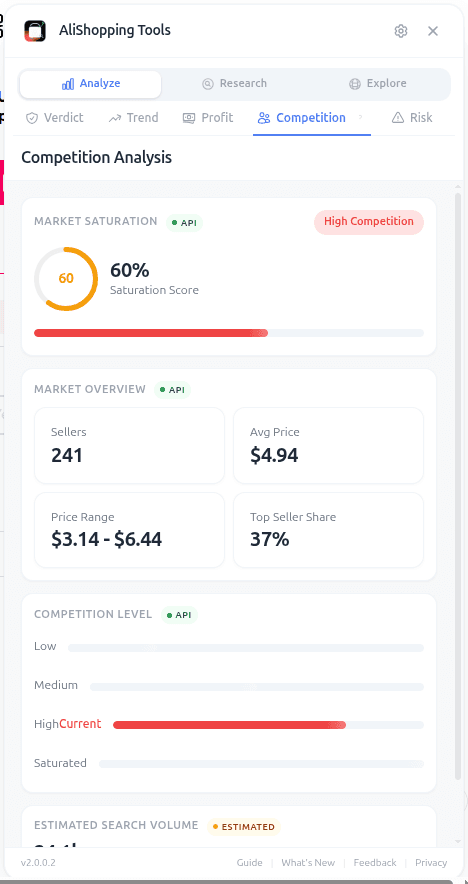
The competition check is not just about avoiding overcrowded products. It is also about identifying differentiation opportunities. If you see a product with high demand and moderate competition, the next question is: how are current sellers positioning it? If every listing uses the same white-background product photography and identical copy, there is white space for a brand that uses lifestyle photography, a specific niche audience framing, or a bundle approach.
Profit Simulator
The Profit Simulator is where reality meets enthusiasm. Enter your product cost, estimated shipping, selling price, and target ad spend — and it shows you your real margin.
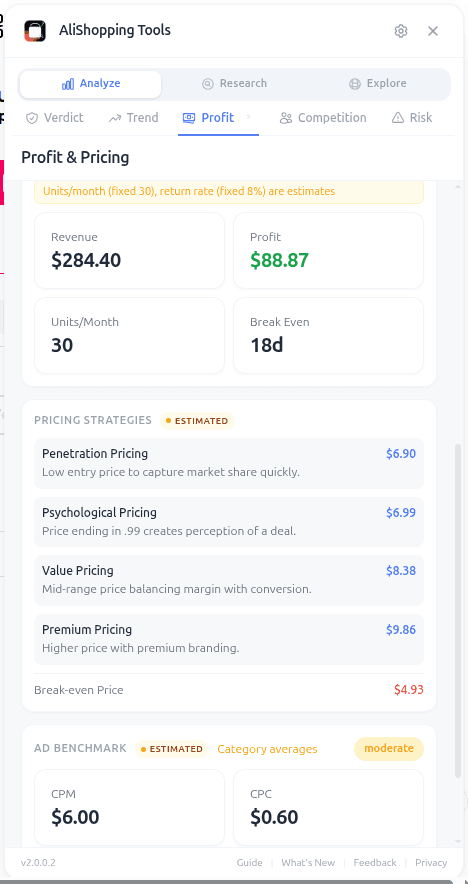
For the bags category, the math is tight. With an average AliExpress cost of $3.05 and shipping of $2.50 to $4.50 to the US or EU, your total landed cost is typically $5.50 to $7.50. To make paid acquisition work at a $15 to $22 selling price, you need a customer acquisition cost (CAC) under $6 to $8. That requires either strong organic reach, warm audiences from prior campaigns, or an exceptional creative with above-average CTR.
The Profit Simulator makes these constraints visible before you launch, which prevents the common trap of discovering the margin problem only after spending $300 on test ads.
For a deeper walkthrough of the research process, see the complete product research guide and avoid the common product research mistakes that kill most dropshipping stores before they reach profitability.
Supplier Quality Checks for Bags: Stitching, Zippers, and Hardware
Return rates in the bags category can destroy your margins if you choose the wrong supplier. Unlike many categories where a defective product is obvious from the order volume stats, bag quality issues are subtle and only reveal themselves at scale — usually after you have already committed to a supplier.
There are two quality signals that determine whether a bag supplier is worth working with: stitching density and zipper grade.
Stitching Density and Seam Integrity
Stitching is the first thing that fails on a low-quality bag. The seams at the base corners and handle attachment points bear the most stress, and inferior suppliers use loose stitching patterns that begin to separate after two to four weeks of regular use. This triggers a wave of one-star reviews and return requests precisely when your store has built up enough scale to notice it.
When evaluating a supplier, look for:
- Stitch count per inch. Higher is more durable. A supplier who photographs close-ups of their stitching is confident in it. A supplier whose photos avoid seam detail is often hiding something.
- Thread color contrast. Visible stitching in a contrasting thread color is usually better quality than invisible stitching, because a manufacturer who cares about the appearance of their stitching usually also cares about its structural integrity.
- Reinforcement at stress points. Look for bar tacks (the cross-stitched reinforcement) at the attachment points of handles, straps, and zipper ends. Their presence is a reliable indicator of production standards.
- Customer review photos. Sort AliExpress reviews by "with images" and specifically look for photos that show handles, corners, and strap attachments. Real customer photos taken after weeks of use are your most reliable quality proxy.
Zipper Grade and Hardware Quality
The zipper is the number one failure point in bags. A bag that looks premium but has a plastic generic zipper will begin to misalign, skip, or jam within weeks of use. This creates returns, but more damaging, it creates customers who will never buy from you again.
When assessing zipper quality on AliExpress listings:
- Brand name zippers are a positive signal. YKK is the global quality benchmark. Suppliers who specify "YKK zippers" in their listing are paying a small premium that signals overall quality standards. SBS is another reputable alternative. Listings that describe zippers only as "smooth" or "high quality" without naming the brand warrant skepticism.
- Metal versus plastic. Metal zipper pulls on fashion bags indicate a supplier who cares about perceived quality. All-plastic hardware on a bag priced above $15 is a mismatch that customers notice.
- Slider type. A zipper with a locking slider (one that requires a pull to slide) is significantly more durable than an open-run slider. Laptop bags and backpacks especially benefit from locking sliders.
- Order a sample before scaling. This is not optional for bags. Open and close every zipper 50 times. Load the bag to its stated capacity and carry it for a day. Inspect every seam and stress point under good light. If you are not willing to spend $20 on a sample, you are not ready to spend $300 on ads for it.
How to Differentiate in the Bags Category
The bags category on AliExpress is crowded because demand is consistent and the entry barrier is low. Selling a generic crossbody bag into the generic market is a race to the bottom. Differentiation is not optional — it is the strategy.
There are three differentiation levers that work specifically for bags in 2026.
Custom Prints and Branded Aesthetic
AliExpress has a growing number of suppliers who offer custom print-on-demand for fabric bags, especially canvas totes, backpacks, and gym bags. This opens a straightforward path to a differentiated product: design a print, have it applied to a quality base bag, and sell it to a specific community who identifies with the design.
Custom prints do not need to be complex to be effective. A single-color line art print of a mountain range on a 20L hiking backpack creates something visually distinct without requiring a complex design. A nurse-themed print on a crossbody bag — stethoscope, heartbeat line, RN initials — instantly communicates relevance to a 4.4 million person profession that is actively underserved by mainstream bag brands.
Custom print suppliers typically charge a per-unit premium of $1.50 to $3 over the base bag cost. That is usually recovered in the higher price premium a differentiated product commands and in lower ad CPMs from higher audience relevance scores.
Niche Audience Targeting
Selling "a crossbody bag" to "women who like bags" is expensive. Selling "a hands-free crossbody bag with a pen loop and ID window for nurses and healthcare workers" to an audience of traveling medical professionals is dramatically cheaper on a cost-per-acquisition basis because the relevance score drives down CPMs and the creative resonates immediately.
Effective niche audience targeting for bags in 2026 includes:
- Travel nurses: Hands-free crossbody bags, multi-compartment totes with ID windows, anti-theft packs for hospital commutes. This audience is active on Facebook, has disposable income, and is underserved by existing bag brands.
- Outdoor hikers and trail runners: Hydration-compatible daypacks, minimalist trail vests, waterproof dry bags. The outdoor community is gear-oriented and price-tolerant for products that meet clear functional specs.
- School-aged kids (marketed to parents): Themed backpacks for specific ages and interests. Parents in parenting Facebook groups convert exceptionally well for back-to-school purchases.
- Digital nomads: Sleek anti-theft backpacks with laptop compartments, passport pouches, minimalist packing cubes. This audience congregates on Reddit, YouTube, and travel-focused Instagram accounts.
- Gym-goers and group fitness participants: Branded gym bags with fitness motivational prints, separate shoe compartments, small external pockets for cards and earbuds.
Each of these audiences allows you to write ad creative that speaks directly to the buyer's context and pain points — which consistently outperforms generic product ads in both CTR and conversion.
Bundling and Complete-Kit Positioning
Individual bag items at the $3.05 average GMV are difficult to make profitable through paid ads alone. Bundles change the math entirely. A "weekend travel kit" combining a compact duffel, a set of packing cubes, a passport holder, and a cable pouch can be sourced for $9 to $14 and sold for $34 to $44 as a curated set.
Bundles also reduce your customer acquisition cost on a per-unit basis, because the same ad click that would have resulted in a $15 single-item order now results in a $38 bundle order. Your ad cost stays the same; your revenue and margin per conversion goes up significantly.
The key to effective bundle positioning is cohesion. The items in the bundle need to tell a story and share an aesthetic. A mismatched set of items shoved into one listing does not convert. A "minimalist travel essentials kit" with matching colorways and a lifestyle photo of someone packing for a weekend trip converts because it sells an aspiration, not just a collection of products.
Getting Started: A Practical First-Week Checklist
The bags category rewards specificity and preparation. Here is a practical checklist for getting started without burning budget on avoidable mistakes:
Day 1 — Niche selection: Install AliShopping Tools and spend two hours browsing the bags and luggage category. Use the Verdict tab to shortlist products scoring above 65. Pay attention to which sub-niches appear repeatedly in your shortlist. Patterns are signals.
Day 2 — Competitor research: Search your top five shortlisted products on Facebook Ad Library. Look at how current stores are positioning the product, what audiences they appear to be targeting, and what creative formats they are using. Identify the gaps in their positioning that your niche audience angle could fill.
Day 3 — Supplier evaluation: For each shortlisted product, identify the top three suppliers by order volume and rating. Read every review with a photo. Check the zipper brand if specified. Message suppliers about stitch count and whether they offer custom print options.
Day 4 — Margin validation: Run every candidate product through the AliShopping Tools Profit Simulator with realistic numbers: actual shipping cost, your target selling price, and a conservative CAC estimate based on your niche's typical Facebook CPM. Eliminate any product where the margin does not support acquisition at a realistic cost.
Day 5 — Sample orders: Order one unit from the top two suppliers for your most promising product. Use your home address as the destination to check the real shipping time and packaging quality from the customer's perspective.
Day 6–7 — Creative preparation: While samples are in transit, prepare your creative strategy. Draft ad copy that speaks to your specific niche audience. Plan photography angles that highlight the quality signals buyers care about — zippers, stitching, interior organization. If using custom prints, finalize your design.
Launch: Start with a small test budget ($15 to $25 per day) against your most specific audience. Let the data run for three to five days before drawing conclusions. Use the Trend tab to confirm the product's demand direction is still rising before scaling.
Run the full checklist free with AliShopping Tools — no credit card required
Final Thoughts
The bags and luggage category is not the most glamorous niche in dropshipping. It does not have the viral ceiling of beauty gadgets or the impulse-buy power of novelty gifts. What it has is something more valuable for building a sustainable dropshipping business: year-round demand, repeat purchase potential, and a dozen clearly defined sub-niches where a focused operator with the right tools can carve out a profitable position.
The $3.05 average GMV is a feature, not a bug. It is what makes bags an impulse buy. It is what drives the repeat purchase cycle. It is what keeps customers coming back when their crossbody wears out, their kid outgrows their backpack, or they need a new gym bag for their January fitness reset.
The operators who win in this category in 2026 are the ones who stop selling "bags" and start selling specifically — to travel nurses, outdoor hikers, minimalist commuters, fitness-motivated gym-goers, and parents shopping for their kids. Specificity combined with supplier quality discipline and data-driven product validation is the formula. AliShopping Tools provides the data layer. The niche selection and supplier work is yours to do.
More AliExpress Dropshipping Category Guides
Researching other niches? Each guide below uses real GMV data and AliShopping Tools product analysis.
- Car Accessories — $33.02 avg order value, highest-GMV category on AliExpress
- Security & Protection — $22.18 avg order value, compliance-first guide
- Home & Garden — $9.01 avg order value, 4 seasonal demand peaks
- Sports & Entertainment — impulse-buy niche with TikTok-native products
- Phone Accessories — high-volume niche, saturation navigation guide
Product Tracker Free Beta
Track any AliExpress product’s real price, orders, stock & rating for 180 days. Data doesn’t lie. But discounts can.
Before you buy
Is this deal real? Check the price history before you buy.
Prices often spike just before a “sale.” See 180-day price history and fake discount detection — free, no account needed.
Verify on AliShopping Deals →Ready to find winning products?
Try AliShopping Tools — 15 free AI tools for product research.
Quick answers
Frequently Asked Questions
1Is dropshipping bags and luggage profitable?
Yes, though the model differs from high-AOV niches.
The average GMV sits around $3.05 per unit, meaning this is a volume-driven category rather than a high-ticket one.
What makes it consistently profitable is year-round demand (no dead seasons), predictable seasonal spikes you can plan around, a diverse sub-niche landscape that reduces head-to-head competition, and high repeat purchase rates — a customer who buys a backpack today is a prospect for a gym bag, travel organiser, and laptop bag over the next 12 months.
2When do bags and luggage sell best throughout the year?
There are three major demand spikes: back-to-school season (July–August), which anchors around school backpacks and student bags; travel season (May–June), which drives luggage, packing cubes, and travel organisers; and holiday gifting (November–December), which lifts crossbody bags, premium backpacks, and gift-ready designs.
Between these peaks, everyday carry products — crossbody bags, work bags, gym bags — maintain a steady baseline.
This makes bags one of the few categories where ad spend can stay active all 12 months.
3What bags sell best for dropshipping on AliExpress?
The six sub-categories worth building around in 2026 are: crossbody bags (evergreen everyday carry, low return rate), backpacks (school + hiking + laptop variants), travel organisers and packing cubes (travel season spike), gym bags and duffle bags (January fitness rush), laptop bags and briefcases (work segment), and kids backpacks (predictable August demand).
Crossbody bags and travel organisers tend to have the best combination of low competition and consistent demand for new operators.
4How do I check bag quality when sourcing from AliExpress suppliers?
Focus on two physical quality signals: zipper grade and stitching density.
Request a sample and test the zipper 50 times — if it feels loose or catches after 20 pulls, it will fail in customer use within weeks.
Inspect stitching density at stress points (handles, shoulder strap attachment, zipper base) with a magnifying photo — 8 stitches per cm is a minimum standard.
Also check hardware (buckles, clasps, D-rings) for sharp edges and loose rivets.
Listings with multiple reviewer photos showing wear patterns are more informative than star ratings alone.
5How do I differentiate in the bags and luggage niche?
Niche down by audience rather than trying to compete on price for generic products.
A 'bags for travel nurses' store, a 'hiking backpacks under $50' brand, or a 'organisation bags for school kids' position is far more defensible than a general bag store.
Custom print-on-demand allows you to add niche-specific designs without holding inventory — AliExpress has multiple suppliers who offer custom logo and pattern printing at reasonable MOQs.
Differentiation through audience specificity also improves ad targeting and ad creative performance.
6What margins should I expect when dropshipping bags from AliExpress?
Crossbody bags sourced at $4–9 retail for $22–42 (40–55% net margin).
School backpacks at $5–12 retail for $24–45.
Travel organisers and packing cubes at $3–8 retail for $16–32.
Gym bags at $6–14 retail for $28–55.
Higher-end laptop bags can reach $12–25 wholesale and $55–95 retail, giving the best absolute dollar margin per unit.
Use the AliShopping Tools Profit Simulator to model each bag SKU with your actual shipping cost to destination market before placing orders.
7What is the average shipping time for AliExpress luggage dropshipping orders in 2026, and how can I reduce delivery delays?
Shipping times for luggage dropshipping vary by supplier and shipping method — standard e-packet is generally slower and cheaper, while premium DHL/EMS-type options cost more but deliver faster.
Rather than relying on a fixed day-range, filter suppliers by their stated delivery speed and prioritize ones with warehouses closer to your target market.
Enabling order tracking and routing high-volume SKUs through a faster fulfillment option where it makes economic sense are reasonable ways to tighten delivery times.
8How can I calculate the true ROI for a dropshipped backpack using AliExpress supplier costs, advertising spend, and hidden fees?
To calculate true ROI, subtract every real cost — product price, shipping, platform fees, ad spend, and any customs/handling fees — from the sale price, then divide the resulting profit by total cost.
Your actual ad cost per sale depends on your real CPM and conversion rate, which you should pull from your own campaign data rather than assuming a fixed benchmark.
Use the AliShopping Tools Profit Simulator to plug in your own numbers per SKU once you have real cost and ad-performance data.
9Which advertising platforms generate the highest conversion rates for travel bags dropshipping in 2026, and what CPM benchmarks should I target?
TikTok Ads and Google Shopping are both commonly used for travel-bag dropshipping, but actual conversion rates and CPMs vary widely by creative, audience, and season — we don't have reliable benchmarked figures to quote for either platform.
Track your own CPC, conversion rate, and cost-per-acquisition once you start testing, and use the AliShopping Tools Competition tab to spot less-saturated ad niches rather than targeting a fixed CPM number.
10What steps should I follow to set up automated order fulfillment from AliExpress to my Shopify store for luggage items?
Connect a fulfillment/order-automation app (like DSers) to your Shopify store to handle order placement and tracking sync, and use AliShopping Tools' Shopify Direct Import feature to pull selected AliExpress products into your catalog.
Configure your automation settings so new Shopify orders trigger supplier orders, set inventory thresholds to avoid overselling, and always run a test order on a low-cost item first to confirm the workflow before activating it for all active SKUs.
11How do I create a bundled product offer (e.g., backpack + travel organizer) that maximizes average order value without violating AliExpress supplier policies?
You can create a bundle by listing a composite product on your storefront and sourcing both items from a single AliExpress supplier that offers a multi‑SKU package.
Negotiate a bundle MOQ that lets you price the package 10–15% higher than the sum of individual retail prices, boosting average order value.
Use the AliShopping Tools to verify that the combined cost still meets your profit targets and that the supplier can ship the items together in one package, avoiding split shipments that could breach policy.
Sync inventory levels for the bundle, and clearly state in the product description that the items are shipped as a single package to stay compliant.
Daniel has spent 6 years dropshipping across AliExpress and Shopify, testing over 200 products in home, apparel, electronics, and accessories niches. He writes for the AliShopping Tools blog to share the research frameworks and supplier vetting processes that separate profitable product launches from expensive mistakes.
View profileRelated Articles
- How to Do Product Research for Dropshipping: 7-Step Framework (Free Tools, 2026)guides
- Dropshipping Home & Garden Products from AliExpress in 2026: The Complete Playbookdropshipping
- Dropshipping Phone Accessories from AliExpress in 2026: Opportunity, Saturation, and How to Windropshipping
- Dropshipping Security & Protection Products from AliExpress in 2026dropshipping
- I Spent $1,000 Testing 12 AliExpress Products. Here's the Spreadsheet.misc
- AliExpress Product Research Tool 2026: Free 5-Step Workflowproducts
More from the blog
How to Do Product Research for Dropshipping: 7-Step Framework (Free Tools, 2026)
A repeatable 7-step product research framework for dropshippers in 2026 — from idea sourcing to live testing, using only free tools. No Ecomhunt subscription needed.
Dropshipping Home & Garden Products from AliExpress in 2026: The Complete Playbook
Home & Garden delivers $9.01 avg order value and 35–55% margins on AliExpress. Covers the top 5 sub-categories, supplier red flags, and seasonal timing for 2026.
Dropshipping Phone Accessories from AliExpress in 2026: Opportunity, Saturation, and How to Win
Phone accessories on AliExpress: which sub-categories still have room, how to spot saturation fast, and how to build a defensible position in 2026.