AliExpress vs Temu vs SHEIN for Dropshipping Sourcing in 2026
AliExpress vs Temu vs SHEIN for Dropshipping Sourcing in 2026
Quick answer: AliExpress is the only one of the three built for dropshipping — single-unit orders, visible supplier ratings, and mature tooling (DSers, AliShopping Tools). Temu's Terms of Use prohibit resale outright and its systems ban accounts showing reseller order patterns; SHEIN runs no official dropship program and leaves resale in an unsanctioned gray area (its product images and descriptions are also copyright-protected, so you can't reuse them in your store). Both do run legitimate affiliate/creator programs — link commission, not resale — a separate income stream, not a sourcing option. Building a store? Source from AliExpress. Install AliShopping Tools on the Chrome Web Store →
Bottom line at a glance:
| Platform | Dropship-friendly? | What it's actually for |
|---|---|---|
| AliExpress | ✅ Yes — sanctioned, dropship-native | Sourcing + fulfilling customer orders (DSers / AutoDS) |
| Temu | ❌ No — Terms prohibit resale, real ban risk | Consumer D2C buying; affiliate/creator commissions |
| SHEIN | ⚠️ No official program — gray-area resale | Consumer fashion buying; trend-scouting + affiliate |
Through most of the dropshipping era, the answer to "where do I source from" was AliExpress. There were alternatives — Alibaba for higher-volume operators, CJDropshipping for faster shipping, Spocket for EU/US suppliers — but the default was AliExpress and most operators never moved off it.
Temu and SHEIN's aggressive pricing and marketing spend since 2023 have made a lot of dropshippers ask whether either platform now supports resale the way AliExpress does. The honest answer, checked directly against each platform's own policy and support pages: no, neither Temu nor SHEIN runs an official dropshipping or resale program. Both are consumer-facing D2C marketplaces built around direct-to-buyer pricing, not wholesale-to-reseller supply chains. This guide is the honest head-to-head from the dropshipper's seat — what's real, what isn't, and what the actual risk looks like if you try to use Temu or SHEIN for resale anyway.
We will say up front: we are operationally biased toward AliExpress because we have built our research tooling around it for the past three years. But the analysis below reflects each platform's actual, current policy — not marketing claims or forum speculation — and we are explicit about which platforms our tooling covers today versus which it does not.
1. Why this question keeps coming up — and what's actually true
Dropshippers keep asking about Temu and SHEIN because the retail prices on both platforms are aggressively low, and low retail price looks — on the surface — like sourcing margin. Three things are worth separating clearly:
- Temu does not have a dropshipper program, and its Terms of Use explicitly prohibit resale. Temu's own support documentation states it does not support individuals or businesses using the platform for dropshipping. Its systems actively look for reseller signatures — high order volume from one account shipped to many different addresses, mismatched billing/shipping details — and accounts that trip those signals risk permanent suspension and frozen funds. There is no supported fulfillment API, no dropshipper dashboard, no partner integration for resale.
- SHEIN does not have an official dropshipper program either. SHEIN's terms are written for end customers making personal purchases, not for sellers running a resale business. SHEIN does not explicitly ban resale the way Temu does, but it doesn't endorse or support it — meaning informal resale sits in an unsanctioned gray area with the same underlying account risk, just less aggressively enforced in practice.
- AliExpress remains the only platform of the three where dropshipping is a recognized, supported use case. Single-unit ordering, supplier ratings, buyer protection built around resale-style order volume, and official tooling (DSers) that assumes you're fulfilling customer orders, not buying for yourself.
What both Temu and SHEIN do have is a real, official affiliate/creator program — you sign up, get a tracked referral link, and earn a commission (roughly 5–20%+ depending on category and program tier) when someone buys through your link. That is fundamentally different from dropshipping: you never take inventory, never mark up a price, never fulfill an order — the customer buys directly from Temu or SHEIN, at Temu's or SHEIN's price, and you get a referral fee. It's a legitimate side-income stream for content creators and deal-sharing communities, but it is not a substitute for a dropshipping supply chain, and treating it as one is where a lot of "Temu dropshipping" confusion online comes from.
2. Side-by-side comparison — 10 dimensions
The table below reflects each platform's own policy and support documentation, checked directly rather than sourced from dropshipping-guide sites that often blur "affiliate program" and "dropship program" together. Platform policy can change; verify directly on each platform before committing budget or building a workflow around any of this.
| Dimension | AliExpress | Temu | SHEIN |
|---|---|---|---|
| Catalogue breadth | Very broad — millions of SKUs across all categories | Broad — strong on commodity / household / electronics | Narrow — fashion, apparel, accessories, beauty, home only |
| Official dropshipping/resale program | Yes — dropshipping is a recognized, supported use case | None — Terms of Use explicitly prohibit commercial resale | None — no official program; terms written for personal-use buyers |
| Typical retail unit cost | $2-15/unit, wide variance | Often lower than AE retail on equivalent commodity goods | Apparel often cheapest in category at retail |
| MOQ (minimum order quantity) | 1 unit — true single-order, dropship-native | 1 unit — but priced/operated for an end personal buyer, not a reseller | 1 unit — same caveat as Temu |
| Shipping speed (US/EU) | 14-28 days standard, 7-14 days express tier | Often faster than AE via Temu's own logistics network | Often 1-2 weeks for fashion items |
| Supplier transparency | High — supplier name, store rating, and history visible | Low — Temu is the merchant of record on most listings, not a supplier marketplace | Low — SHEIN is the brand of record; original manufacturer not exposed |
| Fulfillment / dropship app integration | DSers (official), AutoDS, CJ, and others | None official — no dropship-oriented API | None official — no dropship-oriented API |
| Real affiliate/creator program | Exists, but dropshipping is the dominant use case | Yes — commission on referred purchases via tracked links (not resale) | Yes — commission on referred purchases via tracked links (not resale) |
| Risk if you resell anyway | Low — resale is the sanctioned use case | High — order-pattern detection systems flag reseller behavior; account suspension and fund freezes reported | Medium — unsanctioned gray area; less aggressive enforcement reported than Temu, but no policy protection if flagged, and SHEIN's product images/descriptions are copyright-protected (can't be reused in your store) |
| Buyer dispute mechanism | Standard AE buyer protection, built around resale-style order volume | Standard consumer buyer protection (not built for a reseller's order pattern) | Standard consumer buyer protection (not built for a reseller's order pattern) |
[Sources checked directly against Temu and SHEIN's own terms-of-use / support documentation and affiliate program pages, verified July 2026. Policies can change — confirm on each platform before building a workflow around this.]
3. The real risk profile of each platform
AliExpress — operational stability is the moat
AliExpress's strongest argument in 2026 is not pricing — pricing has compressed across all three platforms at the retail-consumer level. It is that AliExpress is actually built for what dropshippers need: single-unit orders that don't look anomalous, a supplier-rating system, and dispute paths that assume resale-style order volume. AliExpress has been the default dropshipping sourcing platform for nearly a decade and the rules of engagement are well understood.
The risks that do exist are well-known: variable supplier quality, 14-28 day shipping windows, mixed review authenticity. We have a supplier risk guide for 2026 covering the specific signals, and our product research hub lays out the full sourcing workflow.
For operators choosing between AliExpress and Alibaba (a different question, for higher-volume operators), our AliExpress vs Alibaba guide covers the volume threshold where Alibaba starts to beat AliExpress on unit economics.
Temu — no dropship program, real ban risk if you try anyway
Temu is a D2C discount marketplace, not a supplier network. Its Terms of Use prohibit commercial resale in plain language, and its systems are built to detect it: repeated orders shipped to different addresses from one account, billing/shipping mismatches, and order volume inconsistent with personal use are the patterns operators report triggering suspensions. There is no dropshipper dashboard, no official fulfillment API, no partner program for resale — anyone selling a "Temu dropshipping" workflow is describing an informal, unsanctioned buy-on-demand-and-ship process that runs against Temu's own stated rules.
The one thing that is real and sanctioned on Temu is its affiliate/influencer program — you promote a tracked link, the customer buys directly from Temu, and you earn a referral commission. That's a legitimate income stream, but it is not a dropshipping alternative: you're not fulfilling orders, holding a product page in your own store, or marking up price. If your business model depends on buying Temu inventory and reselling it under your own store, you are operating outside Temu's terms and taking on account-ban and fund-freeze risk with no policy protection if flagged.
SHEIN — no program, gray-area resale, real value as a trend-scouting source
SHEIN's position is closer to a gray area than Temu's outright prohibition, but the underlying fact is the same: there is no official SHEIN dropshipper program. SHEIN's terms are written for personal-purchase customers, not resellers, and the platform does not provide a dropship dashboard or fulfillment API. Operators who informally resell SHEIN products (buying to order and shipping to the end customer) are doing so without policy protection — SHEIN hasn't published aggressive anti-reseller enforcement the way Temu has, but that is a difference of enforcement intensity, not of sanctioned status. There's a second, often-missed catch: SHEIN's product images and descriptions are copyright-protected, so reusing them on your own store or marketplace listing exposes you to copyright takedowns independent of any account-status question.
Where SHEIN genuinely earns its place in a dropshipper's toolkit is as a fast-fashion trend-scouting source, independent of whether you ever buy from it directly. SHEIN's catalogue turns over on a genuinely fast cycle and is a useful signal for what's trending in apparel and accessories — many apparel-focused dropshippers use SHEIN's storefront for trend discovery, then source the equivalent (or identical) item on AliExpress, where the resale use case is actually supported. SHEIN also runs the same kind of affiliate/creator program as Temu — real, sanctioned, commission-based — which is worth using for its own sake rather than as a workaround for a dropship program that doesn't exist.
4. Which AStools covers (and which it does not)
We will be direct about this because clarity on tooling coverage is more useful than aspirational marketing.
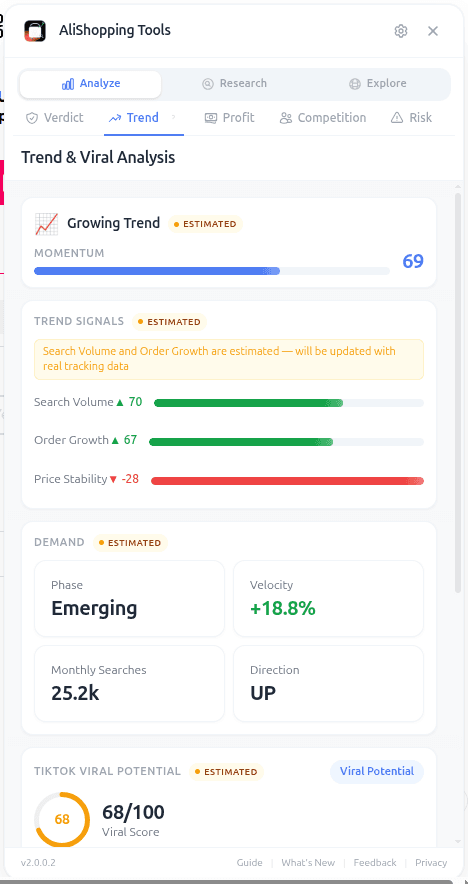
AStools' AliExpress coverage is mature. When you open any AliExpress product page with the AliShopping Tools Chrome extension installed, fourteen analysis tabs surface automatically: AI verdict scoring, profit simulator, supplier risk score, supplier compare across multiple sellers, review trust analysis, trend phase classification, competition saturation reading, niche discovery, similar product finder, promotions tracker, viral trend scoring, and more. This is the depth that the AStools tool was designed for over the past three years, and it makes sense given AliExpress is the platform where resale is actually the supported use case.
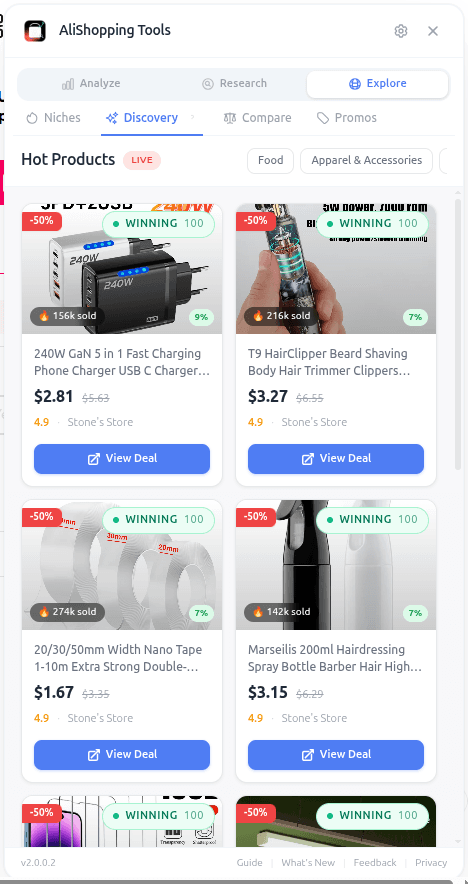
AStools' TikTok module exists. A TikTok product research module is shipped and covers TikTok shop browsing for trend identification. It is narrower in scope than the AliExpress coverage and does not include the verdict-scoring or supplier-risk depth.
AStools does not currently provide a Temu or SHEIN tab. This is honest disclosure: we have not built dedicated coverage for either platform's listing pages. Since neither Temu nor SHEIN runs a dropshipping program, this is a smaller gap for resale-focused workflows than it would first appear — but if you use SHEIN or Temu for trend-scouting or affiliate content, you'll need the platforms' native tools (Temu Trends, SHEIN Search) plus general analytics tools, until dedicated coverage ships.
We mention this because pretending AStools covers a use case that shouldn't exist in the first place (Temu/SHEIN dropshipping) would be worse than admitting the gap. The honest answer is: AStools is the right research tool if your sourcing platform is AliExpress (today, where dropshipping is actually supported), and a complementary research tool if you're doing trend discovery on TikTok or SHEIN (today, narrower coverage, and not a sourcing/fulfillment tool for those platforms).
5. Recommended path per operator stage
The honest stage-by-stage recommendation for a 2026 dropshipper:
Stage 1 — beginner, no winning product yet
Platform: AliExpress. This isn't close: AliExpress is the only one of the three where dropshipping is a recognized, supported use case. Beginners need stable platform behaviour, well-documented dispute paths, and a deep tooling layer to identify their first winning product — and they need to not be building a business on a platform whose terms explicitly prohibit what they're doing. The 14-28 day shipping window is real but manageable with clear customer expectations. The supplier risk is manageable with the right tooling.
A beginner who starts by trying to resell Temu or SHEIN inventory is taking on account-ban risk (Temu) or unsanctioned gray-area risk (SHEIN) on top of normal product-validation risk, for no real upside — there's no dropship-specific pricing tier or fulfillment support on either platform to offset that risk.
Stage 2 — validated winner, scaling to $20K-50K monthly revenue
Platform: AliExpress, full stop, for sourcing. There is no "selective Temu" sourcing tier to graduate into — Temu doesn't offer one. The margin-optimization move at this stage is deepening your AliExpress supplier relationships (negotiated pricing, better shipping tiers via DSers/AutoDS) and tightening your tooling workflow, not diversifying sourcing onto platforms that don't support resale.
Where Temu and SHEIN can add revenue at this stage is as a side channel through their affiliate programs — running content or deal-sharing that earns referral commission — but that's a separate revenue line from your dropshipping store, not an alternative sourcing platform for it.
Stage 3 — apparel-led TikTok dropshipper
Platform: AliExpress for sourcing, SHEIN for trend-scouting only. If your operator profile is "I find fashion items on TikTok and run them as short campaigns," use SHEIN's storefront and fast catalogue turnover to spot what's trending, then source the equivalent item on AliExpress, where the resale use case is actually supported and DSers/AutoDS can fulfill it. Buying directly from SHEIN to fulfill customer orders puts you in the same unsanctioned gray area described above — real account risk with no dropship-specific policy protection if something goes wrong.
If you also run content (reviews, hauls, "what's trending" posts), SHEIN's and Temu's official affiliate programs are legitimate additional income — just keep that revenue stream conceptually separate from your dropshipping store's sourcing.
Stage 4 — multi-category established store
Platform: AliExpress, with affiliate content as a secondary revenue line, not a secondary sourcing platform. At this stage, platform diversification for risk management means deepening multiple AliExpress supplier relationships and tooling coverage, not adding Temu or SHEIN as resale sources — neither supports that use case, regardless of your order volume. If you run content alongside your store, Temu's and SHEIN's affiliate programs are worth adding as a separate monetization line.
For TikTok-driven product discovery feeding your AliExpress sourcing, our TikTok viral products guide covers the trend identification workflow. For the deeper sourcing-side methodology, the dropshipping product research guide is the pillar covering verdict scoring, profit modelling, and saturation reading, and the AliExpress trust hub for 2026 walks through the supplier-side trust signals for AliExpress sourcing.
6. The honest summary
AliExpress is the only one of the three platforms actually built for dropshipping in 2026 — not because Temu and SHEIN are worse retailers (they compete hard on price), but because they are D2C marketplaces with no official resale program, and in Temu's case, terms that explicitly prohibit it. The tooling layer alone — DSers integration, supplier risk research, profit simulation — has years of accumulated depth built around a use case that only AliExpress actually supports.
Temu and SHEIN are worth knowing well: Temu for its aggressive commodity pricing (as a place your customers might already be shopping, and as an affiliate income stream), SHEIN for its trend-scouting value in apparel and its own affiliate program. But trying to use either as a dropship supplier means operating outside their terms, with real account-suspension risk and zero policy protection if you're flagged. Keep sourcing on AliExpress, and treat Temu/SHEIN affiliate programs as separate, legitimate income streams rather than substitute supply chains.
If your sourcing is on AliExpress today, install AliShopping Tools free from the Chrome Web Store — it covers the full research stack on every AliExpress product page automatically.
For a Pakistan-specific breakdown covering PKR pricing, FBR customs, and Daraz sourcing, see AliExpress vs Temu for Pakistani Resellers 2026.
Disclosure: This article is published by the AliShopping Tools team. Platform policy claims here (Temu's resale prohibition, SHEIN's lack of an official dropship program, both platforms' affiliate programs) were checked directly against each platform's own terms-of-use, support documentation, and affiliate program pages as of July 2026. Platform terms can change — verify current rules on each platform before making sourcing decisions. Email feedback via contact page.
All trademarks referenced are the property of their respective owners. This guide is for educational purposes and is not financial or business advice.
AliShopping Tools
See live AliExpress data in your browser.
Seller trust score, 90-day price history, and live promo codes — on every AliExpress product page. No account, free.
Ready to find winning products?
Try AliShopping Tools — 15 free AI tools for product research.
Quick answers
Frequently Asked Questions
1Can you use Temu or SHEIN for dropshipping?
Not through an official program — neither exists.
Temu's Terms of Use explicitly prohibit commercial resale, and its systems actively flag reseller order patterns (bulk orders shipped to many different addresses, billing/shipping mismatches) for account suspension.
SHEIN doesn't explicitly ban resale, but it has no official dropship program either — its terms are written for personal-use buyers, so informal resale sits in an unsanctioned gray area with the same underlying account risk, just less aggressively enforced.
AliExpress is the only one of the three built for dropshipping: single-unit ordering, supplier transparency, and dropshipper-friendly fulfilment terms.
2Which is better for dropshipping — AliExpress, Temu, or SHEIN?
AliExpress is the only viable dropshipping sourcing platform of the three — it's the only one where resale is a recognized, supported use case, with the broadest catalogue, deepest tooling integration, and stable, documented terms.
Temu has no dropship program and its terms explicitly prohibit resale.
SHEIN has no official dropship program either and is fashion-only, so it isn't a general sourcing option even setting the resale question aside.
3Does Temu have an official dropshipper program?
No.
Temu does not run a dropshipper program, dashboard, or fulfilment API.
Its Terms of Use state that products are for personal use and prohibit commercial resale, and its detection systems ban accounts showing reseller-style order patterns.
Temu does run a separate, legitimate affiliate/influencer program — you share a tracked referral link and earn a commission when someone buys through it — but that is referral marketing, not dropshipping: you never take inventory, mark up a price, or fulfil an order.
4What tooling covers AliExpress that doesn't cover Temu or SHEIN?
AliExpress has the deepest third-party tooling layer of the three, and that tracks with it being the only platform where dropshipping is actually supported.
Extensions like AliShopping Tools provide AI verdict scoring, profit calculation, supplier comparison, and risk assessment specifically for AliExpress listings.
Neither Temu nor SHEIN has comparable dropshipping-focused research tooling — there isn't a dropship workflow on either platform for such tooling to serve.
5What happens if you try to resell Temu or SHEIN products anyway?
On Temu, you're operating directly against the platform's stated terms.
Operators report that order patterns inconsistent with personal use — repeat orders to different shipping addresses from one account, mismatched billing/shipping details, high order volume — can trigger account suspension and frozen funds, with no dropshipper-specific appeal path since the use case isn't sanctioned in the first place.
On SHEIN, the same underlying risk exists in a less explicitly enforced gray area: there's no dropship program, so there's no policy protection if an account is flagged.
Neither platform offers a supported resale path the way AliExpress does.
6Do Temu and SHEIN have affiliate programs, and is that the same as dropshipping?
Both run real, official affiliate/creator programs — you apply, get a tracked referral link, and earn a commission (roughly in the 5-20%+ range depending on category and program tier) when someone buys through your link.
That is a completely different model from dropshipping: the customer buys directly from Temu or SHEIN at their price, you never hold inventory or fulfil the order, and you earn a referral fee rather than a resale margin.
It's a legitimate side-income stream for content creators, but it isn't a substitute for a dropship supply chain.
7Is SHEIN useful for dropshippers even without an official program?
Yes, as a trend-scouting source rather than a sourcing platform.
SHEIN's fashion catalogue turns over quickly, which makes it a useful signal for what's trending in apparel and accessories.
Many apparel-focused dropshippers browse SHEIN for trend discovery, then source the equivalent or identical item on AliExpress, where dropshipping is actually supported and DSers/AutoDS can handle fulfilment — rather than buying from SHEIN directly to fill customer orders.
8Why do so many guides claim Temu and SHEIN have dropshipping programs?
Most of that confusion comes from conflating the platforms' real affiliate/influencer programs with dropshipping, or from describing an informal buy-on-demand-and-ship workflow as if it were an official, sanctioned program.
Neither Temu nor SHEIN publishes a dropshipper onboarding flow, dashboard, or fulfilment API — checking directly against each platform's own terms-of-use and support documentation is the only reliable way to confirm this, since third-party guide sites vary widely in accuracy.
9What's the safest way to build a dropshipping business given this landscape in 2026?
Source and fulfil through AliExpress, where resale is a recognized use case with supplier transparency, buyer protection built around resale-style order volume, and mature tooling (DSers, AutoDS, and research extensions like AliShopping Tools).
Use Temu and SHEIN, if at all, for what they're actually good for — Temu as a low-price consumer reference point and affiliate income stream, SHEIN as a fast-fashion trend-scouting source and affiliate income stream — and keep both separate from your store's actual sourcing and fulfilment, since neither offers policy protection for resale.
More from the blog
AliExpress vs All Platforms 2026: Ultimate Comparison
AliExpress vs Alibaba, Temu, DHgate, CJ Dropshipping, Zendrop, and Shein: 2026 guide to shipping, pricing, dropshipping, and which platform wins your use case.
AliExpress vs Temu for Bangladeshi Resellers in 2026: Which Platform Wins?
Bangladeshi resellers and buyers sourcing from AliExpress or Temu in 2026: here's the honest platform comparison. Covers BDT pricing, NBR customs duties, the $12,000 annual FE quota for personal imports, shipping times to Bangladesh, and which payment methods work — bKash, Nagad, and Rocket do not work on either platform.
AliExpress vs Temu for Indian Resellers in 2026: Which Platform Wins?
Indian resellers sourcing for Meesho, Flipkart, or local markets: here's the honest AliExpress vs Temu breakdown for 2026. Covers INR pricing, CBIC customs (BCD + IGST), RBI LRS limits, TCS on international purchases, shipping times to India, and which payment methods actually work.