AliExpress vs Alibaba for Dropshipping: Which One Should You Use in 2026?
AliExpress vs Alibaba for Dropshipping: Which One Should You Use in 2026?
Quick answer: No — per unit, AliExpress is not cheaper than Alibaba. Alibaba sells at factory/wholesale prices that are lower per item, but it requires bulk minimum orders (typically 50–1,000+ units). AliExpress costs more per unit yet lets you buy single items with no minimum order, built-in shipping, and full buyer protection — which makes it the cheaper practical choice for dropshippers testing products before committing to inventory. Once a product is validated, switching to Alibaba bulk pricing improves margins. AliShopping Tools is a free Chrome extension that helps you research and evaluate AliExpress products before sourcing. Install AliShopping Tools on the Chrome Web Store →
If you are starting a dropshipping business, one of the first decisions you will face is choosing your sourcing platform. AliExpress and Alibaba are both owned by Alibaba Group, but they serve very different purposes. Picking the wrong one can cost you time, money, and momentum.
This guide breaks down the key differences between AliExpress and Alibaba for dropshipping in 2026 so you can make an informed decision based on your business stage, budget, and goals.
<div class="quick-answer">AliExpress is for dropshipping — you buy single units, no MOQ, and the supplier ships direct to your customer. Alibaba is for wholesale — minimum orders (usually 100–500 units), you stock inventory, then ship yourself. For dropshipping beginners: use AliExpress. Once you find a winning product, negotiate bulk pricing on Alibaba to improve margins.</div>The Fundamental Difference
Before diving into specifics, here is the core distinction:
-
AliExpress is a B2C (business-to-consumer) marketplace. Suppliers sell individual items directly to buyers at retail or near-wholesale prices. No negotiations, no minimum orders. Think of it as the Amazon of Chinese suppliers.
-
Alibaba is a B2B (business-to-business) marketplace. Manufacturers and trading companies sell in bulk at factory prices. Most listings require minimum order quantities (MOQs), and pricing is typically negotiated through direct communication with the supplier.
Both platforms connect you with Chinese suppliers, but the buying experience, pricing structure, and risk profile are fundamentally different.
Side-by-Side Comparison
| Factor | AliExpress | Alibaba |
|---|---|---|
| Business model | B2C retail marketplace | B2B wholesale marketplace |
| Minimum order quantity | 1 unit | Typically 50-1,000+ units |
| Unit price | Higher (retail markup) | Lower (factory/wholesale) |
| Shipping | Built-in shipping options (ePacket, AliExpress Standard, etc.) | Arranged separately; freight forwarding often required |
| Shipping speed | 7-30 days (varies by method) | 15-45 days (sea freight can take 60+) |
| Payment protection | Full buyer protection with dispute system | Trade Assurance (covers quality and shipping) |
| Product pages | Detailed with photos, reviews, order counts | Basic; often just specs and MOQ ranges |
| Communication | Optional; buy directly | Required; negotiate price, MOQ, samples |
| Customization | None (buy as-is) | Private labeling, custom packaging, OEM |
| Best for | Beginners, testing products, small orders | Scaling, bulk orders, private label brands |
| Supplier verification | Seller ratings and reviews | Gold Supplier, Verified Manufacturer badges |
| Return policy | Standard return/refund process | Negotiated per order; often limited |
| Product research tools | Extensive (order history, reviews, third-party extensions) | Limited (no public order data) |
Pricing Model: Retail Markup vs. Bulk Discount
AliExpress Pricing
On AliExpress, you see a fixed price per unit. A phone case might list at $3.50 with free shipping. What you see is what you pay. There is no negotiation, no back-and-forth. This simplicity is a major advantage for beginners who want to test products without committing capital.
The tradeoff is that AliExpress prices already include the supplier's retail margin. You are paying more per unit than you would on Alibaba, which directly impacts your profit margins.
Alibaba Pricing
Alibaba pricing is tiered by quantity. That same phone case might cost $0.80 per unit at 500 pieces, $0.60 at 1,000 pieces, and $0.45 at 5,000 pieces. The savings are significant, but so is the upfront investment.
Most Alibaba listings show a price range rather than a fixed number. You will need to contact the supplier, negotiate terms, request samples, and agree on a final price. This process can take days or weeks.
Bottom line: AliExpress gives you instant, transparent pricing. Alibaba gives you better margins but requires negotiation and capital.
Minimum Order Quantities (MOQ)
This is often the deciding factor for new dropshippers.
AliExpress has no MOQ. You can buy a single unit of any product. This means you can test 10 different products for the cost of a single Alibaba order. For product validation, this flexibility is invaluable.
Alibaba MOQs vary by supplier but typically start at 50-100 units for small items and can reach 500-1,000+ for manufactured goods. Some suppliers advertise "low MOQ" or "sample orders," but even then you are looking at 10-20 units minimum, and the per-unit price at low quantities may not be much better than AliExpress.
For beginners testing products: AliExpress wins decisively. You should never commit to 500 units of a product you have not validated with real customers.
Shipping and Fulfillment
AliExpress Shipping
AliExpress has standardized shipping built into the platform. Most sellers offer multiple options:
- AliExpress Standard Shipping: 15-20 days to most countries
- ePacket: 7-15 days (where available)
- AliExpress Premium / DHL / FedEx: 5-10 days at higher cost
Tracking is integrated into the platform. Your customer gets a tracking number, and you can monitor delivery status from your AliExpress dashboard.
Alibaba Shipping
Alibaba shipping is a different beast entirely. For small orders (under 200 kg), you can use express shipping (DHL, FedEx, UPS) arranged through the supplier. For larger orders, you are looking at sea freight, which involves:
- Freight forwarder coordination
- Customs clearance
- Import duties and taxes
- Warehouse receiving
Sea freight is dramatically cheaper per unit but adds 30-60 days of lead time and requires you to manage (or pay someone to manage) logistics.
For dropshipping specifically: AliExpress shipping is designed for individual order fulfillment. Alibaba shipping is designed for bulk inventory moves. If you are fulfilling orders one at a time directly to customers, AliExpress is the practical choice.
Payment Protection and Risk
AliExpress Buyer Protection
AliExpress offers robust buyer protection. Every order is covered by a guarantee: if your item does not arrive or does not match the description, you can open a dispute and receive a refund. The platform mediates between buyer and seller.
For dropshippers, this means if a supplier sends a defective product to your customer, you have recourse. You can dispute the order and get your money back.
Alibaba Trade Assurance
Alibaba's equivalent is Trade Assurance, which covers:
- On-time shipment guarantee
- Product quality protection (if you define specifications upfront)
- Payment security through Alibaba's escrow system
Trade Assurance is effective but requires more diligence on your part. You need to clearly define product specifications, quality standards, and delivery timelines in writing before placing an order. Disputes on Alibaba are more complex and slower to resolve than on AliExpress.
Risk assessment: With AliExpress, the per-order risk is low (you lose $5-20 on a bad item). With Alibaba, a bad order can cost hundreds or thousands of dollars.
Product Research: Where AliExpress Has a Clear Edge
One area where AliExpress significantly outperforms Alibaba for dropshippers is product research.
AliExpress product pages display rich data that helps you evaluate demand:
- Order count: See exactly how many units a listing has sold
- Customer reviews: Read detailed feedback with photos and ratings
- Seller ratings: Check store age, feedback score, and communication quality
- Price history: Track how pricing has changed over time
Alibaba offers none of this. Product pages show specifications and MOQ ranges, but there is no public order volume data, no customer reviews you can analyze, and no way to gauge demand from the listing itself.
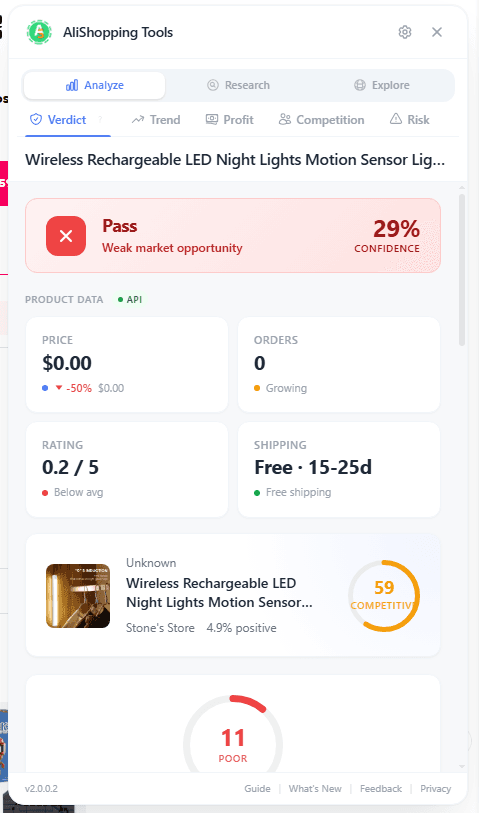
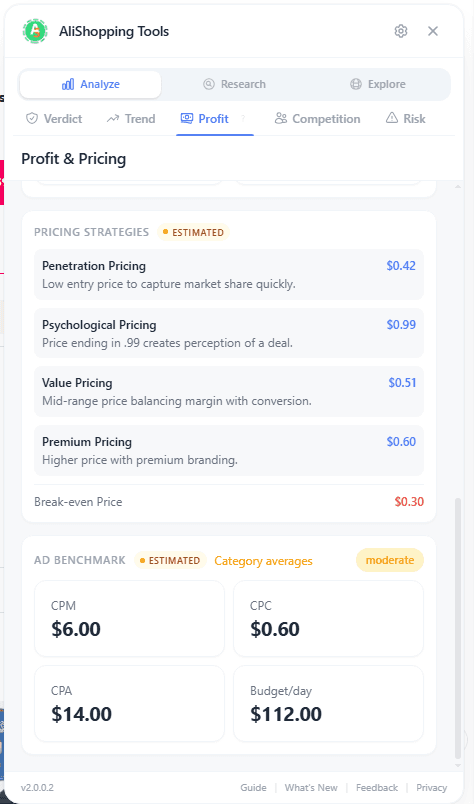
This is where product research tools make a real difference. With a tool like AliShopping Tools, you can take AliExpress research even further. The free Chrome extension analyzes any AliExpress product page and provides an instant AI-powered verdict — Strong Buy, Buy Signal, Hold / Watch, or Pass, shown with a confidence percentage — profit simulation with real margin calculations, trend analysis with demand forecasting, supplier risk scores, and market saturation data. Instead of spending hours scrolling through listings and manually comparing products, you get data-driven insights in seconds, directly on the page you are already browsing.
That kind of intelligence simply is not available on Alibaba, where evaluating a product typically means requesting samples, waiting weeks, and relying on the supplier's own claims.
When to Use AliExpress for Dropshipping
AliExpress is the right choice when:
- You are just starting out. No MOQ means you can test products with minimal risk. Buy one unit, ship it to yourself, evaluate quality, then list it.
- You are validating product ideas. Test 5-10 products simultaneously for under $100 total. See what sells before committing to inventory.
- Your order volume is low. If you are selling 1-20 units per day of a given product, per-unit fulfillment through AliExpress makes sense.
- You want simplicity. No negotiations, no freight forwarding, no customs paperwork. Buy, ship, track, done.
- You need fast product research. AliExpress data (order counts, reviews, pricing trends) combined with analysis tools gives you a research advantage that Alibaba cannot match.
When to Use Alibaba for Dropshipping (or Beyond)
Alibaba becomes the better option when:
- You have a proven product. Once a product is validated and selling consistently (50+ units per week), buying in bulk from Alibaba dramatically improves your margins.
- You want to build a brand. Alibaba suppliers offer private labeling, custom packaging, and product modifications. You cannot get this on AliExpress.
- You are ready to hold inventory. If you have the capital and storage (or use a 3PL warehouse), Alibaba bulk pricing makes sense.
- You are scaling past $5,000-10,000/month. At this revenue level, the per-unit savings from Alibaba can mean the difference between a sustainable business and one that barely breaks even.
- You need custom or modified products. Want to change the color, add your logo, or modify the design? Alibaba suppliers work with you on OEM/ODM orders.
The Smart Path: Start with AliExpress, Scale with Alibaba
The most successful dropshippers in 2026 do not choose one platform exclusively. They use both, at different stages:
-
Research and validate on AliExpress. Use the platform's rich data and research tools to find promising products. Test with small orders. Analyze reviews, order trends, and profit potential.
-
Build your store and prove demand. List the product, run ads, and get real sales data. Aim for consistent daily orders over 2-4 weeks.
-
Move to Alibaba for proven winners. Once a product is validated, contact Alibaba suppliers for bulk pricing. Negotiate MOQ, request samples, and compare quality against your AliExpress source.
-
Transition to branded inventory. As you scale, use Alibaba for private-label versions of your winning products. This builds a defensible brand rather than a commodity store.
This approach minimizes risk at every stage. You never commit capital to unvalidated products, and you capture better margins as you scale.
Common Mistakes to Avoid
Starting on Alibaba too early. Ordering 500 units of a product you have never sold is one of the fastest ways to lose money in dropshipping. Always validate first.
Ignoring shipping times. AliExpress shipping to most countries takes 2-4 weeks. Alibaba sea freight takes 6-8 weeks. Factor lead times into your customer expectations and ad strategies.
Skipping supplier research. On both platforms, not all suppliers are equal. On AliExpress, check seller ratings, store age, and review quality. On Alibaba, look for Verified Manufacturer badges and request references.
Not calculating true margins. Your product cost is not just the item price. Include shipping, payment processing fees, ad costs, returns, and platform fees. A product with a 60% markup can easily become unprofitable if you do not account for all costs.
Frequently Asked Questions
Can I dropship directly from Alibaba without holding inventory?
Technically some Alibaba suppliers accept single-unit orders, but it is not designed for that. Alibaba is built for bulk purchases. Most suppliers require MOQs of 50-1,000+ units. If you want to fulfill orders one at a time without inventory, AliExpress is the right platform.
At what sales volume should I switch from AliExpress to Alibaba?
Once you are consistently selling 50+ units per week of a single product, it is worth contacting Alibaba suppliers for bulk pricing. At that volume, the per-unit savings (often 30-50% cheaper than AliExpress) justify the upfront investment and logistics complexity.
Is product quality better on Alibaba than AliExpress?
Not necessarily. Many Alibaba and AliExpress sellers source from the same factories. The difference is that Alibaba gives you more control: you can negotiate specifications, request custom packaging, and order samples from the actual production batch. On AliExpress, you get what is listed with no customization.
How do I research products if I plan to eventually source from Alibaba?
Start your research on AliExpress, where you have access to order counts, customer reviews, price history, and tools like AliShopping Tools for AI-powered analysis. Validate the product on AliExpress first, then use those findings to negotiate confidently with Alibaba suppliers.
Final Verdict
For most people getting into dropshipping in 2026, AliExpress is the right starting point. It offers zero-risk product testing, built-in shipping, transparent data, and a research ecosystem that helps you make smarter decisions. Tools like AliShopping Tools make AliExpress product research even more efficient by surfacing AI-driven insights that would take hours to compile manually.
Alibaba is where you go to scale. Once you have validated demand and are ready to invest in inventory, Alibaba's wholesale pricing and customization options become essential for building a real brand.
The platforms are not competitors. They are different stages of the same journey.
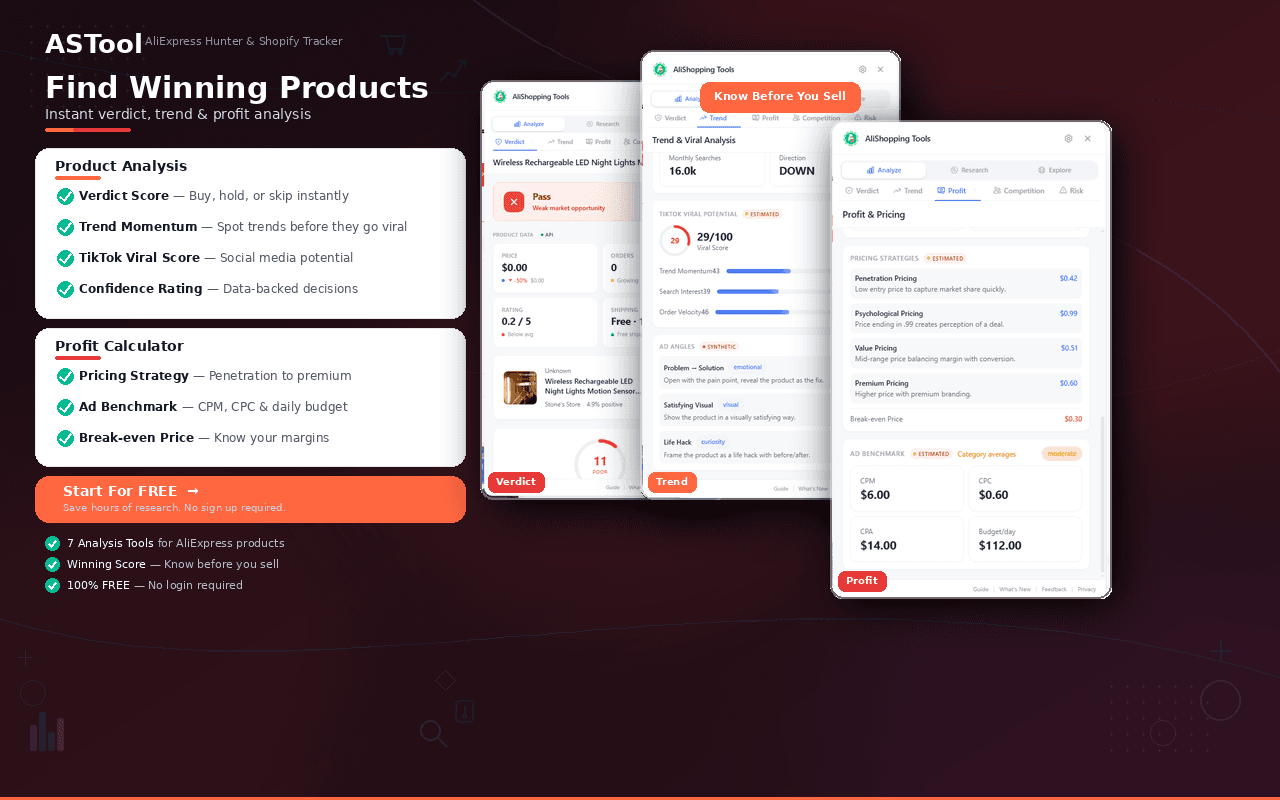
Ready to find your next winning product on AliExpress? Install AliShopping Tools for free and get instant AI-powered analysis on any product page. No account required, no subscription, no credit card. Just data-driven decisions in seconds.
AliShopping Tools
See live AliExpress data in your browser.
Seller trust score, 90-day price history, and live promo codes — on every AliExpress product page. No account, free.
Ready to find winning products?
Try AliShopping Tools — 15 free AI tools for product research.
Quick answers
Frequently Asked Questions
1What is the fundamental difference between AliExpress and Alibaba?
AliExpress is a B2C (business-to-consumer) marketplace — suppliers sell individual items directly at retail or near-wholesale prices with no minimum order quantity and no negotiation.
Alibaba is a B2B (business-to-business) marketplace where manufacturers and trading companies sell in bulk at factory prices; most listings require MOQs (minimum order quantities, typically 50–1,000+ units) and pricing is negotiated through direct communication with the supplier.
Both are owned by Alibaba Group but serve different buyers.
2Which platform should a beginner dropshipper use — AliExpress or Alibaba?
For beginners testing products, AliExpress wins decisively per the post.
AliExpress has no MOQ, so you can test 10 different products for the cost of a single Alibaba order.
Alibaba MOQs typically start at 50–100 units for small items and reach 500–1,000+ for manufactured goods — you should never commit to 500 units of a product you have not validated with real customers first.
Move to Alibaba only after a product proves itself.
3How do shipping options compare between AliExpress and Alibaba?
AliExpress has standardized shipping built into the platform with integrated tracking: AliExpress Standard Shipping (15–20 days), ePacket (7–15 days), and Premium/DHL/FedEx (5–10 days at higher cost).
Alibaba shipping is arranged separately — freight forwarding is often required, sea freight can take 15–45 days (sometimes 60+), and you coordinate tracking yourself.
AliExpress is the turnkey choice; Alibaba requires logistics know-how.
4How do payment security and buyer protection differ between AliExpress and Alibaba for dropshipping?
AliExpress has built-in Buyer Protection covering non-delivery and items not as described, with disputes handled directly through the platform.
Alibaba relies more on Trade Assurance escrow (available on eligible orders) or third-party payment protection.
Exact refund timelines vary by order and are shown in each platform's own dispute center rather than being a fixed number.
AliShopping Tools does not track escrow status on either platform — it shows AliExpress product-page data (price history, supplier trust rating), not payment/escrow tracking.
5What impact do minimum order quantities (MOQs) have on cash flow for a new dropshipper choosing between AliExpress and Alibaba?
AliExpress's zero-MOQ model lets a new dropshipper test a product for the cost of one or a few units, keeping capital exposure low.
Alibaba's MOQs (commonly in the tens to hundreds of units, depending on the product) require a much larger upfront commitment before you know whether the product sells.
The practical approach most dropshippers use: validate demand cheaply on AliExpress first, then move proven winners to Alibaba once sales justify the bulk commitment.
AliShopping Tools does not include a cash-flow or break-even calculator — that math is done separately based on your own cost and pricing data.
6Can I create private‑label or custom‑branded products on AliExpress and Alibaba, and what are the typical costs and timelines?
Alibaba is the platform generally used for private-label/custom-branded manufacturing — tooling/mold fees and production lead times vary widely by product complexity and supplier, so get a quote directly from the manufacturer rather than relying on a fixed cost range.
AliExpress listings are mostly generic, non-branded items; a smaller subset of AliExpress sellers may offer limited customization on request.
AliShopping Tools does not generate mock-up designs or landed-cost estimates for private-label orders — that scope is outside what the extension does.
7How does supplier communication speed and language proficiency compare on AliExpress versus Alibaba for dropshippers?
Alibaba suppliers, being oriented toward B2B deals, often have dedicated sales staff for faster back-and-forth on pricing and customization.
AliExpress sellers vary widely in responsiveness and English proficiency since many run smaller consumer-facing stores.
Neither platform publishes a verified average response time or English-fluency rate, so treat any specific percentage as unverified — judge a given supplier by their actual message history and reviews instead.
AliShopping Tools does not include a bulk-messaging feature for contacting suppliers.
8What effect does switching from AliExpress to Alibaba have on SEO and product listing consistency for a dropshipping store?
Sourcing from Alibaba (often for private-label/custom SKUs) lets you write unique product titles, descriptions, and images instead of reusing the same AliExpress listing copy that appears across many competing stores — unique content generally helps SEO versus duplicated content, though the exact traffic impact depends on your niche and competition, not a fixed percentage.
AliShopping Tools does not include a bulk SEO rewrite or listing-optimizer feature; that would need a separate SEO tool or manual copywriting.
More from the blog
AliExpress Shipping to the UK: Delivery Times, VAT & Customs (2026)
How long AliExpress takes to reach the UK, how 20% VAT and post-Brexit customs work, and which shipping method is fastest for UK shoppers in 2026.
AliExpress Shipping to the USA: Delivery Times, Customs & Duty (2026)
How long AliExpress takes to the USA, what import duty you pay after the 2026 de minimis change, and which shipping method is fastest. Realistic estimates.
AliExpress Shipping to Australia: Delivery Times, Customs & Tracking (2026)
Everything Australian shoppers need: how long AliExpress takes to deliver to AU (5-45 days), 10% GST rules, which promo codes work, and how to spot fake discounts before you pay.