






Dropshipping Product Research Checklist: 25-Point Evaluation Guide
Quick answer: To do market research for a dropshipping product, work through three passes:
- 1Quick filter (2 min) — check Google Trends direction, rough pricing, and an AliExpress order-count search to drop obvious losers;
- 2Moderate analysis (15 min) — validate demand (5,000+ monthly searches, 500+ AliExpress orders), margins (3x minimum markup, $20–75 selling price, shipping under 20% of price), and competition;
- 3Deep evaluation (45–60 min) — run the full 25-point checklist across supplier quality, shipping viability, legal compliance, and marketing fit, scoring each point Pass/Partial/Fail. Do this before ordering samples, not after launching ads.
Why You Need a Systematic Product Evaluation Process
Most dropshipping failures trace back to one mistake: choosing the wrong product. Not a bad store design, not poor ad creatives, not insufficient budget, but a fundamentally flawed product selection. The store owner either picked something nobody wanted, something too expensive to advertise profitably, or something a dozen competitors were already selling at rock-bottom prices.
A structured checklist eliminates the guesswork. Instead of relying on intuition or trend-chasing, you evaluate every product candidate against the same objective criteria. This checklist is part of a broader research methodology -- for the full step-by-step process from product discovery through launch, see our Complete Dropshipping Product Research Guide. Products that score well across all dimensions have a high probability of success. Products that fail multiple criteria get eliminated before you waste a dollar on them.
This 25-point checklist is organized into seven categories. Each point includes the specific metric or question to evaluate, the threshold for passing, and practical advice for verification.
Category 1: Demand Validation (Points 1-4)
Point 1: Google Trends Shows Stable or Growing Interest
Pull up the product name and category on Google Trends. Set the timeframe to the past 12 months and compare against the past 5 years to identify seasonal patterns.
Pass criteria: The trend line is flat or rising over the past 6 months, with no decline greater than 30% from the 12-month peak. Seasonal products should show consistent year-over-year peaks.
Why it matters: A declining trend means you are entering a shrinking market. Even with perfect execution, swimming against the demand tide is extraordinarily difficult. For a deeper dive into demand signals, see our guide to analyzing product demand.
Point 2: Search Volume Confirms Active Buyer Intent
Use a keyword research tool (Google Keyword Planner, Ubersuggest, or Ahrefs) to check monthly search volume for the product name and related buying keywords.
Pass criteria: At least 5,000 monthly searches for the primary product keyword in your target market. Related keywords (product name + "buy," "best," "review," "price") should collectively add another 3,000-10,000 searches.
Why it matters: Search volume directly measures how many people are actively looking for this product. Low search volume means you will rely entirely on interruption marketing (paid social ads), which is more expensive and less predictable than capturing existing demand.
Point 3: Social Media Engagement Validates Interest
Search for the product on TikTok, Instagram, and Pinterest. Look for organic content (not just ads) that demonstrates genuine consumer interest.
Pass criteria: At least 10 organic posts or videos with meaningful engagement (100+ likes/views) in the past 90 days. Higher engagement ratios (likes/views above 5%) indicate strong audience resonance.
Why it matters: Social engagement signals predict advertising performance. Products that generate organic interest are significantly easier and cheaper to promote through paid campaigns.
Point 4: AliExpress Order Volume Confirms Transaction Velocity
Check the order count on the product's AliExpress listing. More importantly, look at recent orders (last 30 days if available) to gauge current velocity rather than cumulative historical sales.
Pass criteria: At least 500 total orders with visible recent order activity. Products with 2,000+ orders and recent sales velocity demonstrate sustained demand rather than a one-time spike.
Why it matters: High order counts confirm that people are willing to pay for this product. Recent velocity confirms that demand is current, not historical.
Category 2: Margin Analysis (Points 5-9)
Point 5: Minimum 3x Markup Is Achievable
Calculate the ratio between your target selling price and the total landed cost (product + shipping from supplier).
Pass criteria: A minimum 3x markup on the landed cost. For a product that costs $5 from the supplier including shipping, your selling price should be at least $15. A 4x or 5x markup provides more room for advertising costs and still maintaining profitability.
Why it matters: Dropshipping has inherent costs that eat into margins: payment processing (2.9% + $0.30), advertising (typically 25-40% of revenue for paid acquisition), returns (5-15%), and platform fees. A 3x markup ensures you can absorb these costs and still profit.
Point 6: Target Selling Price Falls Within the Sweet Spot
Evaluate whether your selling price fits within the optimal range for paid social advertising.
Pass criteria: Selling price between $20 and $75 for most markets. This range is high enough to support profitable unit economics but low enough to trigger impulse purchases. Products above $75 can work but require more trust-building and longer consideration periods.
Why it matters: Products under $15 rarely generate enough margin per sale to cover customer acquisition costs. Products above $100 typically need multiple touchpoints (retargeting, email sequences, reviews) before conversion, increasing your effective cost per acquisition.
Point 7: Shipping Cost Does Not Destroy the Margin
Factor in the actual shipping cost from the supplier to your target market using the shipping method you plan to use.
Pass criteria: Shipping cost should not exceed 20% of the selling price if you offer free shipping (absorbing the cost), or should be presentable as a reasonable flat rate if you charge for shipping.
Why it matters: Unexpected shipping costs are the number one cause of cart abandonment in ecommerce. If shipping costs force you to either raise prices beyond market rates or accept razor-thin margins, the product is not viable.
Point 8: Return Rate for the Category Is Manageable
Research typical return rates for the product category. Clothing has the highest return rates (20-30%), followed by electronics (10-15%), while home goods and accessories typically see 5-10%.
Pass criteria: Estimated return rate below 10% for the specific product. Each return costs you the original product cost, shipping, processing time, and potentially a lost customer.
Why it matters: A product with a 15% return rate at a 3x markup may not be profitable at all once you account for the fully loaded cost of each return.
Point 9: Payment Processing Fees Are Factored In
Ensure your margin calculation includes Shopify's transaction fee (if not using Shopify Payments), payment processor fees (typically 2.9% + $0.30 per transaction through Stripe), and any app subscription costs.
Pass criteria: After subtracting all fixed and variable costs per transaction, the remaining contribution margin is at least $10 per order, or at least 20% of the selling price.
Why it matters: Many beginners calculate margins based only on product cost vs. selling price, ignoring the 5-8% in transaction-related fees that apply to every sale.
Category 3: Competition Assessment (Points 10-13)
Point 10: Fewer Than 15 Active Advertisers in Meta Ad Library
Search the Meta Ad Library for the product and count the number of unique advertisers running active campaigns. Our competition analysis guide covers this process in detail.
Pass criteria: Fewer than 15 active advertisers for the specific product. Moderate competition (5-10 advertisers) is actually healthy since it confirms market viability without excessive saturation.
Point 11: No Dominant Brand Owns the Category
Search Google for the product name. If a single brand dominates the first page of organic results and shopping ads, breaking into that market will require disproportionate spending.
Pass criteria: No single competitor holds more than 30% of the visible search real estate (organic + paid + shopping results) for the primary product keyword.
Point 12: Differentiation Opportunity Exists
Identify at least one meaningful way to differentiate your offer from existing competitors.
Pass criteria: You can articulate a specific differentiation strategy: better branding, bundled accessories, superior product photography, faster shipping through a US/EU warehouse, exclusive color options, or targeting an underserved customer segment.
Point 13: Competitor Reviews Reveal Unmet Needs
Read 20-30 negative reviews on competitor stores and Amazon listings for the same or similar products.
Pass criteria: You identify at least 2-3 recurring complaints that you can address through product selection, supplier choice, or store presentation. Common actionable complaints include poor packaging, missing instructions, sizing confusion, and misleading product photos.
Category 4: Supplier Quality (Points 14-17)
Point 14: Primary Supplier Scores 95%+ Positive Feedback
Your main supplier must have a strong track record on AliExpress.
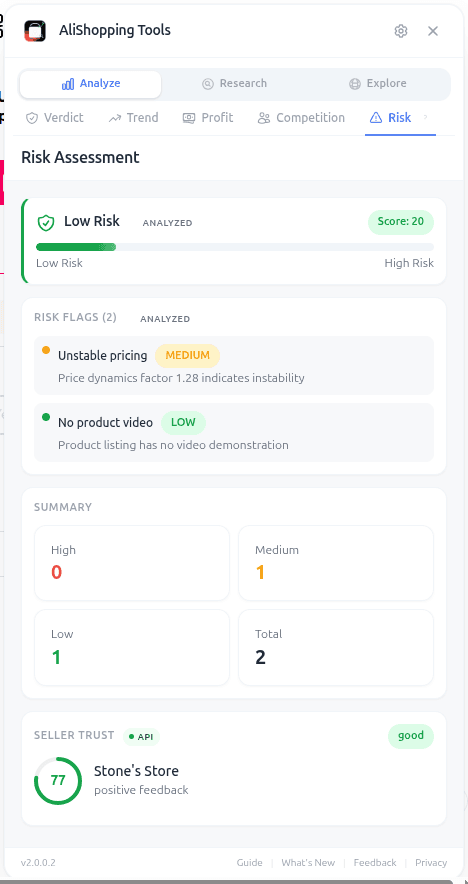
Pass criteria: Positive feedback score of 95% or higher, store open for at least 2 years, and visible evidence of regular transaction volume. For a detailed supplier vetting process, see our AliExpress supplier risk checklist.
Point 15: At Least Two Backup Suppliers Are Available
Relying on a single supplier creates a risky single point of failure. Factory closures, shipping disruptions, and quality fluctuations can halt your business overnight.
Pass criteria: At least two alternative suppliers offering the same or comparable product at acceptable quality and pricing. Both backups should meet the same minimum quality standards as your primary supplier.
Point 16: Sample Order Passes Quality Inspection
Order a physical sample and evaluate it against a standardized quality checklist.
Pass criteria: The product matches listing photos in appearance and dimensions (within 10% tolerance), functions as described, has acceptable build quality, arrives in intact packaging, and does not exhibit any safety concerns.
Point 17: Supplier Communication Is Responsive and Clear
Test the supplier's communication before committing.
Pass criteria: Response time under 24 hours, ability to understand and answer specific product questions, willingness to provide additional photos or documentation, and clear communication about processing times and shipping options.
Category 5: Shipping and Logistics (Points 18-20)
Point 18: Total Delivery Time Is Under 21 Days
Calculate the total customer-facing delivery time: processing time + transit time. Total delivery of 14-21 days to your primary market with trackable shipping is the baseline. US/EU warehouse sourcing for under 7-day delivery is a significant competitive advantage.
Point 19: Product Weight and Dimensions Allow Cost-Effective Shipping
Product weight should be under 2 kg with dimensions that fit standard small parcel shipping. Heavier or bulky items need explicit margin calculations that account for the higher shipping costs.
Point 20: Tracking Is Available Through the Entire Journey
Full tracking from pickup to delivery must be available through the selected shipping method. The tracking number should work with common tracking websites (17track, AfterShip) and provide regular updates. Untracked shipments generate more support tickets, higher dispute rates, and lower customer satisfaction.
Category 6: Legal and Compliance (Points 21-23)
Point 21: No Patent or Trademark Infringement Risk
Selling patented products without authorization exposes you to cease-and-desist orders, legal action, and platform bans.
Pass criteria: The product does not appear to infringe on existing patents or trademarks. Search the USPTO (US), EUIPO (EU), and Google Patents for related filings. Avoid products that closely resemble branded items or feature trademarked logos, characters, or designs.
Point 22: Product Meets Regulatory Requirements for Target Markets
Different product categories have different regulatory requirements depending on the market.
Pass criteria: You have verified that the product meets the regulatory requirements for your primary selling market, and the supplier can provide relevant certification documents (CE, FCC, CPSIA, etc.) where applicable.
Point 23: No Advertising Restrictions Apply
Certain product categories face advertising restrictions on major platforms. Facebook restricts ads for health claims, before/after images, and certain product categories. Google Shopping has its own prohibited and restricted product lists.
Pass criteria: The product can be freely advertised on your planned marketing channels without requiring special approval or facing content restrictions that limit your creative options.
Category 7: Marketing Feasibility (Points 24-25)
Point 24: The Product Demonstrates Well in Video
Video advertising drives the majority of dropshipping sales. Products that are visually compelling, demonstrate a clear before/after transformation, or solve a visible problem perform dramatically better in video ads.
Pass criteria: You can envision at least three different video ad angles for the product: a problem-solution demonstration, a lifestyle/aspirational presentation, and a feature highlight or comparison format.
Products that demonstrate well: Items with visible functionality (gadgets, tools), aesthetic appeal (home decor, fashion), or surprising features (unexpected uses, transformations).
Products that demonstrate poorly: Commodities without visual differentiation (basic cables, generic cases), products whose value is internal (supplements, internal components), or items where the benefit is abstract (organizational tools with no dramatic before/after).
Point 25: Target Audience Is Clearly Definable and Reachable
You need to be able to describe your target customer in specific enough terms to create effective ad targeting.
Pass criteria: You can define at least three specific audience characteristics: demographic (age, gender, location), interest-based (hobbies, brands they follow, content they consume), and behavioral (recent purchases, life events, online activity patterns). The target audience must be reachable through at least one paid advertising platform at a reasonable cost.
How to Score and Prioritize Products
Rate each of the 25 points as Pass (1), Partial (0.5), or Fail (0). Calculate the total score out of 25.
- 20-25 points: Strong candidate. Proceed to sample ordering and ad creative development.
- 15-19 points: Moderate candidate. Evaluate whether the failing points are fixable or fundamental.
- 10-14 points: Weak candidate. Deprioritize unless you have a unique advantage.
- Below 10 points: Eliminate. Too many fundamental issues to overcome.
When multiple products score similarly, prioritize higher margin per unit, then lower competition, then better visual demonstration potential.
Streamlining Your Research Workflow
Running through 25 evaluation points for every product idea sounds thorough but time-consuming. In practice, experienced product researchers use a funnel approach:
- Quick filter (2 minutes): Check Google Trends, approximate pricing, and a quick AliExpress search. Eliminate obviously unviable products.
- Moderate analysis (15 minutes): Run through the demand, margin, and competition sections. Eliminate products that fail in two or more categories.
- Deep evaluation (45-60 minutes): Complete the full 25-point checklist for surviving candidates, including supplier communication and compliance checks.
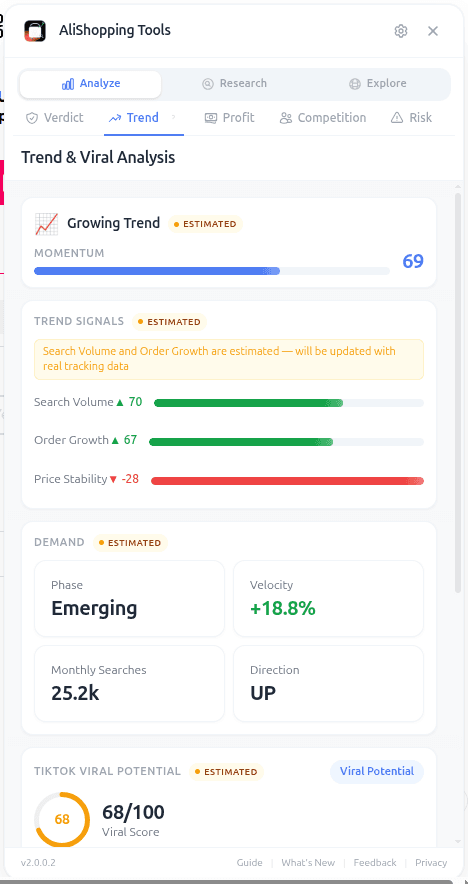
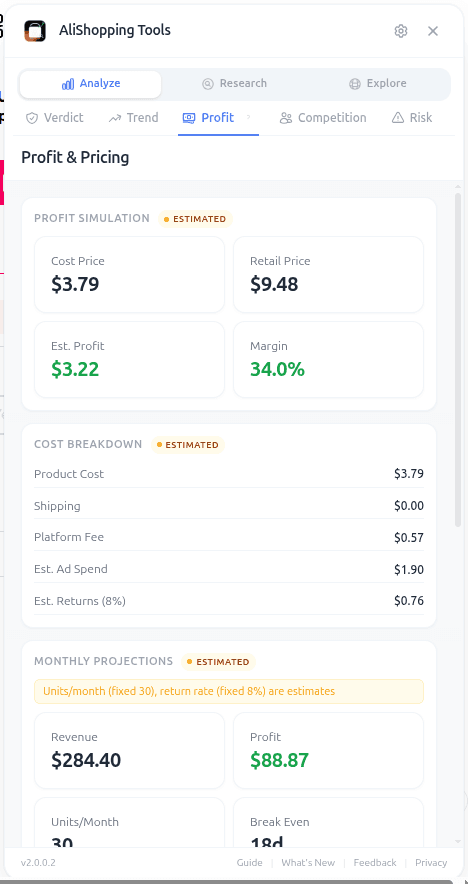
The quick filter stage is where most of your time goes — screening dozens of products before committing to deeper analysis. The free ASTools Chrome Extension can accelerate this step by displaying winning scores, risk assessments, and margin estimates directly on AliExpress product pages, turning a 5-minute manual review into a 30-second scan.
💡 Do this checklist in 3 minutes with AliShopping Tools. Point 3 (price history) → Trend tab. Point 7 (margin) → Profit tab. Point 10-13 (competition) → Compare + Similar tabs. Point 14-17 (supplier) → Risk tab. Install free — 1 permission, no signup.
Maintaining Your Research Standards
The temptation to skip steps grows as you gain experience. Resist it. Review and update your checklist quarterly as market conditions, platform policies, and shipping infrastructure evolve. As you develop expertise in specific niches, add category-specific criteria that further refine your selection process.
Frequently Asked Questions
How long does it take to evaluate a single product with this checklist?
The full 25-point evaluation takes 45-60 minutes per product. Most experienced researchers use a funnel approach: a 2-minute quick filter eliminates obvious misses, a 15-minute moderate analysis covers demand, margins, and competition, and the full deep evaluation is reserved for the top 2-3 candidates.
Which checklist category should I prioritize if I am short on time?
Margin analysis (Category 2) and demand validation (Category 1) are the most critical. A product with strong demand and healthy margins can overcome moderate competition and imperfect suppliers, but no amount of marketing will save a product that lacks demand or cannot be sold profitably.
How does this checklist apply to products I find on TikTok or social media?
Apply it the same way. Social media discovery is a valid source of product ideas, but viral attention does not replace data-driven validation. Run any socially-discovered product through the full checklist before committing budget — many viral products fail on margin analysis or competition assessment.
Should I use the same checklist for seasonal products?
Yes, with one addition: verify that you are entering the market early enough to capture the seasonal peak. Check Google Trends for timing, and factor in ad optimization ramp-up time (4-6 weeks) plus shipping lead times when deciding whether the seasonal window is still viable.
AliShopping Tools
See live AliExpress data in your browser.
Seller trust score, 90-day price history, and live promo codes — on every AliExpress product page. No account, free.
Ready to find winning products?
Try AliShopping Tools — 15 free AI tools for product research.
Quick answers
Frequently Asked Questions
1How many points is the product research checklist and how is it organized?
A 25-point checklist organized into seven categories: demand validation (points 1–4), margin analysis (points 5–9), competition assessment, supplier evaluation, shipping and fulfillment, legal compliance, and marketing fit.
Each point includes the specific metric or question to evaluate, the threshold for passing, and practical advice for verification.
Products scoring well across all dimensions have high probability of success; products failing multiple criteria are eliminated before you spend a dollar on them.
2What Google Trends threshold passes the demand validation point?
Point 1 pass criteria: the trend line is flat or rising over the past 6 months with no decline greater than 30% from the 12-month peak.
Seasonal products should show consistent year-over-year peaks — a one-off spike that does not repeat is a signal of trend fatigue rather than a real seasonal pattern.
A declining trend means you are entering a shrinking market, and swimming against demand tide is extraordinarily difficult even with perfect execution.
3What search volume and order count pass the demand points?
Point 2 passes at 5,000+ monthly searches for the primary product keyword in your target market, with related keywords (product name + buy/best/review/price) adding another 3,000–10,000 searches.
Point 4 passes at 500+ total AliExpress orders with visible recent order activity — 2,000+ orders and recent sales velocity demonstrate sustained demand rather than a one-time spike.
Social engagement (Point 3) needs at least 10 organic posts or videos with 100+ likes/views in the past 90 days.
4What profit margin should I aim for according to the dropshipping product research checklist?
The checklist recommends a minimum 3× markup, which translates to at least a 200 % gross profit margin (selling price ÷ cost ≥ 3).
For example, if a product costs $12, you should aim to sell it for $36 or more, giving a margin of roughly 66.7 % after shipping and fees.
The guide also suggests keeping the final price between $20 and $75 so the margin stays healthy while remaining attractive to shoppers.
Calculate this before any ad spend; a product that fails the 3× rule should be dropped even if other points look good.
5How do I determine if a niche is too saturated using the competition score in the checklist?
The competition point looks at how many ads and high-review listings dominate the top Google results for your product — the more crowded the top results are with established, well-reviewed competitors, the more saturated the niche.
AliShopping Tools can help you check saturation and seller-count signals on the AliExpress side of your research, though it doesn't pull Google ad-density data directly.
If the niche looks dominated by entrenched players, narrowing your product variant or targeting a less-competitive angle is the standard response.
6When is the right time to order a sample from a supplier based on the checklist criteria?
You should order a physical sample only after the product meets at least 20 of the 25 checklist points, especially the supplier reliability, shipping viability, and legal compliance sections.
The guide recommends placing the sample request within 7 days of completing your research, using the same AliExpress supplier you intend to work with, so you can verify product quality, packaging, and delivery speed before any ad campaign launches.
If the sample fails any of the final three points—defects, inaccurate dimensions, or delayed shipping—skip the product and re‑evaluate alternatives.
7What legal compliance checks are included in the checklist and how long do they usually take?
The legal compliance section covers three mandatory checks: trademark clearance, safety certification (e.g., CE, FCC, or ASTM), and import restriction verification.
A basic trademark search on the USPTO database typically takes 1–2 business days, while requesting a copy of the safety certificate from the supplier usually requires 2–3 days.
Import restriction checks through your country’s customs portal are often instantaneous online, but you should allow an extra day for any follow‑up questions.
Completing all three checks within a week ensures the product can be marketed without risking takedowns, fines, or shipping delays.
8How does the shipping viability point affect my advertising budget and ROI?
The shipping viability point requires shipping costs to stay under 20 % of the selling price, which directly protects your advertising ROI.
For a $50 product, shipping should be $10 or less; this keeps the cost‑per‑acquisition (CPA) below roughly 30 % of the net profit after the 3× markup rule.
By meeting the shipping threshold, you can allocate a larger portion of your ad budget to clicks rather than freight, resulting in a higher return on ad spend (ROAS).
If shipping exceeds the 20 % limit, the checklist advises you to renegotiate with the supplier or choose a lighter, cheaper‑to‑ship alternative.
More from the blog
The 20-Point Dropshipping Product Checklist Before You Order (2026)
The definitive pre-order checklist for dropshippers: 20 checks across demand, margin, supplier quality, product risk, and competition. 16+ = green light.
AI Product Scoring for Dropshipping: How It Actually Works in 2026
AI product scoring replaces gut-feel product research with data-driven composite metrics. Learn how tools like Winning Score and Verdict work, what data feeds them, where they fall short, and how to use scores without over-trusting them.
Winning Products August 2026: 12 Back-to-School Peak Categories
12 dropshipping categories for August 2026 — back-to-school peak (first two weeks), dorm setup, and the early-fall transition — plus how to vet any candidate with AStools before you spend.