AliExpress Customs & Import Taxes by Country (2026 Guide)
AliExpress Customs & Import Taxes by Country (2026 Guide)
Quick answer: Whether you pay customs or import tax on AliExpress orders depends entirely on your country. In the EU, UK, and Australia, AliExpress collects VAT/GST at checkout — so no surprise fees on delivery. In the US, most personal orders under $800 enter duty-free. In countries like Brazil, India, and Nigeria, expect to pay import taxes collected by your local postal service or courier before the package is released. Check the country table below for your specific situation.
You found a great deal on AliExpress. The price looks right. You place the order. Three weeks later, your local post office sends a notice: pay an additional fee before you can pick up your package. That fee is customs duty, import tax, VAT, or some combination — and it can add 10-60% to what you thought you were paying.
This guide explains how customs and import taxes work on AliExpress orders, which countries charge what, where AliExpress pre-collects tax at checkout so you avoid surprises, and what you can do to minimize unexpected costs.
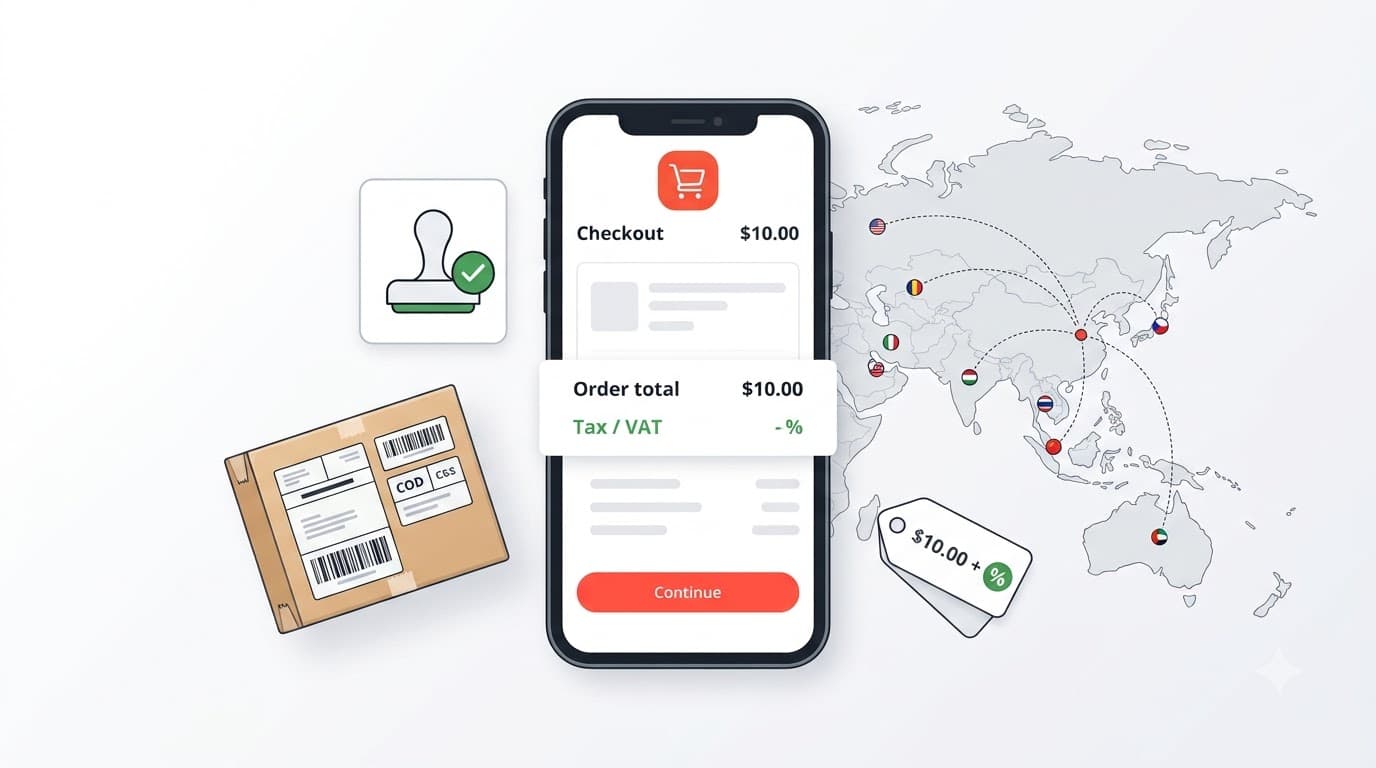
How customs and import taxes work on AliExpress orders
When you buy something on AliExpress, the package ships from China (or another origin country) to your country. When it crosses your border, your country's customs authority decides whether to charge import duties, VAT (value-added tax), GST (goods and services tax), or other fees.
Three factors determine what you pay:
1. Declared value of the package. This is the price you paid, as stated on the customs declaration. Customs authorities compare this to the de minimis threshold — a value below which imports enter tax-free. If your order is below the threshold, you pay nothing extra. Above it, taxes apply.
2. Product category. Different products have different duty rates. Electronics, clothing, cosmetics, and luxury goods often have different tariff classifications. A $50 phone case and a $50 piece of jewelry may be taxed at very different rates.
3. Your country's tax and customs rules. Every country sets its own thresholds, tax rates, and collection methods. Some countries have eliminated de minimis thresholds entirely, meaning every import is taxed regardless of value.
The customs process for an AliExpress package
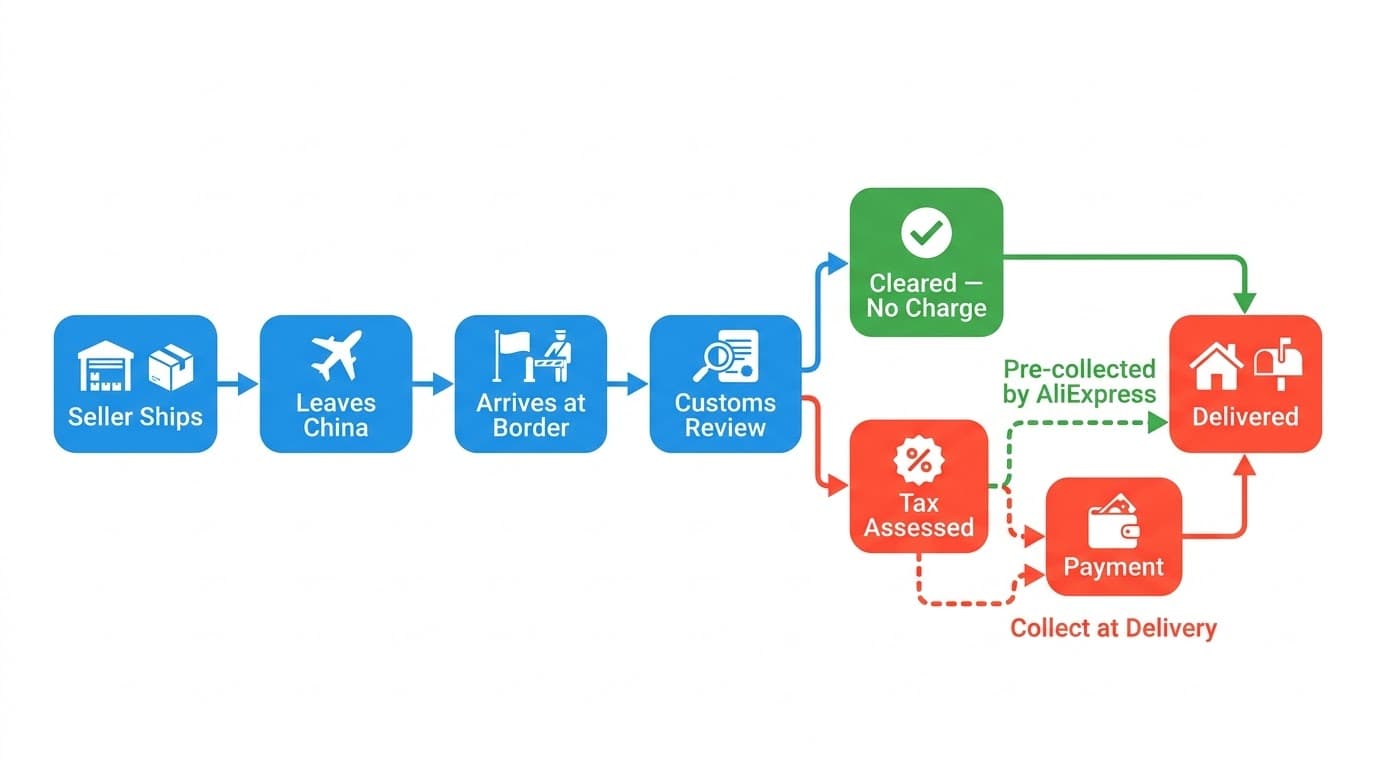
Here is what happens after your package leaves China:
- Seller ships the package with a customs declaration form listing the contents, value, and HS (Harmonized System) product code
- Package arrives at your country's border and enters the customs screening process
- Customs authority reviews the declaration — automated systems flag packages for inspection based on value, origin, and product type
- If below de minimis threshold: package clears customs and proceeds to delivery, no extra charges
- If above threshold (or no threshold exists): customs calculates the duty and tax owed
- Tax collection: either already paid at checkout (AliExpress pre-collected) or your postal service/courier collects before delivery
Where AliExpress collects tax at checkout
This is the most important development for AliExpress buyers in recent years. For several major markets, AliExpress now collects VAT, GST, or sales tax at the point of purchase — meaning the tax is included in your checkout total, and your package should clear customs without additional charges.
EU — IOSS (Import One Stop Shop)
Since July 2021, the EU eliminated the previous EUR 22 de minimis exemption for VAT. All imports are now subject to VAT regardless of value. AliExpress registered under the IOSS scheme, which means:
- AliExpress collects VAT at checkout on orders up to EUR 150
- The VAT rate matches your country's standard rate (typically 19-27% depending on the EU member state)
- Your package clears customs without additional VAT charges
- For orders above EUR 150, customs duties may still apply and are collected at the border
UK — VAT at checkout
The UK applies a 20% VAT on all imports. AliExpress collects this at checkout for consignments valued at GBP 135 or less. For orders above GBP 135, customs duty and VAT are collected at the border, and the courier typically charges a handling fee on top.
Australia — GST at checkout
Australia charges 10% GST on all imported goods. AliExpress collects GST at checkout for orders valued at AUD 1,000 or less. This has been in effect since 2018. For goods above AUD 1,000, customs duty and GST are assessed at the border.
Other countries with pre-collection
AliExpress also pre-collects taxes for several other markets including South Korea, Japan, and select additional countries. The platform continues expanding its tax collection to more regions. When tax is pre-collected, you will see it itemized in your order total at checkout.
How to check: During checkout, look at the order summary. If you see a line item for "Tax" or "VAT" or "GST," AliExpress is collecting it. If there is no tax line, you may owe tax on delivery.
Country-by-country customs and tax breakdown
The table below covers the 15 most common destination countries for AliExpress orders. Tax rates and thresholds change — verify current rates with your local customs authority before relying on these figures for high-value orders.
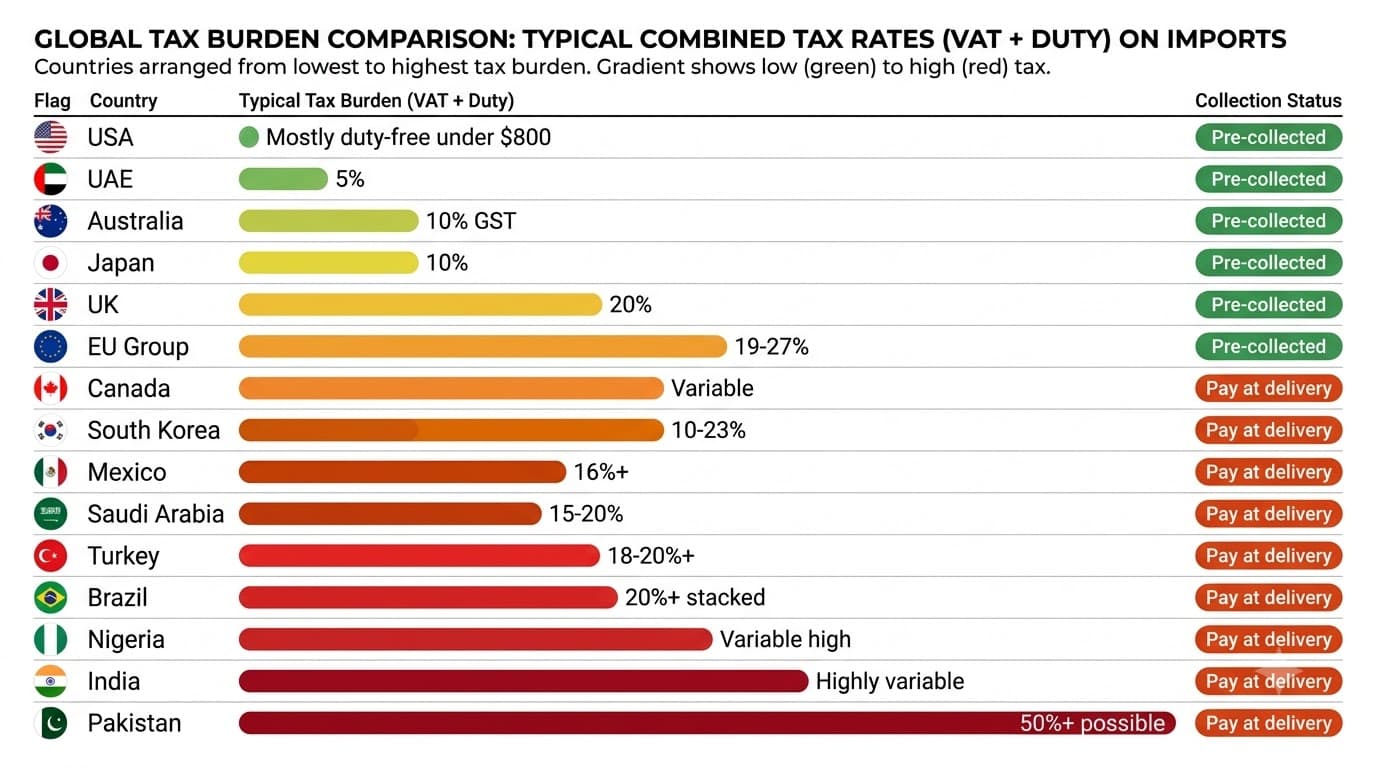
| Country | De minimis threshold | Tax type & typical rate | AliExpress pre-collects? | Notes |
|---|---|---|---|---|
| United States | $800 (Section 321) | Customs duty varies by product; no federal VAT/GST | No | Most personal AliExpress orders fall under $800 and enter duty-free. Note: the $800 threshold has been under policy review — verify current status for 2026 |
| United Kingdom | No threshold (all imports taxed) | 20% VAT + customs duty on goods over GBP 135 | Yes (orders up to GBP 135) | AliExpress collects VAT at checkout for orders up to GBP 135. Above that, VAT + duty collected by courier. Royal Mail charges a GBP 8 handling fee for collecting customs charges |
| EU (27 countries) | No threshold for VAT (EUR 0); EUR 150 for customs duty | VAT 19-27% (varies by member state) + duty above EUR 150 | Yes (IOSS, orders up to EUR 150) | AliExpress collects VAT via IOSS. Customs duty applies on declared values above EUR 150. Rate depends on product HS code |
| Canada | CAD 20 (tax), CAD 150 (duty) | 5% GST (federal) + provincial sales tax varies; duty varies by product | Partially (expanding) | Gifts under CAD 60 may be exempt. Orders under CAD 20 avoid GST. Orders under CAD 150 avoid customs duty but GST may still apply. Canada Border Services Agency assesses |
| Australia | AUD 1,000 (for customs duty) | 10% GST on all imports; customs duty on goods above AUD 1,000 | Yes (GST on orders up to AUD 1,000) | GST collected at checkout by AliExpress. Customs duty only kicks in above AUD 1,000 — rare for typical AliExpress orders |
| Brazil | No threshold (all imports taxed) | 20% import tax (simplified regime) + ICMS ~17-20% (state tax) | No | Brazil taxes all international purchases. The "Remessa Conforme" program may apply reduced rates for compliant platforms — verify current AliExpress participation status |
| Mexico | USD 50 | 16% IVA (VAT) + customs duty varies | Partially | Orders under USD 50 may be exempt. Above that, expect 16% IVA plus variable customs duty. Mexican customs (SAT) has increased enforcement on low-value imports |
| India | No threshold (all imports taxed) | Basic customs duty 10-150% (varies widely by product) + IGST 12-28% | No | India has some of the highest import duty rates. Electronics, clothing, and accessories face significant duties. Calculate total landed cost before ordering high-value items |
| Saudi Arabia | SAR 1,000 | 15% VAT + customs duty 5-15% on goods above threshold | Partially | Orders under SAR 1,000 may clear without duty. VAT applies to most imports. Saudi customs (ZATCA) processes |
| UAE | AED 300 | 5% VAT + customs duty 0-5% | Partially | Low VAT rate compared to other countries. Most consumer goods face 5% duty. AED 300 threshold for duty exemption |
| Turkey | EUR 30 (approx.) | 18-20% KDV (VAT) + customs duty varies | No | Turkey has lowered thresholds and increased enforcement on international e-commerce purchases. Personal imports face significant combined tax rates |
| South Korea | USD 150 (for personal use) | 10% VAT + customs duty 8-13% typical | Yes (expanding) | Personal-use imports under USD 150 are exempt from duty. AliExpress collects VAT at checkout for applicable orders. Korean customs (KCS) processes |
| Japan | JPY 10,000 (approx. for personal imports) | 10% consumption tax + customs duty 0-15% | Yes (consumption tax) | Personal-use imports under a certain value qualify for reduced rates. AliExpress collects consumption tax at checkout. Actual duty rates vary by product classification |
| Nigeria | No formal threshold (enforcement varies) | 5-35% customs duty + 7.5% VAT + other levies | No | Nigeria taxes imports but enforcement on small packages varies. Total effective tax rate can be high due to stacked levies. NCS (Nigeria Customs Service) processes |
| Pakistan | PKR 0 (all imports taxable in principle) | Customs duty 3-30% + 18% sales tax + additional regulatory duties | No | Pakistan applies multiple layers of tax on imports. Combined effective rate can exceed 50% for some product categories. Verify with Pakistan Customs for specific items |
Important disclaimers: Tax rates and thresholds change frequently. The figures above reflect general ranges as of mid-2026. For high-value orders, verify current rates with your country's customs authority. Some countries are actively revising de minimis thresholds for cross-border e-commerce — particularly the US (Section 321 review) and several EU proposals for tightening duty-free limits.
How to tell if you will be charged
Before placing an order, you can estimate whether customs fees will apply:
Check the checkout page. If AliExpress shows a "Tax" or "VAT" line item in your order summary, they are collecting it upfront. This is the simplest indicator — tax shown at checkout means no surprise fees at delivery for that tax component.
Check your country's de minimis threshold. If your order total (including shipping) falls below your country's threshold, you are likely exempt from customs duty. Note that some countries use the item value only, while others include shipping cost in the dutiable value.
Consider the product category. Certain products attract higher duty rates regardless of value. Electronics, cosmetics, alcohol, tobacco, and branded goods often have specific tariff rates. Clothing and textiles also tend to have higher duty classifications.
Check if the seller declares accurately. Some sellers under-declare package values on customs forms. While this can reduce taxes, it is technically customs fraud and carries risks — if customs inspects the package and finds a discrepancy, they may charge penalties or seize the goods.
Tips to avoid surprise customs charges
Buy from local warehouses when available
AliExpress sellers increasingly stock items in local warehouses (US, EU, UK, Australia). When you buy from a local warehouse, the item ships domestically — no customs, no import taxes, no waiting at the border. Look for "Ships from: [your country]" on the product page. The item may cost slightly more, but you save on taxes and get faster delivery.
Stay under de minimis thresholds
If your country has a meaningful de minimis threshold (like the US $800 or Australia AUD 1,000 for duty), keep individual orders below that value. If you are ordering multiple items, consider placing separate orders rather than combining everything into one shipment — customs assesses per consignment, not per item within a consignment in most jurisdictions.
Use AliExpress's tax pre-collection to your advantage
In countries where AliExpress collects tax at checkout (EU, UK, Australia, South Korea, Japan), this is actually a benefit — you know exactly what you will pay upfront. No handling fees from the postal service. No waiting at the post office to pay charges. The price at checkout is the price you pay, period.
Factor total landed cost into price comparisons
The product price on AliExpress is not your total cost if customs applies. Before buying, estimate the total "landed cost": product price + shipping + customs duty + VAT/GST + any handling fees. A $30 product that attracts 20% VAT and a $8 handling fee actually costs $44. Compare that against local alternatives.
Check price history to verify real savings
Before deciding that an AliExpress deal is worth the customs risk, check whether the price is genuinely low or inflated. AliShopping Tools shows price history charts directly on AliExpress product pages — so you can see if the "sale" price is really the normal price with tax on top. A minute checking price history can save you from paying customs on a product that is not actually discounted.
Keep receipts and tracking
If customs charges your package, keep the receipt. In some countries, you can appeal or request a review if you believe the assessment was wrong. Your AliExpress order confirmation (showing the actual price paid) is useful evidence if the seller over-declared the value.
Country-specific shipping guides
For detailed shipping information including delivery times, carriers, and tracking for your country, see our country shipping guides:
- AliExpress shipping to USA
- AliExpress shipping to UK
- AliExpress shipping to Canada
- AliExpress shipping to Australia
- AliExpress shipping to Brazil
- AliExpress shipping to Mexico
- AliExpress shipping to India
- AliExpress shipping to Saudi Arabia
- AliExpress shipping to UAE
- AliExpress shipping to Turkey
- AliExpress shipping to South Korea
- AliExpress shipping to Japan
- AliExpress shipping to Nigeria
- AliExpress shipping to Pakistan
FAQ
Does AliExpress charge customs fees?
AliExpress itself does not charge customs fees. Customs duties and import taxes are charged by your country's government. However, AliExpress does pre-collect VAT/GST at checkout for certain countries (EU, UK, Australia, South Korea, Japan, and expanding). When AliExpress collects tax at checkout, you pay the tax upfront and your package should clear customs without additional charges. When they do not collect, your local postal service or courier collects the tax before delivering your package.
How can I avoid paying customs on AliExpress orders?
The most reliable way is to order from local warehouses (items ship domestically, no customs). If ordering from China, keep orders below your country's de minimis threshold where one exists. In the US, that is $800 — most personal orders are well under that. In Australia, duty only applies above AUD 1,000. Some countries like Brazil and India tax all imports regardless of value, so there is no threshold to stay under. You cannot legally avoid taxes that apply — but you can factor them into your buying decision.
Why was I charged tax when AliExpress already collected VAT at checkout?
This can happen in rare cases due to processing errors, or when the IOSS/VAT registration number is not properly transmitted to customs. If you were charged VAT at checkout AND at delivery, you have been double-taxed. Contact AliExpress customer service with proof of both charges — the checkout receipt showing tax collected and the delivery tax receipt. You are entitled to a refund of one of the charges.
Do all AliExpress orders go through customs?
Yes, every international shipment technically passes through customs. But not every package gets inspected or taxed. Customs authorities use risk-based screening — they cannot physically inspect every package. Low-value items in countries with de minimis thresholds often pass through automatically. Higher-value items, certain product categories, and randomly selected packages get closer scrutiny.
What happens if I refuse to pay customs charges?
If you refuse to pay the customs duty or import tax assessed on your package, the package will not be delivered. In most countries, the package is held at the customs office or post office for a period (typically 15-30 days), after which it is returned to the sender or destroyed. You would then need to open a dispute with AliExpress to get a refund on the product cost, but you will have lost the shipping time and may not recover all fees.
Are customs charges refundable if I return the item?
Generally, customs duties paid on import can be refunded if you return the item and can prove it left the country. However, the process for claiming a customs duty refund is separate from your AliExpress refund — you need to apply to your country's customs authority, not AliExpress. The process is often bureaucratic and not worth it for low-value items. VAT collected by AliExpress at checkout is handled through AliExpress's normal refund process.
The bottom line
Customs and import taxes are the hidden cost of international shopping that catches many AliExpress buyers off guard. The good news: AliExpress's expansion of tax pre-collection (IOSS in the EU, VAT in the UK, GST in Australia) means more buyers now see their full cost at checkout with no surprises at delivery.
For countries where AliExpress does not pre-collect — know your de minimis threshold, estimate your landed cost before buying, and factor taxes into your price comparison. A product that looks 50% cheaper on AliExpress may only be 20% cheaper after customs, handling fees, and the wait.
The simplest strategy: buy from local warehouses when available, stay under thresholds when you can, and always check whether tax is shown at checkout before completing your order.
Install AliShopping Tools — check price history and real cost before you buy → — price history charts, seller trust scores, review analysis. Free, no account required.
Related Buyer Guides
- How to Track Your AliExpress Order — tracking statuses, carrier types, and what to do when updates stop
- Which Payment Method Is Safest? — protection layers and fees compared
- How to Get a Refund on AliExpress — what to do if customs returns your package
- AliExpress Scams to Avoid — fake discount markups and other red flags
Disclosure: This article is published by the AliShopping Tools team. Tax rates and de minimis thresholds reflect general information as of mid-2026 and are subject to change. This is not tax advice — verify current rates with your country's customs authority for specific import decisions. If you notice anything out of date, let us know at our contact page.
Ready to find winning products?
Try AliShopping Tools — 15 free AI tools for product research.
Quick answers
Frequently Asked Questions
1Does AliExpress charge customs fees?
AliExpress itself does not charge customs fees.
Customs duties and import taxes are charged by your country's government.
However, AliExpress does pre-collect VAT/GST at checkout for certain countries (EU, UK, Australia, South Korea, Japan, and expanding).
When AliExpress collects tax at checkout, you pay the tax upfront and your package should clear customs without additional charges.
When they do not collect, your local postal service or courier collects the tax before delivering your package.
2How can I avoid paying customs on AliExpress orders?
The most reliable way is to order from local warehouses (items ship domestically, no customs).
If ordering from China, keep orders below your country's de minimis threshold where one exists.
In the US, that is $800 — most personal orders are well under that.
In Australia, duty only applies above AUD 1,000.
Some countries like Brazil and India tax all imports regardless of value, so there is no threshold to stay under.
3Why was I charged tax when AliExpress already collected VAT at checkout?
This can happen in rare cases due to processing errors, or when the IOSS/VAT registration number is not properly transmitted to customs.
If you were charged VAT at checkout AND at delivery, you have been double-taxed.
Contact AliExpress customer service with proof of both charges — the checkout receipt showing tax collected and the delivery tax receipt.
You are entitled to a refund of one of the charges.
4Do all AliExpress orders go through customs?
Yes, every international shipment technically passes through customs.
But not every package gets inspected or taxed.
Customs authorities use risk-based screening — they cannot physically inspect every package.
Low-value items in countries with de minimis thresholds often pass through automatically.
Higher-value items, certain product categories, and randomly selected packages get closer scrutiny.
5What happens if I refuse to pay customs charges?
If you refuse to pay the customs duty or import tax assessed on your package, the package will not be delivered.
In most countries, the package is held at the customs office or post office for a period (typically 15-30 days), after which it is returned to the sender or destroyed.
You would then need to open a dispute with AliExpress to get a refund on the product cost.
6Are customs charges refundable if I return the item?
Generally, customs duties paid on import can be refunded if you return the item and can prove it left the country.
However, the process for claiming a customs duty refund is separate from your AliExpress refund — you need to apply to your country's customs authority, not AliExpress.
VAT collected by AliExpress at checkout is handled through AliExpress's normal refund process.
More from the blog
AliExpress Summer Clearance August 2026 Promo Codes — Up to 60% OFF (70% for US, Brazil, Mexico) + How to Apply
Working AliExpress promo codes for August 2026. Verified at checkout — seven spend tiers from $2 off to $70 off. Updated daily during the Summer Clearance sale window (Aug 1-7).
Best AliExpress Chrome Extensions for Shoppers 2026 — Honest Comparison
Six Chrome extensions that help AliExpress shoppers avoid scams, track prices, and find real deals. Ranked by genuine strengths — not all the same tool repackaged. Includes what each one cannot do.
AliExpress vs Temu 2026: Which Platform Should You Buy From?
Comparing AliExpress and Temu on pricing, shipping, returns, product quality, and buyer protection. No affiliate bias — just what real buyers experience in 2026.