AliExpress vs Temu vs Shein 2026: Which Is Best for Buyers?
AliExpress vs Temu vs Shein 2026: Which Is Best for Buyers?
Quick answer: Shein is best for fast fashion. Temu is cheapest for trending gadgets and ships fast from local warehouses. AliExpress has the widest catalog and the most tools for verifying products before you buy. The right platform depends on what you are shopping for.
Three platforms, all selling products from Chinese manufacturers at low prices, all running aggressive promotions. You have probably browsed all three and wondered which one actually deserves your money.
The answer is not simple because these platforms are built differently. They look similar on the surface — low prices, flashy discounts, shipping from China — but their business models, product strengths, and buyer experience diverge in ways that matter for your wallet and your satisfaction.
This is not an affiliate comparison. We build a free Chrome extension (AliShopping Tools) that works on AliExpress, so we know AliExpress well. We will be honest about where Temu and Shein are genuinely better.
How AliExpress, Temu, and Shein Actually Work
Before comparing features, you need to understand the structural differences.
AliExpress is a marketplace. Millions of independent sellers list products, set their own prices, and handle their own inventory. Buying on AliExpress is like shopping at a flea market — every booth is run by a different vendor. You get variety and competition, but quality and service vary between sellers.
Temu is a managed storefront. It sources products directly from manufacturers, sets prices centrally, and controls logistics. Buying on Temu is like shopping at a single discount store — one checkout, one return policy, one consistent experience. You get simplicity, but less choice and less transparency about sourcing.
Shein is a vertically integrated fast-fashion brand. It designs its own clothing lines, manufactures in-house through a tightly controlled supply chain, and sells under its own brand. Shein is less a marketplace and more a fashion retailer — the equivalent of a Zara or H&M that happens to ship from China. Its non-fashion categories (home, beauty, electronics) exist but are not its core strength.
| Aspect | AliExpress | Temu | Shein |
|---|---|---|---|
| Business model | Marketplace (independent sellers) | Managed platform (centralized pricing) | Vertically integrated fast-fashion brand |
| Parent company | Alibaba Group (founded 2010) | PDD Holdings (launched 2022) | Roadget Business Pte. Ltd. (founded 2008, rebranded 2015) |
| Who sets prices | Each seller independently | Temu negotiates and sets prices | Shein sets prices for own-brand items |
| Core strength | Everything — widest catalog | Trending consumer goods at lowest price | Fast fashion and accessories |
| Product listings | Same item from dozens of sellers | Usually one listing per product | Own-brand designs, single listing |
These structural differences are the root cause of most pros and cons on each side.
Quick Comparison Table
| Category | AliExpress | Temu | Shein | Winner |
|---|---|---|---|---|
| Product catalog breadth | Massive (niche to mainstream) | Curated trending items | Fashion-focused, growing home/beauty | AliExpress |
| Fashion and clothing | Wide but inconsistent sizing | Limited fashion range | Best trend speed, detailed sizing | Shein |
| Electronics and gadgets | Best variety and seller competition | Cheap commodity gadgets | Very limited | AliExpress |
| Pricing (trending items) | Competitive, varies by seller | Often cheapest | Competitive on fashion | Temu |
| Pricing (niche items) | Seller competition drives deals | Limited or unavailable | Not available | AliExpress |
| Shipping speed | 5-30 days (varies widely) | 3-15 days (most consistent) | 7-15 days standard | Temu |
| Shipping cost | Varies ($0-5 per item) | Free (built into price) | Free over threshold, $4-5 under | Temu |
| Return window | 15 days | 90 days | 45 days (first return free) | Temu |
| Buyer reviews | Deep, with photos and history | Fewer, shorter | Detailed with fit/size data | AliExpress |
| Price verification | Available (third-party tools) | Not available | Not available | AliExpress |
| Seller transparency | High (ratings, history, reviews) | Low (platform-curated) | N/A (own brand) | AliExpress |
| Platform maturity | 15+ years | 3+ years | 10+ years (as Shein) | AliExpress |
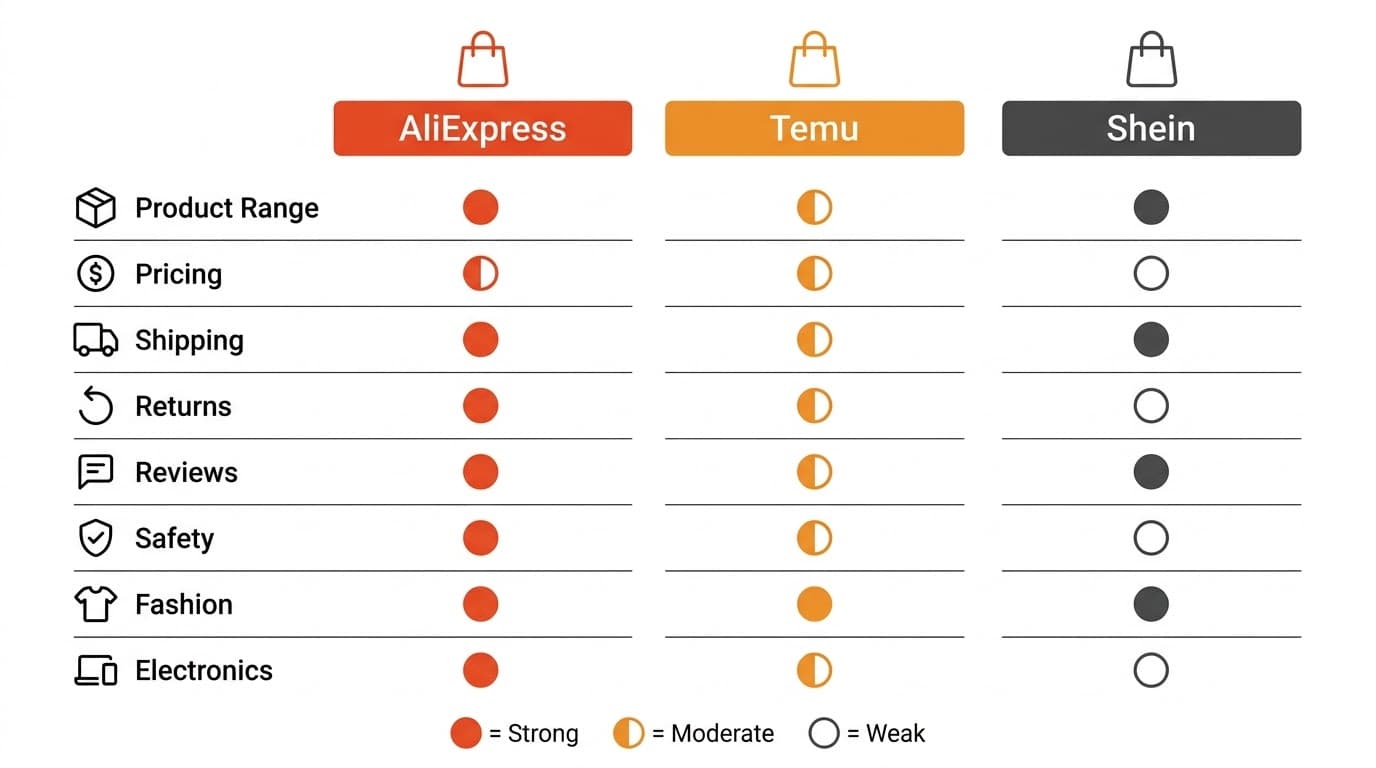
Pricing: Who Is Actually Cheapest?
The honest answer is that it depends entirely on the product category.
Temu: cheapest for commodity consumer goods
Temu frequently undercuts both AliExpress and Shein on trending consumer goods — phone cases, home gadgets, kitchen tools, seasonal items. PDD Holdings negotiates directly with factories and subsidizes prices to drive growth. On commodity items where you do not care which factory made it, Temu is often the cheapest option. Temu also bundles shipping into the product price, so what you see is what you pay.
Shein: cheapest for fast fashion
For clothing, Shein's vertically integrated model often produces lower prices than AliExpress fashion sellers. A dress or top on Shein is typically priced competitively with equivalent quality on AliExpress, and Shein runs constant flash sales and coupon programs on its own brand. Shein's pricing advantage in fashion comes from controlling the entire chain — design, manufacture, and sale — without marketplace seller margins.
AliExpress: cheapest when competition works
AliExpress wins on price when seller competition drives costs down — niche electronics, hobbyist components, industrial parts, and bulk orders. Because multiple sellers list the same product, you can compare prices across vendors. This competition sometimes pushes AliExpress prices below both Temu and Shein, especially for items outside mass-market trending categories.
AliExpress also has a layered coupon system (store coupons + select coupons + platform coupons) that can be stacked during major sales like 11.11 and the Anniversary Sale. When stacked correctly, these coupons can bring prices well below either competitor.
The fake discount problem — all three do it
All three platforms inflate "original" prices to make discounts look bigger. A product listed as "was $29.99, now $7.99" may have never sold for $29.99.
On AliExpress, you can verify this. Price history tools show a product's actual price over the past 90 days, so you can see whether today's "sale" is genuinely lower than the regular price. The AliShopping Tools extension overlays this data directly on product pages — no separate lookup needed.
On Temu and Shein, no equivalent third-party price tracking exists. You are trusting the displayed discount at face value.
Bottom line on pricing: Temu wins for commodity gadgets and home goods. Shein wins for fashion. AliExpress wins for niche items with seller competition and for verified deals during sales events.
Shipping Speed and Reliability
Shipping has improved on all three platforms, but the experience still differs.
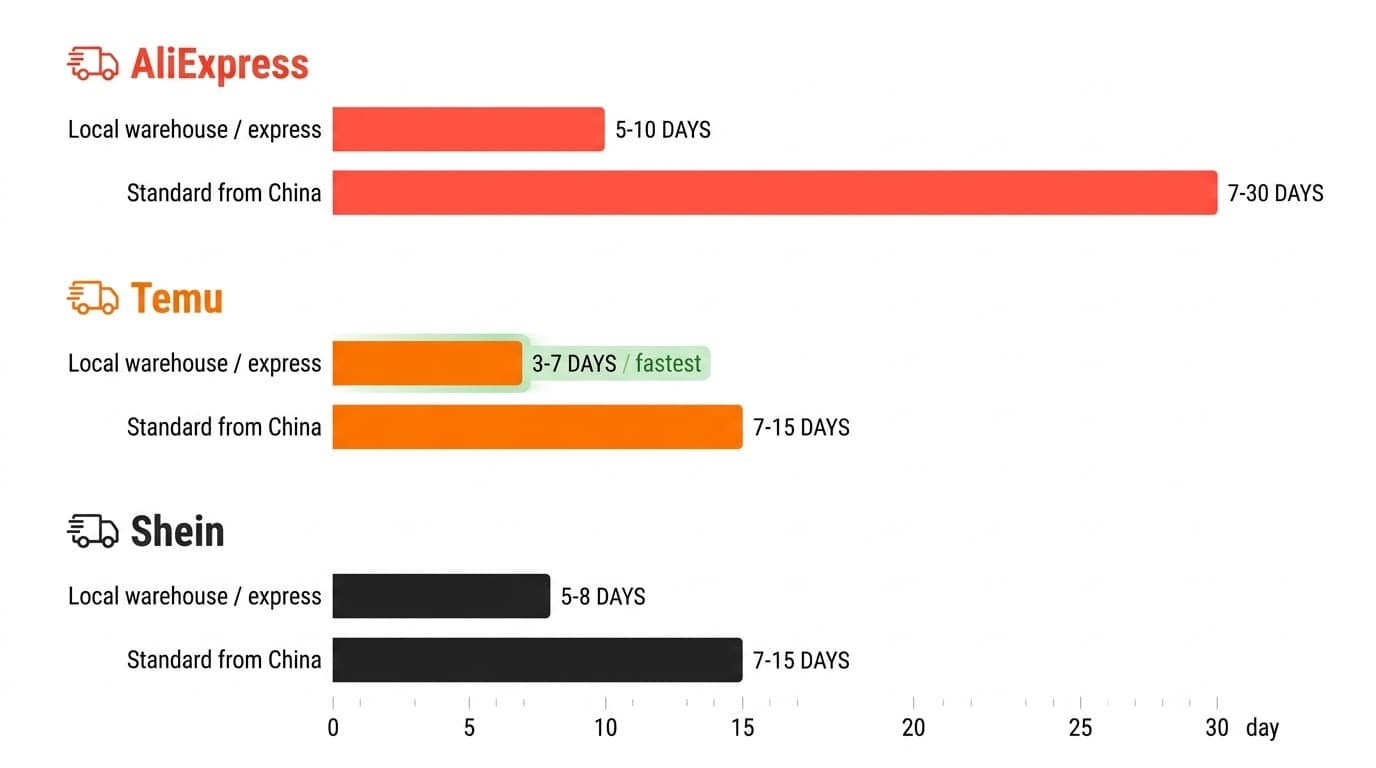
Temu shipping
- Local warehouse items (US, EU, UK, AU): 3-7 business days. Genuinely fast.
- Standard from China: 7-15 business days. More predictable than AliExpress.
- Shipping cost: Free on most items.
- Tracking: Reliable and consistent through the Temu app.
AliExpress shipping
- AliExpress Choice items (warehouse): 5-10 business days.
- Standard from China: 7-30 business days. Wide range depending on seller and method.
- Shipping cost: Varies by seller. Some free, others $1-5.
- Tracking: Reliable for AliExpress Standard and Cainiao. Spotty with budget carriers.
Shein shipping
- Standard shipping: 7-15 business days to most regions. Consistent but not as fast as Temu's local warehouse.
- Express shipping: 5-8 business days (available in key markets, costs extra).
- Shipping cost: Free above a spending threshold (varies by region, often $29-49). Below threshold, $4-5.
- Tracking: Reliable through the Shein app and email updates.
Honest assessment
Temu offers the most consistent and fastest shipping, especially from local warehouses. Shein's shipping is predictable but not the fastest — most orders arrive within two weeks. AliExpress shipping quality depends entirely on the seller — top-rated sellers ship reliably, budget sellers can take 3-4 weeks.
If you shop on AliExpress regularly, checking seller ratings and shipping history before buying reduces your risk. The AliShopping Tools extension includes a seller trust indicator that flags sellers with thin order history or inconsistent shipping patterns.
Buyer Protection and Returns
All three platforms offer buyer protection, but the processes differ significantly.
AliExpress buyer protection
- Dispute system: Structured resolution with defined timelines. You open a dispute, the seller responds, AliExpress mediates if needed.
- Return window: 15 days after confirmed delivery.
- Return shipping: Buyer pays in most cases.
- Strengths: 15 years of dispute infrastructure. System generally sides with buyers who have evidence.
- Weaknesses: Resolution can take 7-15 days. Communication with sellers sometimes involves language barriers.
Temu buyer protection
- Centralized returns: Temu handles returns directly, not through individual sellers.
- Return window: 90 days — the most generous of all three.
- Return shipping: Free prepaid labels for most items in the US and EU.
- Strengths: Simplest return process. Longest window. Free return shipping.
- Weaknesses: Some refunds issued as Temu credit rather than to your payment method. Customer service quality varies for complex issues.
Shein buyer protection
- Centralized returns: Shein handles returns for its own-brand items.
- Return window: 45 days from purchase.
- Return shipping: First return per order is free. Subsequent returns may incur fees.
- Strengths: Well-organized return portal. Faster processing than AliExpress since there is no seller mediation step.
- Weaknesses: Some categories (swimwear, lingerie, accessories) may be non-returnable. Refund-to-wallet is sometimes the default option unless you specify otherwise.
Verdict on buyer protection
Temu wins on convenience — easiest returns, longest window, free return shipping. Shein is a solid middle ground — reasonable window, organized process, first return free. AliExpress wins on track record — its dispute system is the most mature and transparent, and you can see dispute outcomes from other buyers in seller reviews.
Product Quality: The Honest Truth
All three platforms source from the same manufacturing base in China. A $5 phone case on Temu may come from the exact same factory as a $5 phone case on AliExpress. The platform does not determine quality — the manufacturer does.
What differs is how much information you have before buying:
| Quality signal | AliExpress | Temu | Shein |
|---|---|---|---|
| Buyer reviews | Thousands per product, with photos | Fewer, shorter | Detailed, with fit/body-type data |
| Review history | Years of accumulated data | Shorter history (launched 2022) | Several years of clothing-specific reviews |
| Seller track record | Visible: store age, ratings, order count | Not visible — platform curates | N/A — Shein is the seller |
| Third-party tools | Available (price history, seller trust) | Not available | Not available |
| Sizing accuracy | Inconsistent across sellers | Inconsistent | Detailed size charts with fit data |
Where quality differs by platform
Fashion quality: Shein has an edge here. Because Shein designs and manufactures its own clothing, sizing is more consistent within the Shein brand than buying clothing from random AliExpress sellers. Shein's reviews also include body measurements and fit notes, which helps you pick the right size. AliExpress fashion is a gamble unless you find a trusted seller. Temu fashion quality is generally the least predictable.
Electronics quality: AliExpress wins because seller competition lets you compare options and read deep review histories. Temu electronics are cheap but you cannot verify quality beforehand. Shein barely competes in electronics.
Home goods: Temu and AliExpress are comparable. Shein has a growing home category but is not the primary destination.
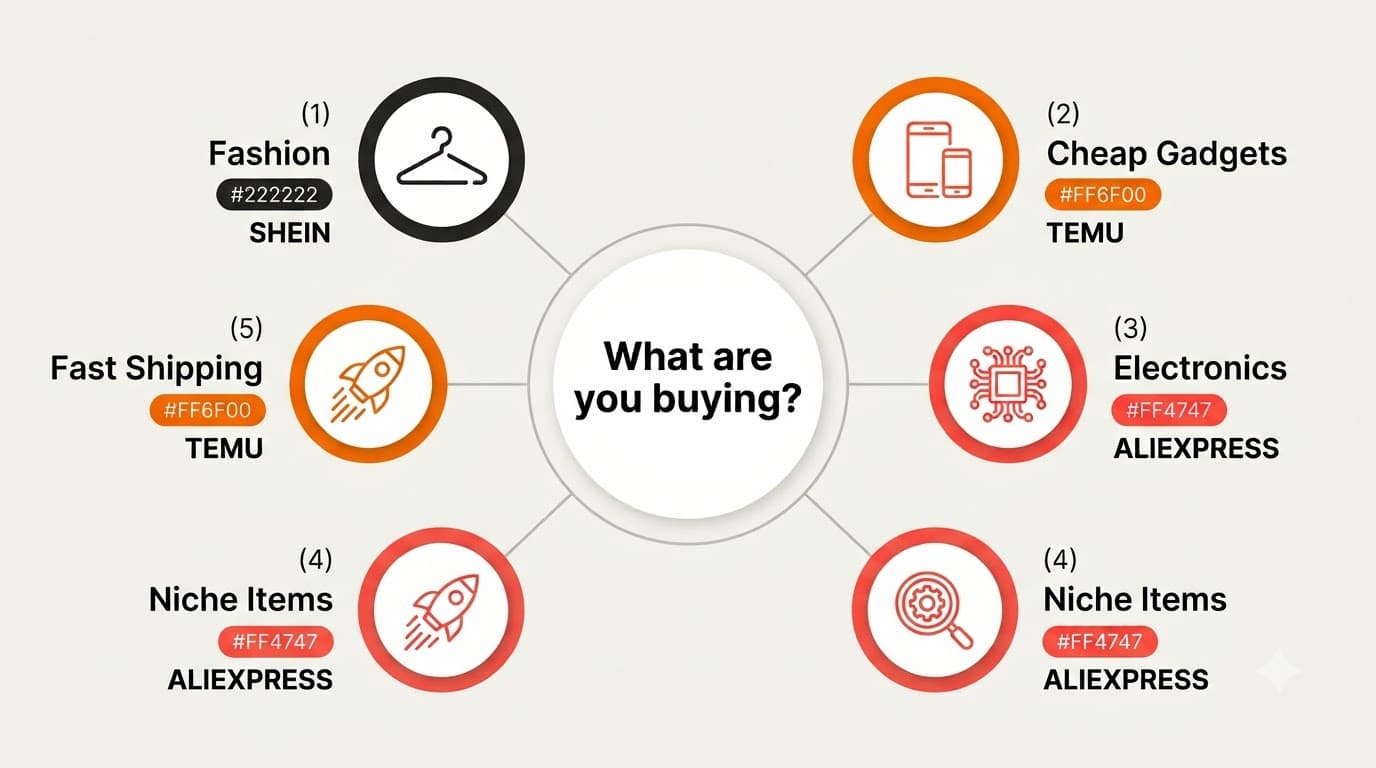
Best Platform by Use Case
Cheapest overall: Temu
For commodity consumer goods — phone accessories, kitchen gadgets, home decor, seasonal items — Temu's factory-direct pricing and free shipping make it consistently the cheapest option.
Fastest shipping: Temu
Temu's local warehouse network in the US, EU, UK, and Australia delivers in 3-7 business days. Neither AliExpress nor Shein can match this consistency.
Best for fashion: Shein
Shein's vertically integrated fast-fashion model means trend-cycle speed that AliExpress and Temu cannot match. New styles appear daily. Sizing data is more detailed. Reviews include fit information from buyers with similar body types. If fashion is your primary shopping category, Shein is the clear choice.
Best for electronics: AliExpress
Seller competition, deep review histories, and third-party verification tools make AliExpress the safest bet for electronics purchases. You can compare the same product across multiple sellers, check price history to avoid fake discounts, and verify seller reliability before buying.
Best for niche and specialty items: AliExpress
Hobbyist components, industrial tools, craft supplies, auto parts, specialty electronics — if a product is manufactured in China, it is probably on AliExpress. Temu's catalog is too curated and Shein is too fashion-focused for niche needs.
Best for new buyers who want simplicity: Temu
One listing per product, one price, free shipping, 90-day returns. Less decision fatigue than AliExpress's marketplace model. Aggressive new-user discounts that are legitimate for the first few orders.
Which Platform Is Safest?
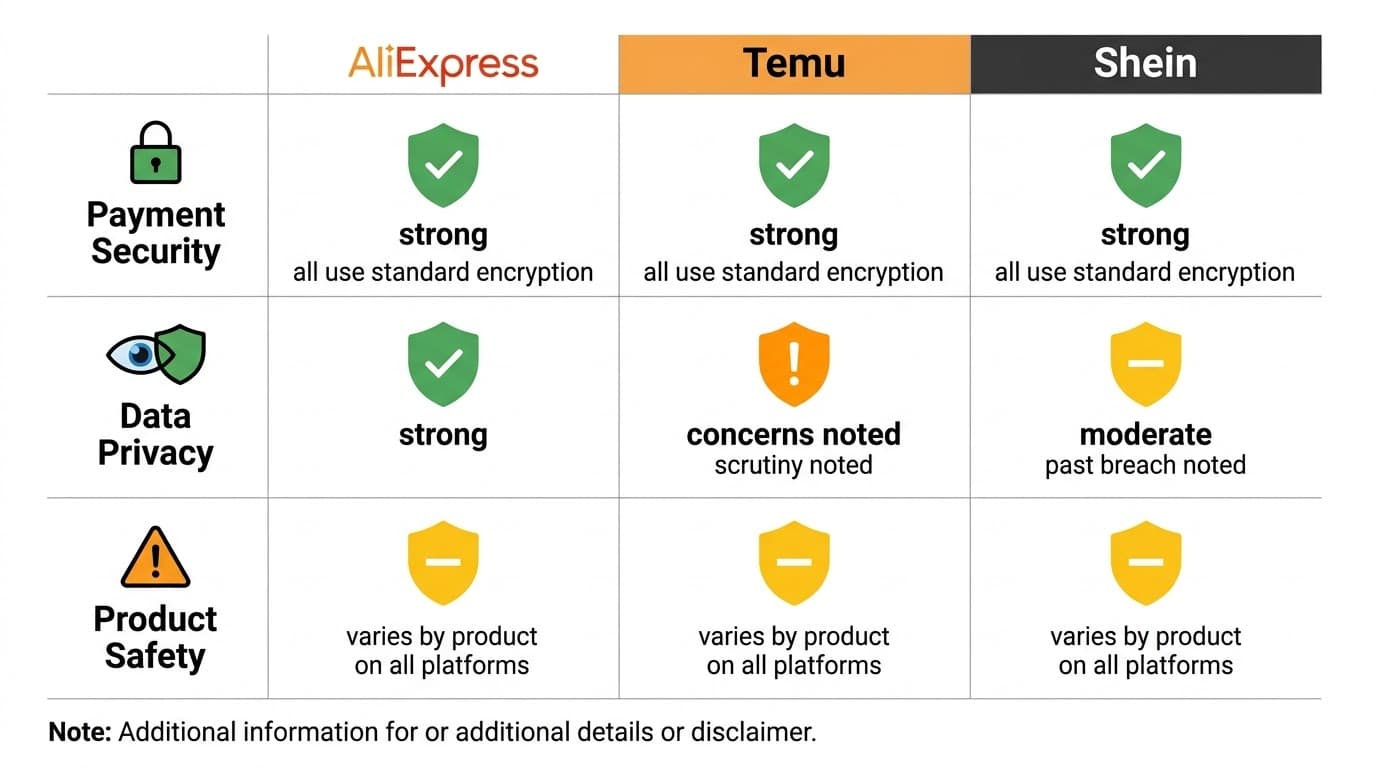
Safety covers three dimensions: payment security, data privacy, and product safety.
Payment security
All three platforms use standard payment encryption and support major payment methods (Visa, Mastercard, PayPal, Apple Pay, Google Pay). None stores full card numbers client-side. For maximum protection on any platform, use PayPal or a virtual card number.
AliExpress supports the widest range of local payment methods, especially in markets where it has operated for years. Temu and Shein are expanding but have fewer region-specific options.
Data privacy
This is where the three platforms diverge. All three collect user data, but the scope and transparency differ:
- AliExpress is operated by Alibaba Group. Standard e-commerce data collection. No major data controversies specific to AliExpress in recent years.
- Temu has faced scrutiny over its data collection practices. The Temu app requests more device permissions than typical shopping apps. Multiple government inquiries in Europe and the US have examined Temu's data handling. No confirmed breaches, but the permission scope has raised concerns.
- Shein has also faced data privacy scrutiny, including a documented data breach in 2018 that affected millions of accounts. The company has since updated its security practices, but past incidents are worth noting.
Product safety
All three platforms sell products manufactured in China, and product safety compliance (CE marking, FCC compliance, CPSC standards) varies by product and seller. None of the three platforms independently tests every product for safety compliance. For items like children's toys, electronics with batteries, or cosmetics, check for relevant safety certifications regardless of which platform you use.
Bottom line on safety: All three are reasonably safe for payments. For privacy-conscious buyers, AliExpress currently has the fewest data controversies. For product safety, due diligence is required on all three platforms.
How AliShopping Tools Helps on AliExpress
We build AliShopping Tools, a free Chrome extension that works on AliExpress. Here is what it does:
- Price history charts: See the actual price of any product over the past 90 days, directly on the product page. Know whether a "sale" is real or just the normal price with an inflated original.
- Seller trust checks: Instant indicators for seller reliability — store age, order volume, feedback patterns. Helps you avoid new or low-rated sellers.
- Review analysis: Highlights review quality and patterns so you can spot products with thin or suspicious review histories.
These tools are not available for Temu or Shein — both are closed platforms that do not expose the data third-party tools need. This is not a criticism of those platforms; it is simply a structural consequence of how they are built. On AliExpress, the open marketplace model allows independent verification that managed storefronts do not.
If you are deciding between platforms and your purchase is available on AliExpress, the ability to verify before buying is a meaningful advantage — especially for items over $10-20 where a bad purchase actually stings.
How to Shop Smarter on Any Platform
Regardless of which platform you choose:
- Never trust the displayed "original price." All three platforms inflate reference prices. On AliExpress, use a price history tool. On Temu and Shein, compare with other sites before assuming you are getting a deal.
- Read reviews with photos. Text-only reviews can be fabricated. Photo reviews show you what actually arrives.
- Size carefully on fashion purchases. Shein's detailed size charts are the most helpful. On AliExpress, check the size chart for each seller individually — they are not standardized. On Temu, size charts are improving but less detailed.
- Do not overbuy on first orders. Test with one or two items before placing a large order on any platform.
- Use secure payment methods. PayPal or virtual card numbers add a layer of protection everywhere.
- Know the return policy before buying. Temu (90 days, free returns), Shein (45 days, first return free), AliExpress (15 days, buyer pays return shipping). These differences matter.
When to Use Which Platform
Many experienced online shoppers use all three strategically:
- Fashion and clothing — check Shein first. Best trend selection, most detailed sizing data, reasonable return window.
- Cheap trending gadgets and home goods — check Temu first. Lowest prices, fastest shipping, easiest returns.
- Electronics, niche items, and anything over $20 — check AliExpress. Compare sellers, read reviews, verify price history with AliShopping Tools before buying.
- Compare prices across platforms for anything over $15. The price gap can be significant in either direction.
For a detailed head-to-head between AliExpress and Temu specifically, see our in-depth AliExpress vs Temu 2026 comparison.
FAQ
Is AliExpress, Temu, or Shein the cheapest in 2026?
It depends on the product category. Temu is typically cheapest for trending consumer goods like phone cases, home gadgets, and kitchen tools. Shein is most competitive on fast fashion and clothing. AliExpress is cheapest for niche items and during major sale events when coupons stack. There is no single cheapest platform across the board.
Which platform is safest to buy from?
All three use standard payment encryption and support secure methods like PayPal and Apple Pay. AliExpress has the longest track record (since 2010) and the most mature buyer protection system. Temu offers the most generous return window (90 days with free returns). Shein has a well-organized return process. For maximum safety on any platform, use PayPal or a virtual card number.
Does Shein sell the same products as AliExpress and Temu?
Shein primarily sells its own-brand fashion, which is not available on AliExpress or Temu. For non-fashion categories (home, beauty, accessories), there is some overlap with the same Chinese manufacturers supplying all three platforms. However, AliExpress has a much wider catalog for electronics, industrial supplies, and specialty items. Temu overlaps most with AliExpress on consumer goods.
Which platform has the best return policy?
Temu leads with a 90-day return window and free return shipping on most items in the US and EU. Shein offers 45 days with the first return per order free. AliExpress has a 15-day window with seller-mediated returns where the buyer typically pays return shipping. If easy returns are your top priority, Temu is the clear winner.
Can I check if prices are real on these platforms?
On AliExpress, yes. Price history tools like the AliShopping Tools Chrome extension show the actual price of products over the past 90 days, so you can verify whether a sale is genuine. On Temu and Shein, no equivalent third-party price tracking tools exist because both are closed platforms.
Which platform is best for clothing?
Shein is the strongest choice for clothing. It designs its own fashion lines, offers detailed size charts with fit data from real buyers, and releases new styles faster than AliExpress or Temu. AliExpress has more variety but inconsistent sizing across sellers. Temu's fashion selection is growing but is the least developed of the three.
Should I use all three platforms?
Many experienced shoppers do. Use Shein for fashion, Temu for cheap trending gadgets and home goods, and AliExpress for electronics, niche items, and anything where you want to verify quality and pricing before buying. Comparing prices across all three platforms before purchasing items over $15-20 often saves meaningful money.
Our Honest Take
No single platform is "the best." Each wins in its own lane:
- Temu is best for fast, cheap, no-research-needed purchases of common consumer goods. Its return policy is the most generous, shipping is the fastest, and prices on commodity items are hard to beat.
- Shein is best for fashion-focused shopping. Trend speed, sizing data, and clothing-specific reviews make it the top choice for apparel and accessories.
- AliExpress is best when you want control — more sellers to compare, deeper review histories, price verification tools, and niche products that neither Temu nor Shein carries.
If you shop on AliExpress, AliShopping Tools helps you get the most out of it — price history, seller trust checks, and review analysis, all free with no account required. We do not have Temu or Shein integration (and we are transparent about that), but for AliExpress purchases, the extension turns a chaotic marketplace into a more informed buying experience.
Related Buyer Guides
- Is AliExpress Legit? — platform safety, buyer protection, and how to vet sellers
- AliExpress Scams to Avoid — 9 common scams across marketplaces
- Which Payment Method Is Safest? — protection layers compared across payment options
- How to Spot Fake Reviews — 7 red flags for evaluating product reviews
Disclosure: This article is published by the AliShopping Tools team. We build a free Chrome extension for AliExpress — we do not have Temu or Shein integrations. Platform details are based on publicly available information as of July 2026. Features, policies, and pricing change frequently; we update this article when we notice drift. If something is out of date, let us know via our contact page.
Sẵn sàng tìm sản phẩm thắng?
Thử AliShopping Tools — 15 công cụ AI miễn phí cho nghiên cứu sản phẩm.
Giải đáp nhanh
Câu hỏi thường gặp
1Is AliExpress, Temu, or Shein the cheapest in 2026?
It depends on the product category.
Temu is typically cheapest for trending consumer goods like phone cases, home gadgets, and kitchen tools.
Shein is most competitive on fast fashion and clothing.
AliExpress is cheapest for niche items and during major sale events when coupons stack.
There is no single cheapest platform across the board.
2Which platform is safest to buy from?
All three use standard payment encryption and support secure methods like PayPal and Apple Pay.
AliExpress has the longest track record (since 2010) and the most mature buyer protection system.
Temu offers the most generous return window (90 days with free returns).
Shein has a well-organized return process.
For maximum safety on any platform, use PayPal or a virtual card number.
3Does Shein sell the same products as AliExpress and Temu?
Shein primarily sells its own-brand fashion, which is not available on AliExpress or Temu.
For non-fashion categories (home, beauty, accessories), there is some overlap with the same Chinese manufacturers supplying all three platforms.
However, AliExpress has a much wider catalog for electronics, industrial supplies, and specialty items.
Temu overlaps most with AliExpress on consumer goods.
4Which platform has the best return policy?
Temu leads with a 90-day return window and free return shipping on most items in the US and EU.
Shein offers 45 days with the first return per order free.
AliExpress has a 15-day window with seller-mediated returns where the buyer typically pays return shipping.
If easy returns are your top priority, Temu is the clear winner.
5Can I check if prices are real on these platforms?
On AliExpress, yes.
Price history tools like the AliShopping Tools Chrome extension show the actual price of products over the past 90 days, so you can verify whether a sale is genuine.
On Temu and Shein, no equivalent third-party price tracking tools exist because both are closed platforms.
6Which platform is best for clothing?
Shein is the strongest choice for clothing.
It designs its own fashion lines, offers detailed size charts with fit data from real buyers, and releases new styles faster than AliExpress or Temu.
AliExpress has more variety but inconsistent sizing across sellers.
Temu's fashion selection is growing but is the least developed of the three.
7Should I use all three platforms?
Many experienced shoppers do.
Use Shein for fashion, Temu for cheap trending gadgets and home goods, and AliExpress for electronics, niche items, and anything where you want to verify quality and pricing before buying.
Comparing prices across all three platforms before purchasing items over $15-20 often saves meaningful money.
Bài viết khác
AliExpress vs Temu 2026: Which Platform Should You Buy From?
Comparing AliExpress and Temu on pricing, shipping, returns, product quality, and buyer protection. No affiliate bias — just what real buyers experience in 2026.
AliExpress vs Temu 2026: Honest Buyer Comparison
AliExpress or Temu in 2026? We compare pricing, shipping, returns, and product quality honestly — no affiliate bias, just what buyers actually experience.
AliExpress vs Temu vs Shein: Which Has Real Products? (2026)
AliExpress vs Temu vs Shein — honest 2026 comparison of product quality, pricing, shipping, and which platform is better for dropshippers vs consumers.