How to Tell If an AliExpress Product Will Sell — Dropshipper's Checklist (2026)
How to Tell If an AliExpress Product Will Sell — Dropshipper's Checklist
Quick answer: Check order velocity (rising, not just high), review quality (photo reviews from real buyers, not incentivized), price margin (enough room after ads + shipping), competition level (not already saturated on Shopify), and trend timing (entering growth, not past peak). If you want all of this scored automatically, install AliShopping Tools — the AI verdict panel runs this evaluation on every AliExpress product page, free.
The most expensive mistake in dropshipping is not a bad ad or a slow supplier. It is listing a product that was never going to sell. Every dollar you spend on ads, every hour you spend building a product page, every customer service headache — all of it compounds on a product that had visible warning signs before you ever listed it.
This checklist is the evaluation step. You have already found a product that looks interesting — on AliExpress trending, in a competitor's store, on TikTok. Now you need to decide: is this worth testing with real money?
Nine signals. Check all nine before you list anything.
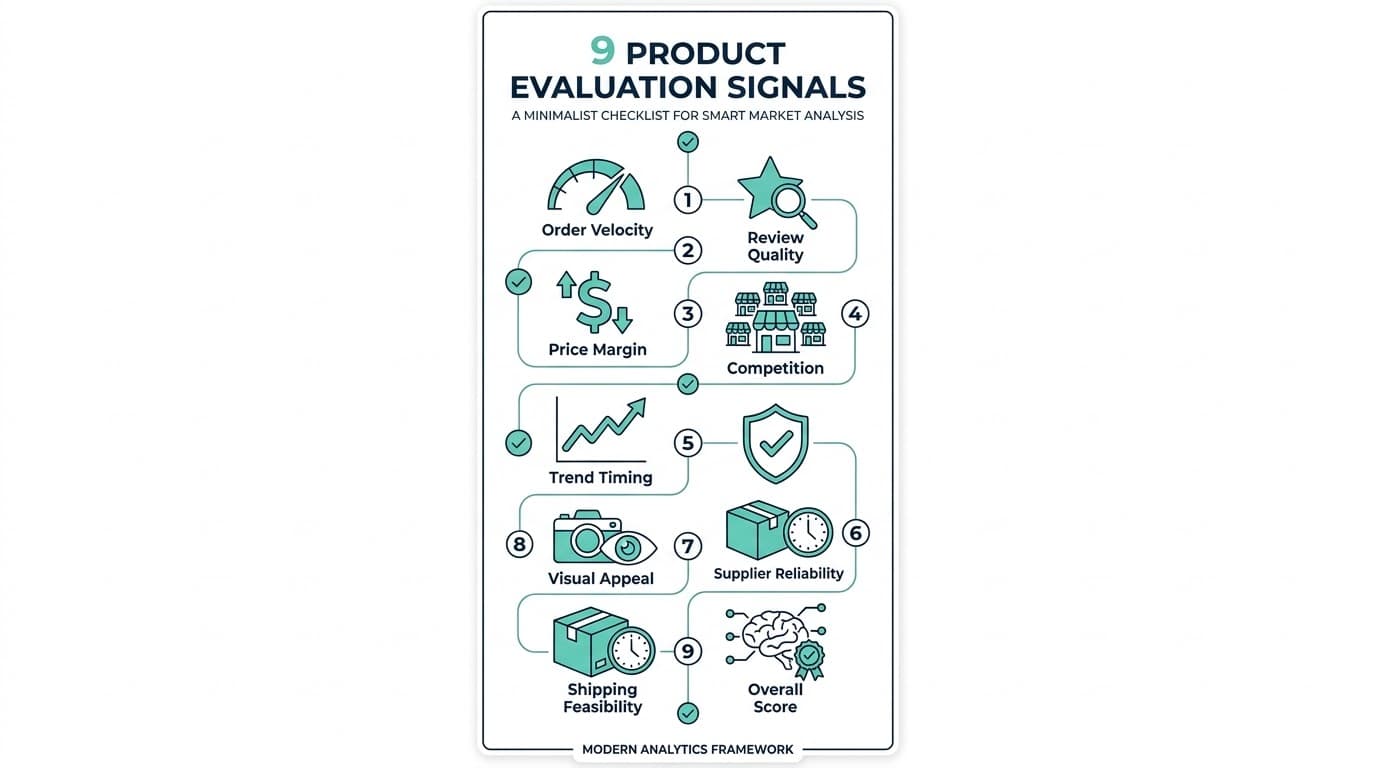
Signal 1: Order velocity — is demand real and current?
What to look for: The number of orders a product has received recently matters more than the total order count. A product with 50,000 lifetime orders but declining weekly sales is a worse bet than a product with 2,000 lifetime orders and a rising weekly trend.
Check the 30-day order trend, not the all-time number. You want to see orders that are stable or increasing — that tells you current demand exists, not just historical demand.
Red flags:
- High lifetime orders but flat or declining recent velocity — the product already peaked
- A single massive spike followed by a drop — likely a viral moment that already passed
- Very low order counts across all sellers listing the same product — demand may not exist at all
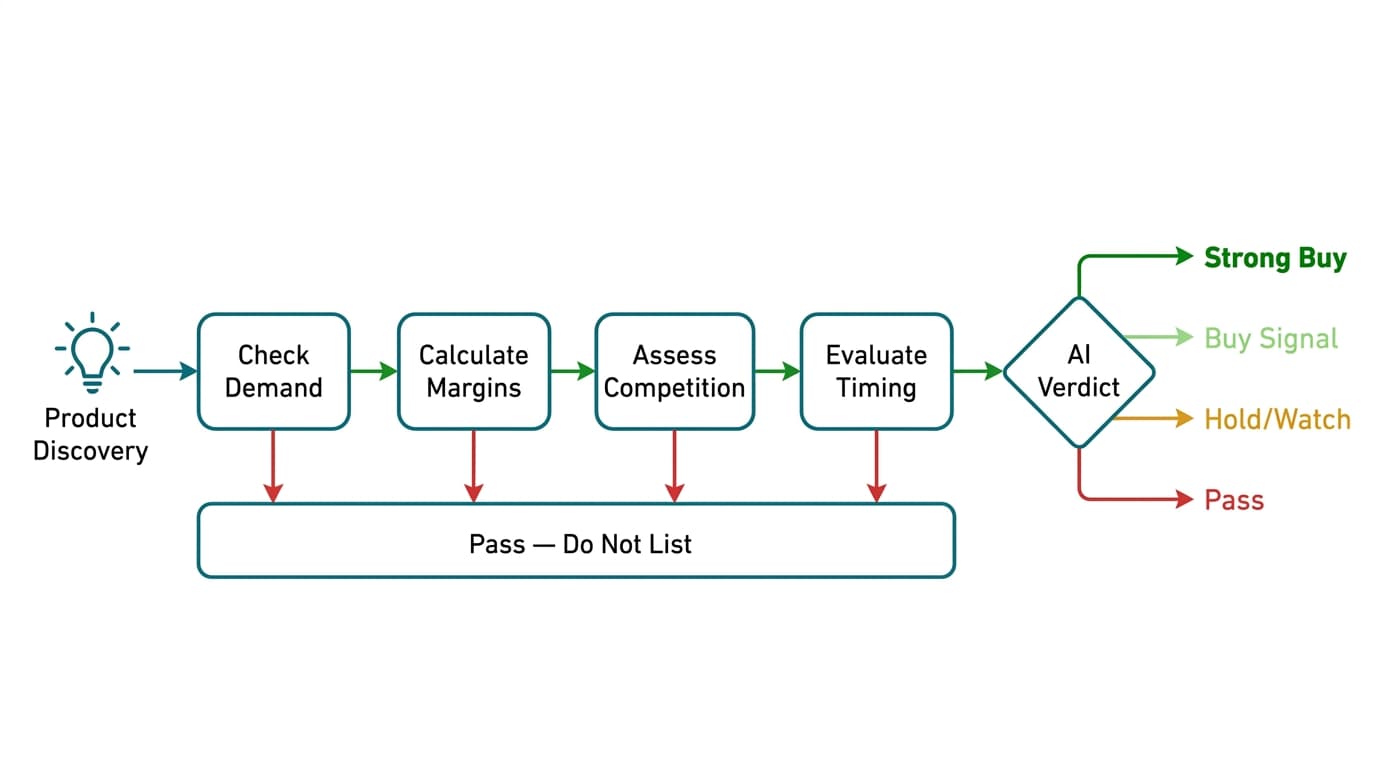
How AliShopping Tools helps: The AI verdict panel shows order velocity as part of its product fundamentals score. The trend classification (Emerging, Growing, Peak, Declining) tells you where a product sits in its lifecycle without requiring you to manually track order counts across weeks.
Signal 2: Review quality — are real buyers satisfied?
What to look for: The star rating alone is nearly useless. A 4.8-star rating on AliExpress could mean genuine satisfaction or it could mean incentivized reviews from sellers offering discounts for 5-star feedback.
Dig into the reviews themselves. Look for:
- Photo reviews from real buyers — these are harder to fake and show the actual product received
- Review text that mentions specific product details — generic "good quality, fast shipping" reviews are often incentivized
- Negative reviews that mention real product flaws — a product with zero negative reviews is suspicious, not perfect
- Review volume relative to order count — a healthy ratio suggests organic feedback
Red flags:
- A flood of 5-star reviews with identical or near-identical text
- Very few photo reviews relative to total reviews
- Reviews that mention receiving a discount or free product in exchange for the review
- A sudden cluster of reviews posted within the same week (review farming)
How AliShopping Tools helps: The review analysis panel breaks down ratings by distribution, shows the photo-review percentage, and flags incentivized review patterns. This saves you from manually reading through hundreds of reviews to judge authenticity.
Signal 3: Price margin — can you actually profit after all costs?
What to look for: The gap between AliExpress cost and your selling price needs to cover more than just the product itself. Your margin calculation must include:
- Product cost (AliExpress price including any variations)
- Shipping cost (to your target market — this varies dramatically by country and method)
- Payment processing fees (Shopify Payments, Stripe, PayPal — typically 2.9% + $0.30 per transaction)
- Ad cost per acquisition (this is the number most beginners underestimate)
- Returns and refunds (budget for a percentage of orders coming back)
- Platform fees (Shopify subscription, app costs)
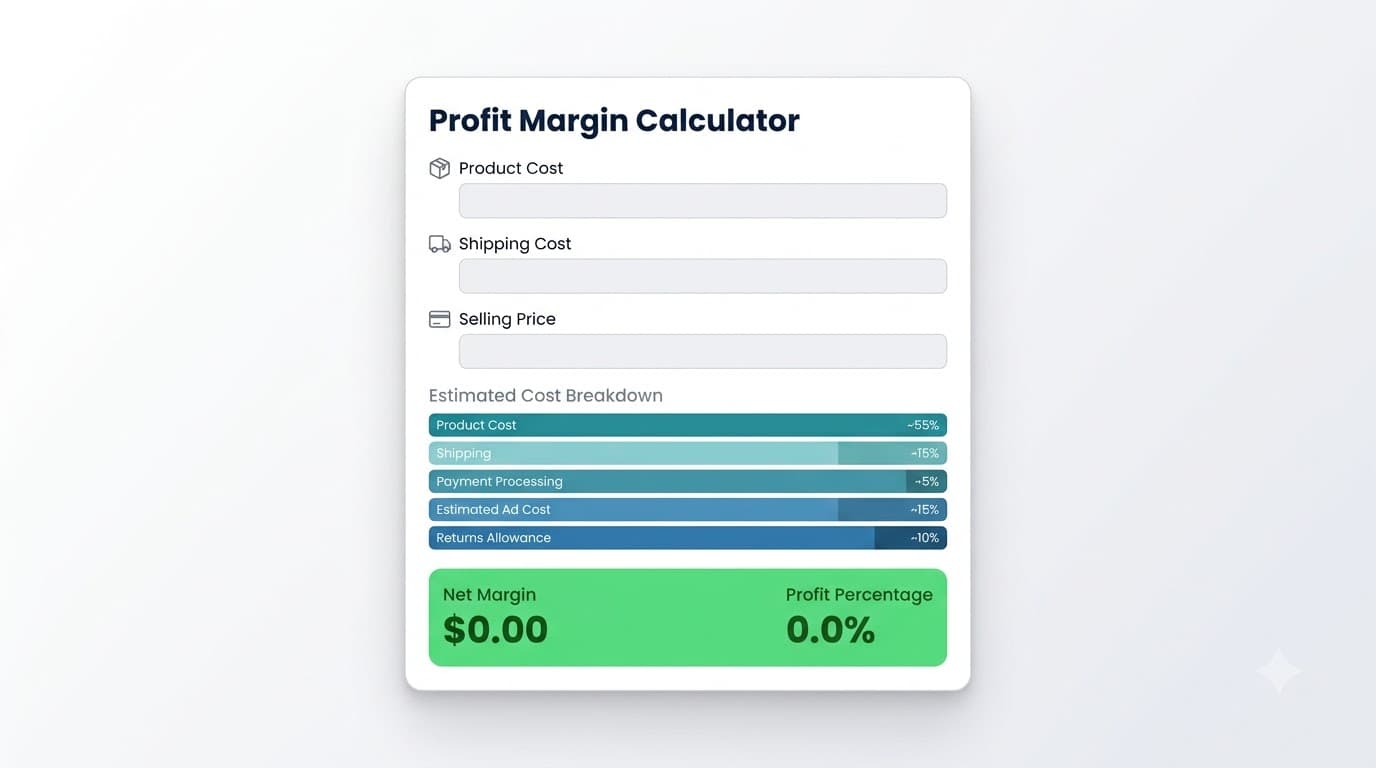
A product that costs $5 on AliExpress and sells for $25 looks like an 80% margin. After shipping ($3-8), payment processing ($1), ads ($8-15 per sale for most niches), and returns (5-10% of revenue), you might be left with $0-3 per sale — or negative.
Red flags:
- Selling price below $15 — the fixed costs (processing, shipping) eat most of the margin
- Product cost above 30% of your expected selling price before accounting for ads
- Competitors selling the same product at prices that leave no room for your markup
- Heavy or bulky items where shipping cost approaches the product cost
How AliShopping Tools helps: The profit calculator on the product page lets you input your target selling price and shipping cost, then shows your margin after costs. The profit potential dimension in the AI verdict factors in typical market pricing for that product category, so you can see whether your margin expectations are realistic before you commit.
Install AliShopping Tools — run margin calculations on any AliExpress product →
Signal 4: Competition level — is this market already saturated?
What to look for: A product with strong demand and good margins can still fail if hundreds of stores are already selling it. Competition level determines how much you will pay in ads to acquire each customer — and whether you can differentiate enough to win any clicks at all.
Check these:
- How many Shopify stores carry this exact product? If you can find the same product on dozens of stores with a quick Google search, you are entering a crowded market.
- What are established competitors charging? If well-reviewed stores with strong brands sell it at $19.99, you cannot realistically sell at $29.99 without a compelling reason.
- Are competitors running active ads? Heavy ad spend from multiple competitors means customer acquisition cost will be high.
- Is there a brand-name version? If Nike makes a version of this product, competing with a generic AliExpress version is an uphill battle.
Red flags:
- More than 10 Shopify stores selling the identical product (same photos, same description) on the first page of Google Shopping
- Multiple competitors with established review counts in the hundreds or thousands
- The product is available on Amazon Prime — you cannot compete with 1-day shipping
- Ad library shows dozens of active ads from different stores for this product
How AliShopping Tools helps: The market saturation score in the AI verdict panel evaluates competitive density for that product category. The Shopify spy feature lets you check specific competitor stores — see what they charge, what apps they use for marketing, and estimate their sales volume. This tells you what you are up against before you enter.
Signal 5: Trend timing — where is this product in its lifecycle?
What to look for: Every product goes through a lifecycle: emerging, growing, peaking, declining. Where a product sits on this curve when you start selling it determines your chances of success.
- Emerging — few sellers, low order volume, early search interest. High risk, high reward. You might be too early.
- Growing — increasing orders, rising search volume, moderate competition. This is the sweet spot for entering.
- Peak — highest order volume, many competitors, everyone has seen it. Late entry. You will pay premium ad costs and compete with established sellers.
- Declining — orders dropping, search interest falling, competitors exiting. You are too late.
Red flags:
- Google Trends shows a steep decline over the past 3-6 months
- The product went viral on TikTok more than 3 months ago — the opportunity window has likely closed
- Multiple "top products" listicles from 2024 or 2025 feature this exact product — it is old news
- AliExpress sellers are aggressively discounting (price war = late stage)
How AliShopping Tools helps: The AI verdict includes a trend classification that labels each product as Emerging, Growing, Peak, or Declining based on order velocity patterns and market signals. This replaces the manual process of cross-referencing Google Trends with AliExpress order history.
Signal 6: Supplier reliability — can this seller actually deliver?
What to look for: A great product from an unreliable supplier will destroy your store's reputation. Check the supplier, not just the product.
- Store age — how long has this AliExpress seller been operating? Stores under 6 months old carry more risk.
- Feedback score — look at the seller's overall feedback rating and the number of transactions. Both matter.
- Communication responsiveness — send the seller a message before ordering. Response time and quality tell you what customer service will be like.
- Shipping promises vs reality — check review mentions of actual shipping times. "Ships in 3 days" on the listing often becomes 7-14 days in practice.
- Product consistency — do photo reviews show a product that matches the listing photos? Significant differences between listing images and received products are common.
Red flags:
- Seller feedback below 95%
- No photo reviews or photo reviews showing products that differ from listing images
- Store has been open for less than 6 months with very few total transactions
- Multiple reviews mentioning shipping delays beyond what was promised
- Seller does not respond to messages within 48 hours
How AliShopping Tools helps: The supplier risk score evaluates seller history, feedback patterns, and consistency markers. The supplier comparison feature lets you find the same product from multiple sellers — so if your preferred supplier has risk signals, you can identify a more reliable alternative without starting your product search over.
Signal 7: Visual and perceived value — does it look worth the price?
What to look for: Dropshipping products need to create a perceived value gap — the customer needs to feel like the product is worth significantly more than what they are paying. This is primarily visual.
- Does the product photograph well? Items that look premium in photos (clean lines, interesting textures, unique design) convert better than generic-looking products.
- Can you create or source compelling product photos and videos? If the AliExpress listing photos are the only assets available and they look low-quality, your product page will look low-quality too.
- Is there a "wow factor" or problem-solving angle? Products that solve a visible problem or produce a surprising result perform well in video ads.
- Does the packaging look acceptable? If the product arrives in a plain poly bag with Chinese text, the unboxing experience will generate negative reviews.
Red flags:
- The product looks identical to items available at Walmart or Target for less money
- All listing photos are clearly renders, not real product shots — you do not know what the actual product looks like
- The product is a generic commodity (phone cases, basic cables, standard tools) with no design differentiation
- No video content exists for this type of product — it does not demonstrate well
Signal 8: Shipping feasibility — can you deliver within customer expectations?
What to look for: Shipping time and cost are dealbreakers. Customers in 2026 expect deliveries within 7-14 days for most online purchases. AliExpress standard shipping to most Western markets takes 15-45 days. That gap kills repeat business and generates chargebacks.
- What shipping methods are available for this product to your target market? ePacket, AliExpress Standard Shipping, and seller-specific logistics all have different timelines and costs.
- Is the product available from warehouses closer to your market? Some AliExpress sellers operate warehouses in the US, EU, or other regions — shipping from these is faster and more predictable.
- What does the product weigh and how large is it? Shipping cost scales with weight and dimensions. A lightweight item under 500g ships cheaply. A 2kg item with large dimensions can cost more to ship than the product itself.
- Is this product restricted or difficult to ship? Batteries, liquids, magnets, and certain electronics face shipping restrictions that add cost and complexity.
Red flags:
- Only shipping option is China Post with 30-60 day delivery estimates
- Product weight above 1kg with no warehouse option in your target market
- Product contains lithium batteries, liquids, or other restricted materials
- No tracking available on the cheapest shipping method
- Shipping cost exceeds 40% of the product cost
Signal 9: Overall AI verdict — what does the composite score say?
What to look for: Signals 1-8 each tell you something about one dimension of the product. The real question is what they mean together. A product with great margins but declining trend and saturated competition is a pass. A product with moderate margins but growing trend and low competition might be worth testing.
This is where composite scoring matters. Rather than mentally juggling eight variables, a weighted scoring framework gives you a single directional signal:
- Product fundamentals (order velocity, reviews, supplier quality) — weighted heavily because these are the hardest to change
- Profit potential (margin room, pricing dynamics) — weighted heavily because this determines sustainability
- Market saturation (competition level, number of sellers) — weighted moderately because it affects customer acquisition cost
- Risk factors (shipping, trend timing, supplier reliability) — weighted moderately because these determine downside exposure
How AliShopping Tools helps: The AI verdict panel on every AliExpress product page scores across these four dimensions and produces a four-level verdict: Strong Buy, Buy Signal, Hold / Watch, or Pass. It is not a guarantee — no scoring system can promise a product will sell. But it compresses the multi-signal evaluation into a structured framework so you spend your manual research time on products that pass the initial filter, not on products that fail on obvious signals.
Install AliShopping Tools — AI verdict + profit calculator on every AliExpress product →
How to use this checklist: the decision framework
Do not treat these signals as a pass/fail exam where every signal must be green. Use this framework:
Strong candidate (test with confidence): 7-9 signals positive. The product has real demand, healthy margins, manageable competition, and you are entering at the right time. Allocate test budget.
Worth testing (proceed with caution): 5-6 signals positive, no critical failures on signals 1, 3, or 5 (velocity, margin, trend). Missing signals are in areas you can compensate for — like weak supplier that can be swapped, or average visuals that you can improve with better photos.
Pass (do not list): Fewer than 5 signals positive, OR a critical failure on any of: declining trend, negative margins after ad costs, or saturated market with established competitors. No amount of good marketing fixes a product that fails on fundamentals.
Critical failures (immediate pass regardless of other signals):
- Negative or break-even margin after realistic ad cost estimates
- Product is clearly in the declining phase
- No reliable supplier option available
- Shipping timeline exceeds 30 days to your target market with no alternative
Common mistakes when evaluating products
Mistake 1: Confusing viral attention with buying intent. A TikTok video with 5 million views proves the content is entertaining. It does not prove anyone will pay $29.99 for the product. Always check order velocity alongside social signals.
Mistake 2: Ignoring ad costs in margin calculations. The biggest margin killer is customer acquisition cost. A product with a 60% gross margin can still lose money if you spend $15 per sale on Facebook or TikTok ads. Run realistic ad cost scenarios — not best-case.
Mistake 3: Entering at peak. By the time a product appears in "top winning products" listicles and everyone in your dropshipping Discord is talking about it, the opportunity window is closing. The best entry point is during the growing phase — enough data to validate demand, but before saturation.
Mistake 4: Ignoring the supplier. Two suppliers sell the same product at the same price. One has a 98% feedback score and 3 years of history. The other has 90% feedback and 4 months of history. The second supplier is cheaper by $0.50. Many beginners pick the cheaper one. Do not do this — the $0.50 savings will cost you multiples in returns, chargebacks, and negative reviews.
Mistake 5: Evaluating one product in isolation. Successful dropshippers evaluate products in batches. Check 20-30 products through this checklist, shortlist 3-5 that pass, and test those simultaneously. One product is a gamble. A portfolio of validated products is a strategy.
FAQ
How many orders should an AliExpress product have before I consider selling it?
There is no magic number. What matters more than total orders is the trend direction — a product with 500 orders that gained 200 of them in the last 30 days shows stronger current demand than a product with 10,000 orders that has been flat for months. Rising velocity matters more than absolute volume.
Can a product with low competition on AliExpress still fail?
Yes. Low competition sometimes means low demand — not an untapped opportunity. Always cross-check competition level with order velocity and search interest. Low competition plus rising orders is a strong signal. Low competition plus minimal orders is a warning sign that demand may not exist.
How much profit margin do I need per product for dropshipping to work?
After all costs (product, shipping, ads, processing fees, returns), you need a minimum net margin that makes sense given your volume goals. If your net margin per order is very slim, you need high volume to cover fixed costs (Shopify subscription, apps, your time). Higher-margin products are more forgiving of low volume and ad cost fluctuations. Run the full cost breakdown — not just product cost minus selling price.
Is a 4.8-star rating on AliExpress good enough?
A 4.8 rating is a starting point, not a verdict. Check what is behind the number — the proportion of photo reviews, the content of negative reviews, and whether there are signs of incentivized feedback. A 4.5-star product with genuine, detailed reviews from real buyers is often a safer choice than a 4.9-star product where most reviews look templated.
How do I check if a product is already saturated?
Search for the product on Google Shopping and note how many stores appear. Check Facebook Ad Library for active ads featuring the same product. Use the Shopify spy feature in AliShopping Tools to browse competitor stores in the same niche. If you find the same product (same images, same description) on more than 10 active stores, saturation is likely high.
Should I sell seasonal products?
Seasonal products can work well if your timing is right — entering the growing phase before the season peaks. The risk is getting stuck with ad spend and supplier commitments after the season ends. If you sell seasonal products, plan your entry and exit dates based on historical trend data, and do not scale ad spend past the peak window.
How reliable is AI product scoring for predicting sales?
AI product scoring (like the AliShopping Tools verdict) compresses multiple data signals into a structured evaluation — it does not predict the future. A "Strong Buy" verdict means the product passes well on measurable signals (demand, margin potential, competition, risk). It does not guarantee your specific store, ads, and execution will succeed. Use the verdict as a filter to focus your time on the most promising candidates, then validate with small test orders and ad campaigns.
The bottom line
Every product on AliExpress looks like it could sell. The ones that actually do share a pattern: real demand (not just viral attention), healthy margins (after all costs, not just product cost), manageable competition (not already saturated), good timing (growing, not declining), and a reliable supplier behind them.
This checklist does not guarantee a winning product. Nothing does. What it does is eliminate the obvious losers before you spend money on them — and in dropshipping, avoiding bad products is often more profitable than finding great ones.
Install AliShopping Tools — evaluate any AliExpress product in seconds → — AI verdict, profit calculator, review analysis, supplier comparison. Free, no account required.
Disclosure: This article is published by the AliShopping Tools team. The checklist framework reflects our product research methodology and is designed to work with or without our extension. Feature descriptions are accurate as of July 2026. If you notice anything out of date, let us know at our contact page.
Ready to find winning products?
Try AliShopping Tools — 15 free AI tools for product research.
Quick answers
Frequently Asked Questions
1How many orders should an AliExpress product have before I consider selling it?
There is no magic number.
What matters more than total orders is the trend direction — a product with 500 orders that gained 200 of them in the last 30 days shows stronger current demand than a product with 10,000 orders that has been flat for months.
Rising velocity matters more than absolute volume.
Cross-check with Google Trends and review recency to confirm the demand signal is current.
2Can a product with low competition on AliExpress still fail?
Yes.
Low competition sometimes means low demand, not an untapped opportunity.
Always cross-check competition level with order velocity and search interest.
Low competition plus rising orders is a strong signal.
Low competition plus minimal orders is a warning sign that demand may not exist.
Validate with Google Trends and keyword search volume before treating low competition as an advantage.
3How much profit margin do I need per product for dropshipping to work?
After all costs — product, shipping, ads, payment processing fees, returns — you need a net margin that sustains your business at realistic volume.
If your net margin per order is very slim, you need high volume to cover fixed costs like your Shopify subscription, apps, and your time.
Higher-margin products are more forgiving of ad cost fluctuations.
Always run the full cost breakdown including customer acquisition cost, not just product cost minus selling price.
4Is a 4.8-star rating on AliExpress good enough to sell?
A 4.8 rating is a starting point, not a verdict.
Check what is behind the number: the proportion of photo reviews from real buyers, the content of negative reviews mentioning specific product flaws, and whether there are signs of incentivized feedback (identical review text, sudden review clusters).
A 4.5-star product with genuine detailed reviews is often a safer choice than a 4.9-star product where most reviews look templated or incentivized.
5How do I check if a dropshipping product is already saturated?
Search for the product on Google Shopping and count how many stores appear selling the identical item.
Check Facebook Ad Library for active ads featuring the same product from different advertisers.
Browse competitor Shopify stores in the same niche using store analysis tools.
If you find the same product with the same images on more than ten active stores, saturation is likely high and customer acquisition costs will be elevated.
6Should I sell seasonal products through dropshipping?
Seasonal products can work well if your timing is right — entering during the growing phase before the season peaks.
The risk is getting stuck with ad spend commitments after the season ends and demand drops.
Plan your entry and exit dates based on historical Google Trends data for that product category, scale ad spend during the rising window, and reduce spend before the peak passes.
Do not enter a seasonal product after its peak.
7How reliable is AI product scoring for predicting dropshipping sales?
AI product scoring compresses multiple data signals — order velocity, review quality, margin potential, competition density, trend timing, supplier reliability — into a structured evaluation framework.
It does not predict the future or guarantee sales.
A strong verdict means the product passes well on measurable data points.
It does not account for your specific store quality, ad creative, or execution.
Use AI scoring as a filter to focus research time on promising candidates, then validate with small test orders and ad campaigns.
More from the blog
How to Do Product Research for Dropshipping: 7-Step Framework (Free Tools, 2026)
A repeatable 7-step product research framework for dropshippers in 2026 — from idea sourcing to live testing, using only free tools. No Ecomhunt subscription needed.
Dropshipping Home & Garden Products from AliExpress in 2026: The Complete Playbook
Home & Garden delivers $9.01 avg order value and 35–55% margins on AliExpress. Covers the top 5 sub-categories, supplier red flags, and seasonal timing for 2026.
Dropshipping Luggage & Bags from AliExpress in 2026: The Complete Category Guide
Bags & luggage on AliExpress: best sub-niches, 3 seasonal demand peaks per year, supplier quality checks, and how to differentiate in a crowded market in 2026.