






How to Find Winning Dropshipping Products in 2026 (Step-by-Step Guide)
How to Find Winning Dropshipping Products in 2026 (Step-by-Step Guide)
Quick Answer: To find winning dropshipping products in 2026, evaluate each candidate across 8 dimensions: trend phase, demand velocity, profit margin, market saturation, supplier risk, competitor intelligence, weighted scoring matrix, and a $50–100 ad test. AliShopping Tools runs all 8 analyses on any AliExpress product page in under 30 seconds — compressing a 2-3 hour manual process into 15 minutes per product.
Finding a winning product is the single biggest factor that separates dropshippers who make money from those who quit after month one. Yet most beginners still pick products based on gut feeling, copying competitors, or scrolling AliExpress for hours hoping something catches their eye.
That approach worked in 2020. It does not work in 2026.
The market is faster, more competitive, and more data-rich than ever. The good news? The same data that makes the market harder also makes it possible to find winning products with near-scientific precision — if you know what to look for and how to look for it.
This guide breaks down the exact process, step by step.

What Makes a Product "Winning" in 2026?
Before you start searching, you need clear criteria. A winning dropshipping product is not just something that looks cool. It checks specific boxes.
Here are the five winning product criteria that matter most this year:
- High perceived value relative to cost. The product should look and feel like it is worth 3-5x what you pay your supplier. A $4 product that customers happily pay $24.99 for is the sweet spot.
- Solves a problem or triggers emotion. Products that fix a daily annoyance or spark curiosity ("I need to see how this works") consistently outperform generic items.
- Not easily found in local stores. If someone can grab it at Target for the same price, your ad spend is wasted.
- Lightweight and shippable. Shipping cost eats margin. Products under 500g with no fragile components win on logistics alone.
- Content-friendly. Can you demonstrate it in a 15-second video? If the product tells its own story visually, your ad costs drop dramatically.
Write these criteria down. Every product you consider should pass at least four of the five.
Why Most Beginners Pick the Wrong Products
Here is an uncomfortable statistic: roughly 90% of new dropshippers fail within the first year. And the primary reason is not bad ads, a slow website, or poor customer service. It is choosing the wrong product.
The failure pattern looks the same almost every time. You see a product blowing up on TikTok or in a Facebook group. You rush to list it. You launch ads. And then you discover that twenty other stores already sell the same item, the margin after ad spend is razor-thin, and the supplier has a 15% defect rate that buries you in disputes.
The root cause is not stupidity. It is making decisions without data. When you do not know the actual market saturation, profit margin breakdown, supplier risk level, and trend trajectory, you are gambling — not building a business.
The shift from guessing to data-driven product research is the single highest-leverage move a beginner can make.
Step 1: Start With Trend Detection, Not Product Browsing
Most people begin their product research by browsing AliExpress categories or scrolling TikTok. This is backwards.
Start with trends instead. A trending product in its early growth phase has momentum working in your favor. A product that peaked three months ago has momentum working against you.
Look for products that match these trend signals:
- Rising search volume over the past 30-60 days (not just a single spike)
- Increasing order velocity — more units sold per week, not just high total orders
- Growing social media mentions — especially across multiple platforms simultaneously
- Emerging, not peaked — you want "growing" or "early peak," not "declining"
Google Trends is a starting point, but it only shows search interest. You need order-level data to confirm that search interest is converting into actual purchases.
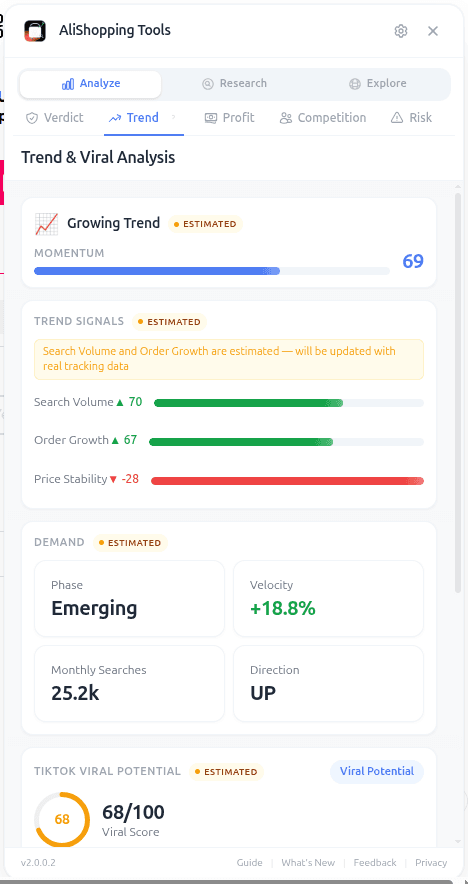
Tools like AliShopping Tools classify products into trend phases — Emerging, Growing, Peak, or Declining — with a momentum score from 0 to 100. This saves you from chasing products that already peaked weeks ago.
Step 2: Validate Demand With Numbers, Not Opinions
Once you have a shortlist of trending products, validate demand with hard numbers. "It looks popular" is not validation.
Here is what real demand validation looks like:
Order volume and velocity. A product with 10,000 total orders sounds impressive until you realize 9,500 of those were from two years ago. What matters is recent order velocity — how many units are moving per week right now.
Search volume. How many people actively search for this product or its category each month? High search volume with low competition is the ideal scenario.
Price sensitivity. Check the price range across sellers. If there is a wide price spread ($8 to $35 for the same product), the market has room for positioning. If every seller clusters at $12.99, margins are compressed and competition is fierce.
Platform diversity. Is demand concentrated on one platform, or are people buying this across AliExpress, Amazon, TikTok Shop, and Shopify stores? Multi-platform demand signals genuine market interest, not just algorithm-driven virality.
Do not skip this step. Many products look trending but lack the sustained demand needed to build a profitable campaign around them.

Step 3: Run the Numbers on Profit Before You Spend a Dollar
This is where most beginners get burned. They see a product selling for $29.99 with a $6 supplier cost and assume they will pocket $24 per sale. Reality is much less generous.
A proper profit calculation includes every cost:
| Cost Component | Example |
|---|---|
| Product cost | $6.00 |
| Shipping (to customer) | $3.50 |
| Platform/payment fees (3-5%) | $1.20 |
| Ad spend per acquisition | $8.00-15.00 |
| Returns/refunds (5-10%) | $1.50 |
| Total cost per sale | $20.20-$27.20 |
On a $29.99 sale price, that leaves you with $2.79 to $9.79 per unit. Suddenly the math requires a lot more precision.
Before you commit to any product, simulate the full profit breakdown. Know your margin at different price points. Know your break-even point — how many units you need to sell before recouping your initial ad test budget.
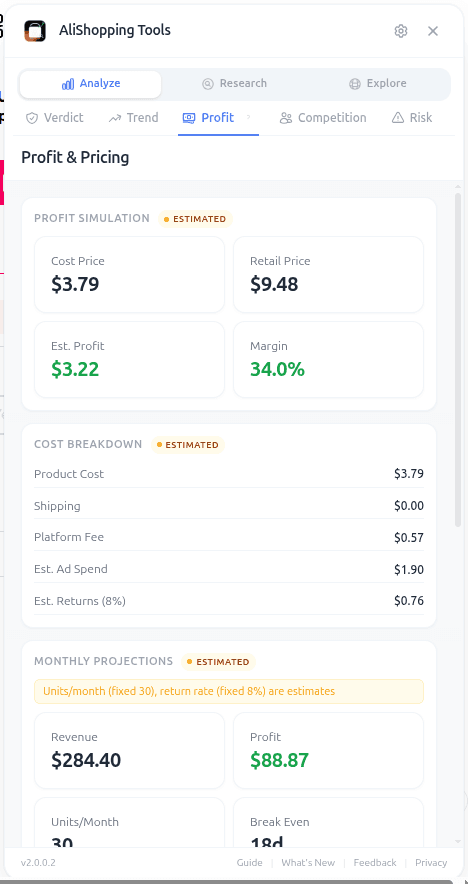
AliShopping Tools includes a built-in profit simulator that calculates all of this automatically when you view any AliExpress product page. It factors in product cost, shipping, platform fees, estimated ad spend by category, and return rates — then shows your projected margin, monthly revenue at different sales volumes, and the number of days to break even.
This is the difference between hoping a product is profitable and knowing it before you spend your first dollar on ads.
Step 4: Check the Competition — Saturation Kills Margins
A product can be trending, in-demand, and profitable on paper — and still fail if the market is oversaturated.
Saturation means too many sellers competing for the same buyers. When saturation is high, two things happen: ad costs spike because everyone bids on the same audiences, and customers comparison-shop until someone undercuts your price.
Here is how to assess saturation:
- Count active sellers. Search the product on AliExpress, Amazon, and TikTok Shop. If dozens of stores list the exact same item with similar photos, the market is crowded.
- Check ad libraries. Meta Ad Library and TikTok Creative Center let you see how many brands currently run ads for similar products. More than 15-20 active advertisers is a warning sign.
- Analyze pricing compression. When all sellers cluster within a narrow price range, it indicates a price war. Healthy markets show price diversity.
- Look for differentiation opportunities. Can you bundle the product, improve the imagery, target a different audience, or position it with a unique angle? If yes, saturation is manageable. If no, move on.
A saturation score (0-100%) gives you a quick read. Products scoring below 40% saturation generally have the most room for new entrants. Above 70%, you need a strong differentiation strategy or risk a price war you cannot win.

Step 5: Evaluate Supplier Risk Before You Commit
Supplier problems are the silent killer of dropshipping businesses. A product can tick every other box, but if your supplier ships defective units, delivers late, or disappears mid-campaign, your store takes the hit in chargebacks, bad reviews, and lost customers.
Evaluate these risk factors for every supplier you consider:
- Store rating and age. A supplier with a 4.7+ rating and 3+ years in operation is significantly safer than a new store with few reviews.
- Dispute rate. Look at the ratio of disputes to orders. Anything above 3% is a red flag.
- Product review quality. Read the 1-star and 2-star reviews specifically. Patterns like "arrived broken," "wrong size," or "nothing like the photos" tell you more than the average score does.
- Communication responsiveness. Message the supplier before ordering. A supplier who responds within 24 hours is likely to handle order issues well. No response within 48 hours is a warning.
- Business license verification. On AliExpress, check whether the seller has a verified business license. Verified sellers have more accountability.
AliShopping Tools automates this with a risk assessment that scores suppliers from 0 to 100, flags specific risk factors (such as a high dispute rate or an unverified business licence), and gives you a trust score so you can compare suppliers at a glance. It does not assess the reviews themselves — for that, open the Reviews tab and read the star distribution and photo reviews yourself.

Step 6: Spy on What Already Works — Learn From Successful Stores
You do not need to reinvent the wheel. Thousands of successful Shopify stores already sell products profitably. Studying what works for them accelerates your learning curve dramatically.
Here is what to look for when analyzing competitor stores:
- Best-selling products. Which items get the most traffic and orders? These are proven winners in their niche.
- Pricing strategy. What do they charge for similar products? This tells you what the market will bear.
- Apps and tools. What review apps, upsell tools, and analytics do they use? Their tech stack reveals their optimization strategy.
- Store design and positioning. How do they present products? What trust signals do they use? What does their brand story look like?
Manually analyzing Shopify stores is tedious but valuable. AliShopping Tools includes a Shopify spy module that shows you a store's products, estimated sales, apps installed, and theme — all from the storefront, no login needed.
The goal is not to copy competitors directly. It is to understand what the market rewards and build something better.

Step 7: Score and Rank Your Shortlist
By this point, you should have 5-10 products that passed your initial filters. Now you need to rank them objectively.
Create a simple scoring matrix:
| Criteria | Weight | Product A | Product B | Product C |
|---|---|---|---|---|
| Trend momentum | 20% | 8/10 | 6/10 | 9/10 |
| Demand strength | 20% | 7/10 | 8/10 | 7/10 |
| Profit margin | 25% | 9/10 | 5/10 | 8/10 |
| Low saturation | 20% | 6/10 | 9/10 | 7/10 |
| Low supplier risk | 15% | 8/10 | 7/10 | 6/10 |
Multiply each score by its weight and sum them up. This gives you a weighted total that accounts for what matters most in dropshipping profitability.
AliShopping Tools generates a Winning Score (0-100) for every AliExpress product using a similar weighted approach — though with a different set of inputs than the matrix above. It combines seven signals read off the listing itself: demand potential (20%), price attractiveness (15%), product rating (15%), social proof (15%), visual appeal (15%), commission value (10%) and shipping quality (10%), sorted into three bands (High Potential 75+, Medium 50-74, Low below 50).
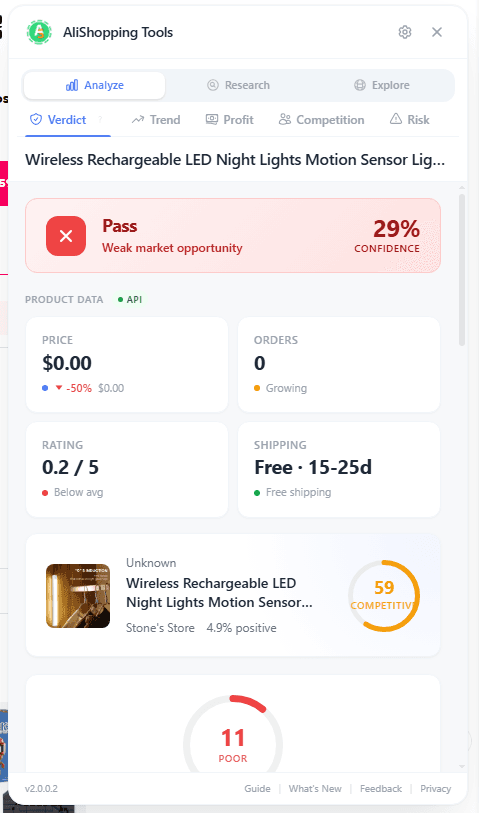
Note that margin and saturation — two columns in the matrix above — are deliberately not in the Winning Score. They feed the separate Verdict readout, which is the go/no-go call and carries four states: Strong Buy, Buy Signal, Hold / Watch, or Pass.
This does not replace your judgment. It accelerates it. Instead of spending two hours analyzing a product manually, you get a data-backed starting point in seconds.
Step 8: Test Small, Scale What Works
Even with perfect data, the market has the final vote. Your research narrows the odds — it does not guarantee success.
The smart testing approach for 2026:
- Pick your top 2-3 products from the scoring matrix.
- Set a test budget of $50-100 per product. This is enough for initial signal at current CPMs.
- Run 3-5 ad creatives per product. Different hooks, different angles. The creative matters as much as the product.
- Measure after 48-72 hours. Look for a cost per purchase under 30% of your selling price. If a $30 product costs more than $9 to acquire, the unit economics do not work at scale.
- Kill losers fast, double down on winners. Do not let emotional attachment to a product override the data.
The products that survive testing with positive unit economics are your winners. Scale those by increasing budget gradually (20-30% every 2-3 days) and expanding to new audiences.

The 2026 Product Research Workflow (Summary)
Here is the complete workflow in one view:
- Detect trends — Find products with rising momentum, not peaked popularity.
- Validate demand — Confirm with order velocity, search volume, and multi-platform presence.
- Simulate profit — Calculate real margins including all costs. Know your break-even.
- Check saturation — Avoid crowded markets unless you have a clear differentiation angle.
- Assess risk — Vet suppliers on ratings, disputes, reviews, and verification.
- Spy competitors — Study what works on successful stores and improve on it.
- Score and rank — Use a weighted matrix to compare products objectively.
- Test and scale — Small budget tests, kill losers, scale winners.
This process takes most beginners 2-3 hours when done manually. With the right tools, you can compress it to 15-20 minutes per product.
Frequently Asked Questions
How long does it take to find a winning dropshipping product?
With a structured, data-driven process, you can evaluate a product in 15-20 minutes using tools like AliShopping Tools. Most sellers need to research 20-30 products before finding one worth testing. Budget a few hours per week for research, and expect to test 2-3 products before landing a winner.
How many products should I test at the same time?
Start with 2-3 products maximum. Testing more than that spreads your ad budget too thin to get meaningful data. Allocate $50-100 per product for initial testing over 3-5 days, then kill the losers and scale the winner.
What profit margin should I aim for on a winning product?
Target at least 25-35% net margin after all costs including product, shipping, platform fees, ad spend, and returns. Below 20% is risky because one bad ad week or a spike in returns can wipe out your profit entirely.
Can I find winning products without paid tools?
Yes. Google Trends, TikTok hashtag research, and manually browsing AliExpress are all free. However, free tools like AliShopping Tools dramatically speed up the process by automating trend analysis, profit simulation, and supplier risk checks directly on the product page.
Is it too late to start dropshipping in 2026?
No, but the bar is higher than it was in 2020. Successful dropshippers in 2026 use data to make decisions instead of guessing. The market is bigger than ever, and new products trend every week. The opportunity is there if you approach it systematically.
Start Finding Winning Products Today
Product research does not have to be overwhelming. The difference between struggling and succeeding in dropshipping comes down to one thing: replacing guesswork with data.
Every product you evaluate should have a clear trend trajectory, validated demand, a realistic profit simulation, a saturation assessment, and a supplier risk check. Skip any of these steps and you increase your odds of picking a loser.
AliShopping Tools puts all of these capabilities — AI-powered product verdicts, trend analysis, profit simulation, competition scoring, risk assessment, and Shopify spy — into a single free Chrome extension. No account required. No credit card. Install it, open any AliExpress product page, and see the data instantly.
AliShopping Tools
See live AliExpress data in your browser.
Seller trust score, 90-day price history, and live promo codes — on every AliExpress product page. No account, free.
Ready to find winning products?
Try AliShopping Tools — 15 free AI tools for product research.
Quick answers
Frequently Asked Questions
1What are the five criteria that define a winning product in 2026?
Per the post: high perceived value relative to cost (a $4 product customers happily pay $24.99 for — the 3–5x sweet spot), solves a problem or triggers emotion (daily annoyances or curiosity-sparking mechanics outperform generic items), not easily found in local stores (if Target has it for the same price your ad spend is wasted), lightweight and shippable (under 500g with no fragile components wins on logistics), and content-friendly (demonstrable in a 15-second video).
Every product you consider should pass at least four of five.
2Why does trend detection come before product browsing?
The post argues starting on AliExpress or TikTok scrolling is backwards.
A trending product in its early growth phase has momentum in your favor; one that peaked three months ago has momentum against you.
Trend signals to look for: rising search volume over the past 30–60 days (not just a single spike), increasing order velocity (weekly units, not lifetime totals), growing social mentions across multiple platforms simultaneously, and emerging or early-peak classification (not declining).
Google Trends is a starting point but only shows search interest — pair with order-level data.
3Why does the post reject "gut feeling" product selection?
Roughly 90% of new dropshippers fail within the first year, and the primary reason is not bad ads, slow websites, or poor customer service — it is choosing the wrong product.
The failure pattern: see something blowing up on TikTok or in a Facebook group, rush to list it, launch ads, then discover 20+ stores already sell the same item, margin after ad spend is razor-thin, and the supplier has a 15% defect rate that buries you in disputes.
The shift from guessing to data-driven research is the single highest-leverage move a beginner can make.
4How long should I run a $50‑$100 test ad before deciding if a product is a winner?
Run the test long enough to get past the ad platform's initial learning phase and collect a meaningful sample — typically at least a week.
Watch click-through rate, conversion, and ROAS trends rather than a fixed universal benchmark, since acceptable numbers vary a lot by niche and price point.
If cost-per-acquisition stays comfortably under your target margin across the test window, it's a reasonable signal to scale; otherwise pause and move to the next candidate.
5What is the best way to calculate true profit margin when accounting for shipping, taxes, and ad spend?
Add up your real costs — AliExpress product price, actual shipping, any import duties that apply, and your real ad spend per sale — and subtract that total from your selling price.
Use your actual test-campaign numbers rather than assumed benchmarks wherever possible, since ad costs and duty rates vary a lot by niche and destination country.
6How can I use AI‑driven scoring to prioritize product candidates in my research pipeline?
Use an AI scoring system that weighs several factors together — demand trend (whether demand is rising or fading), order velocity, saturation, and supplier risk — then rank products by their combined score.
Rather than treating every factor equally, lean hardest on demand trend and order velocity (products with rising demand and fast‑growing orders), while still discounting saturated markets (many competing stores) and unreliable suppliers (low ratings).
Input each metric into the AliShopping Tools dashboard, where the algorithm automatically normalises the data and outputs a 0‑100 score.
Products scoring above 75 are ready for a low‑budget test, while those below 50 should be discarded or revisited later.
This quantitative approach removes bias and speeds up decision‑making.
7What signals indicate that a niche is becoming saturated, and how quickly should I drop it?
A niche is trending toward saturated when you notice the same handful of sellers dominating search results for a product and order velocity across those listings starting to flatten or decline.
A rising number of new near-identical listings appearing over a short window is another sign the market is getting crowded.
When you see these signals stacking up, it's reasonable to pause new spend on that niche and look at adjacent, less-crowded alternatives.
8How many product ideas should I keep in my shortlist before moving to the testing phase, and why?
Keep your shortlist small enough that you can run a real test campaign on each one without spreading your budget too thin — for most beginners that means somewhere in the single digits to low double digits, sized to your actual testing budget.
Testing too many products at once dilutes both your ad spend and the quality of the data you get back from each one.
More from the blog
Is This Product Worth Selling? 7 Signs of a Winning Dropshipping Product
Winning dropshipping products 2026: 7 data-backed signals — order velocity, margin, supplier trust, trend momentum, competition read, ad proof. Free evaluation checklist included.
Winning Products August 2026: 12 Back-to-School Peak Categories
12 dropshipping categories for August 2026 — back-to-school peak (first two weeks), dorm setup, and the early-fall transition — plus how to vet any candidate with AStools before you spend.
Winning Products July 2026: 12 Post-618 Categories
12 dropshipping categories for July 2026 — post-618 restock, back-to-school prep, summer peak — plus how to vet any candidate with AStools before you spend.