AliExpress Fake Review Checker: Free Tools & Methods (2026)
AliExpress Fake Review Checker: How to Spot Fake Reviews With Free Tools (2026)
Honest answer up front: No tool reliably detects fake AliExpress reviews automatically. Any product calling itself a "fake review checker" or claiming AI-powered detection should be treated with healthy skepticism. What actually works is checking the review data yourself using five pattern signals. Free browser extensions can put that data in front of you faster — but the judgment stays yours.
If you've ever searched for "AliExpress fake review checker," you were probably hoping for a tool that scans a product listing and tells you which reviews are real. That tool doesn't exist — not in any reliable form. What does exist is a set of patterns that fake reviews consistently follow, and a handful of free tools that make those patterns easier to spot.
This guide covers both: the patterns to look for and the tools that help you look faster.
Why Fake Reviews Are a Real Problem on AliExpress
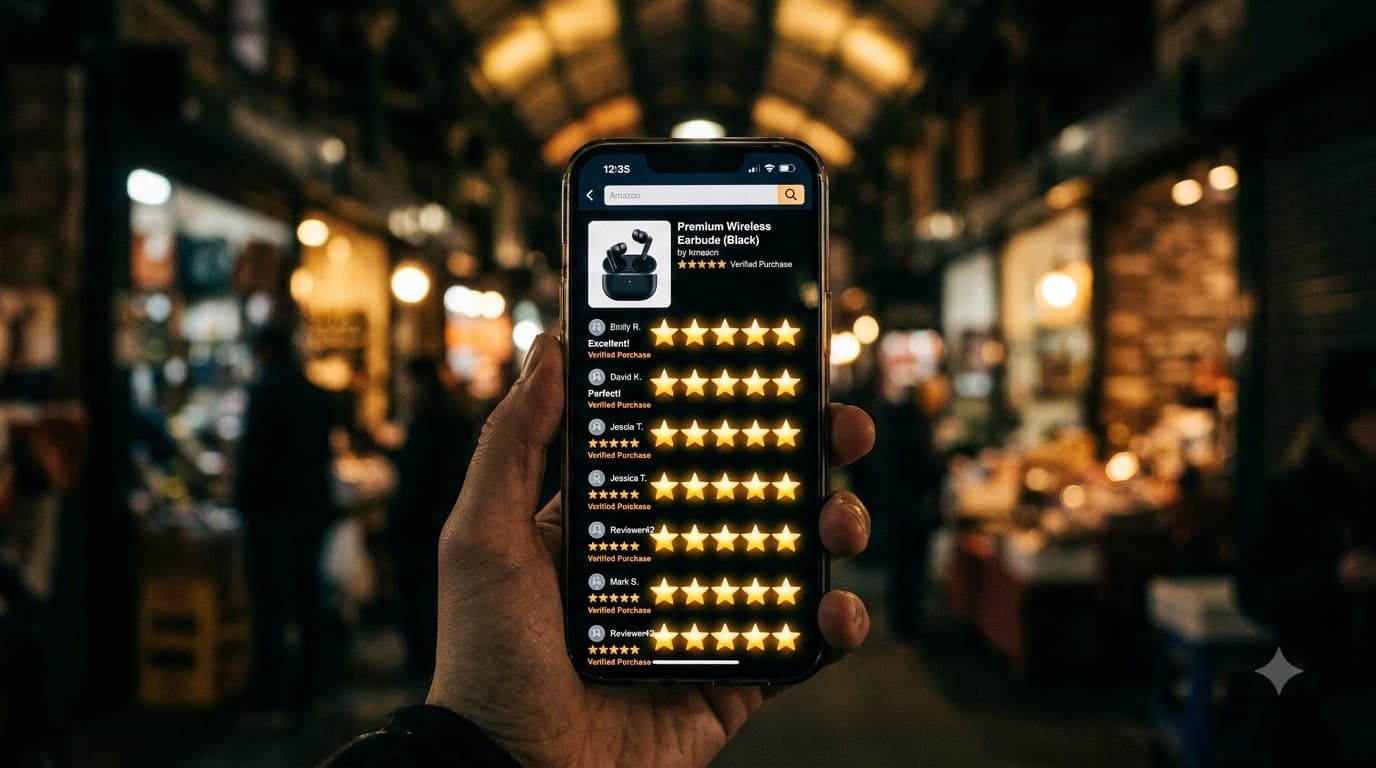
AliExpress hosts millions of sellers competing for visibility, and review count and star ratings directly affect search placement on the platform. That creates a structural incentive for review manipulation.
Common forms of manipulation include:
- Incentivized reviews — sellers offer discount coupons, partial refunds, or free items in exchange for 5-star reviews. AliExpress allows some forms of this, which blurs the line between "incentivized" and "fake."
- Purchased bulk reviews — third-party services sell packages of positive reviews from accounts created specifically for this purpose.
- Stolen photo reviews — review photos taken from other listings or product images presented as buyer photos.
- Review padding after launch — new products that accumulate hundreds of reviews within days of listing, before enough orders could have shipped and been received.
Industry estimates suggest that 10-30% of reviews on major e-commerce marketplaces may be incentivized or manipulated, though exact figures for AliExpress specifically are difficult to verify independently. The concentration is highest in trending, high-competition categories — exactly the products buyers search for most.

5 Red Flags of Fake AliExpress Reviews
These five patterns appear consistently in manipulated review sets. Any single one is a caution signal. Two or more together strongly suggest manipulation.
1. Burst posting dates
Genuine reviews trickle in over weeks and months as orders ship and buyers receive products. Fake reviews often appear in a dense burst — 30, 50, or 100+ reviews posted within a 2-3 day window, then silence.
How to check: Scroll through the review timeline on the product page. Look at posting dates. A natural pattern shows reviews spread across weeks. An unnatural pattern shows clusters.
2. Low photo-to-review ratio
Real buyers who are genuinely satisfied often post photos, especially for physical products where appearance matters. A listing with 3,000 text reviews but only 12 photo reviews suggests the bulk of reviews were generated without anyone actually holding the product.
How to check: Filter for "With Photos" and compare the count against the total review number. There's no universal benchmark, but a ratio below 2-3% on a product where appearance matters (clothing, electronics, home decor) is worth questioning.
3. Generic repeated text
Fake reviews tend to use the same short phrases: "good quality," "fast shipping," "as described," "love it," "will buy again." Real reviews mention specific things — the actual color compared to the listing photo, whether the size runs small, how the material feels.
How to check: Read 10 recent reviews out loud. If you could swap any review onto any other product listing and it would still make sense, that's a signal. Genuine reviews contain details that only apply to the specific product.
4. Unnatural star distribution
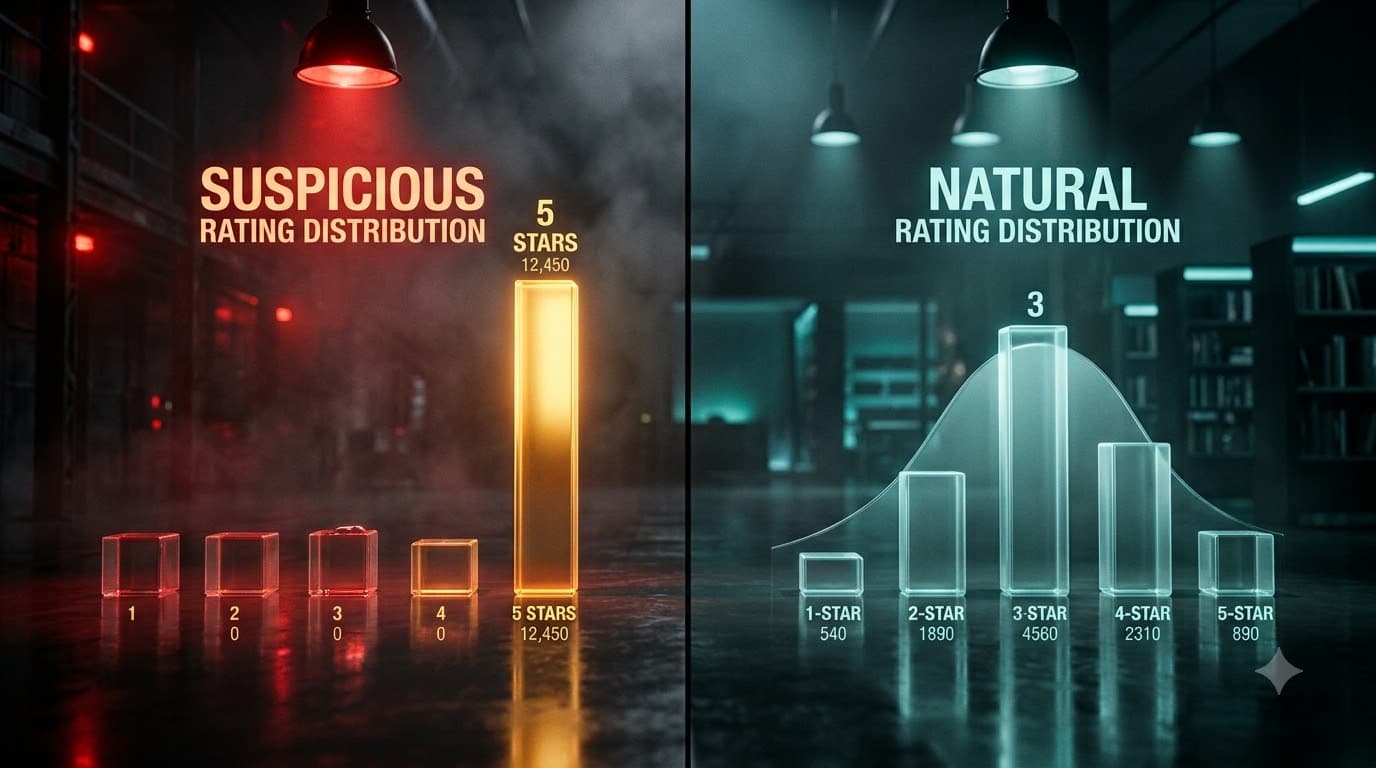
A real product that buyers genuinely like will still have some 3-star and 4-star reviews. A star distribution showing 96% five-star, 2% four-star, and almost nothing else is statistically unusual for any product with significant volume.
How to check: Look at the full 1-5 star breakdown rather than the average. A healthy distribution has a visible spread. An unhealthy one is a single tall bar at 5 stars with everything else near zero.
5. Single-review buyer accounts
Bulk review services create accounts that post one review and are never used again. If you click on multiple reviewer profiles and find that most have exactly one review in their entire history, the review set was likely purchased.
How to check: Click on 3-5 reviewer usernames and check their review history. A mix of active accounts (10+ reviews across different products) and occasional single-review accounts is normal. All single-review accounts is not.
Manual Methods to Verify Review Authenticity
Beyond the five red flags, several manual techniques help verify whether reviews are trustworthy.
Reverse image search review photos
If a review includes photos, you can check whether those images appear elsewhere online. Right-click the photo, select "Search image with Google Lens" (or your preferred reverse image search tool), and see if the same photo appears on other listings or stock photo sites.
This catches stolen photos — images taken from a different seller's listing or from the manufacturer's product shots, then uploaded as a "buyer review."
Read negative reviews first
Skip the 5-star reviews entirely. Sort by 1-star and 2-star. Negative reviews are rarely faked (no one pays for bad reviews), so they give you the most honest picture of actual product issues: wrong size, cheap material, slow shipping, different from photos.
If a product has 500 five-star reviews and zero one-star reviews, that itself is suspicious. Every product at scale receives some complaints.
Compare review count to order count
AliExpress shows both order count and review count on most listings. Typically, 5-15% of buyers leave reviews. A product with 10,000 orders and 8,000 reviews (80% review rate) is unusual. A product with 10,000 orders and 50 reviews may have suppressed negative feedback — or it may just be a low-engagement category. Context matters.
Check the seller's other products
If a seller has 20 listings and every single one has a 4.9+ rating with identical review patterns, that's a store-level signal. Genuine sellers usually have a range — some products perform well, some don't.

Free Tools That Help You Check Reviews
No tool detects fake reviews for you. But several free tools put the data you need for your own analysis in one place, saving time on the manual checks above.
AliShopping Tools (free Chrome extension)
AliShopping Tools shows a Reviews tab on AliExpress product pages with:
- Rating distribution — the full 1-5 star breakdown as percentages, so you can see at a glance whether the distribution is natural or suspiciously top-heavy
- Review count — total reviews displayed clearly
- Photo filter — one-click filter to see only reviews with buyer photos, making the photo-to-review ratio check instant
- Photo lightbox — buyer photos open full-size for easier inspection
- Review export — download reviews as CSV, JSON, TXT, or XLSX to analyze patterns in a spreadsheet (useful for checking repeated text or posting date clusters)
What it does not do: AliShopping does not score reviews for authenticity, flag individual reviews as fake, use AI or machine learning to detect manipulation, or make any automated judgment about whether reviews are real. It shows you the data; you decide.
The extension also includes a Verdict tab that evaluates products across four dimensions (product, profit, market, risk) and assigns one of four labels (Strong Buy, Buy Signal, Hold / Watch, Pass). This is a product evaluation feature, not a review checker — but the risk component does factor in review patterns as one of several signals.
Install AliShopping Tools on the Chrome Web Store →
Google Lens (reverse image search)
Free, built into Chrome. Right-click any review photo to check if it appears elsewhere online. Best for catching stolen product images presented as buyer photos.
Fakespot and ReviewMeta
These tools were built primarily for Amazon reviews and have limited AliExpress support. They analyze review text patterns and posting behavior to flag suspicious reviews. Worth trying, but results on AliExpress listings are inconsistent because their models were trained on Amazon data patterns.
Honest note: If you find a tool that claims high accuracy in detecting fake AliExpress reviews specifically, check when it was last updated and what data it actually analyzes. Most "review checker" tools are either Amazon-focused, no longer maintained, or make claims they can't substantiate.
Beyond Reviews: Other Trust Signals to Check
Reviews are one piece of the puzzle. Before buying from any AliExpress seller, also check:
- Seller age — stores open for 2+ years with consistent activity are lower risk than brand-new stores
- Store feedback score — the overall store rating (separate from individual product ratings) reflects cumulative buyer experience
- Order volume — high order counts with reasonable review ratios suggest genuine demand
- Price history — use a price history tool to check whether the "sale" price is actually lower than the regular price
- Product photos — are they professional studio shots (manufacturer images, used by many sellers) or do they include real-world context photos unique to this seller?
- Description quality — poorly translated, copy-pasted descriptions with inconsistent specifications suggest a low-effort listing
For a deeper dive on seller verification, see our guide on how to check if an AliExpress seller is trustworthy.
Step-by-Step: Verify Any AliExpress Product in 60 Seconds
Here's a practical workflow that combines everything above into a quick check you can run on any listing before buying.
Step 1: Star distribution (5 seconds). Look at the 1-5 star breakdown. If it's 95%+ five-star with negligible 3-4 star reviews, proceed with caution. With AliShopping installed, this is visible immediately on the Reviews tab.
Step 2: Photo filter (10 seconds). Click the photo filter. Count how many photo reviews exist relative to the total. Below 2-3% on an appearance-dependent product is a flag.
Step 3: Read 5 reviews (20 seconds). Read five recent text reviews. Are they specific to the product, or could they describe anything? Look for details about size, color accuracy, material quality.
Step 4: Check 2 reviewer profiles (15 seconds). Click two reviewer usernames. Do they have review history beyond this one product?
Step 5: Negative reviews (10 seconds). Sort by 1-star. Read the top complaint. Is it a quality issue you can live with, or a dealbreaker?
If a listing passes all five checks, the reviews are likely mostly genuine. If it fails two or more, consider finding an alternative seller for the same product — or at minimum, factor the review quality into your buying decision.
The Bottom Line
The search for an "AliExpress fake review checker" usually ends in disappointment because the tool people want — something that reliably separates real reviews from fake ones with a single click — doesn't exist in a trustworthy form for AliExpress.
What does work is learning the five patterns (burst dates, low photos, generic text, skewed stars, single-review accounts) and spending 60 seconds checking before you buy. Free tools like AliShopping's review breakdown make the data side of that check faster — but they don't make the judgment for you, and you should be skeptical of anything that claims to.
The best fake review checker is an informed buyer. Now you know what to look for.
Ready to find winning products?
Try AliShopping Tools — 15 free AI tools for product research.
Quick answers
Frequently Asked Questions
1Are AliExpress reviews real?
AliExpress reviews are a mix of genuine buyer feedback and incentivized or manipulated reviews.
Industry estimates suggest 10-30% of reviews on major e-commerce marketplaces may be incentivized, though exact figures for AliExpress are difficult to verify independently.
Look for detailed text with product-specific language and real buyer photos as trust signals.
Reviews that are short, generic, and clustered in posting date are more likely to be manipulated.
2Is there a free tool to check AliExpress reviews?
No tool reliably detects fake AliExpress reviews automatically.
The AliShopping Tools Chrome extension shows review data that helps you judge for yourself — rating distribution (full 1-5 star breakdown), a photo filter, buyer photo lightbox, and review export to CSV or spreadsheet.
These make manual pattern checks faster but do not score or flag individual reviews as fake.
Tools like Fakespot and ReviewMeta exist but were built primarily for Amazon and have limited accuracy on AliExpress listings.
3How can I tell if AliExpress photos in reviews are real?
Use reverse image search: right-click the review photo, select 'Search image with Google Lens,' and check if the same photo appears on other listings or stock photo sites.
Real buyer photos typically show the product in everyday settings (on a table, held in hand, next to a ruler for scale).
Photos that look like professional studio shots or match the seller's own product images are likely not from actual buyers.
4What is a good review-to-order ratio on AliExpress?
Typically 5-15% of AliExpress buyers leave reviews.
A product with 10,000 orders and 8,000 reviews (80% review rate) is unusually high and may indicate incentivized reviewing.
A product with 10,000 orders and only 50 reviews is unusually low and may indicate suppressed feedback — or it may simply be a low-engagement product category.
Compare the ratio against similar products in the same category for context.
The AliShopping Tools team tracks AliExpress seller data, buyer protection signals, and promo code windows across 50+ markets.
View profileMore from the blog
How to Spot Fake Reviews on AliExpress (2026 Guide)
AliExpress fake reviews follow predictable patterns: burst posting, no photos, generic text. Here are 5 red flags to check manually, plus how the AliShopping Reviews tab puts the evidence in front of you faster.
How to Check If an AliExpress Seller Is Trustworthy (Buyer's Guide 2026)
Check any AliExpress seller's trust score in 30 seconds: feedback %, store age, dispute rate, and order count. A step-by-step buyer guide for 2026.
AliExpress Coupon Finder: How to Find and Use Real Promo Codes (2026)
AliExpress has real coupons — store coupons, select coupons, platform codes, and new-user deals. Here's where to find them, how to stack them, and how to tell if a 'discount' is actually a price increase in disguise.