


How to Spot Fake Reviews on AliExpress: 7 Red Flags + Free Checker (2026)
How to Spot Fake Reviews on AliExpress (2026 Guide)
Quick answer: Fake AliExpress reviews follow seven predictable patterns: a burst of reviews posted within a day or two, almost no photo reviews, generic repeated text with no specific product details, a perfect all-5-star distribution with zero 3- or 4-star ratings, reviewer accounts with no other purchase history, suspicious buyer-country concentration, and a review count that exceeds plausible order conversion. These are manual checks — you read the listing and judge. The free AliShopping Tools Chrome extension makes two of them faster by showing the full star distribution and a one-click photo filter on every product page. Install AliShopping Tools free →
AliExpress review manipulation is a structured industry, not an occasional edge case. Sellers pay for reviews, brokers arrange them, and entire networks of accounts exist solely to leave five-star feedback on products they have never touched. The platform's search ranking heavily favors products with high review counts and strong average ratings, which creates an arms race where sellers who do not buy reviews get buried.
The good news: fake reviews follow predictable patterns. Once you know what to look for, a two-minute scan reveals manipulation signals that the headline rating number completely hides.
7 Red Flags of Fake AliExpress Reviews
| Red flag | Severity | What to check |
|---|---|---|
| Generic templated text | High | Vague phrases, no product specifics |
| Perfect 5-star distribution | High | Missing 3- and 4-star reviews |
| Burst posting dates | High | Many reviews on same day |
| Missing photo reviews | Medium | High review count, low photo count |
| Single-review accounts | High | Reviewer profiles with 1 total review |
| Country concentration | Medium | 90%+ reviews from one country |
| Review-to-order mismatch | High | Review count exceeds plausible conversion |
1. Generic, Templated Text
Real buyers write like real people. They mention specific details: "The stitching on the left pocket came loose after two washes" or "Fits true to size, I ordered M and I'm 5'9." Fake reviews use vague, universally applicable phrases that could describe any product on the platform.
Watch for lines like: "Very good product, fast delivery, recommend," "Nice quality, will buy again," or "As described, thank you seller." When you see the same generic language repeated across dozens of reviews, you are looking at a review farm.
How to check: Read 10 recent reviews. If the wording sounds identical or robotic across multiple reviews — and none mention specific product attributes like dimensions, colour accuracy, or material feel — that is a pattern signal.
2. Perfect 5-Star Distribution With No 3- or 4-Star Reviews
Real products from sellers with thousands of orders have a natural star distribution. Some buyers rate 4 stars because shipping was slower than expected. Some rate 3 stars because packaging was poor. A listing with hundreds of reviews, all 5-star, with zero 3-star and zero 4-star ratings, has an unnatural shape.
A genuine product with 500 reviews typically shows something like 78% five-star, 12% four-star, 5% three-star, 3% two-star, and 2% one-star. When 98% are five stars with negligible 3-4 star ratings, that distribution is artificial.
This is the one check the headline rating actively hides from you, and it is the reason reading the full 1-5 split matters more than reading the average.
3. Burst Posting — Reviews Clustered on the Same Day
Sort reviews by "Recent" on the product page. If you see a dense cluster of reviews all posted within a day or two, with thin activity either side of it, the reviews were likely purchased as a batch. Natural review accumulation is gradual — even a top-selling product receives reviews spread across days and weeks.
Small spikes around major sales events like 11.11 or Black Friday are normal. Huge unexplained clusters of 30, 50, or 100+ reviews in a 2-3 day window are not.
4. Almost No Photo Reviews
Use the photo filter on the review section and compare what comes back against the total review count. Fake reviews almost never include photos because submitting one requires owning the physical product and taking the time to upload it. AliExpress actively incentivizes buyers to leave photo reviews with bonus coupons and coins, so a product that real people are buying will naturally accumulate photo reviews over time.
What counts as a normal photo rate varies by category — apparel and home goods run much higher than cables and small accessories. Build your own sense of normal by checking several listings in the same category before judging any single one. A listing with 3,000 text reviews but only 12 photo reviews is a strong warning sign.
5. Reviewers With Zero Other Reviews
Click on a reviewer's username in the reviews section. If their profile shows they have left only 1 review — ever — on all of AliExpress, the account was likely created for a single seeded review. Bulk review services create accounts that post one review and are never used again.
How to check: Click on 3-5 reviewer usernames and check their review history. A mix of active accounts (10+ reviews across different products) and occasional single-review accounts is normal. All single-review accounts is not.
6. Suspicious Buyer-Country Concentration
A natural review profile shows buyers from multiple countries. If 90% of reviews come from a single country that the seller barely ships to, that is a strong seeding signal. Cross-check the buyer countries in the reviews against the seller's main shipping destinations.
7. Review Count Exceeding Plausible Order Conversion
AliExpress shows both order count and review count on most listings. Typically, 5-15% of buyers leave reviews. A product with 10,000 orders and 8,000 reviews (80% review rate) is mathematically implausible without review manipulation.
How to Check AliExpress Reviews Manually (Step by Step)
You can run a basic fake review audit without any tools in under 2 minutes:
- Check the star distribution — look at the full 1-5 star breakdown. If it is 95%+ five-star with negligible 3-4 star reviews, proceed with caution.
- Filter for photo reviews — compare how many photo reviews exist against the total. Below 2-3% on an appearance-dependent product is a flag.
- Read 10 reviews — if the wording sounds identical or robotic, that is a manipulation signal. Look for product-specific language vs generic praise.
- Check 3 reviewer profiles — click the username of three recent reviewers. If all three have only 1 total review, treat the review set as likely manipulated.
- Sort by recent and scan dates — a dense block of same-day reviews with thin activity on either side is a classic batch pattern.
Check this seller before you buy.
Seller trust score and risk-flag scan on every AliExpress product page. No account, free.
If a listing passes all five checks, the reviews are likely mostly genuine. If it fails two or more, consider finding an alternative seller for the same product.
What the AliShopping Reviews Tab Shows You
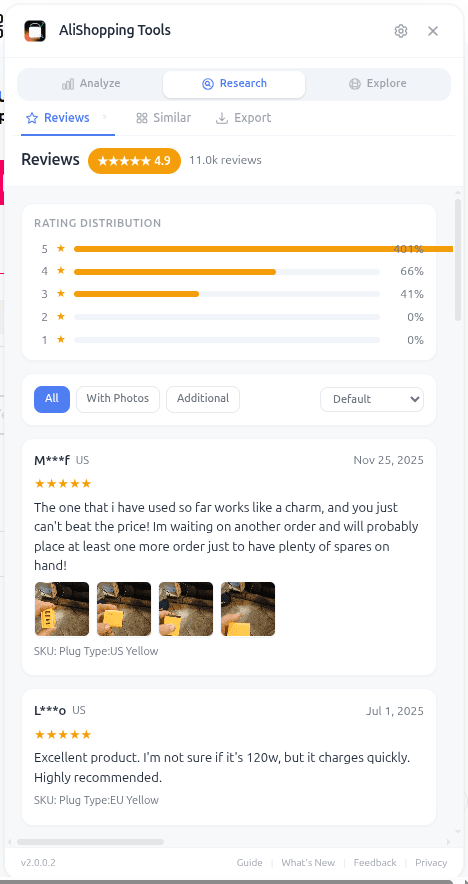
AliShopping Tools does not run the audit for you. There is no fake-review detector in the extension — it does not read review text, score authenticity, or flag anything as suspicious. What it does is remove the clicking, so the manual audit above takes a fraction of the time.
Open the Reviews tab on any AliExpress product page and you get:
- The total review count — the real number the star average is built on. A high rating over a thin sample is a weak signal.
- The full 1-5 star distribution, each level as a percentage. This is red flag #2 answered in one glance.
- Three filters — All, With Photos, Additional. The With Photos filter is red flag #4 in one click.
- Buyer photos in a lightbox, full size, so you can compare what actually arrived against the seller's studio shots.
- Export to CSV, JSON, TXT or XLSX. Pull the reviews into a spreadsheet, sort by date to check for burst patterns, or sort by text to find repeated phrasing.
Red flags #1, #3, #5, #6, and #7 stay manual. You run those on the AliExpress review feed itself.
What AliShopping does NOT do: It does not score reviews for authenticity, flag individual reviews as fake, or use AI to detect manipulation. Any tool that claims automated fake review detection should be treated with skepticism — there is no public dataset of confirmed-fake AliExpress reviews to train against. Evidence-first tools that show you the data are more honest than tools that claim a "fake review score."
Install AliShopping Tools — Free on Chrome Web Store →
How Incentivized Reviews Work on AliExpress
Incentivized reviews are a specific sub-type of manipulation where the seller pays the buyer to leave a positive review. Unlike bulk-purchased reviews from fake accounts, incentivized reviews come from real buyers who received the actual product — which makes them harder to detect but no less misleading.
The typical scheme: the buyer orders and receives the product, then the seller messages them offering a partial or full refund, a free gift, or a coupon code in exchange for a 5-star review. The buyer posts the review, the seller sends the incentive, and the rating is inflated. AliExpress policy prohibits this, but enforcement is inconsistent.
Signals That Distinguish Incentivized Reviews
Five patterns help separate incentivized feedback from organic reviews:
- Near-100% 5-star distribution with no 3 or 4-star reviews. Incentivized buyers always leave 5 stars — that is the deal.
- Review bursts in short date windows. Sellers run incentive campaigns in batches.
- Reviewer profiles with only one or two reviews. Some incentivized reviewers are real buyers who would not normally leave reviews.
- Templated review wording. Incentive schemes often suggest or provide review text.
- Review count exceeding plausible organic conversion. Typical review rates are 5-15% of orders.
Why the Dispute Rate Exposes What Incentivized Reviews Hide
A buyer who accepted a refund-for-review deal files no dispute — they got their money back. But a buyer who was genuinely wronged files a dispute. A high dispute rate underneath a near-perfect star average is the clearest contradiction you will find. The star rating can be purchased; the dispute rate cannot.
AliShopping Tools shows the dispute rate on the Supplier Risk tab alongside the review evidence on the Reviews tab. If the stars say "perfect" but the dispute rate says "problems," trust the dispute rate.
Can You Trust a 4.8-Star Seller on AliExpress?
Rating alone is insufficient. A seller with a 4.8-star headline rating can have a heavily seeded review set, while a seller with a 4.6-star rating may have entirely genuine reviews. The star average tells you nothing about review authenticity.
A 4.6-star seller with a natural review distribution — some 3-star reviews about slow shipping, some 4-star reviews about minor packaging issues, a mix of specific and photo-backed reviews — is a more reliable signal than a 4.9-star seller where every review was posted on the same Tuesday.
For the full picture on seller trustworthiness, combine your own review read with the four trust signals (feedback rate, store age, category transactions, dispute rate) from our seller trust guide.
What a Healthy Review Profile Looks Like
Use this as your benchmark when comparing listings:
Rating distribution follows a natural curve. Expect 65-85% five-star, 8-15% four-star, 3-8% three-star, and small percentages at one and two stars. The key is seeing a distribution, not a spike.
Photo reviews exist and look authentic. A product real people are buying accumulates a visible share of photo reviews over time. Those photos should show the product in real-world settings with inconsistent lighting and backgrounds — not polished studio shots.
Review dates spread naturally. Reviews should appear steadily over weeks and months. Small spikes around major sales events are normal. Huge unexplained clusters are not.
Negative reviews contain specific complaints. One-star and two-star reviews that mention specific issues are actually a good sign. They mean real people are buying and honestly reporting. A product with zero negative reviews after hundreds of sales is less trustworthy than one with a few genuine complaints.
What to Do If You Suspect Fake Reviews
When a product's review set looks manipulated, do not dismiss the listing outright — verify through alternative signals:
- Cross-check seller trust signals. A high star rating paired with a poor dispute rate is a clear red flag. The dispute rate is harder to fake than the review score.
- Filter reviews by photo only. Even on a manipulated listing, genuine buyer photos are harder to fake. Read the photo-backed reviews carefully.
- Read the 1-star and 2-star reviews. Negative reviews are rarely faked — no one pays for bad reviews. The complaints tell you what actually goes wrong.
- Search for the same product from a different seller. In most categories, multiple sellers carry the same item. Find one with a more natural review distribution.
- Reverse image search review photos. Right-click a review photo and use Google Lens. If the same photo appears on other listings or stock photo sites, it was not taken by a real buyer.
Frequently Asked Questions
Are AliExpress reviews fake?
Many are genuine, but review manipulation is common on competitive AliExpress product categories. The seven red flags in this guide — burst posting, generic text, missing photos, perfect star distributions, single-review accounts, country concentration, and review-to-order mismatches — help you distinguish genuine reviews from manipulated ones. The platform's ranking algorithm rewards high review counts, which creates a structural incentive for sellers to inflate their reviews.
How do I check if AliExpress reviews are real?
Run the five-step manual check: look at the star distribution (not the average), filter for photo reviews, read 10 recent reviews for repeated text, check 3 reviewer profiles, and scan posting dates for bursts. Two or more red flags together strongly suggest manipulation. The AliShopping Tools Reviews tab puts the star distribution and photo filter one click away on every product page.
What is an AliExpress fake review checker?
Most tools marketed as "fake review checkers" analyze review text patterns and posting behavior. No tool reliably detects fake reviews automatically — review manipulation is a judgment call based on patterns, not a binary classification. The honest approach is evidence-first tools like AliShopping Tools that show you the underlying data (star distribution, photo filter, export) so you can judge yourself.
Can I trust AliExpress products with thousands of reviews?
High review counts alone are not proof of quality. A product with 5,000 generic five-star reviews is less trustworthy than one with 500 reviews showing a natural distribution with specific complaints. Always check the star distribution shape and the photo-review ratio before trusting the headline number.
Are Google reviews about AliExpress reliable?
Google reviews about AliExpress as a platform reflect individual buyer experiences and vary widely. For specific product decisions, the product-level review data on AliExpress itself is more relevant than platform-level Google reviews. Use the seven red flags in this guide to evaluate product reviews directly.
How do incentivized reviews work on AliExpress?
Sellers message buyers after delivery offering partial refunds, free gifts, or coupons in exchange for 5-star reviews. These come from real buyers who received the product, making them harder to detect. The strongest counter-signal is the dispute rate — incentivized buyers file no disputes, but genuinely dissatisfied buyers do. A high dispute rate under perfect stars is the clearest sign of incentivization.
Related Buyer Guides
- How to Check If an AliExpress Seller Is Trustworthy — 4 trust checks beyond reviews
- AliExpress Scams to Avoid — 9 common scams including inflated reviews
- How to Get a Refund on AliExpress — what to do if fake reviews led to a bad purchase
- AliExpress Price History Checker — verify if a "sale" price is real
- AliExpress Complete Buyer's Guide — the full safety, reviews, and shipping walkthrough
AliShopping Tools
Check this seller before you buy.
Seller trust score and risk-flag scan on every AliExpress product page. No account, free.
Product Tracker Free Beta
Track any AliExpress product’s real price, orders, stock & rating for 180 days. Data doesn’t lie. But discounts can.
Trending Products on AliExpress
ALLPOWERS Portable Power Station R600, 299Wh LiFeP04 Battery with 2x 600W (1200W Surge) AC Outlets for Outdoor Camping RV Home

YZ For Tesla Floor Mat Model YL 2026 Car Trunk Mat Set Luggage Mat TPE waterproof Anti-Slip Set LHD&RHD Floor Liner Mat
 -1%
AYN Thor Android Handheld Dual Screen Clamshell 6'' AMOLED Screen 1080p Gaming Entertainment Device
 -35%
ELITEWHEELS Carbon Wheels ENT 2.0 Disc Brake 700c Carbon Rim Center Lock Road Bike Wheelset UCI Quality Road Racing Wheelset

Women 100% Merino Wool Sleeveless Pullovers Turtleneck Sweater Waistcoat Wool Knitwear Spring Autumn Winter Fashion Vest Tops

GEYA G2R Automatic Transfer Switch Din Rail ATS Dual Power Electrical Selector Switches Uninterrupted Power 25A 40A 63A 110V 220
Prices shown are from AliExpress. Links may earn a commission.
Before you buy
Is this deal real? Check the price history before you buy.
Prices often spike just before a “sale.” See 180-day price history and fake discount detection — free, no account needed.
Verify on AliShopping Deals →Ready to find winning products?
Try AliShopping Tools — 15 free AI tools for product research.
Quick answers
Frequently Asked Questions
1Are AliExpress reviews fake?
Many AliExpress reviews are genuine, but review manipulation is common on competitive product categories.
Seven red flags help you distinguish: burst posting dates, generic repeated text, missing photo reviews, perfect 5-star distributions, single-review buyer accounts, suspicious country concentration, and review-to-order count mismatches.
The platform's ranking algorithm rewards high review counts, which creates a structural incentive for sellers to inflate their reviews.
2How do I check if AliExpress reviews are real?
Run a five-step manual check: look at the full 1-5 star distribution (not just the average), filter for photo reviews, read 10 recent reviews for repeated text, check 3 reviewer profiles for single-review accounts, and scan posting dates for bursts.
Two or more red flags together strongly suggest manipulation.
The free AliShopping Tools Reviews tab puts the star distribution and photo filter one click away on every product page.
3What is an AliExpress fake review checker?
Most tools marketed as fake review checkers analyze review text patterns and posting behavior.
No tool reliably detects fake reviews automatically — review manipulation is a judgment call based on patterns, not a binary classification.
The honest approach is evidence-first tools like AliShopping Tools that show you the underlying data (star distribution, photo filter, review export) so you can judge yourself.
4Can I trust AliExpress products with thousands of reviews?
High review counts alone are not proof of quality.
A product with 5,000 generic five-star reviews is less trustworthy than one with 500 reviews showing a natural distribution with specific complaints.
Always check the star distribution shape and the photo-review ratio before trusting the headline number.
5Are Google reviews about AliExpress reliable?
Google reviews about AliExpress as a platform reflect individual buyer experiences and vary widely.
For specific product decisions, the product-level review data on AliExpress itself is more relevant than platform-level Google reviews.
Use the seven red flags in this guide to evaluate product reviews directly on the listing page.
6How do incentivized reviews work on AliExpress?
Sellers message buyers after delivery offering partial refunds, free gifts, or coupons in exchange for 5-star reviews.
These come from real buyers who received the product, making them harder to detect than bulk-purchased fake reviews.
The strongest counter-signal is the dispute rate — incentivized buyers file no disputes, but genuinely dissatisfied buyers do.
A high dispute rate underneath perfect stars is the clearest sign of incentivization.
Related Articles
- AliExpress Fake Review Checker: Free Tools & Methods (2026)guides
- How to Check If an AliExpress Seller Is Trustworthy (Buyer's Guide 2026)guides
- How to Spot Fake AliExpress Reviews in 30 Secondsguides
- پاکستانی خریداروں کے لیے AliExpress گائیڈ 2026misc
- AliExpress Buyer's Guide for Pakistan 2026misc
- How to Check AliExpress Price History in Pakistan Before 618 2026misc
Related Tools
More from the blog
AliExpress Fake Review Checker: Free Tools & Methods (2026)
No tool reliably detects fake AliExpress reviews. But you can spot them yourself using five pattern checks and free data tools. Full method guide inside.
How to Check If an AliExpress Seller Is Trustworthy (Buyer's Guide 2026)
Check any AliExpress seller's trust score in 30 seconds: feedback %, store age, dispute rate, and order count. A step-by-step buyer guide for 2026.
How to Check If an AliExpress Price Drop Is Real Before You Buy (2026)
AliExpress sellers routinely inflate prices before sales so the 'drop' looks bigger than it is. Here is a 5-step method to verify any price drop before you spend.