
AliExpress vs Zendrop Dropshipping 2026: Full Comparison
Quick answer: AliExpress is better for catalog breadth and low unit costs with no monthly fee; Zendrop wins for US/EU shipping speed, auto-fulfillment, and branded packaging — at a subscription cost. For most new dropshippers, start with AliExpress and upgrade to Zendrop's model when fulfillment speed becomes a bottleneck. Install AliShopping Tools on the Chrome Web Store →
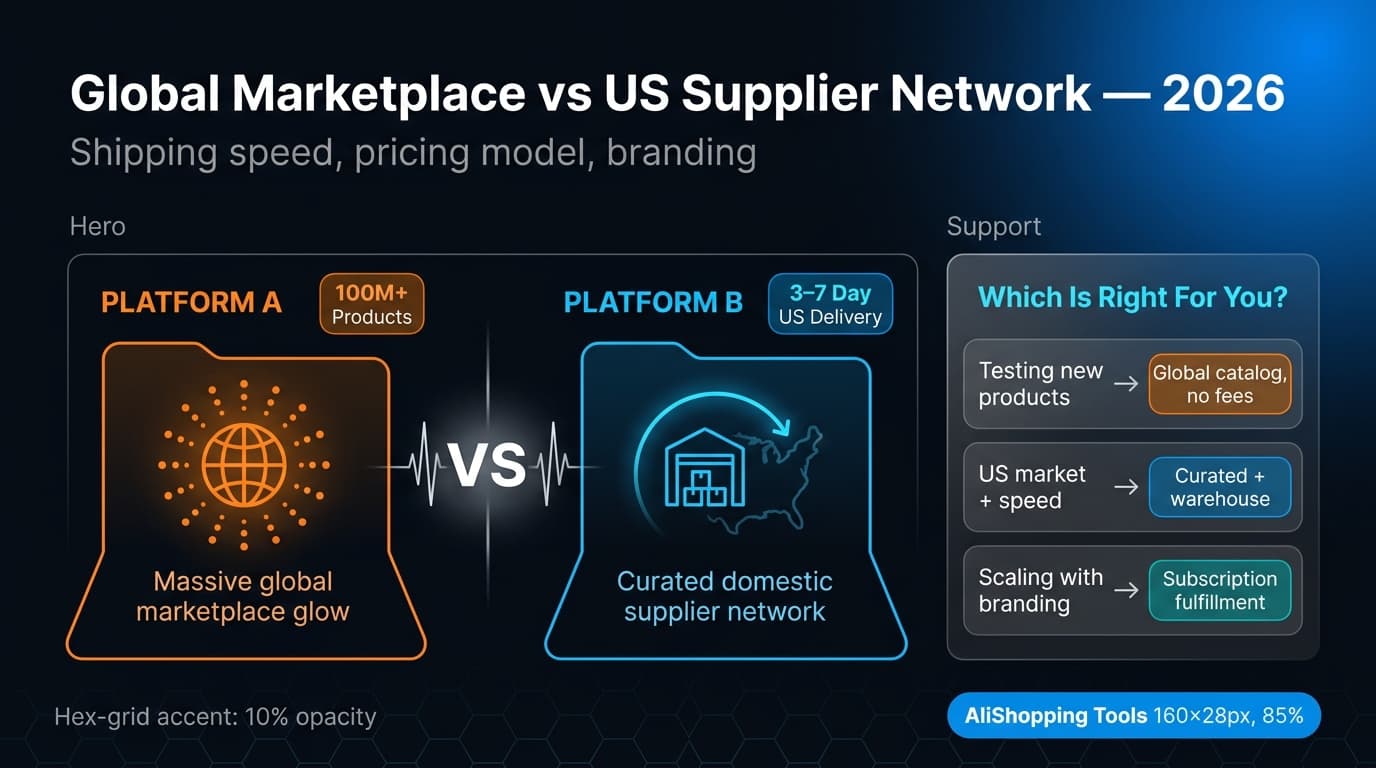
The dropshipping platform you choose shapes your product margins, fulfillment speed, and how much operational work you handle manually. AliExpress and Zendrop serve different points in the dropshipping journey — and understanding where each one excels will save you from a costly platform switch mid-operation.
This guide compares both platforms across the metrics that matter most for dropshipping profitability in 2026.
AliExpress vs Zendrop: What Is the Core Difference?
The core difference is scope vs. structure. AliExpress is an open marketplace with hundreds of millions of products from independent suppliers — you have maximum choice, but you manage supplier relationships, shipping variations, and quality control yourself. Zendrop is a curated dropshipping platform with a vetted supplier network, automated fulfillment, and built-in branding tools — you get consistency, but your product catalog is smaller and you pay a monthly subscription.
Who each platform is built for:
| Platform | Built For |
|---|---|
| AliExpress | Dropshippers who want maximum product variety and lowest unit costs |
| Zendrop | Dropshippers targeting US/EU markets who prioritize fulfillment reliability |
Neither platform is universally better. The right choice depends on your target market, niche, and where you are in scaling.
Product Range and Supplier Options
AliExpress carries an estimated 100+ million products across every conceivable category — electronics, fashion, home goods, beauty, automotive, industrial components, and more. Suppliers range from manufacturers to trading companies to individual resellers. This breadth means you can test virtually any niche without being limited by what a curated platform has sourced.
The tradeoff: supplier quality is highly variable. A product category on AliExpress might have 500 suppliers — finding the three or four worth working with requires testing, reviews analysis, and order samples. AliShopping Tools helps by surfacing price history, seller ratings, and order volume data directly on AliExpress product pages, which speeds up supplier vetting significantly.
Zendrop's catalog is smaller — focused on winning products that have been pre-vetted for quality and fulfillment reliability. The curation means less time evaluating suppliers, but you cannot go off-catalog. If your niche requires something outside Zendrop's existing inventory, you will need to request sourcing (available on higher-tier plans).
Verdict: AliExpress for catalog depth and niche flexibility. Zendrop for reduced supplier vetting overhead.
Shipping Speed and Fulfillment Reliability
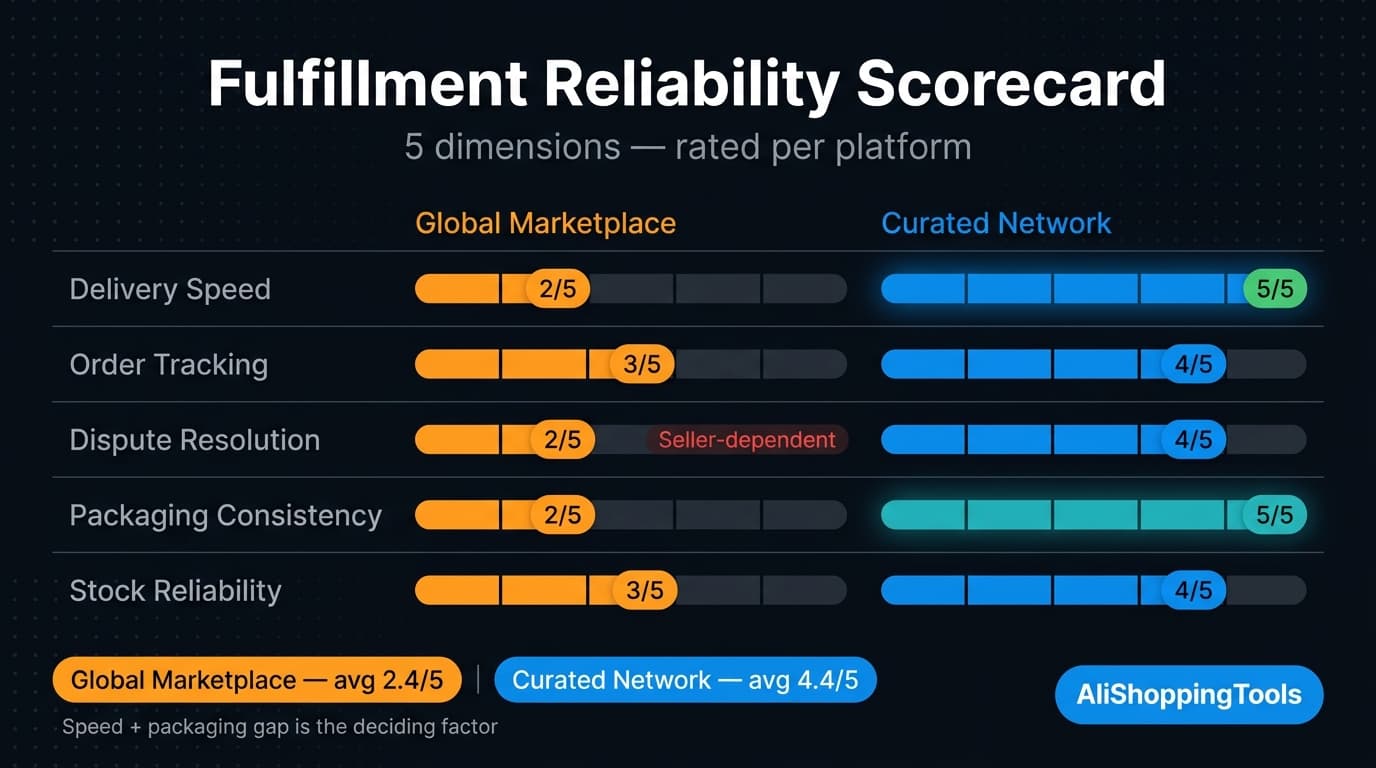
This is where the platforms diverge most sharply.
AliExpress shipping timelines (typical, June 2026):
| Shipping Method | Delivery Time |
|---|---|
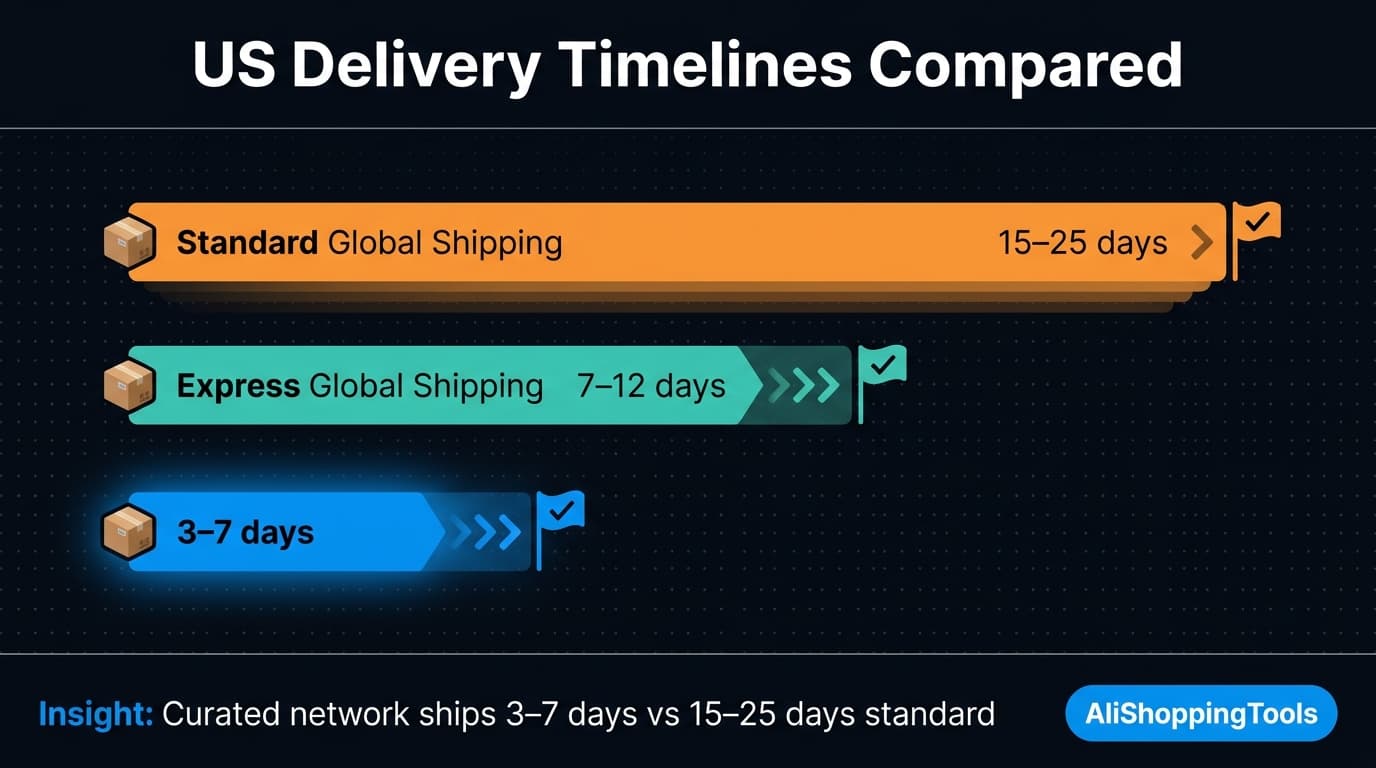
| AliExpress Standard Shipping | 15–25 business days |
| AliExpress Choice (warehouse pre-stocked) | 7–12 business days |
| ePacket (select routes) | 12–20 business days |
| Cainiao Super Economy | 20–35 business days |
AliExpress's Choice program has improved fulfillment reliability by pre-stocking fast-moving products in regional warehouses. For US and EU buyers, Choice listings can arrive in 7–10 days — competitive with some Zendrop tiers.
Zendrop operates US and EU warehouse hubs, enabling 3–7 day domestic fulfillment for US-stocked items. Their auto-fulfillment system processes orders automatically once connected to your Shopify store — no manual order submission required.
Where shipping matters most: If you are running paid social ads on a US or EU audience, 15–25 day delivery rates will hurt conversion and increase chargebacks. Zendrop's domestic warehouse advantage directly addresses this. For price-sensitive markets (Southeast Asia, South America, Africa), AliExpress shipping timelines are competitive with local alternatives.
Pricing and Monthly Costs
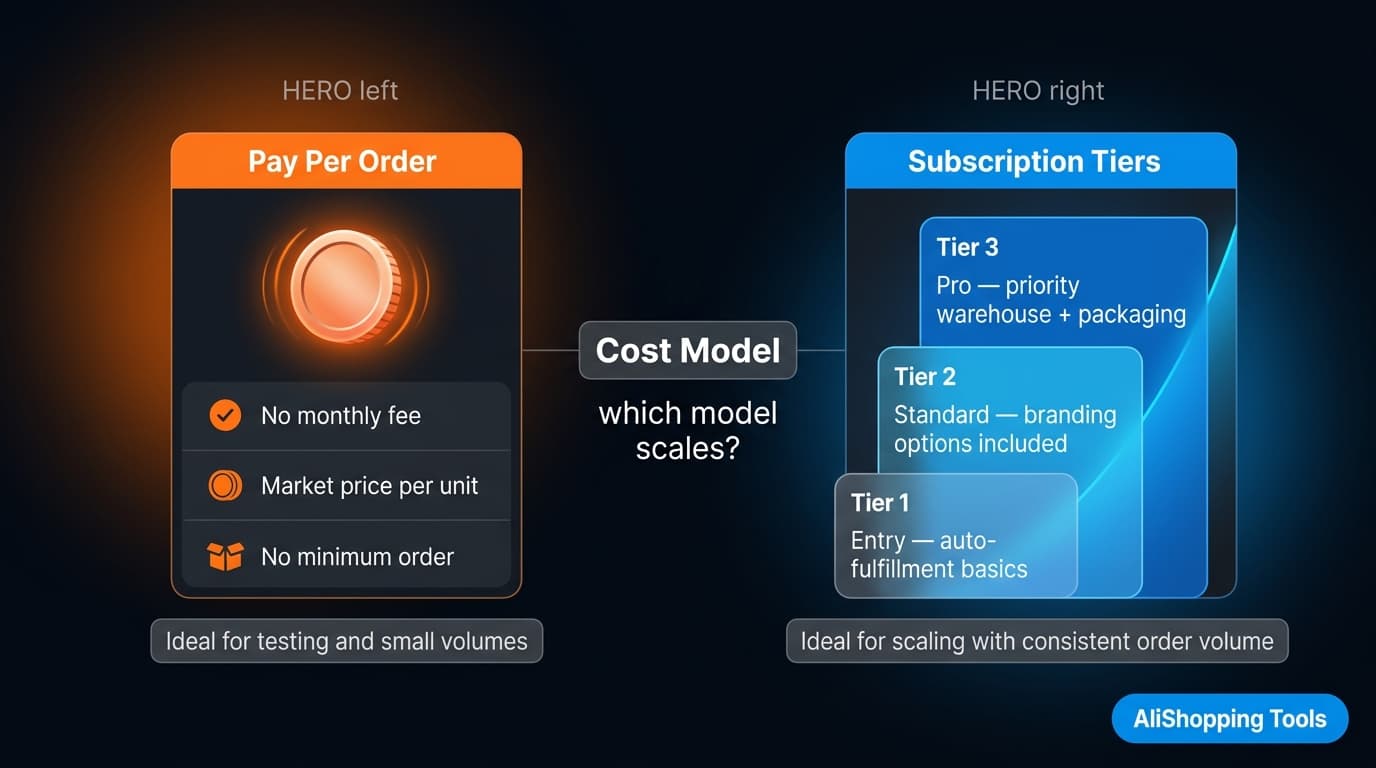
AliExpress has no subscription fee — you pay per order at the product's listed price. The business model is purely transactional, which makes it zero-risk to test before you have revenue.
Zendrop uses a tiered subscription model (check Zendrop's website for current pricing as of June 2026):
| Tier | Approximate Price | Key Features |
|---|---|---|
| Basic | $0/month (limited) | Manual order fulfillment, limited catalog |
| Pro | Paid monthly | Auto-fulfillment, full catalog, branding |
| Plus | Higher tier | Custom products, subscription box, faster support |
The subscription cost only makes sense once you have consistent order volume. If you are placing fewer than 20–30 orders per month, the per-unit cost savings from Zendrop's automation do not yet outweigh the subscription overhead.
AliExpress unit costs are typically lower than Zendrop equivalents because you are buying from the original supplier chain without a platform margin layer. The gap narrows significantly once you factor in the time cost of manual order processing on AliExpress.
Branding and Custom Packaging
Custom branding is one of Zendrop's strongest differentiators. Pro and Plus tier plans include custom packaging, branded invoices, and in some cases custom product labeling — allowing you to build a branded dropshipping store rather than shipping products in AliExpress boxes.
AliExpress suppliers can also provide custom packaging, but it requires direct negotiation with individual suppliers, minimum order quantities for custom print runs, and manual coordination per supplier. At scale, this is workable but operationally intensive.
If your brand positioning depends on unboxing experience — especially for DTC (direct-to-consumer) positioning or repeat-purchase product categories — Zendrop's branding infrastructure is a genuine operational advantage.
Shopify Integration Comparison
Both platforms integrate with Shopify, but the implementation differs.
Zendrop: Native Shopify app with full auto-fulfillment. When a customer places an order in your Shopify store, Zendrop automatically routes the fulfillment to their supplier network, generates tracking, and updates order status — no manual steps. The integration is clean and requires minimal technical setup.
AliExpress: Multiple integration options. AliShopping Tools v23 adds one-click product import from AliExpress directly to Shopify — this covers catalog management and listing creation. For order fulfillment, most AliExpress dropshippers use DSers (the official AliExpress-recommended tool) or AutoDS for automated order routing.
The AliExpress + DSers/AutoDS combination can achieve similar automation levels to Zendrop's native Shopify app, but requires two tool integrations instead of one. See our comparison of DSers vs CJ Dropshipping vs AutoDS for a full breakdown of AliExpress automation tools.
Which Platform Should You Use?
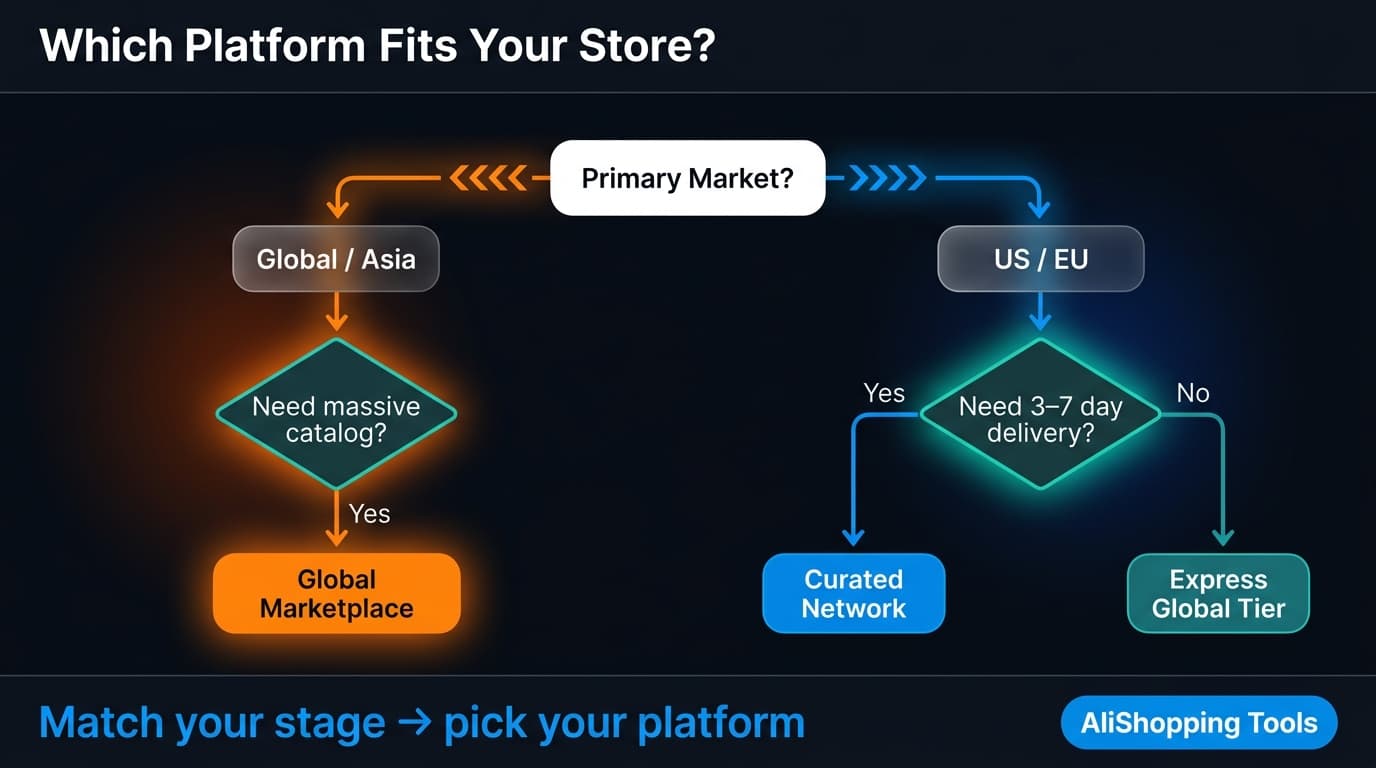
Use this decision framework:
Choose AliExpress if:
- You are testing new niches and need maximum product variety
- Your target customers are in markets where 15–25 day shipping is acceptable
- You want zero upfront platform cost while validating your store
- You are comfortable with supplier vetting and order management tools
Choose Zendrop if:
- Your primary market is the US or EU and shipping speed is a competitive requirement
- You want auto-fulfillment without configuring multiple third-party tools
- Custom branding is part of your positioning and you are at consistent order volume
- You are scaling past the point where manual supplier management creates operational drag
Hybrid approach (advanced): Many experienced dropshippers run AliExpress for catalog testing and price benchmarking, then migrate winning SKUs to Zendrop for US/EU fulfillment once a product proves demand. This gives you the product breadth of AliExpress with the fulfillment quality of Zendrop on your proven winners.
For a broader comparison including CJ Dropshipping, Temu, and Alibaba, see the Ultimate AliExpress vs All Platforms Guide 2026.
Install AliShopping Tools on the Chrome Web Store →
FAQ
Is Zendrop better than AliExpress for dropshipping?
Zendrop is better for US/EU-focused dropshippers who prioritize fast fulfillment (3–7 days domestic), automated order processing, and branded packaging. AliExpress is better for catalog breadth, lower unit costs, and zero monthly subscription overhead. Neither is universally superior — the right platform depends on your target market and fulfillment speed requirements.
Does Zendrop ship faster than AliExpress?
Yes, for US and EU markets. Zendrop ships domestic US orders in 3–7 business days from their US warehouse. AliExpress standard shipping to the US takes 15–25 business days. AliExpress Choice listings can reach 7–12 days for US delivery, partially closing the gap, but Zendrop's domestic warehouse model is consistently faster for US-stocked items.
Can you use both AliExpress and Zendrop together?
Yes. Many experienced dropshippers use AliExpress for product discovery and niche testing, then migrate high-volume winning products to Zendrop for US/EU fulfillment. The platforms are not mutually exclusive — you can run AliExpress products via DSers alongside Zendrop products in the same Shopify store.
What are Zendrop's subscription tiers?
Zendrop offers a Basic (limited, no-cost), Pro, and Plus tier. Pro and Plus are paid monthly subscriptions with auto-fulfillment, full catalog access, and custom branding features. Check Zendrop's website for current pricing as of June 2026 — tiers and pricing may update.
Does AliExpress allow dropshipping?
Yes. AliExpress is widely used for dropshipping and does not prohibit it in its terms of service. Most suppliers are aware their products are being dropshipped and accept single-unit orders. The AliExpress Choice program and DSers integration are specifically built to facilitate dropshipping workflows.
What is cheaper: AliExpress or Zendrop?
AliExpress has lower unit costs (no platform margin layer or subscription fee). Zendrop's per-unit cost is higher, but you are paying for curated suppliers, automated fulfillment, and faster shipping infrastructure. At low order volumes (<20 orders/month), AliExpress is cheaper in total. At higher order volumes, Zendrop's automation reduces manual labor costs, which can offset the subscription and unit price premium.
AliShopping Tools
See live AliExpress data in your browser.
Seller trust score, 90-day price history, and live promo codes — on every AliExpress product page. No account, free.
Ready to find winning products?
Try AliShopping Tools — 15 free AI tools for product research.
Quick answers
Frequently Asked Questions
1Is Zendrop better than AliExpress for dropshipping?
Zendrop is better for US/EU-focused dropshippers who need fast fulfillment (3–7 days from US warehouse), automated order processing, and branded packaging.
AliExpress is better for catalog breadth, lower unit costs, and zero monthly subscription overhead.
The right choice depends on your target market and whether shipping speed is a competitive requirement in your niche.
2Does Zendrop ship faster than AliExpress?
Yes, for US and EU markets.
Zendrop ships US domestic orders in 3–7 business days from their US warehouse.
AliExpress standard shipping to the US takes 15–25 business days.
AliExpress Choice listings can reach 7–12 days for pre-stocked items, partially closing the gap, but Zendrop's domestic warehouse model is consistently faster for US market fulfillment.
3Can you use both AliExpress and Zendrop at the same time?
Yes.
Many experienced dropshippers use AliExpress for product discovery and niche testing, then migrate proven winning products to Zendrop for US/EU fulfillment.
The two platforms are not mutually exclusive — you can run AliExpress products via DSers alongside Zendrop products in the same Shopify store simultaneously.
4Does AliExpress allow dropshipping?
Yes.
AliExpress supports dropshipping and does not prohibit it in its terms of service.
Most AliExpress suppliers accept single-unit orders and are familiar with the dropshipping model.
The AliExpress Choice program and the DSers integration are specifically built to facilitate dropshipping workflows at scale.
5What are Zendrop's pricing tiers in 2026?
Zendrop offers a Basic tier (limited functionality, no cost), a Pro tier (paid monthly — auto-fulfillment, full catalog, custom branding), and a Plus tier (higher cost — custom products, subscription box features, priority support).
Check Zendrop's website for current pricing as of June 2026, as tiers and fees may have been updated.
6Which is cheaper for dropshipping: AliExpress or Zendrop?
AliExpress has lower unit costs and no monthly subscription fee, making it cheaper at low order volumes.
Zendrop's per-unit pricing is higher due to the platform margin and subscription cost, but auto-fulfillment reduces manual labor at scale.
At fewer than 20–30 orders per month, AliExpress is typically cheaper in total operational cost.
7How does the product quality verification process differ between AliExpress and Zendrop?
Zendrop states it pre-vets suppliers as part of its curated catalog model, which is a structural difference from AliExpress's open marketplace where quality signals come mainly from individual seller ratings and buyer reviews rather than centralized vetting.
Neither company publishes an independently audited defect-rate percentage, so treat any specific number for either platform as unverified — check Zendrop's current supplier-vetting claims on their own site and rely on seller ratings/reviews for AliExpress.
8What are the average order fulfillment times for US‑based customers when using AliExpress versus Zendrop?
Zendrop's US-warehouse model is generally faster for US customers than AliExpress's standard e-packet shipping from China, which is the core value proposition of using a US-based fulfillment partner.
Exact day-counts for either platform change over time and by specific product/route — check current shipping estimates on each platform rather than a fixed day-range or an unsourced conversion-rate-improvement claim.
9Can I automate inventory syncing and price updates on Shopify using AliExpress and Zendrop, and which platform offers tighter automation?
Zendrop offers a native Shopify app with built-in inventory/price sync.
AliExpress requires a third-party connector (like DSers) for Shopify automation.
Exact sync frequency and feature depth for either path change over time — check each app's current Shopify App Store listing rather than relying on a fixed minutes-based refresh interval or an unsourced workload-reduction percentage.
AliShopping Tools is a product-research browser extension, not a Shopify inventory-sync connector.
10How do return and refund policies compare between AliExpress and Zendrop for dropshippers?
Zendrop, as a single fulfillment partner, generally offers a more standardized return process than AliExpress, where return terms are set individually by each seller and vary listing to listing.
Exact day-counts, processing times, and any resulting support-ticket-reduction figures change over time and aren't independently audited — check each platform's current stated policy rather than a fixed number.
11Which platform provides better branding options for private‑label products, and how does that affect profit margins?
Zendrop offers dedicated private-label/branding services (custom packaging, branded inserts) as part of its core value proposition; AliExpress branding options are seller-dependent and generally more limited (often just a basic logo option where the seller offers it at all).
Exact pricing, product-count coverage, and any resulting margin or repeat-purchase-rate improvement change over time and aren't independently audited — check Zendrop's current branding page for up-to-date terms rather than a fixed percentage claim.
More from the blog
AliExpress vs All Platforms 2026: Ultimate Comparison
AliExpress vs Alibaba, Temu, DHgate, CJ Dropshipping, Zendrop, and Shein: 2026 guide to shipping, pricing, dropshipping, and which platform wins your use case.
AliExpress vs CJ Dropshipping 2026: Full Comparison
AliExpress vs CJ Dropshipping 2026: catalog size, shipping speed, pricing, and Shopify integration compared. Choose the right sourcing platform for your store.
AliExpress vs DHgate Wholesale 2026: Which Is Better?
AliExpress vs DHgate 2026: compare wholesale pricing, MOQs, product categories, shipping, buyer protection, and dropshipping to choose the right platform.
See something out of date? Let us know.
We keep these listings accurate and review them regularly. If you spot anything incorrect, email us and we'll update it.
Suggest a correctionFeatured on AStools? Show it off.
If your tool is listed here, you're welcome to display this badge on your site. Copy the snippet below — it links back to this page.
<a href="https://news.astools.app/en/blog/aliexpress-vs-zendrop-dropshipping-2026?utm_source=featured-badge&utm_medium=referral&utm_campaign=listing" target="_blank" rel="noopener" style="display:inline-flex;align-items:center;gap:6px;padding:8px 14px;border-radius:9999px;background:#0f172a;color:#ffffff;font:600 13px/1.2 system-ui,-apple-system,Segoe UI,sans-serif;text-decoration:none;border:1px solid #334155"><span style="color:#5eead4">★</span> Featured on AStools</a>