






Dropshipping Product Research: 5 Methods That Actually Work in 2026
Dropshipping Product Research: 5 Methods That Actually Work in 2026
Quick answer: Five product research methods work in 2026:
- 1AI-powered scoring with AliShopping Tools (fastest — 30+ products/hour),
- 2TikTok trend hunting for 500K+ view videos from the last 7–14 days (highest upside for visual products),
- 3Amazon and AliExpress bestseller analysis,
- 4competitor Shopify store reverse-engineering, and
- 5Google Trends combined with keyword volume mapping. Start with AI scoring to filter fast, then apply the others for deeper validation.
Product research is the single highest-leverage activity in dropshipping. Get it right, and everything downstream — ads, creatives, fulfillment — gets easier. Get it wrong, and no amount of ad spend will save you.
Most product research guides boil down to "scroll AliExpress and look for stuff with lots of orders." That advice was mediocre in 2022. In 2026 — with higher ad costs, faster saturation cycles, and smarter competitors — it's a fast track to wasted money.
Here are five methods that actually work today, each with clear steps, honest pros and cons, and the time investment required.
Method 1: AI-Powered Product Scoring
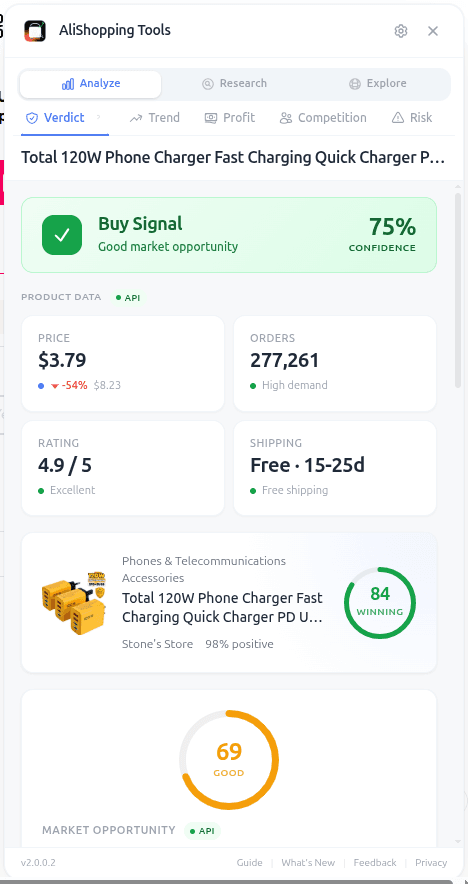
What it is: You use an AI scoring engine that weighs product strength, profit potential, market saturation, and supplier risk — then delivers a single verdict: Strong Buy, Buy Signal, Hold / Watch, or Pass. What would take 30-60 minutes of manual research happens in seconds.
Step-by-step:
- Install a product analysis tool. AliShopping Tools is a free Chrome extension that does this — no account or payment required.
- Browse AliExpress normally. When you land on a product page, the extension activates automatically.
- Check the Verdict tab for an instant recommendation — Strong Buy, Buy Signal, Hold / Watch, or Pass — with a confidence score beside it.
- Dig deeper with the Trend tab (is demand growing or declining?), Profit tab (what are your real margins after all costs?), Competition tab (how saturated is this market?), and Risk tab (is this supplier reliable?).
- If the product scores well across all dimensions, move it to your shortlist. If not, move on — you just saved yourself weeks of testing a dud.
Pros:
- Fastest method by far. Full analysis in under 2 minutes per product.
- Removes emotional bias. Data decides, not gut feelings.
- Catches risks that manual research misses — supplier reliability, IP issues, market saturation signals.
- Free tools like AliShopping Tools mean no recurring subscription costs.
Cons:
- AI scoring depends on the data it can access. Emerging products with very little sales history may get conservative scores.
- You still need human judgment for brand positioning, creative angles, and audience targeting.
- Not every scoring tool is equal. Some paid tools charge $50-100/month for similar capabilities.
Tools needed: AliShopping Tools (free Chrome extension), or alternatives like subscription-based product finders or niche research platforms (paid).
Time investment: 1-2 minutes per product. You can evaluate 30+ products in an hour.
Method 2: Social Media Trend Hunting (TikTok and Instagram)
What it is: You find products by watching what's going viral on TikTok, Instagram Reels, and YouTube Shorts. If millions of people are watching content about a product, there's proven demand. Your job is to spot the trend early enough to capitalize before competitors flood in.
Step-by-step:
- Search TikTok hashtags: #TikTokMadeMeBuyIt, #AmazonFinds, #DropshippingProducts, or category-specific tags like #KitchenHacks or #PetProducts.
- Filter for recent videos (last 7-14 days) with 500K+ views and high comment-to-view ratios.
- Check if the product is sourceable on AliExpress and shippable (not too heavy, fragile, or restricted).
- Search AliExpress for that product. Check supplier count, price range, and whether order volumes are climbing.
- Validate with AliShopping Tools' Trend tab — is the product "Emerging" or "Growing"? Check the TikTok Viral Score for quantified viral potential.
- Check the Competition tab. A viral product with 72% market saturation means the window has likely closed.
Pros:
- You're riding proven demand — people are already excited about these products.
- Visual platform gives you creative inspiration. You can see what content angles work before you create your own.
- Free to use. TikTok doesn't charge you to browse trends.
Cons:
- Timing is everything. If you see it trending on your For You Page, thousands of other dropshippers see it too.
- Viral products can peak and die within 2-3 weeks. You need fast execution.
- Not all viral products are profitable. A $5 novelty item with razor-thin margins will get views but won't build a business.
- Trends on TikTok skew young. Some categories (B2B, premium home goods) rarely trend here.
Tools needed: TikTok (free), Instagram (free). For validation: AliShopping Tools (free) or Google Trends (free).
Time investment: 30-60 minutes per session. Plan for 3-4 sessions per week to stay current.
Method 3: Marketplace Bestseller Analysis (Amazon and AliExpress)
What it is: You study what's selling well on Amazon and AliExpress — Best Sellers, Movers & Shakers, New Releases — and look for products you can source and sell through your own store. This method is less about catching the next wave and more about finding proven, steady sellers that generate consistent revenue.
Step-by-step:
- Go to Amazon Best Sellers and pick a category — Home & Kitchen, Beauty, Electronics, Pet Supplies, etc.
- Browse the top 50-100 products. Look for generic or white-label items NOT dominated by established brands.
- Cross-reference on AliExpress. If you can source it for 20-30% of the Amazon retail price, the margin math works.
- Check Amazon reviews: 1,000-10,000 reviews in the 4.0-4.5 star range is ideal — validated demand without impossible competition.
- Use AliShopping Tools' Discovery tab to browse hot AliExpress products by category, with Winning Badges highlighting products scoring 80+.
- Run a full analysis on promising finds: Verdict, Trend, Profit, and Competition tabs.
Pros:
- Data-backed validation. These products are selling in volume — the demand is proven.
- More stable than trend-chasing. Bestseller products often have months or years of runway.
- Easy to find suppliers. If a product is popular on Amazon, multiple AliExpress suppliers carry it.
- Great for beginners. Lower risk than trying to predict the next viral hit.
Cons:
- Higher competition. If a product is a bestseller, other dropshippers have noticed too.
- Price pressure. Amazon sets the price anchor in buyers' minds. You need to justify your price or target audiences that aren't comparison-shopping on Amazon.
- Some bestseller products are brand-protected or have utility patents. Always check before listing.
- This method favors established categories over emerging ones. You won't discover the "next big thing" this way.
Tools needed: Amazon (free to browse), AliExpress (free), AliShopping Tools (free) for scoring and validation. Optional: Jungle Scout or Helium 10 (paid) for deeper Amazon data.
Time investment: 1-2 hours per research session. Best done weekly.
Method 4: Competitor Store Spying (Shopify)
What it is: You find successful Shopify stores in your niche and reverse-engineer what's working — products, best-sellers, apps, theme, and real-time sales volume. This isn't about copying. It's about understanding what the market rewards.
Step-by-step:
- Find competitor stores. Search Google for "[your niche] + powered by Shopify," check myip.ms, or follow social media ads — most link to Shopify stores.
- Visit the store. With AliShopping Tools installed, a bottom toolbar appears automatically.
- Check the Shop tab: theme name, product count, vendor distribution, and launch timeline.
- Browse the Products tab. Sort by newest — recent additions signal what they're testing or scaling.
- Check the Apps tab to see their marketing stack (Klaviyo? Loox? Bold Upsell?) and get ideas for your own store.
- Turn on Live Sales. It monitors checkout activity every 30 seconds. Watch 15-30 minutes to gauge sales velocity and identify actual best-sellers.
- Cross-reference their top products on AliExpress to find the sourcing opportunity.
Pros:
- You're learning from stores that have already done the hard work of testing and optimizing.
- Live sales data is incredibly valuable — it shows real demand, not just what a store lists.
- App detection helps you build a better tech stack without trial and error.
- Free with AliShopping Tools. Competing dedicated Shopify spy tools charge monthly fees for similar features.
Cons:
- You can only spy on Shopify stores. WooCommerce, BigCommerce, and custom-built stores are not covered.
- Some stores use checkout decoys or test orders that can inflate perceived sales.
- This method is reactive by nature. You're following, not leading.
- Ethical boundary: use this for market intelligence, not to clone someone's store pixel-for-pixel.
Tools needed: AliShopping Tools (free — detects 200+ apps, 100+ themes, real-time sales tracking), or alternatives like dedicated Shopify spy tools or Shopify analytics extensions (paid).
Time investment: 15-30 minutes per store. Research 5-10 competitor stores per niche for a solid picture.
Method 5: Niche Community Research (Reddit and Facebook Groups)
What it is: You go where your target customers hang out — Reddit, Facebook groups, niche forums — and listen to what they talk about, complain about, and wish existed. While other methods rely on sales data, community research taps into unmet needs and emotional triggers. Someone posting "I wish there was a better way to organize cables on my desk" just handed you a product idea.
Step-by-step:
- Find relevant communities: r/dropshipping, r/ecommerce, r/shutupandtakemymoney, or niche-specific subs like r/MechanicalKeyboards or r/SkincareAddiction. On Facebook, search for niche groups.
- Read, don't post. Look for recurring themes: what do people recommend, complain about, or wish existed?
- Watch for "I just bought..." and "has anyone tried..." posts — these signal active buying intent.
- Search within communities for "recommend," "best," "worth it," "alternative to." These surface product discussions directly.
- Validate candidates with data. Search AliExpress, then use AliShopping Tools to check Verdict, Trend, and Competition scores.
- Save the language people use to describe their problems. This becomes your ad copy later — nothing converts better than your customer's own words.
Pros:
- Uncovers products before they trend. Community discussions often precede mainstream virality by weeks or months.
- Gives you audience language and pain points — pure gold for marketing copy.
- Free. Reddit and Facebook cost nothing to browse.
- Builds genuine market understanding. You're not just finding products; you're learning what your customers actually care about.
Cons:
- Time-intensive. Reading through threads is slow work.
- Not scalable. You can't automate reading Reddit posts with nuance.
- Communities can be echo chambers. A product that r/BuyItForLife loves might be too niche to sustain a dropshipping business.
- No quantitative data. You get signal, not statistics. Always validate with sales data before committing.
Tools needed: Reddit (free), Facebook Groups (free), AliShopping Tools (free) for product validation once you've identified candidates.
Time investment: 2-3 hours per week of dedicated reading. This is a slow-burn method that compounds over time.
Putting It All Together
No single method is perfect. The best dropshippers combine them into a weekly system:
- Early week: 30 minutes of TikTok trend hunting (Method 2). Bookmark 5-10 products.
- Mid-week: Marketplace bestseller analysis (Method 3) for one category, plus 3-5 competitor Shopify stores (Method 4).
- End of week: Validate your entire shortlist using AI scoring (Method 1). Cut anything that doesn't pass.
- Ongoing: Browse niche communities (Method 5) during downtime. Screenshot promising threads for your next validation session.
Total time: 5-7 hours per week. That's a fraction of what you'd spend testing products blindly with paid ads.
Frequently Asked Questions
Which product research method is best for complete beginners?
Start with AI-powered product scoring (Method 1) because it removes the guesswork and teaches you what good metrics look like. As you build confidence reading data, layer in social media trend hunting and marketplace analysis. Community research is the most advanced method because it requires interpreting qualitative signals.
How much time should I spend on product research each week?
Plan for 5-7 hours per week across all methods. Split it into daily 45-60 minute sessions rather than marathon research days. Consistent, short sessions keep you current on trends without burning out or falling into analysis paralysis.
Can I rely on just one research method?
You can start with one, but relying on a single method creates blind spots. AI scoring misses community sentiment. TikTok trend hunting misses products that sell well through search. The best results come from combining at least two methods and cross-validating findings with data from AliShopping Tools.
How do I know when to stop researching and start testing?
Set a hard deadline. If you have been researching for more than one week without placing a test order or launching a test ad, you are overthinking it. Pick the top-scoring product from your shortlist, order a sample, and run a $50-100 ad test. Real market data always beats more research.
The Bottom Line
Product research in 2026 rewards systems, not shortcuts. Start with AI scoring to build the habit of data-driven decisions. Layer in social media trends and marketplace analysis for discovery. Use competitor spying to learn from what works. And invest in community research for insights no algorithm can surface.
Every method on this list is available to you right now, and most of the tools are free.
Ready to start? Install AliShopping Tools — it's free, takes one click, and gives you AI-powered product scoring, trend analysis, profit simulation, competition checks, and Shopify store spying. No account required. Open any AliExpress product page or Shopify store and the data is right there.
Stop guessing. Start researching. Your next winning product is waiting.
Ready to find winning products?
Try AliShopping Tools — 15 free AI tools for product research.
Quick answers
Frequently Asked Questions
1What are the five product research methods that actually work in 2026?
Per the post: AI-powered product scoring (an engine analyzes demand, profit, competition, supplier risk, viral potential, delivers one of four states — Strong Buy, Buy Signal, Hold / Watch or Pass — in seconds — 1–2 min per product so you evaluate 30+ per hour), social media trend hunting on TikTok and Instagram (catch viral products early via hashtag search and TikTok Viral Score), plus three additional methods covered later in the post.
The "scroll AliExpress for orders" method from 2022 is called out as a fast track to wasted money in 2026 given higher ad costs, faster saturation, and smarter competitors.
2What are the pros and cons of AI-powered product scoring?
Pros: fastest method with full analysis under 2 minutes per product, removes emotional bias (data decides not gut), catches risks manual research misses — supplier reliability, IP issues, saturation signals, and free tools mean no recurring subscription.
Cons: AI scoring depends on accessible data, so emerging products with very little sales history may get conservative scores, you still need human judgment for brand positioning, creative angles, and audience targeting, and not every scoring tool is equal — some paid tools charge $50–$100/month for similar capabilities.
3How do I validate a TikTok trend product before listing it?
The post's 6-step workflow: search TikTok hashtags (#TikTokMadeMeBuyIt, #AmazonFinds, #DropshippingProducts, or category tags), filter to recent videos (last 7–14 days) with 500K+ views and high comment-to-view ratios, check sourceability on AliExpress (not too heavy, fragile, or restricted), check supplier count, price range, and climbing order volumes, validate with the Trend tab (Emerging or Growing?) plus TikTok Viral Score, and check the Competition tab — a viral product at 72% market saturation means the window has likely closed.
4How can I automate the AI scoring process to evaluate dozens of products daily without manual input?
You can partially automate AI scoring by batch-checking product URLs through AliShopping Tools rather than one at a time, which speeds up screening a larger list of candidates.
There's no built-in public API for a fully hands-free scheduled workflow — treat automation as speeding up the screening step, with the same manual verification (margin, competition, supplier trust on the live listing) still required before you commit spend.
5What is the best way to combine Google Trends data with keyword volume to predict seasonal demand for a dropshipping product?
Combine Google Trends' seasonality view for your product keyword with a keyword-volume tool to spot rising search interest ahead of a season.
Look for the trend line rising consistently over recent months rather than relying on a fixed percentage threshold — exact lead time before a peak varies by category and year, so treat this as directional planning, not a guaranteed timeline.
6How many TikTok videos should I analyze before deciding a product is a viable trend, and what engagement metrics matter most?
There's no fixed number of TikTok videos that guarantees a trend is viable — look for a pattern across several independent creators (not just one viral clip) posted recently, with engagement that reads as strong relative to the account's normal performance.
Cross-check the product's AliExpress price and margin before committing to ads, since engagement alone doesn't confirm profitability.
7What profit margin should I target for products sourced from AliExpress to remain competitive after ad spend and fees?
Target a healthy gross margin — commonly discussed in the 40-45%+ range — after ad spend and platform fees, using AliShopping Tools' profit calculator with your product's real wholesale cost and your planned retail price rather than a generic industry number.
Monitor margins regularly and drop items that fall below your own threshold as ad costs shift.
8Can I use competitor Shopify store reverse‑engineering to identify upcoming product launches, and how quickly can I replicate their listings?
You can monitor competitor Shopify stores over time (manually or with a store-spy tool like AliShopping Tools) to spot new product launches before they scale.
Treat any specific "replicate within N hours" claim skeptically — building a competitive listing still takes real time for photos, copy, and import, even if you're working from a competitor's product as a starting point.
Use AliShopping Tools' Trend tab to independently confirm demand rather than assuming a competitor's early traction guarantees yours.
More from the blog
Winning Products August 2026: 12 Back-to-School Peak Categories
12 dropshipping categories for August 2026 — back-to-school peak (first two weeks), dorm setup, and the early-fall transition — plus how to vet any candidate with AStools before you spend.
Winning Products July 2026: 12 Post-618 Categories
12 dropshipping categories for July 2026 — post-618 restock, back-to-school prep, summer peak — plus how to vet any candidate with AStools before you spend.
How to Do Product Research for Dropshipping: 7-Step Framework (Free Tools, 2026)
A repeatable 7-step product research framework for dropshippers in 2026 — from idea sourcing to live testing, using only free tools. No Ecomhunt subscription needed.