AliShopping AI Verdict Explained: What Each Level Means for Buyers
AliShopping AI Verdict Explained: What Each Level Means for Buyers
Quick answer: The AI Verdict has four levels. Strong Buy means the product scores well across all dimensions — safe for buyers, high potential for dropshippers. Buy Signal means it is a good product with minor caveats to check. Hold means mixed signals — do more research before committing. Pass means clear red flags — skip this product unless you have a specific reason to override the data.
When you open a product page on AliExpress with AliShopping Tools installed, the AI Verdict is the first thing you see in the extension panel. It is a single assessment that tells you whether the product is worth your time — whether you are buying it for yourself or considering it for a store.
But a label by itself is not useful unless you understand what goes into it. This guide breaks down what each verdict level means, how the underlying score is calculated, what the trend classification tells you, and how to use all of it in practice.
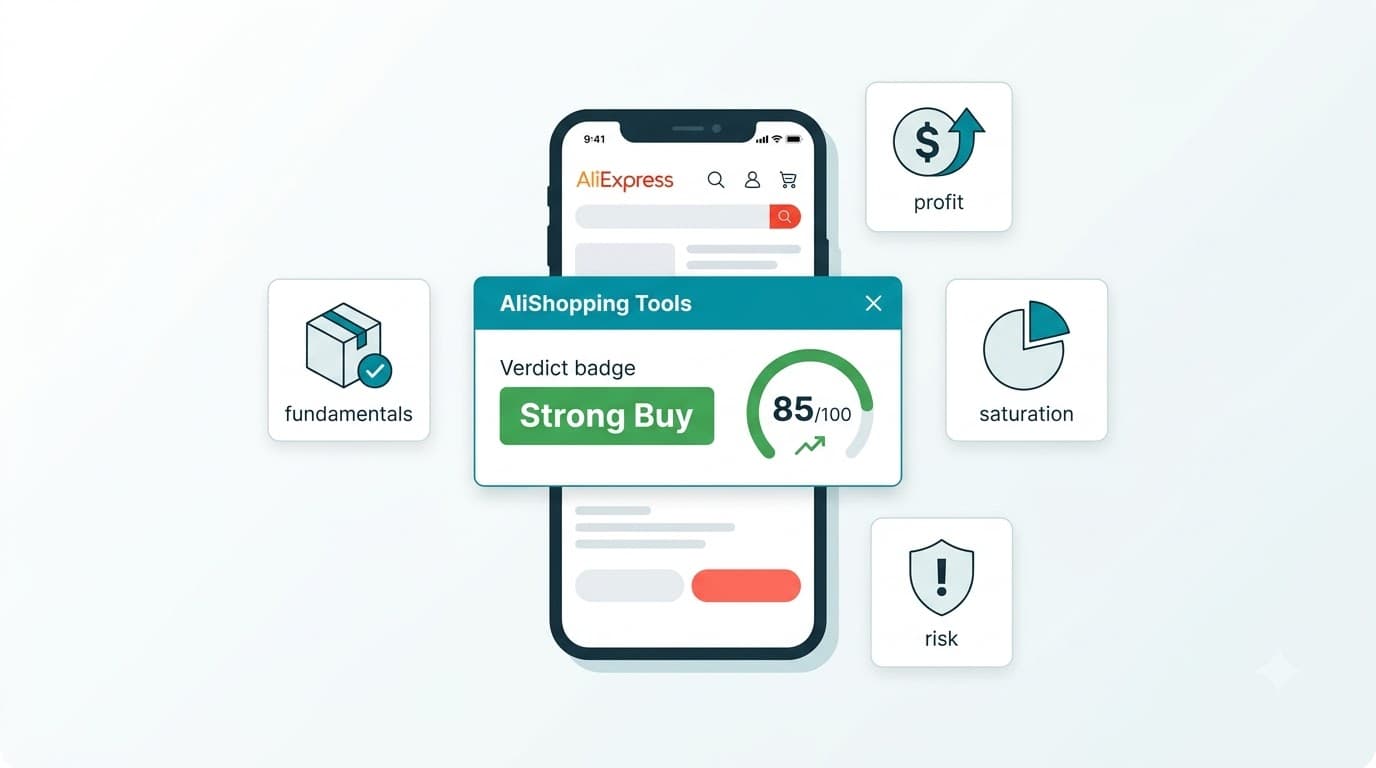
What the AI Verdict actually evaluates
The verdict is not a single number or a gut feeling. It is generated from four weighted dimensions, each capturing a different aspect of product quality:
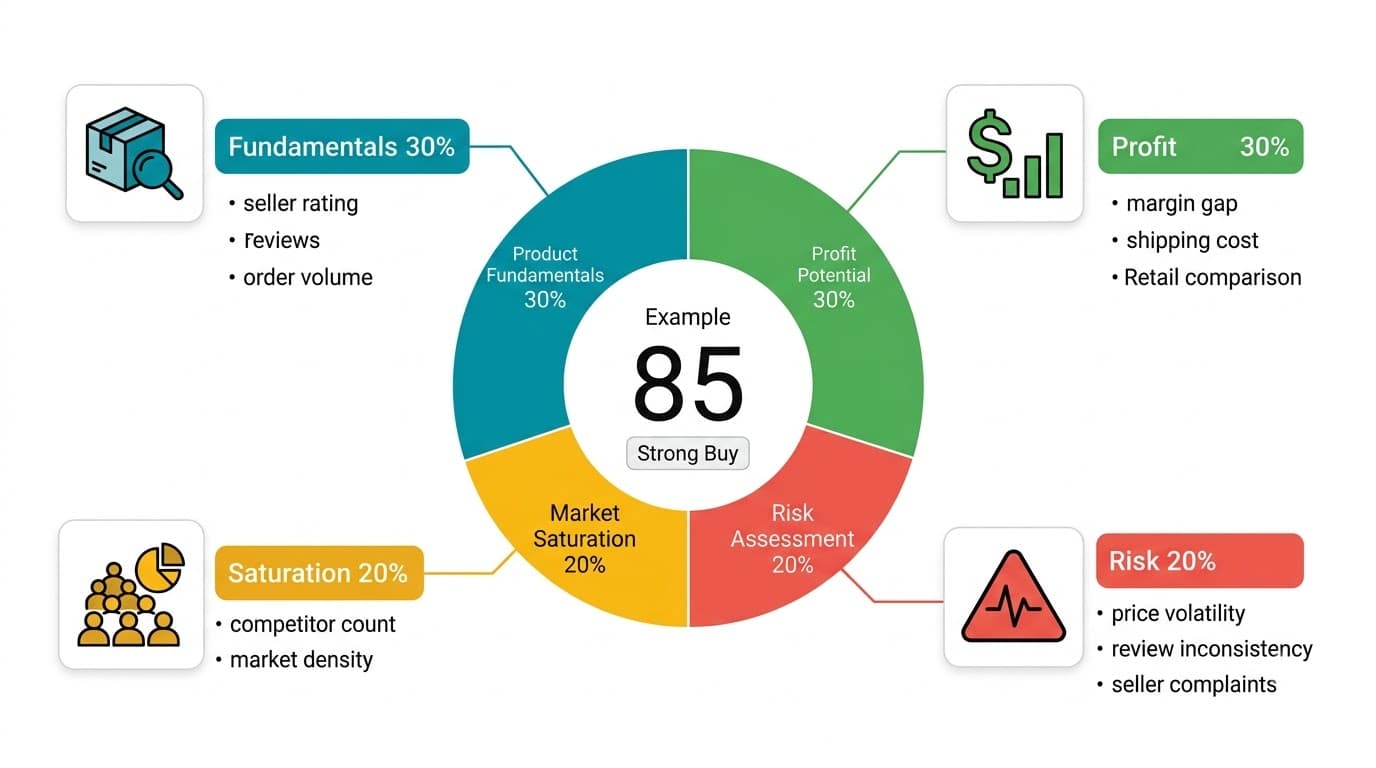
Product fundamentals (30%)
This dimension evaluates the product itself — independent of market conditions or profit math. It looks at signals like seller rating and history, review volume and sentiment, order count relative to store age, listing quality, and shipping options. A product with thousands of orders, consistently positive reviews, and an established seller scores high here. A product with sparse reviews, a new or low-rated seller, or inconsistent listing details scores low.
For buyers, this is the dimension that most directly answers "will I actually receive what is shown in the listing?" For dropshippers, it answers "is this supplier reliable enough to ship to my customers?"
Profit potential (30%)
This dimension matters primarily for dropshippers and resellers, though it also benefits buyers who want to understand whether they are getting a fair price. It analyzes the gap between the AliExpress price and typical retail pricing for comparable products, factoring in shipping costs and estimated fees.
A high profit potential score means there is meaningful margin between what you would pay on AliExpress and what similar products sell for elsewhere. A low score means the pricing is already close to retail — either the category is highly competitive or the product is not suited for resale.
Market saturation (20%)
This dimension estimates how crowded the market is for this product type. It considers factors like the number of sellers offering identical or near-identical items, how many stores are already dropshipping the same product, and whether the product has been widely promoted across social media and ad platforms.
Low saturation is favorable — it means there is still room to enter without competing against dozens of established sellers. High saturation is a warning sign — even a good product becomes unprofitable when the market is flooded with competitors undercutting each other on price.
Risk assessment (20%)
This dimension flags potential problems that the other three dimensions might not catch. It looks for signals like price volatility (the product's price has changed significantly in recent weeks), inconsistent reviews (a mix of very positive and very negative with little in between), seller complaints about shipping delays or wrong items, and category-specific risks like counterfeit concerns or customs issues.
A low-risk score means the product has a stable history and no obvious warning signs. A high-risk score means there are patterns that suggest buying or selling this product carries above-average uncertainty.
The four verdict levels explained
Each verdict is the result of all four dimensions combined. Here is what each level means — and what it signals for different types of users.
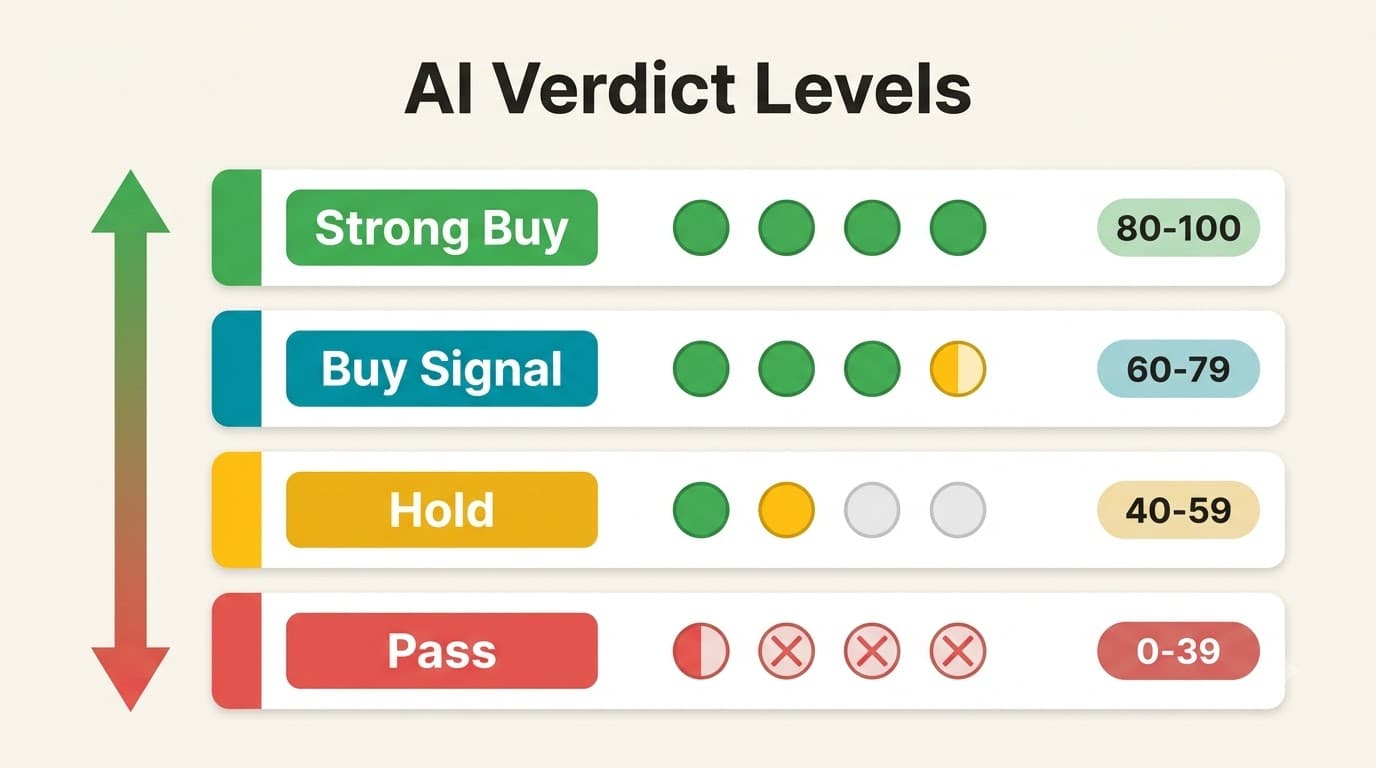
Strong Buy
A Strong Buy means the product scores well across all four dimensions. There are no significant red flags in any category, and the overall profile suggests this is one of the better products available in its category.
What it means for buyers: The seller is reliable, reviews are consistently positive, the price is fair for what you are getting, and there is nothing in the product's history that raises concern. You can buy with confidence.
What it means for dropshippers: The product has healthy margins, the market is not oversaturated, the supplier has a track record of reliable fulfillment, and the risk profile is clean. This is a product worth testing in your store.
Important caveat: Strong Buy does not mean "guaranteed success." It means the data available right now points in a positive direction. Market conditions change, sellers change their practices, and products cycle through trends. A Strong Buy is a strong starting signal — not a permanent endorsement.
Buy Signal
A Buy Signal means the product is good overall but has one or two caveats that are worth investigating before you commit. The core metrics are solid, but at least one dimension has a score that falls short of the Strong Buy threshold.
Common reasons a product gets Buy Signal instead of Strong Buy:
- Profit margins exist but are tighter than average for the category
- The seller is reliable but relatively new, so the track record is shorter
- Reviews are positive but the volume is moderate, making the data less conclusive
- The market is not oversaturated but is showing early signs of growing competition
What it means for buyers: The product is likely fine to purchase, but check the specific caveats. If the concern is seller newness, look at their recent order completion rate. If it is review volume, read the existing reviews more carefully.
What it means for dropshippers: Worth considering, but do not add it to your store blindly. Check the caveat — if it is tight margins, run the numbers in a profit calculator first. If it is growing competition, check whether you can differentiate on shipping speed or branding.
Hold
A Hold verdict means the signals are mixed. Some dimensions score well, others do not. The product is not clearly bad — but it is not clearly good either. The AI is essentially saying "I cannot give this a confident recommendation based on the available data."
Common reasons a product gets a Hold:
- Strong fundamentals but high market saturation — the product is good, but too many sellers are already offering it
- Good margins but elevated risk — the price is attractive for resale, but the seller or product history raises concerns
- Positive reviews but low volume — the product might be fine, but there is not enough data to be confident
- Recent price volatility — the product's cost has shifted meaningfully, making margin projections unreliable
What it means for buyers: Proceed carefully. A Hold does not mean "do not buy" — it means do your own research before committing. Read the reviews yourself, check the seller's profile, and consider whether the specific concerns matter for your situation.
What it means for dropshippers: This product needs manual validation. A Hold-rated product can still be profitable, but it requires research that the AI cannot automate — checking actual competitor pricing in your target market, contacting the seller about shipping timelines, or ordering a sample first.
Pass
A Pass means the AI has identified clear red flags that make this product a poor choice for most buyers and sellers. At least one dimension has a score that falls significantly below acceptable thresholds, or multiple dimensions have moderate concerns that compound into an overall negative assessment.
Common reasons a product gets a Pass:
- The seller has a poor rating, a history of disputes, or signs of being unreliable
- Reviews are predominantly negative or show a pattern of fake positive reviews mixed with real negative ones
- The price-to-quality ratio is poor — you are overpaying for what you receive
- The market is completely saturated with the same product from dozens of sellers
- Risk signals are high — price manipulation, counterfeit indicators, or shipping issues
What it means for buyers: Avoid this product unless you have a very specific reason to buy from this particular seller. The data suggests you are more likely to have a negative experience than a positive one.
What it means for dropshippers: Skip it. A Pass-rated product has one or more characteristics that make it a poor candidate for a dropshipping store — whether that is unreliable fulfillment, no margin, or a flooded market. Your time is better spent on products rated Buy Signal or higher.
The Winning Score: 0 to 100
Behind every verdict is a numerical Winning Score that ranges from 0 to 100. The verdict label is derived from this score, but the number itself gives you more granularity.
| Score range | Verdict | What it means |
|---|---|---|
| 80-100 | Strong Buy | Top-tier product across all dimensions |
| 60-79 | Buy Signal | Solid product with minor caveats |
| 40-59 | Hold | Mixed signals, manual research needed |
| 0-39 | Pass | Clear red flags, skip for most use cases |
The score is useful for comparing products within the same category. Two products might both be "Buy Signal," but one scores 78 and the other scores 62. That difference tells you the first product is closer to Strong Buy territory while the second is borderline Hold.
When researching a product category, sort by Winning Score to see which specific listings within that category have the strongest profiles. This is particularly useful for dropshippers evaluating multiple suppliers offering similar items.
Trend classification: where the product sits in its lifecycle
In addition to the verdict and score, each product receives a trend classification that indicates its market momentum. This answers a different question than the verdict: not "is this product good?" but "where is this product in its lifecycle?"
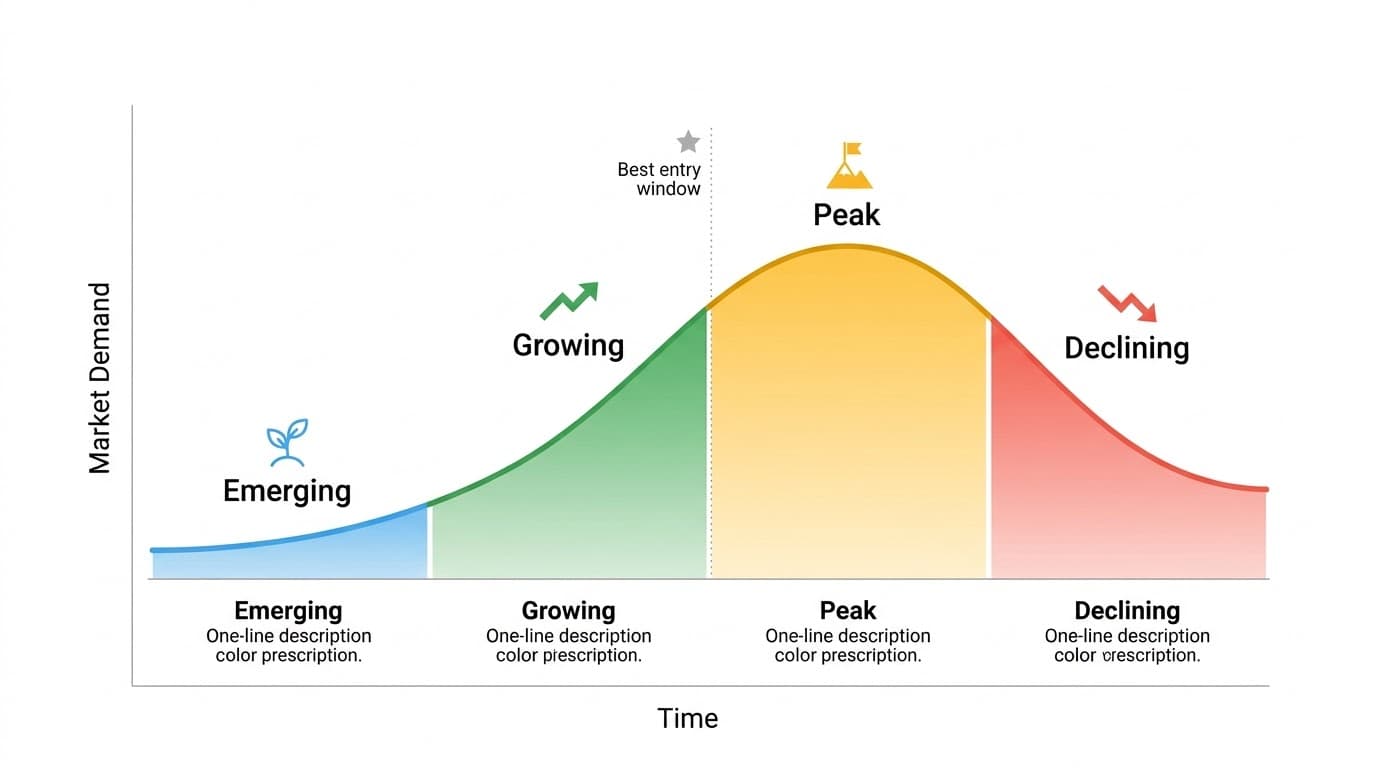
Emerging
The product is relatively new to the market or is starting to gain traction. Order volume is growing but still low compared to established products in the category. Early signals are positive but the data set is small.
For dropshippers: Emerging products carry more uncertainty but also more opportunity. If the product takes off, early movers have an advantage. If it fizzles, you lose the cost of testing it. Best for sellers comfortable with risk.
Growing
The product is in an active growth phase. Order volume is increasing consistently, new sellers are entering the market, and social proof is building. The data is now substantial enough to be reliable.
For dropshippers: This is often the best timing — the product is proven enough to be reliable, but the market is not yet saturated. Move quickly before it hits Peak.
Peak
The product has reached or is near its maximum market penetration. Order volumes are high, the market is crowded with sellers, and competition is driving margins down. The product itself may still be good, but the opportunity to profit from it is narrowing.
For dropshippers: Unless you already have established traffic and a competitive advantage (faster shipping, better branding, loyal customer base), Peak products are usually not worth entering. The margins are thin and the competition is fierce.
Declining
Order volume is dropping, sellers are leaving the market, and interest is fading. This could be because the trend has passed, a better alternative has emerged, or the product category is seasonal and off-season.
For dropshippers: Generally avoid. Declining products mean shrinking demand, leftover inventory risk, and diminishing returns on ad spend.
For buyers: A Declining trend does not necessarily mean the product is bad — it might still be exactly what you need. It just means fewer people are buying it, which can actually work in your favor (less competition for stock, possible price drops from sellers clearing inventory).
What the AI Verdict cannot tell you
The verdict is a data-driven screening tool. It is good at evaluating measurable signals and patterns. But there are things it cannot assess:
Personal preference and taste. A product might score Strong Buy based on reviews, pricing, and seller reliability — but you might simply not like it. The verdict evaluates market data, not whether a product fits your aesthetic or lifestyle.
Local demand in your specific market. The AI analyzes global signals. A product with strong global demand might have zero demand in your particular country, region, or niche audience. If you are dropshipping to a specific geographic market, you need local research that goes beyond what the AI provides.
Your individual cost structure. The profit potential dimension uses general estimates for shipping, fees, and comparable retail pricing. Your actual margins depend on your specific platform fees, ad costs, return rates, and fulfillment expenses. Always run your own numbers.
Timing of trend shifts. The trend classification tells you where a product is right now, but it cannot predict when an Emerging product will become Growing, or when a Peak product will start Declining. Markets shift based on social media trends, seasonal changes, and competitor moves that are inherently unpredictable.
Legal and regulatory issues. The verdict does not check whether a product complies with import regulations, safety certifications, or intellectual property laws in your target market. Some products that score well on market metrics could be restricted or prohibited in certain countries.
How to use the AI Verdict in practice
If you are a buyer
The verdict is a quick screening tool that saves you from the most common AliExpress mistakes — buying from unreliable sellers, overpaying for products that are cheaper elsewhere, or missing red flags buried in reviews.
Before buying any product, glance at the verdict:
- Strong Buy or Buy Signal: Good to go. Skim the caveats if it is a Buy Signal, then purchase with confidence.
- Hold: Spend a few minutes reading reviews and checking the seller profile yourself. The product might still be fine — the AI just cannot confirm it with the available data.
- Pass: Look for an alternative. If this specific product is the only option, read the risk signals carefully and decide if you are comfortable with the identified issues.
If you are a dropshipper
The verdict is a research filter. Instead of manually evaluating hundreds of products, use the Winning Score to narrow your list to the top candidates, then do manual validation on the short list.
Product research workflow:
- Browse your target category on AliExpress
- Filter for products rated Buy Signal or higher
- Among those, prioritize Growing or Emerging trends over Peak or Declining
- For your top 5-10 candidates, check margins with a profit calculator
- Order samples from the top 2-3 before listing them in your store
The verdict is most valuable at step 2 — it eliminates the majority of products that are not worth your time, so you can focus your manual research on the ones that actually have potential.
FAQ
Is the AI Verdict the same as a product review?
No. The AI Verdict is an automated analysis based on data signals — seller metrics, review patterns, pricing, market conditions. It does not involve anyone personally testing or using the product. It tells you whether the data looks favorable, not whether the product itself is subjectively good.
How often does the verdict update?
The verdict recalculates when you view a product page with the extension active. It uses the most current data available at that moment — current seller rating, recent reviews, current pricing, and current market conditions. A product that was a Buy Signal last week could shift to a different level depending on what has changed.
Can a product be Strong Buy but still disappoint me?
Yes. Strong Buy means the measurable data points are all positive — reliable seller, good reviews, fair price, clean risk profile. But data cannot capture everything. The product might not match your personal expectations for quality, the color might look different in person, or it might not fit your specific use case. The verdict reduces risk — it does not eliminate it.
Should I never buy a Hold or Pass product?
Not necessarily. The verdict reflects general suitability. A Hold product might be the only option for a niche item you specifically need. A Pass product from a particular seller might be worth the risk if you have bought from them successfully before. The verdict is a screening tool — you can override it with your own judgment when you have context the AI does not.
Does the Winning Score favor expensive products over cheap ones?
No. The score is relative to the product's own category and price range. A well-sourced item with strong reviews and a reliable seller scores well regardless of whether it costs two dollars or two hundred dollars. Price enters the calculation only through the profit potential and risk dimensions — not as a standalone factor.
How is this different from just reading AliExpress reviews?
Reviews tell you about individual buyer experiences. The AI Verdict aggregates reviews with multiple other data sources — seller history, pricing patterns, market saturation, risk indicators — to provide a broader assessment. Reading reviews tells you what happened to specific buyers. The verdict tells you what is likely to happen to you, based on all available signals combined.
The bottom line
The AI Verdict is a screening tool, not a crystal ball. It takes data you would otherwise spend an hour researching — seller reliability, review authenticity, pricing fairness, market competition, risk patterns — and distills it into a single actionable label with a supporting score.
For buyers, it answers "should I trust this listing?" in seconds. For dropshippers, it answers "is this product worth researching further?" before you invest time in margin calculations and competitor analysis.
Use the verdict as your first filter. Trust it to eliminate the obvious bad options. Then apply your own knowledge — your market, your customers, your cost structure — to make the final call on the products that pass the screening.
Install AliShopping Tools — see AI Verdicts and Winning Scores on every AliExpress product page → — AI product verdicts, profit calculator, seller trust scores, price history. Free, no account required.
Related Guides
- Best Free AliExpress Chrome Extensions 2026 — how AliShopping compares to other shopping tools
- How to Check if an AliExpress Seller Is Trustworthy — deep dive on seller evaluation
- Dropshipping Product Research Guide — full workflow for finding products to sell
- AliExpress Scams to Avoid — red flags the AI Verdict helps you catch
Disclosure: This article is published by the AliShopping Tools team. The AI Verdict feature described is part of the AliShopping Tools Chrome extension. Verdict accuracy depends on available data — products with limited history may receive less reliable assessments. If you notice anything out of date, let us know at our contact page.
Ready to find winning products?
Try AliShopping Tools — 15 free AI tools for product research.
Quick answers
Frequently Asked Questions
1Is the AI Verdict the same as a product review?
No.
The AI Verdict is an automated analysis based on data signals — seller metrics, review patterns, pricing, market conditions.
It does not involve anyone personally testing or using the product.
It tells you whether the data looks favorable, not whether the product itself is subjectively good.
2How often does the verdict update?
The verdict recalculates when you view a product page with the extension active.
It uses the most current data available at that moment — current seller rating, recent reviews, current pricing, and current market conditions.
A product that was a Buy Signal last week could shift to a different level depending on what has changed.
3Can a product be Strong Buy but still disappoint me?
Yes.
Strong Buy means the measurable data points are all positive — reliable seller, good reviews, fair price, clean risk profile.
But data cannot capture everything.
The product might not match your personal expectations for quality, the color might look different in person, or it might not fit your specific use case.
The verdict reduces risk — it does not eliminate it.
4Should I never buy a Hold or Pass product?
Not necessarily.
The verdict reflects general suitability.
A Hold product might be the only option for a niche item you specifically need.
A Pass product from a particular seller might be worth the risk if you have bought from them successfully before.
The verdict is a screening tool — you can override it with your own judgment when you have context the AI does not.
5Does the Winning Score favor expensive products over cheap ones?
No.
The score is relative to the product's own category and price range.
A well-sourced item with strong reviews and a reliable seller scores well regardless of whether it costs two dollars or two hundred dollars.
Price enters the calculation only through the profit potential and risk dimensions — not as a standalone factor.
6How is this different from just reading AliExpress reviews?
Reviews tell you about individual buyer experiences.
The AI Verdict aggregates reviews with multiple other data sources — seller history, pricing patterns, market saturation, risk indicators — to provide a broader assessment.
Reading reviews tells you what happened to specific buyers.
The verdict tells you what is likely to happen to you, based on all available signals combined.
More from the blog
AliShopping vs AliTools vs AliPrice 2026: Honest Extension Comparison
A fair 3-way comparison of the most popular AliExpress Chrome extensions — AliShopping Tools, AliTools, and AliPrice. Features, pricing, strengths, and honest trade-offs for buyers and dropshippers.
AI Product Scoring for Dropshipping: How It Actually Works in 2026
AI product scoring replaces gut-feel product research with data-driven composite metrics. Learn how tools like Winning Score and Verdict work, what data feeds them, where they fall short, and how to use scores without over-trusting them.
AI Product Scoring for Dropshipping: How It Works (2026)
How AI product scoring evaluates dropshipping opportunities across four dimensions — product fundamentals, profit potential, market saturation, and risk — to produce a verdict before you spend money.