
Dropshipping Profit Calculator — Full Margin Workflow (Free Tool)
Dropshipping Profit Calculator — The Full Workflow
Quick answer: AliShopping's Profit tab calculates your true dropshipping margin in under 1 second on any AliExpress product page — inputs: your selling price; outputs: gross margin, net margin after shipping + platform fees + realistic country-specific ad CPM, break-even ROAS, and projected daily profit at various ad spends. It prevents the most common mistake: products that look profitable on surface but cannot support paid acquisition economics.
The single most common dropshipping mistake: testing a product that looks cheap on AliExpress but cannot actually support profitable paid ad acquisition.
Example: $10 AliExpress product. You retail it at $30 on Shopify. Looks like $20 margin per sale. Seems profitable.
But you forgot:
- Shipping from China to buyer: $4-6 per unit
- Shopify platform fee: 2.4-2.9% of transaction + $0.30
- Payment processor fee: another 2-3%
- Your ad spend at realistic Meta or TikTok CPMs: $8-12 per acquired customer
- Returns and refunds: 5-10% bleed
Actual margin per sale: $30 revenue - $10 product - $5 shipping - $1 platform fee - $10 ad spend - $2 refund provision = $2 net margin per sale.
At $30 AOV and $2 net margin, you need 500 sales per month to make $1,000 profit. Most dropshipping tests do not generate that volume. The product fails economically before the margin math matters.
AliShopping's Profit tab runs this full calculation in under 1 second on any AliExpress product page.
The 5-Layer Calculation
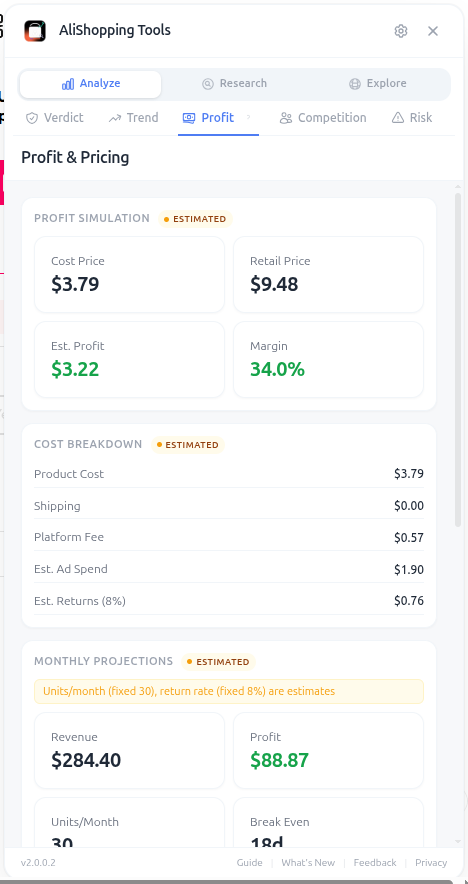
Layer 1: Product Cost
Auto-pulled from the AliExpress product page. Handles:
- Base price for single-unit orders
- Variant pricing (color/size) when applicable
- Wholesale tier pricing at 50/100/500/1,000 unit volumes
You see both retail-basis cost (for initial tests) and wholesale-basis cost (for scaled campaigns).
Layer 2: Shipping Cost
Auto-pulled from AliExpress shipping options. The calculator picks:
- Cheapest reliable shipping to your target country (default: your current browser's inferred country)
- Estimated delivery time
- Express shipping option with higher cost if you want faster fulfillment
Shipping is often 30-50% of product cost for low-priced items — overlooked by operators who only count product price.
Layer 3: Platform Fees
Default configured for Shopify:
- Shopify transaction fee (2.4-2.9% depending on plan)
- Shopify payment processor fee (2.9% + $0.30)
- Shopify subscription cost amortized per sale (optional, rarely material)
Can be overridden if you use WooCommerce, BigCommerce, or custom stack.
Layer 4: Ad Spend at Realistic CPMs
This is the step paid tools get wrong or skip entirely.
Default CPM data for common ad platforms and countries:
- Meta (Facebook/Instagram) US: $15-25 CPM typical
- Meta UK: $12-18 CPM
- Meta Germany: $8-14 CPM
- Meta France: $6-10 CPM
- TikTok US: $5-10 CPM
- TikTok UK: $4-8 CPM
- TikTok Germany: $3-6 CPM
From CPM, the calculator estimates:
- Cost per click (CPC) assuming 1-3% CTR
- Cost per add-to-cart (ATC) assuming 3-5% ATC rate
- Cost per purchase (CAC) assuming 2-5% checkout conversion
Output: estimated CAC range for your target country and ad platform.
Layer 5: Returns and Refund Provision
Default 5-10% of revenue allocated to returns and refunds. This rate can be adjusted based on product category — fashion has higher returns (15-20%), electronics lower (2-5%), consumables near zero (<1%).
Result: realistic net margin after actual operational costs.
The Break-Even ROAS Calculation
One output most operators do not think about until it is too late: Break-Even ROAS.
ROAS = Revenue / Ad Spend. If you are testing a product and your ROAS is 2.5x, you are generating $2.50 in revenue for every $1 of ad spend. Is that profitable?
Depends on your break-even ROAS. If break-even is 2.0x, a 2.5x ROAS is profitable by 25%. If break-even is 3.5x, a 2.5x ROAS loses money every sale.
Break-even ROAS = Revenue / (Revenue - Net Margin). For a product with 20% net margin, break-even ROAS = 1 / 0.2 = 5.0x. You need to generate $5 in revenue for every $1 of ad spend to break even.
Most dropshipping products require break-even ROAS of 2.5-4.0x to be sustainable. If your product's economics require 5.0x+ break-even ROAS, you are in trouble — most Meta and TikTok campaigns peak around 3.0-4.5x ROAS for unscaled dropshippers.
Knowing break-even ROAS before launching saves weeks of losing ad spend.
Output Table Example
For a $30 AliExpress dropshipping product targeting US on Meta Ads, the Profit tab returns a table like:
| Metric | Value |
|---|---|
| Product cost (single unit) | $10 |
| Shipping to US | $5 |
| Platform fees | $1 |
| Gross cost | $16 |
| Your selling price | $30 |
| Gross margin | $14 (47%) |
| Estimated Meta US CPM | $20 |
| Estimated CAC (conservative) | $10 |
| Refund provision (8%) | $2.40 |
| Net margin per sale | $1.60 (5%) |
| Break-even ROAS | 3.75x |
| Verdict | ⚠️ Low margin — risky test |
The 5% net margin signal is loud: this product cannot sustain anything less than a 3.75x ROAS campaign. Many operators enter this test thinking they have 47% margin and discover the actual economics weeks later.
What If Targeting Tier-2 Markets
Changing target country from US to Germany changes everything:
| Metric | US target | Germany target |
|---|---|---|
| CPM | $20 | $10 |
| Estimated CAC | $10 | $5 |
| Net margin per sale | $1.60 | $6.60 |
| Break-even ROAS | 3.75x | 1.55x |
The same product has 4x better economics in Germany than US. This is why tier-2 market targeting is often underrated — lower CPMs make the same product economically viable at break-even ROAS you can actually achieve.
How Scale Changes the Math
The Profit tab also projects scaled daily revenue and profit:
| Daily Ad Spend | Target ROAS | Daily Revenue | Daily Sales | Daily Net Profit |
|---|---|---|---|---|
| $50 | 2.5x | $125 | 4 | ~$6 |
| $200 | 2.5x | $500 | 17 | ~$25 |
| $1,000 | 2.5x | $2,500 | 83 | ~$125 |
Seeing scaled numbers helps operators decide whether a small-margin product can scale profitably (if ROAS holds) or whether margins are too thin to bother.
Install and Run on Your Actual Products
Profit calculation is most valuable applied to products you are actively considering testing — not hypothetical examples.
Install AliShopping Tools free — one Chrome permission, no account, no paywall.
Open the next AliExpress product you are considering, click the Profit tab, and see the full calculation in 1 second. If the margin math fails, skip the product. If it passes, proceed with testing.
The Profit tab alone saves most dropshipping operators hundreds of dollars in failed ad tests per month. It is the single most pragmatic feature in the extension.
Ready to find winning products?
Try AliShopping Tools — 15 free AI tools for product research.
Quick answers
Frequently Asked Questions
1How does the AliShopping Tools profit calculator work?
The Profit tab in AliShopping Tools takes your selling price as input, then applies the AliExpress product cost, shipping cost, platform fees, and country-specific ad spend CPMs to calculate gross margin, net margin, break-even ROAS, and projected daily profit at various ad spend levels.
It outputs a complete P&L for the product before you test it.
2What inputs does the dropshipping profit calculator need?
The primary input is your target selling price.
AliShopping Tools automatically pulls the product cost and shipping cost from the AliExpress listing.
You can adjust for your platform fee and target selling country, which adjusts the CPM benchmark used to calculate realistic ad spend.
The calculator does the rest.
3What is break-even ROAS in dropshipping?
Break-even ROAS (Return on Ad Spend) is the minimum revenue per dollar of ad spend needed to cover all costs and reach zero profit.
A product with 50 percent gross margin needs a ROAS of approximately 2x to break even on ad costs.
Above that ROAS you profit; below it you lose money.
Knowing break-even ROAS before running ads tells you the minimum performance your campaigns must achieve.
4Why do I need country-specific CPM data for profit calculation?
Ad CPMs vary significantly by country — Meta CPMs in the US are substantially higher than in Southeast Asia.
A product that shows strong profit margins when calculated with US CPMs may be unprofitable in practice if actual CPMs come in higher than expected.
AliShopping Tools uses country-specific CPM benchmarks so your profit projection reflects realistic ad costs for your target market.
5Can I compare several AliExpress products side‑by‑side in the profit calculator to choose the most profitable item?
Yes, the AliShopping Tools profit calculator lets you paste up to 10 product URLs and instantly generates a comparison grid that shows gross margin, net margin, break‑even ROAS and projected daily profit for each SKU.
The grid updates in real time, so you can see that a $25 product with $4 shipping may deliver a 28% net margin versus a $30 product with $6 shipping that only yields 15% net margin.
By ranking the rows, you can pick the top‑performing product within seconds without manual spreadsheet work.
6How does changing platform fees—like moving from a 5% Shopify fee to a 7% eBay fee—affect the net margin shown by the calculator?
The calculator subtracts the exact fee percentage you enter from the gross profit, so any increase directly reduces net margin by the same proportion.
For example, on a $30 selling price with $12 product + shipping cost, a 5% fee leaves $13.50 gross profit; raising the fee to 7% cuts gross profit to $13.20, lowering net margin by $0.30 per unit.
The tool recalculates break‑even ROAS instantly, showing you that the higher fee pushes the required ROAS from 2.8× to 3.0×, helping you decide whether the platform switch is financially viable.
7What time frame does the profit calculator use for daily profit projections, and can I extend it to a 30‑day forecast?
The calculator first estimates profit for a single day based on the ad spend you input, then automatically multiplies that figure by 30 to give a month‑long forecast.
If you set a $50 daily ad budget, the tool might show $40 projected daily profit, which it then scales to $1,200 for a 30‑day period.
You can also adjust the horizon manually by changing the “days” slider, allowing you to see 7‑day, 14‑day or 60‑day outlooks.
This feature lets you plan cash flow and inventory needs with realistic, time‑bound profit expectations.
8How often is the country‑specific CPM data refreshed, and how reliable is it for planning Q3 2024 campaigns?
Country‑specific CPM values are refreshed weekly using Meta’s public ad library, so the data always reflects the latest market conditions for Q3 2024.
For instance, the United States CPM averages $7.45, the United Kingdom $6.80, and Germany $5.20 in the most recent update.
Because the tool pulls these numbers directly from the source, you can trust that the ad‑spend estimates are within a 5% variance of actual campaign costs.
This weekly cadence ensures you’re not basing decisions on stale figures, which is crucial for budgeting high‑volume dropshipping ads.
9Does the calculator factor in potential returns or refunds, and how should I adjust inputs to reflect a 5% return rate?
Yes, the AliShopping Tools calculator includes an optional return‑rate field; when you set it to 5%, the tool reduces the net profit per unit by the expected refund amount.
For a $40 product with $12 cost + shipping, a 5% return rate subtracts $2.00 (5% of $40) from each sale, lowering net margin from 30% to roughly 27.5%.
The calculator then updates break‑even ROAS and daily profit projections accordingly, so you can see that a $60 daily ad spend now yields $35 projected daily profit instead of $38.
Adjusting for returns helps you avoid over‑optimistic forecasts.
More from the blog
Dropshipping Profit Calculator: How to Know Your Real Margins Before You Sell
Most dropshippers lose money because they skip the math. Learn how to calculate your true profit margin — including hidden costs like shipping, fees, ads, and returns — before listing a single product.
7 min read
Winning Products July 2026: 12 Post-618 Categories
12 dropshipping categories for July 2026 — post-618 restock, back-to-school prep, summer peak — plus how to vet any candidate with AStools before you spend.
13 min read
How to Do Product Research for Dropshipping: 7-Step Framework (Free Tools, 2026)
A repeatable 7-step product research framework for dropshippers in 2026 — from idea sourcing to live testing, using only free tools. No Ecomhunt subscription needed.
12 min read