












How to Validate a Dropshipping Product Before You Sell It (2026 Guide)
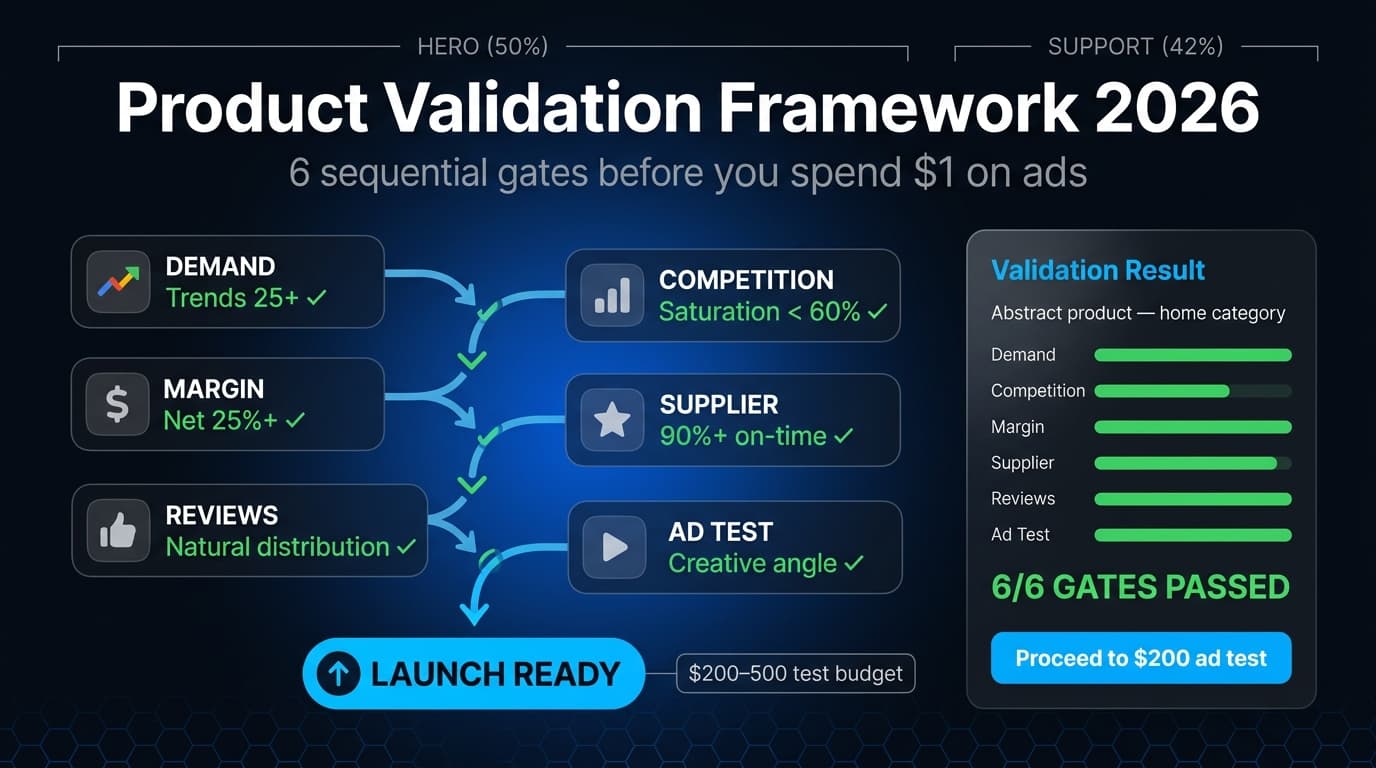
Quick answer: A dropshipping product must pass 6 sequential validation gates before you invest $200–500 in launch costs: demand (Google Trends 25+ score and 1,000+ AliExpress orders), competition (saturation below 60%), margin (25%+ net profit), supplier trust (90%+ on-time rate), review authenticity (natural distribution with photo reviews), and ad testability (viable creative angle confirmed by a small test). Skipping any gate is how sellers burn through $1,000–2,000 with nothing to show.
The Cost of Skipping Validation
Launching an unvalidated product costs more than most beginners realize. Between store setup time, product page creation, sample orders, and initial ad spend, you will invest $200-$500 and 15-25 hours before seeing your first sale. If the product is a dud, that investment is gone. Repeat this three or four times and you have burned through $1,000-$2,000 and two months with nothing to show for it.
Product validation is the process of stress-testing a product idea against real-world data before making that investment. It does not guarantee success, but it eliminates the products that have almost no chance of working. Validation is the final gate before you commit money -- for a complete view of every step leading up to this point, start with our Complete Dropshipping Product Research Guide. Think of it as a filter: you start with a broad list of product ideas and systematically remove everything that fails specific, measurable criteria.
This guide presents a six-gate validation framework. A product must pass all six gates to earn your time and money.
The 6-gate validation framework
| Gate | What it checks | Pass threshold |
|---|---|---|
| 1. Demand | Real search and order volume | Google Trends 25 plus, 1000 plus AliExpress orders |
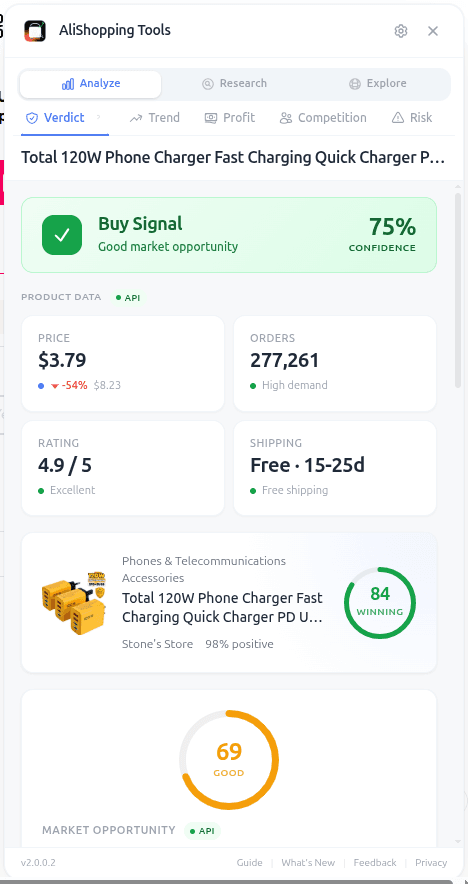
| 2. Competition | Market crowding and seller concentration | Saturation below 60 percent |
| 3. Margin | Realistic net profit after all costs | 25 percent plus net margin |
| 4. Supplier | Trusted source with reliable shipping | Trust Good plus, 90 percent plus on-time |
| 5. Reviews | Authentic review quality | Natural distribution, photo reviews present |
| 6. Ad testability | Creative angle and audience exist | Small ad test yields viable CPA |
Gate 1: Demand Verification
The first and most fundamental question: do enough people actually want this product to sustain a business?
Quantifying Demand
Gut feelings about demand are worthless. You need numbers. Here is how to get them:
Google Trends analysis. Search your product keyword with the time range set to 12 months. You are looking for:
- Stable or upward trajectory (not a single spike followed by decline)
- Search interest score consistently above 25 (on Google Trends' 0-100 scale)
- Geographic distribution that matches your target markets
Keyword search volume. Use a free tool like Ubersuggest, Google Keyword Planner, or Keywords Everywhere to check monthly search volume for your product's primary keyword and its variations. Benchmarks by product category:
- Niche products: 1,000-5,000 monthly searches is healthy
- Broad-appeal products: 10,000-50,000 monthly searches expected
- Below 500 monthly searches: insufficient demand for most dropshipping models
AliExpress order data. Search for the product on AliExpress and examine the top 10 listings by order count. Our AliExpress product research guide covers sourcing and evaluation techniques in detail. Calculate:
- Total orders across all listings
- Average orders per listing in the past 30 days (estimate from order velocity)
- Number of listings with 100+ orders (indicates multiple viable selling points)
Social proof. Check whether the product generates organic discussion on Reddit, TikTok, Facebook groups, or niche forums. TikTok in particular has become a powerful demand signal -- see our guide on how to find trending TikTok products for a structured approach. A product that people talk about without being prompted has stronger demand signals than one that relies entirely on paid advertising.
Demand Red Flags
Reject a product at this gate if:
- Google Trends shows a clear downward trajectory over 6+ months
- Monthly search volume is below 500 across all keyword variations
- Fewer than 3 AliExpress listings have over 500 orders
- You cannot find any organic mentions of the product outside of dropshipper-created content
Gate 2: Competition Assessment
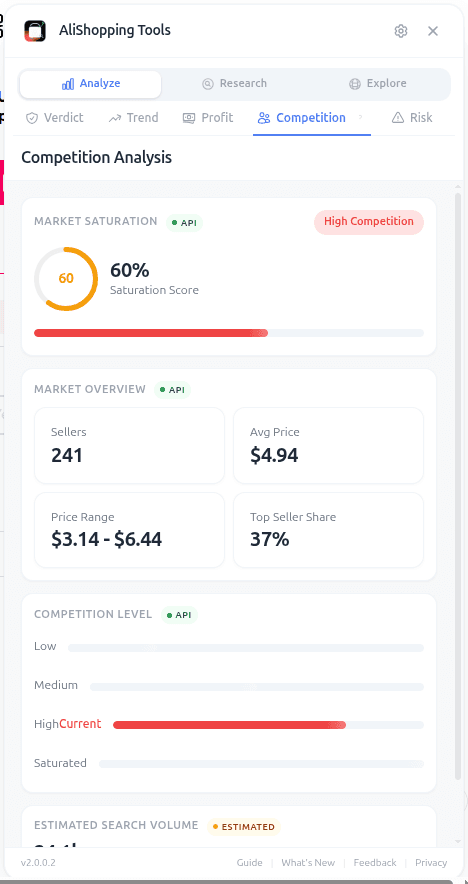
Demand without competition is rare. The question is not whether competition exists, but whether you can compete profitably.
Mapping the Competitive Landscape
Count active advertisers. Search Facebook Ad Library for your product keyword. Count the number of advertisers running active ads. Then categorize them:
- 0-5 advertisers: Low competition, possible first-mover advantage (or possible sign of poor demand)
- 6-15 advertisers: Moderate competition, viable with differentiation
- 16-30 advertisers: High competition, requires strong creative and optimized operations
- 30+ advertisers: Oversaturated, avoid unless you have a significant competitive edge
Analyze competitor pricing. Search Google Shopping for the product. Note the price range across the first page of results. If every competitor is selling at 2x the AliExpress cost, margins are thin and you will struggle to differentiate on price. If there is a wide price range ($15-$45 for the same product), there is room to position yourself.
Evaluate competitor store quality. Visit the top 5 stores selling this product. Rate each on:
- Product page quality (images, descriptions, reviews)
- Store design and professionalism
- Shipping speed promises
- Customer review presence and quality
If most competitors have weak product pages, poor images, and no reviews, you can win by simply being more professional. If competitors have polished stores with hundreds of reviews and fast shipping, you need a more significant differentiator.
Finding Your Angle
For competitive products, identify at least one differentiator:
- Bundle offers: Sell the product with complementary items (e.g., a posture corrector bundled with a resistance band)
- Audience specificity: Target a specific demographic that competitors are ignoring (e.g., marketing a general fitness product specifically to remote workers with back pain)
- Content angle: Create better product content -- detailed comparison videos, user testimonials, or educational content around the product's use case
If you cannot identify a viable differentiator, move to the next product candidate.
Gate 3: Margin Calculation
A product can have strong demand and manageable competition but still fail if the margins do not work. This gate requires precise math, not estimates.
The Full Cost Model
Build this spreadsheet for every product you are validating:
Product Costs:
- AliExpress product price (use the price for your target variant, not the cheapest option)
- AliExpress shipping cost to your primary market
- Packaging upgrade cost (if offering branded or gift-ready packaging)
Transaction Costs:
- Payment processing: 2.9% + $0.30 per transaction (Stripe/PayPal)
- Platform fees: varies by platform (Shopify plan cost allocated per order)
- Currency conversion fees: 1-2% if selling in a different currency
Operational Costs:
- Refund and chargeback provision: budget 5-8% of revenue
- Customer service time: estimate $1-2 per order for support inquiries
- Returns processing: varies, budget $3-5 per returned order
See real delivery time to your country.
Per-seller shipping estimates and trust signals on every AliExpress product page. No account, free.
Marketing Costs:
- Target customer acquisition cost (CPA): research benchmarks for your niche
- Creative production: amortize video/image creation costs across expected orders
Margin Thresholds
After calculating all costs, your product must meet these minimum thresholds:
- Gross margin (before advertising): 60% or higher. This gives you enough room to absorb advertising costs and still profit.
- Net margin (after estimated advertising): 20% or higher. Below this, you are working for minimal return relative to the effort involved.
- Break-even CPA: at least $10. If you can only spend $5 to acquire a customer before losing money, you have almost no room for testing and optimization. For a deeper dive into building cost models, read our guide on how to estimate dropshipping profit.
Products with retail prices between $20 and $50 most consistently hit these thresholds when sourced from AliExpress at $4-$12.
Gate 4: Supplier Verification
A product that looks perfect on paper becomes a liability if the supplier cannot deliver consistent quality and reliable shipping.
Supplier Evaluation Criteria
For each product, evaluate at least 3 AliExpress suppliers. Score each on:
Store fundamentals:
- Store age: 2+ years preferred, 1+ year minimum
- Positive feedback rate: 95%+ required, 97%+ preferred
- Total feedback count: 1,000+ indicates meaningful sample size
- Detailed ratings: all three categories (item as described, communication, shipping speed) at or above category average
Product-specific indicators:
- Number of orders for this specific product listing
- Photo reviews that confirm product matches listing images
- Response time to pre-purchase inquiries (message them before ordering)
- Willingness to customize packaging or include inserts
Shipping capabilities:
- Availability of tracked shipping to your target markets
- Estimated delivery time (under 15 business days for standard, under 7 for express)
- AliExpress Standard Shipping or equivalent tracked shipping availability. For a detailed supplier evaluation checklist, see our AliExpress supplier risk checklist
- Shipping cost transparency (no hidden fees that appear at checkout)
The Sample Order Test
Order the product from your top 2 supplier candidates. When the samples arrive, evaluate:
- Accuracy: Does the product match the listing photos and description? Check dimensions, colors, materials, and functionality.
- Quality: Would you be satisfied receiving this product if you paid your planned retail price? Be honest.
- Packaging: How is the product packaged? Is it protected during shipping? Does the packaging look presentable or cheap?
- Shipping speed: How long did delivery take? Was tracking information accurate and updated?
- Documentation: Did the supplier include any invoices, promotional materials, or branding from their own business that you would need to remove?
If either sample fails your quality standards, you need to find alternative suppliers or reconsider the product entirely.
Gate 5: Market Testing
Gates 1-4 use existing data to predict viability. Gate 5 tests viability with real consumer behavior. This is where you spend money, but in a controlled, measurable way.
The Minimum Viable Test
You do not need a perfect store to run a market test. You need:
- A clean, professional product page with quality images and clear copy
- A functional checkout process
- 2-3 ad creatives (video preferred for social media, image for search)
- A $100-$200 test budget
Test Structure
Platform selection: Choose the platform where your target audience is most active:
- Facebook/Instagram for broad consumer products
- TikTok for products with visual appeal and younger demographics
- Google Shopping for products with established search demand
Ad setup:
- Create 2-3 ad sets targeting different audiences or using different creatives
- Set daily budget at $15-$25 per ad set
- Run for 5-7 days minimum to gather statistically meaningful data
- Do not touch the campaigns during the test period (no optimization, no budget changes)
Success metrics:
- Click-through rate (CTR) above 1.5%: confirms the ad creative resonates
- Add-to-cart rate above 5% of clicks: confirms product page converts interest to intent
- Purchase conversion rate above 2% of clicks: confirms willingness to buy at your price point
- Cost per purchase below your break-even CPA from Gate 3: confirms profitable unit economics
Interpreting Results
- All metrics pass: Proceed to full launch with confidence. Scale ad spend gradually (increase by 20-30% every 3 days).
- Good CTR but low conversion: Your ad is attracting interest but the product page is not converting. Test new images, copy, pricing, or social proof before concluding the product is not viable.
- Low CTR across all creatives: Either your targeting is off or the product does not grab attention in an ad format. Test 2-3 more creative angles before rejecting.
- Good conversion but CPA too high: The product sells, but not profitably at current ad costs. This might improve with creative optimization, but if CPA is more than 2x your target, the product is likely not viable.
Gate 6: Operational Viability
The final gate checks whether you can actually fulfill orders for this product at scale without operational problems eating your profits.
Fulfillment Checks
- Supplier capacity: Message your chosen supplier and ask directly: "Can you fulfill 50 orders per day? 100 per day?" If they hesitate or say no, you need additional suppliers lined up.
- Shipping consistency: Check recent reviews (last 30 days) specifically for shipping complaints. If more than 10% of recent reviews mention slow shipping, the supplier may be experiencing capacity issues.
- Variant management: If your product comes in multiple sizes, colors, or configurations, confirm that the supplier consistently has all variants in stock. Selling a product and then discovering the most popular variant is out of stock creates customer service nightmares.
Customer Service Projections
Estimate the support burden each product will generate:
- Simple products (accessories, decor, gadgets with no sizing): expect 5-10% of orders to generate a support inquiry
- Sized products (clothing, shoes, rings): expect 15-25% of orders to generate inquiries, primarily about sizing
- Electronic products: expect 10-15% of orders to generate inquiries about functionality, compatibility, or defects
- Fragile products: expect 8-12% of orders to involve damage claims
If your projected support volume exceeds what you can handle (or afford to outsource), the product may not be operationally viable even if it passes all other gates.
Legal and Compliance
Before launch, verify:
- The product does not infringe on any patents (search USPTO and Google Patents)
- The product does not require regulatory certifications you do not have (common for electronics, health products, and children's products)
- The product is not restricted or prohibited for import in your target markets
- Your product claims are truthful and do not violate advertising regulations (particularly for health, beauty, and performance claims)
Applying the Framework Efficiently
Running all six gates for every product idea would be slow and expensive. Here is how experienced dropshippers use this framework efficiently:
Quick Rejection at Early Gates
Gates 1 and 2 are cheap (free, in fact) and fast (30-60 minutes per product). Apply them liberally. Out of every 10 product ideas, expect 6-7 to fail at Gates 1 or 2. This is working as intended -- you are eliminating weak candidates before investing time or money.
Parallel Processing
You can run Gates 3 and 4 simultaneously. While you are calculating margins for a product, your sample orders can already be in transit. This saves 1-2 weeks compared to processing sequentially.
Batch Testing
At Gate 5, test 2-3 products simultaneously rather than one at a time. Split your test budget across multiple products. This gives you comparison data and ensures that a single product failure does not stall your entire pipeline.
Maintaining a Validation Pipeline
At any given time, you should have products at different stages of validation:
- 10-15 product ideas awaiting Gate 1/2 screening
- 3-5 products in Gate 3/4 evaluation (margins and supplier checks)
- 1-2 products in Gate 5 market testing
- 1 product passing through Gate 6 operational checks
This pipeline approach ensures you always have validated products ready to launch, rather than scrambling to find something new when your current product peaks.
When Validation Fails -- and That Is Fine
Not every product will pass all six gates. In fact, most will not. A healthy rejection rate at each gate looks like this:
- Gate 1 (Demand): 30-40% of ideas rejected
- Gate 2 (Competition): 20-30% of remaining rejected
- Gate 3 (Margins): 15-20% of remaining rejected
- Gate 4 (Supplier): 10-15% of remaining rejected
- Gate 5 (Market Test): 40-50% of remaining rejected
- Gate 6 (Operations): 5-10% of remaining rejected
Starting with 20 product ideas, you might end up with 1-3 validated products. That ratio is normal and healthy. The alternative -- launching all 20 without validation -- would result in 17-19 failures, each consuming time and money.
Validation is not about finding products that will definitely succeed. It is about avoiding products that will definitely fail. The ones that pass all six gates have a meaningfully higher probability of sustaining a profitable operation, and that probability edge compounds over time as you build a track record of launching winners rather than guessing.
For sellers processing 20 or more products weekly through this framework, the ASTools Chrome Extension compresses the AliExpress evaluation steps into a single dashboard view -- showing winning scores, supplier risk flags, and margin estimates directly on product pages so you can move through Gates 3 and 4 faster.
Frequently Asked Questions
How many products should I validate before launching my store?
Aim to have at least 3 to 5 products that pass all six gates before investing heavily in any single product. This gives you a diversified starting catalog and comparison data for your ad tests. Running Gate 5 market tests on multiple products simultaneously also helps you identify which product resonates most with your target audience.
What is the minimum budget needed to validate a dropshipping product?
Gates 1 through 3 are free -- they require only your time and access to public tools like Google Trends and Facebook Ad Library. Gate 4 costs $10 to $30 for sample orders. Gate 5 requires $100 to $200 in ad spend per product for a statistically meaningful test. Total minimum validation budget per product is approximately $120 to $230.
How long does the full validation process take?
The fastest path through all six gates takes approximately 2 to 3 weeks, primarily because you need to wait for sample orders to arrive (Gate 4) and run ad tests for 5 to 7 days (Gate 5). Gates 1, 2, and 3 can be completed in a single day. Running Gates 3 and 4 in parallel, as described above, saves about a week compared to sequential processing.
Should I validate a product even if it is already selling well on other stores?
Yes. Another store's success does not guarantee your success. Your margins, supplier, target audience, and ad creative will differ. A product selling well on a competitor's store confirms demand (Gate 1) but you still need to assess competition level (Gate 2), verify your own margins (Gate 3), vet your specific supplier (Gate 4), and test with your own audience (Gate 5).
AliShopping Tools
See real delivery time to your country.
Per-seller shipping estimates and trust signals on every AliExpress product page. No account, free.
Product Tracker Miễn phí
Theo dõi giá thật, đơn hàng, tồn kho & đánh giá của bất kỳ sản phẩm AliExpress nào trong 180 ngày. Dữ liệu không nói dối.
Before you buy
Is this deal real? Check the price history before you buy.
Prices often spike just before a “sale.” See 180-day price history and fake discount detection — free, no account needed.
Verify on AliShopping Deals →Sẵn sàng tìm sản phẩm thắng?
Thử AliShopping Tools — 15 công cụ AI miễn phí cho nghiên cứu sản phẩm.
Giải đáp nhanh
Câu hỏi thường gặp
1Sản phẩm chưa validate thực sự tốn tôi bao nhiêu?
Theo bài: giữa thời gian setup store, tạo trang sản phẩm, đặt mẫu và ad spend ban đầu, bạn đầu tư 200–500 USD và 15–25 giờ trước đơn đầu tiên.
Nếu sản phẩm hỏng, khoản đó mất.
Lặp 3–4 lần bạn đã đốt 1.000–2.000 USD và 2 tháng không có gì để khoe.
Validate sản phẩm là stress-test ý tưởng với data thực tế trước khi đầu tư — không bảo đảm, nhưng loại những ý gần như không có cơ hội.
2Volume search nào đủ demand cho sản phẩm dropshipping?
Theo benchmark nhóm của bài: sản phẩm niche qua ở 1.000–5.000 search/tháng, sản phẩm broad-appeal qua ở 10.000–50.000 search/tháng, dưới 500 search/tháng là không đủ demand cho đa số mô hình dropshipping.
Ghép volume với Google Trends quỹ đạo ổn định/tăng (không phải spike đơn rồi giảm), điểm interest trên 25 đều đều trên thang 0–100, và địa lý khớp thị trường đích.
3Cờ đỏ demand nào khiến sản phẩm bị loại ở Gate 1?
Bốn cờ đỏ theo bài: Google Trends giảm rõ trên 6+ tháng, volume search/tháng dưới 500 cho mọi biến thể keyword, dưới 3 listing AliExpress có trên 500 đơn (không có nền demand đã chứng minh), và không tìm thấy mention organic ngoài nội dung do dropshipper tạo (buzz giả tạo không phải organic).
Sản phẩm trượt Gate 1 không bao giờ tới gate cạnh tranh, biên, supplier, và test — khung 6 gate khắt khe có chủ đích.
Bài viết liên quan
- The 20-Point Dropshipping Product Checklist Before You Order (2026)dropshipping
- How to Validate a Dropshipping Product Before Spending on Ads (Free Framework)guides
- Winning Products September 2026: 10 Fall-Transition Categories That Convertproducts
- AI Product Scoring for Dropshipping: How It Actually Works in 2026dropshipping
- المنتجات الرابحة في أغسطس 2026: 12 فئة في ذروة العودة إلى المدارسproducts
- Produits Gagnants Août 2026 : 12 Catégories au Pic de la Rentrée Scolaireproducts
Công cụ liên quan
Bài viết khác
The 20-Point Dropshipping Product Checklist Before You Order (2026)
The definitive pre-order checklist for dropshippers: 20 checks across demand, margin, supplier quality, product risk, and competition. 16+ = green light.
How to Validate a Dropshipping Product Before Spending on Ads (Free Framework)
Stop burning $200–500 on untested products. This 6-step free validation framework tells you if a dropshipping product will sell before you spend a dollar on ads.
Winning Products September 2026: 10 Fall-Transition Categories That Convert
10 dropshipping categories for September 2026 — back-to-school tail, fall wardrobe and home refresh, early Halloween prep, and cozy-season essentials — plus how to vet any candidate with AStools before you spend.