How to Dropship from AliExpress After the 2025 Tariffs (Practical Survival Guide)
How to Dropship from AliExpress After the 2025 Tariffs (Practical Survival Guide)
Quick answer: AliExpress dropshipping to the US is still viable in 2025, but only using US-warehouse products — direct China-to-US shipments now face a $200 flat duty or 120% tariff per package, making them unprofitable for most price points. Sellers targeting the EU, UK, and Australia are completely unaffected by the US de minimis change.
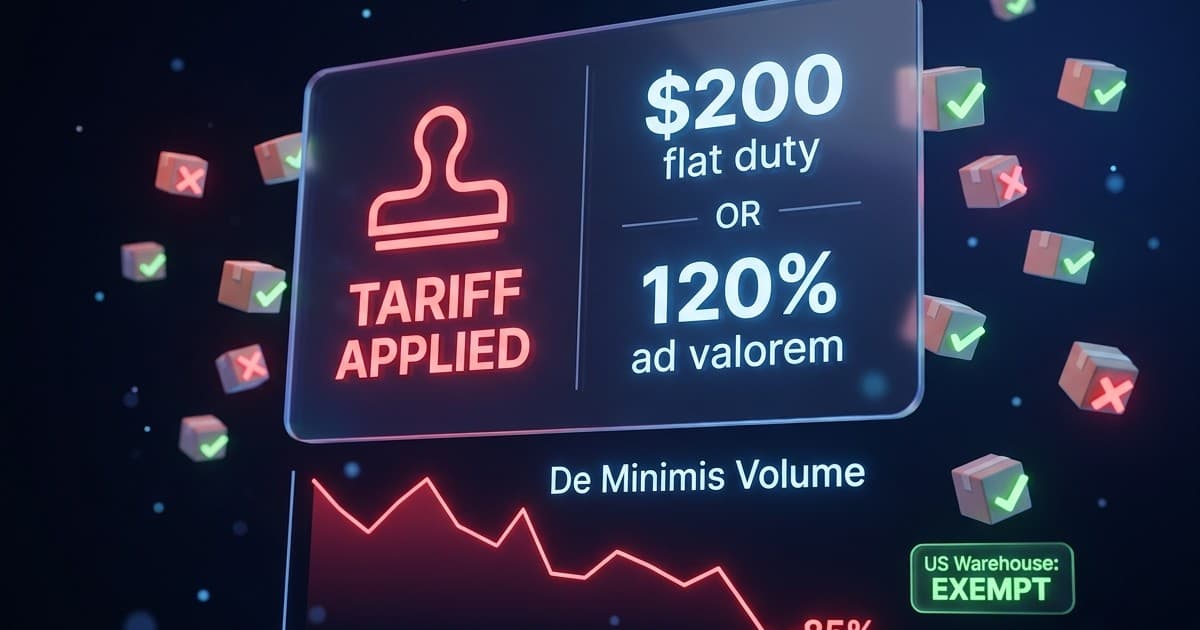
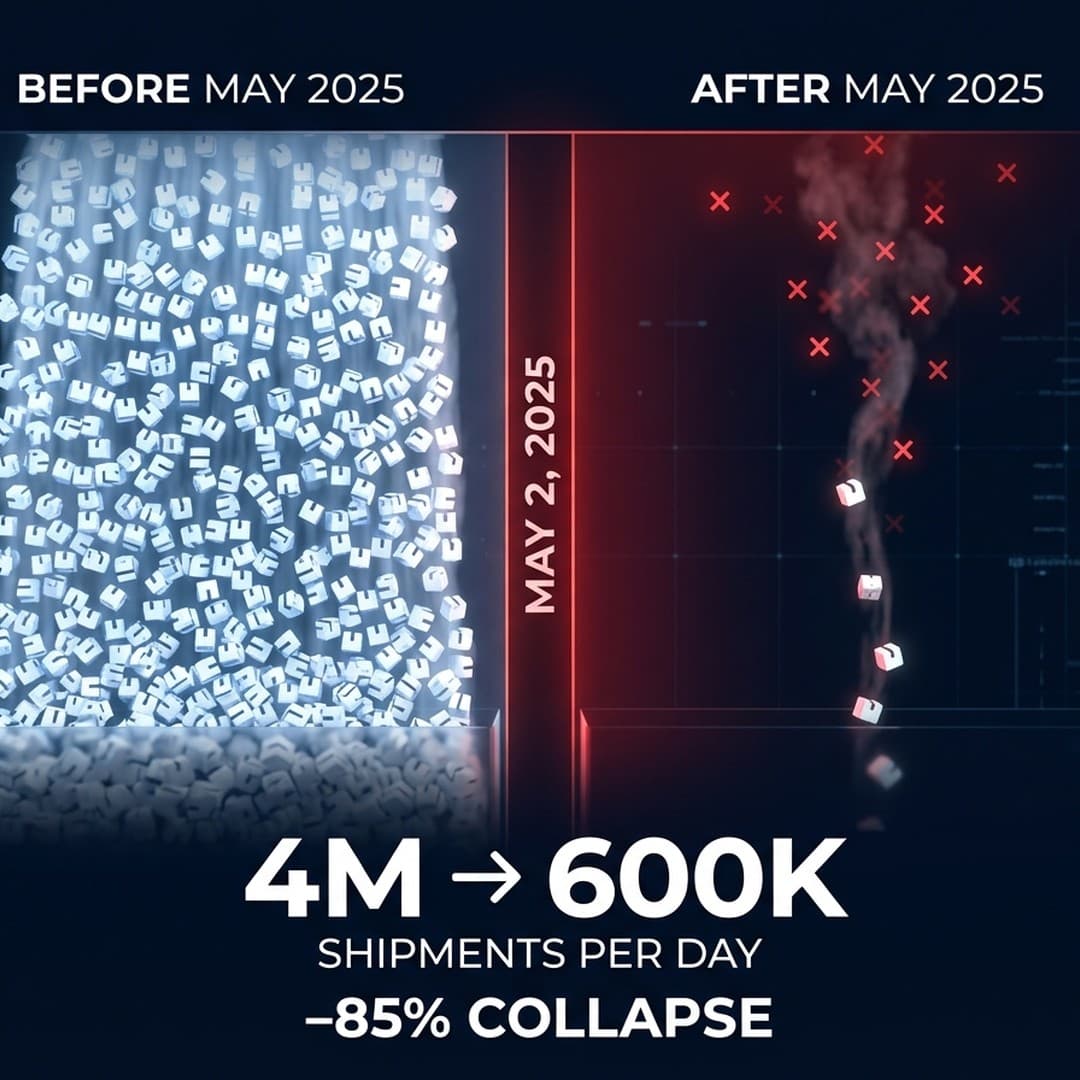
On May 2, 2025, the single biggest structural advantage of AliExpress dropshipping vanished overnight. The $800 de minimis exemption — the rule that let tens of millions of packages per day enter the US duty-free — was eliminated for goods from China and Hong Kong. Daily de minimis shipments into the US dropped from roughly 4 million packages to about 600,000 within weeks. That is an 85% collapse in a matter of days.
This is not a temporary blip. The rule change has bipartisan political support and reflects a multi-year trade posture shift, not a negotiating tactic. The dropshippers who survive this are already adapting. The ones who don't will watch their margins evaporate while their ad costs stay the same.
This guide is the practical version: what exactly changed, who it actually affects (not everyone), and five specific moves you can make this week to stay profitable.
What Exactly Changed — The De Minimis Cliff Explained
The de minimis exemption was a US Customs rule that allowed goods valued under $800 to enter the country without paying import duties or filing formal customs paperwork. For AliExpress dropshippers, this was the entire business model: a $12 product shipped directly from a Chinese factory to a US consumer faced zero tariffs, zero paperwork, zero friction.
The old rule (pre-May 2, 2025):
- Packages valued under $800 from any country: enter duty-free
- No formal customs entry required
- Carrier handles clearance automatically
The new rule (effective May 2, 2025, rates updated June 1, 2025):
- Packages from China and Hong Kong: de minimis exemption eliminated entirely
- Duty applied: $200 flat rate per item OR 120% ad valorem (percentage of declared value), whichever is higher
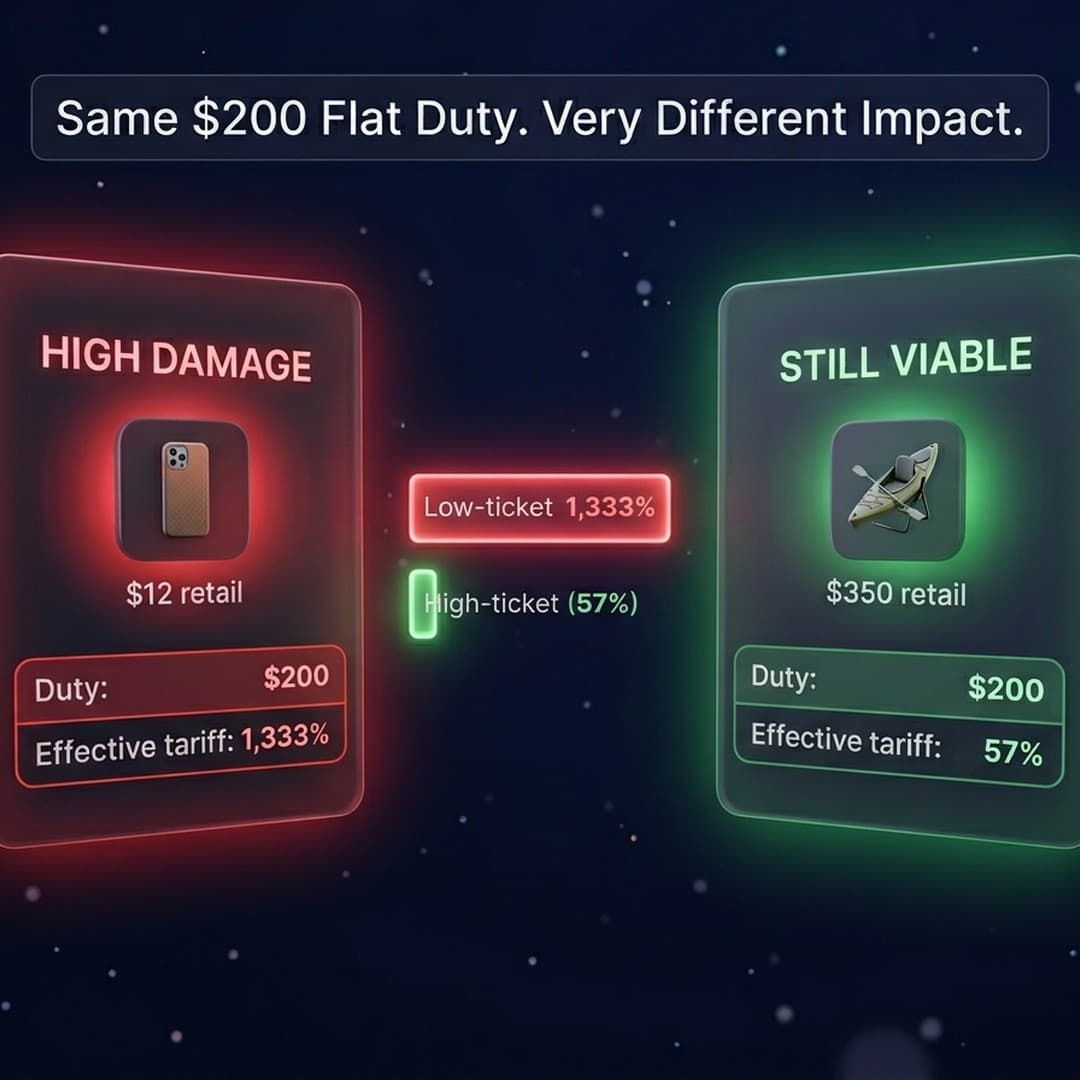
- A $15 AliExpress product now incurs a $200 duty at the border — a 1,333% effective tariff rate
- A $60 product incurs a $72 duty (120% of $60) — still 120% added to cost
The math is brutal at the low end of the price spectrum. For the $10-$40 price band that defines most impulse-purchase dropshipping, the duty often exceeds the product cost by a factor of 3x to 20x.
What Did Not Change
Not everything is affected. Three significant carve-outs survive:
- AliExpress US-warehouse products ship from US soil to US customers. No international border crossing means no import duty. These are completely exempt.
- Non-Chinese goods — products from Vietnam, India, Turkey, Bangladesh — retain the original $800 de minimis threshold under current rules.
- Sellers outside the US — EU, UK, AU, CA, and Southeast Asian dropshippers selling to their own local markets are entirely unaffected. This is a US-specific rule change.
Who Is Affected and Who Isn't
Before adapting, you need an honest diagnosis of whether you're even hit.
Definitely affected
- US-based sellers sourcing directly from Chinese/Hong Kong suppliers on AliExpress, shipping direct-to-consumer in the US
- Any product in the $5-$80 price range sourced from China shipping to US addresses
- Sellers using Chinese fulfillment agents (whether on AliExpress or off-platform) with US consumer delivery
Not affected
- EU sellers targeting European customers — EU customs rules haven't changed; €150 de minimis threshold applies separately
- UK sellers targeting UK customers — post-Brexit £135 threshold remains intact for Chinese goods
- AU sellers targeting Australian customers — AU$1,000 threshold unchanged
- US sellers using US-warehouse AliExpress suppliers — ships domestically, no import tariff
- US sellers using non-Chinese suppliers — Vietnam, India, Bangladesh source countries still qualify for the original de minimis exemption
If you're an EU/UK/AU seller and someone told you to panic: stop. Your business model is unaffected. If you're a US seller who switched to US-warehouse sourcing before May 2025: you're fine. If you're a US seller still routing Chinese factory orders directly to US consumers: every unfulfilled order now carries a tax liability that likely exceeds your margin.
Products Most Hurt vs. Least Hurt
Not all categories are equally exposed. The damage is concentrated.
Highest damage (avoid for US direct-ship)
| Category | Typical AE Cost | New Duty | Effective New COGS |
|---|---|---|---|
| Phone accessories | $3–$8 | $200 | $203–$208 |
| Fashion jewelry | $2–$6 | $200 | $202–$206 |
| LED lighting | $5–$15 | $200 | $205–$215 |
| Small electronics | $8–$25 | $200–$30 | $208–$55 |
| Novelty home goods | $4–$12 | $200 | $204–$212 |
These are dead for US direct-ship from China. The duty exceeds any viable retail price.
Lower damage (still workable with pivots)
| Category | Typical AE Cost | New Duty | Rationale |
|---|---|---|---|
| High-ticket outdoor gear | $40–$80 | $48–$96 | Duty is 120% of cost — painful but can still work at $180-$250 retail |
| Specialty fitness equipment | $45–$90 | $54–$108 | Premium positioning can absorb a $100 duty at $300+ retail |
| Industrial/trade tools | $60–$120 | $72–$144 | B2B buyers factor in landed cost; less price sensitivity |
The pattern is clear: the higher the product's intrinsic value relative to its weight and size, the less punishing the tariff as a percentage of retail price. A $200 flat duty on a $350 foldable kayak is 57% of cost — bad, but not fatal if you're selling at $650. A $200 duty on a $12 phone case kills the product entirely.
Move 1: Switch to AliExpress US Warehouse Products
This is the fastest, lowest-friction adaptation available to any US dropshipper using AliExpress.
AliExpress has been expanding its US warehouse footprint since 2023. Many of the most popular dropshipping categories now have products available from suppliers who have already pre-imported inventory into the US. When you order from a US-warehouse listing, the product ships from within the United States — no customs, no tariff, no paperwork, no delay.
How to find US-warehouse listings on AliExpress:
- Run your normal product search
- Filter by "Ship From: United States" in the left-side filter panel
- Cross-reference the listing to confirm the warehouse location is listed as "United States" on the shipping tab
- Compare product cost against standard Chinese-ship listings (expect 15-30% higher base cost — this is usually still cheaper than paying the tariff)
What to watch for:
- Inventory can deplete faster than Chinese listings — monitor stock levels weekly
- US-warehouse suppliers often have fewer SKU variations
- Returns and quality disputes follow standard AliExpress process — the US warehouse location doesn't change dispute resolution
- Use AliShopping Tools to pull supplier history, rating trends, and price fluctuation data on US-warehouse suppliers before committing volume
The quality of US-warehouse supplier data matters more now — you're putting more eggs in fewer baskets. Vetting suppliers with real data before you onboard them is not optional.
Move 2: Use CJ Dropshipping US Warehouse as a Fulfillment Layer
CJ Dropshipping operates a US-based warehouse network that is structured for dropshippers, with automated fulfillment, WooCommerce/Shopify integrations, and product sourcing support. Like AliExpress US-warehouse products, orders fulfilled from CJ's US facilities ship domestically and are not subject to the new tariff.
CJ's US warehouse is meaningfully different from AliExpress US warehouse in one important way: you can request CJ to source and pre-stock specific products in their US facility. This gives you a path to US-warehouse fulfillment for products that AliExpress doesn't yet carry in the US.
Practical implementation:
- Identify your top 10-15 AliExpress SKUs by order volume that are still shipping from China
- Request CJ source those SKUs for US-warehouse stocking (minimum order quantities apply — typically 20-50 units)
- Migrate your Shopify/WooCommerce product connections from AliExpress direct to CJ US warehouse
- Keep AliExpress as a backup supplier while you validate CJ quality on each SKU
The main tradeoff: CJ US warehouse requires you to pre-buy inventory (not true dropshipping), and the product catalog is narrower than AliExpress. But for your proven winners, this is a sensible cost of doing business in the current tariff environment.
Move 3: Pivot Your Customer Targeting to EU, UK, and AU
The tariff applies only to goods entering the United States from China and Hong Kong. The moment you redirect your customer acquisition to European, British, or Australian buyers, the new rule is entirely irrelevant to your business model.
This is a significant strategic shift — not a quick fix — but it's the highest-leverage long-term move available if you're currently US-focused.
The opportunity:
- EU e-commerce market: €887 billion in 2024, growing at 8% annually
- UK e-commerce: online retail sales of roughly £120–130 billion annually (ONS-tracked online retail sales), high per-capita spend — broader "digital economy" estimates that include travel and services run higher, so figures vary by methodology
- Australia: AUD $64 billion market, Chinese goods fully eligible for standard de minimis treatment
- None of these markets have implemented equivalent de minimis elimination for Chinese goods
Implementation steps:
- Audit your existing winning products against EU/UK demand — not all US winners translate, but many do
- Set up a Shopify market for EU/UK with local currency pricing and VAT compliance (Shopify Markets handles the VAT display)
- Redirect ad spend to Facebook/Instagram targeting EU and UK audiences
- Update AliExpress shipping preferences to EU warehouses (many Chinese suppliers ship to EU via AliExpress Standard Shipping at competitive rates)
- Handle EU VAT compliance — IOSS registration covers under-€150 orders across all 27 EU member states through a single filing
If you already have a profitable product portfolio and your only bottleneck is the tariff, pivoting your customer base — not your supply chain — may be the highest-ROI move.
Move 4: Move Up to High-Ticket Products
The $200 flat duty is a fixed cost per item. On a $12 product, it's a death sentence. On a $350 product, it's a margin problem you can engineer around.
High-ticket dropshipping was already a growing strategy before May 2025 because of its structural advantages: lower order volume needed to hit revenue targets, lower return rates per dollar of revenue, easier brand positioning. The tariff change makes the high-ticket pivot not just attractive but arguably necessary for US sellers.
Products where the $200 tariff math can still work:
| Product | AE Cost | Duty | Total COGS | Realistic Retail | Gross Margin |
|---|---|---|---|---|---|
| Foldable electric bike | $180 | $216 (120%) | $396 | $799 | 50% |
| Outdoor projector | $95 | $114 (120%) | $209 | $449 | 53% |
| Standing desk (manual) | $70 | $84 (120%) | $154 | $329 | 53% |
| Foldable kayak | $120 | $144 (120%) | $264 | $549 | 52% |
| Commercial-grade blender | $45 | $54 (120%) | $99 | $199 | 50% |
These margins are compressed compared to pre-tariff figures, but they're workable — especially because high-ticket products can support higher ad spend per acquisition and typically have better LTV.
The operational shift: high-ticket dropshipping requires better supplier vetting, stricter quality control, and more robust customer service. You cannot absorb high-ticket returns the way you absorb low-ticket ones.
Move 5: Vet US-Warehouse Suppliers with Risk Assessment Before Onboarding
The tariff environment is forcing everyone to US-warehouse suppliers simultaneously. That demand surge is creating a new risk: unvetted suppliers, inconsistent inventory quality, and fulfillment delays from suppliers who weren't built for high volume.
Before you migrate your order flow to any new US-warehouse supplier — whether on AliExpress or CJ — run a proper risk assessment. The signals to check:
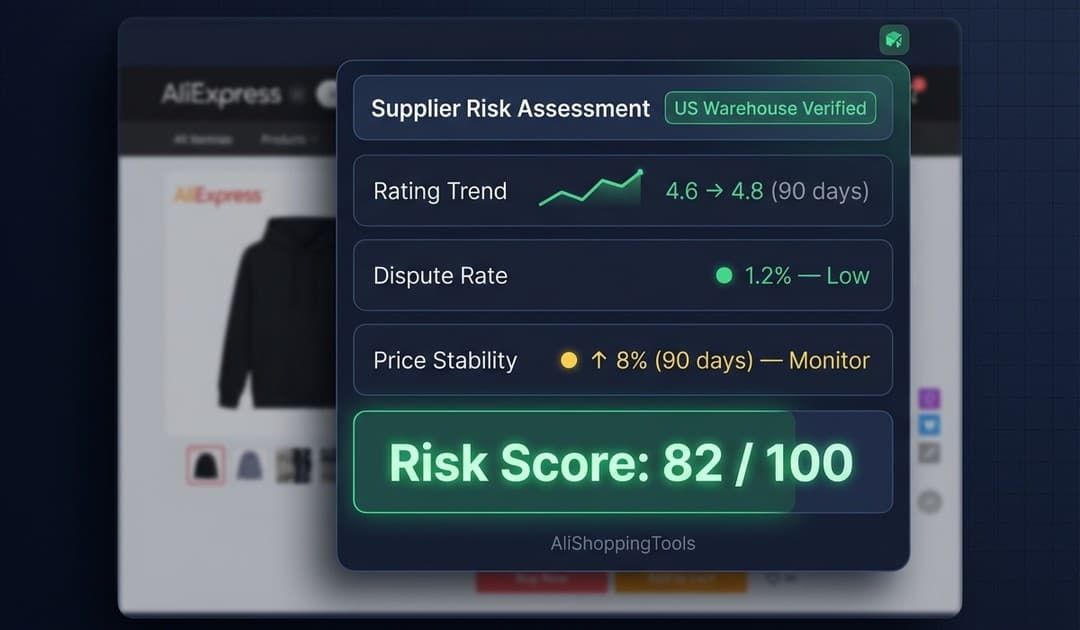
Rating trajectory: A supplier with a 4.8 rating that was 4.6 six months ago is improving. A supplier at 4.7 that was 4.9 six months ago is declining. The direction matters more than the current number.
Order volume history: A supplier with 10,000 lifetime orders is meaningfully more reliable than one with 400, even if the rating is similar. Volume proves fulfillment consistency under pressure.
Dispute rate: High dispute rates on a supplier (visible through tools that track this) predict your own return rate. Don't onboard a supplier with a pattern of item-not-as-described disputes.
Price stability: Suppliers under demand pressure raise prices or degrade quality. Price history over 90 days tells you whether this supplier's cost is drifting.
AliShopping Tools runs this analysis automatically — rating history, order volume trends, price changes, and a composite Risk Assessment score surfaced directly on the AliExpress product page. In a market where everyone is scrambling for the same US-warehouse suppliers, vetting before you commit is how you avoid getting stuck with a supplier whose quality collapses under the demand surge.
The Broader Picture: What This Means for 2025-2026
The de minimis elimination is part of a broader US trade policy shift that is unlikely to reverse in the near term. Both political parties have signaled support for the policy, and the WTO complaints from China are unlikely to produce quick resolution.
What this means practically for the next 12-18 months:
- The low-ticket, high-volume, China-direct dropshipping model is effectively over for US sellers unless they pivot to US-warehouse sourcing
- Sellers who adapt to US-warehouse, high-ticket, or non-US markets in the next 6 months will have structural advantages as slower competitors exit
- The tariff creates a temporary market thinning — ad auction costs for surviving products may actually decrease as competitors drop out
- Long-term, US-warehouse product availability will expand as more Chinese suppliers pre-import inventory to serve the new demand pattern
The dropshippers who treat this as a crisis will struggle. The ones who treat it as a market structure change that requires a one-time adaptation will find themselves in a less crowded competitive landscape by Q4 2025.
Frequently Asked Questions
Does the tariff apply to products I order from AliExpress to ship to EU or UK customers?
No. The de minimis elimination is a US Customs rule and applies only to goods entering the United States. If you're shipping to EU, UK, Australian, or Canadian customers, your shipments from Chinese suppliers cross different customs borders under different rules. The EU, UK, and AU de minimis thresholds remain in place and are unaffected by US policy.
Can I just undervalue my packages to get under the tariff threshold?
No. Customs fraud carries significant penalties including package seizure, fines, and potential criminal liability. Beyond the legal risk, the practical enforcement reality has changed — US Customs significantly increased inspection rates following the de minimis policy change, and carriers are flagging inconsistent declared values. This strategy was already illegal; it's now also high-risk to attempt.
How do AliExpress US-warehouse products compare in quality to China-direct listings?
Quality is product- and supplier-dependent, not warehouse-dependent. US-warehouse products are typically the same manufacturer's goods, pre-imported. The main difference is that you lose the ability to inspect individual units before they ship to your customer. Run the same supplier vetting process — rating trajectory, dispute rate, order volume — regardless of warehouse location.
Is CJ Dropshipping US warehouse actually free to use?
CJ Dropshipping has no platform fee to register and access their catalog. For US-warehouse products you wish to pre-stock, you pay the product cost and shipping cost for the initial stocking order. Per-order fulfillment fees apply (typically $1-3 per order). There is no monthly subscription required for basic use, though premium tiers exist.
If I pivot to EU/UK customers, do I need to handle VAT?
Yes. Selling to EU customers as a non-EU business requires IOSS registration for orders under €150 (covers all 27 EU member states through one filing). Selling to UK customers requires either VAT registration in the UK or selling through a marketplace that handles VAT collection on your behalf (eBay UK, Amazon UK, Etsy handle this). Neither registration process is prohibitively complex, and both can be managed through third-party tax agents without requiring you to have a physical EU or UK presence.
Sẵn sàng tìm sản phẩm thắng?
Thử AliShopping Tools — 15 công cụ AI miễn phí cho nghiên cứu sản phẩm.
Giải đáp nhanh
Câu hỏi thường gặp
1Điều gì thay đổi với dropshipping AliExpress sau thuế quan Mỹ 2025 và bỏ de minimis?
Hai thay đổi lớn vào tháng 5/2025: miễn trừ de minimis $800 cho hàng gốc Trung Quốc bị bãi bỏ, nghĩa là mỗi gói AliExpress vào Mỹ nay phải nhập cảnh hải quan chính thức và chịu thuế áp dụng (từ 10–145% tùy category theo lịch thuế 2025).
Trước đây, kiện dưới $800 thông quan miễn thuế tự động.
Hiệu ứng kết hợp tăng đáng kể chi phí thực tế hàng nhập cho sản phẩm dropshipping nguồn Trung Quốc, đặc biệt bóp biên trên sản phẩm giá thấp.
2Thay đổi thuế quan Mỹ 2025 ảnh hưởng nặng nhất đến ai trong dropshipping AliExpress?
Bài xác định bốn nhóm bị ảnh hưởng nhất:
- 1dropshipper bán sản phẩm nguồn Trung Quốc giá dưới $50 cho khách Mỹ — nơi thuế quan nay chiếm tỷ lệ lớn trong chi phí;
- 2store cạnh tranh chủ yếu về giá với biên mỏng không thể hấp thụ sàn thuế 10–30%;
- 3seller dùng sản phẩm generic không thương hiệu AliExpress nơi thuế nhập khẩu hiện trên thông báo hải quan của khách, gây hại nhận thức brand;
- 4dropshipper trong điện tử và dệt may — hai category có thuế suất cao có thể vượt giá sản phẩm.
35 bước cụ thể để duy trì lợi nhuận dropshipping từ AliExpress sau thuế quan là gì?
Năm bước của bài:
- 1chuyển sang supplier AliExpress có kho địa phương Mỹ hoặc EU để tránh phân loại thuế quan gốc Trung Quốc hoàn toàn;
- 2pivot chọn sản phẩm giá cao hơn nơi thuế quan là tỷ lệ nhỏ hơn trong tổng giá trị đơn và biên có thể hấp thụ;
- 3dùng supplier AliExpress có trụ sở tại Việt Nam, Mexico, hoặc Ấn Độ cho category có đối xử thuế ưu đãi hơn;
- 4điều chỉnh giá listing hiện tại để phản ánh chi phí thực tế thay vì hấp thụ thuế quan như giảm biên;
- 5khám phá sourcing private label từ Alibaba cho sản phẩm winning đã validate để có lý do giá bán cao hơn.
4Bỏ de minimis có ảnh hưởng dropshipping AliExpress sang EU, UK và Úc không?
Không — bỏ de minimis là thay đổi chính sách đặc thù Mỹ.
EU giữ ngưỡng de minimis €150 (VAT áp dụng tất cả gói qua hệ thống IOSS từ tháng 7/2021), UK giữ ngưỡng £135, và Úc giữ ngưỡng A$1.000.
Bài đặc biệt đề cập các thị trường này vẫn thuận lợi về cấu trúc cho dropshipping AliExpress sau 2025 so với Mỹ, và mô tả playbook riêng cho từng thị trường.
5Dropshipping AliExpress sang Mỹ có còn khả thi năm 2026 sau thuế quan không?
Có, nhưng playbook đã thay đổi.
Bài lập luận rằng khả năng tồn tại nay phụ thuộc chọn lựa nhà cung cấp (kho địa phương hoặc nguồn gốc ngoài Trung Quốc), chọn lựa sản phẩm (AOV cao hơn, định vị bảo vệ được), và kỷ luật định giá (phản ánh chi phí thực tế đầy đủ).
Dropshipper vẫn đối xử thị trường Mỹ với giả định trước 2025 về nhập khẩu miễn thuế đang bán với biên âm thực tế.
Những ai đã điều chỉnh sourcing và giá tiếp tục xây store lợi nhuận.
Bài viết khác
AliExpress Dropshipping to EU, UK & Australia in 2025 — The Full Playbook
The tariff story is US-centric. EU, UK, and Australia still have favorable thresholds and growing demand. Here's how to build a profitable dropshipping operation in 2025.
What Is a Winning Score for Dropshipping Products? (Complete Guide)
The Winning Score (0–100) rates every AliExpress product from seven weighted signals on its listing. Learn what each factor measures, what the score does not measure, and how to read the three bands.
How to Read a Risk Assessment on Any AliExpress Product (2026 Guide)
Master AliExpress supplier risk assessment: decode 6 risk dimensions, interpret red flags, and know exactly when to order a sample before you scale.