












AliExpress Incentivized Reviews: How to Detect Fake 5-Star Sellers
AliExpress Incentivized Reviews: How to Detect Fake 5-Star Sellers
Quick answer: Incentivized reviews on AliExpress — where sellers offer refunds or gifts in exchange for 5-star ratings — leave five detectable signals: near-100% 5-star distribution with no 3/4-star reviews, review bursts concentrated in short date windows, reviewer profiles with no other reviews, generic templated wording repeated across reviews, and a review count that exceeds plausible organic conversion on the visible order count. You read all five yourself — no extension detects incentivized reviews, ours included. AliShopping Tools speeds up two of them by putting the star distribution and the photo-review filter on the page, and adds the dispute rate on the Supplier Risk tab as the cross-check the scheme cannot hide.
Incentivized reviews are a structured practice on AliExpress: sellers offer buyers a partial or full refund, a free gift, or a coupon code in exchange for leaving a 5-star review. The buyer gets their money back; the seller gets a review that inflates their rating and pushes them higher in search results.
Install AliShopping Tools — the review evidence and the supplier dispute rate, on the page →
This guide explains how incentivized review schemes work, what signals they leave, and how to detect them in under 2 minutes. Incentivized reviews are one sub-type of the broader fake-review problem — for the full 7-red-flag framework across all review-manipulation types, see our fake AliExpress reviews guide.
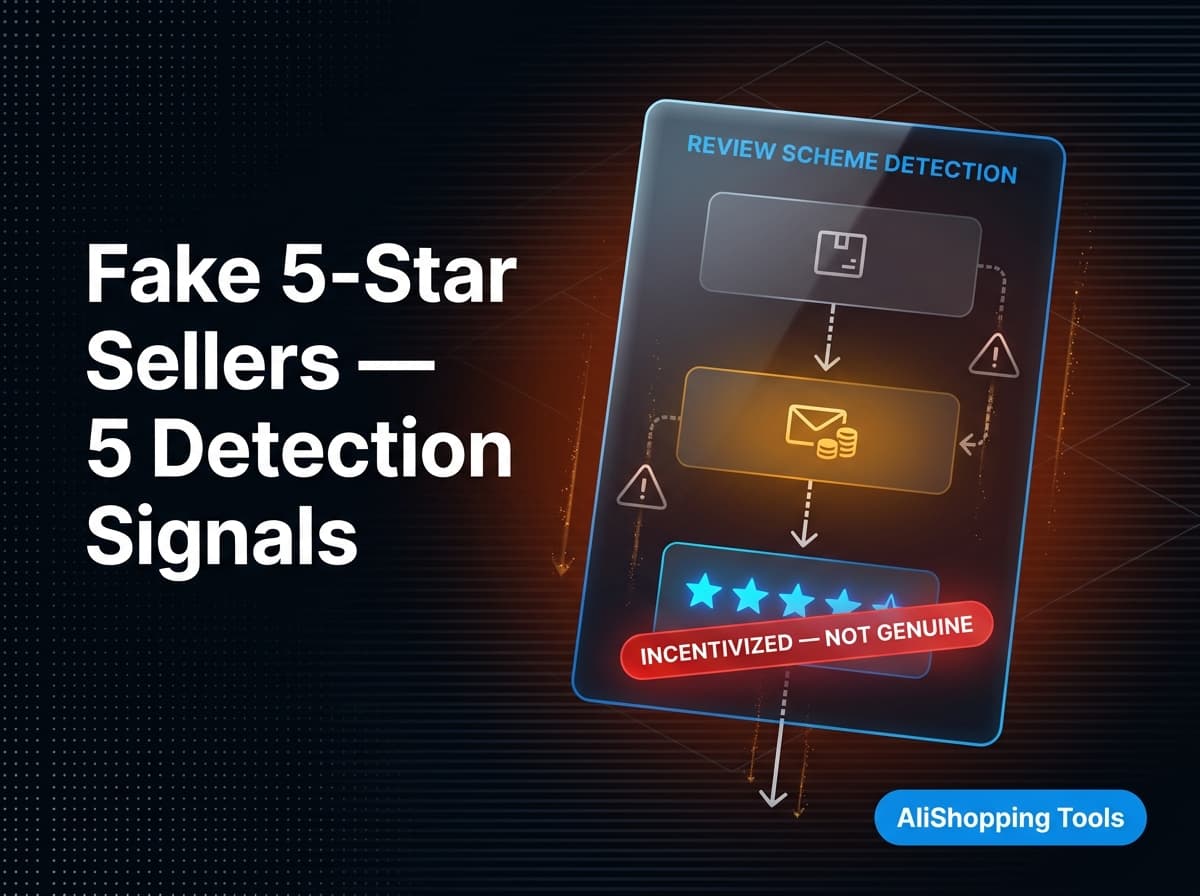
How AliExpress incentivized reviews work
The typical scheme:
- Buyer orders product
- Before or after delivery, seller sends a message: "Leave us a 5-star review and we will refund $X or send you a free gift"
- Buyer leaves 5-star review (often without using the product, or regardless of quality)
- Seller sends the refund or gift via WeChat, Alipay, or a discount coupon on the next order
- The review count and rating are inflated
This is against AliExpress's policies but enforcement is inconsistent. The buyer technically participated in the scheme, so neither party reports it. AliExpress catches some cases through algorithmic review pattern detection, but the practice persists at scale.
The 5 detection signals
Signal 1 — Suspiciously perfect rating distribution
Genuine products accumulate a natural review distribution. Real customer bases include people who had shipping delays, minor quality variations, or different expectations.
Red flag: Product with 500+ reviews and 97-100% 5-star rating. No 3 or 4-star reviews means either: (a) every single buyer was perfectly satisfied, or (b) the reviews are not organic. Option (b) is statistically far more likely.
Healthy pattern: 75-80% 5-star, 10-15% 4-star, 5-8% 3-star, 2-4% combined 2+1-star on a product with real buyers.
Signal 2 — Review burst dates
Organic reviews accumulate gradually over time as new buyers receive products. Incentivized reviews are often arranged in batches.
Red flag: Dozens or hundreds of reviews on the same date or within a 2-3 day window. This is rarely organic — buyers do not all receive products and decide to review on the same day.
How to check: Sort reviews by "Newest First" and look for date clustering. If 150 reviews all appeared in a 3-day window, that is a batch incentivization pattern.
Signal 3 — Reviewer profiles with single reviews
Check this seller before you buy.
Seller trust score and risk-flag scan on every AliExpress product page. No account, free.
AliExpress buyers who organically leave reviews typically leave them on multiple purchases over time. Incentivized review accounts are often created specifically for the purpose — they have one review (the one that was paid for).
How to check: Click on several reviewer profile names. Check how many reviews that account has left in total. Profiles with 1-3 total reviews across all purchases are a yellow flag when they appear in clusters.
Signal 4 — Templated review wording
Incentivized review schemes often provide or suggest review text to buyers, or buyers copy-paste from each other. Multiple reviews with near-identical wording ("Very good product, fast shipping, recommend to all!!!") across different reviewer names is a strong signal.
What to look for: Read 20-30 reviews in sequence. Identical phrasing patterns, the same sentence structure, or the same specific compliments ("the seller is very patient and helpful") repeated across multiple reviewer names.
Signal 5 — Review count vs. order count mismatch
Most buyers never leave a review at all, so the review count on a listing is normally a fraction of its order count. When the review count approaches or exceeds the visible order count, something has been added that buyers did not write — either reviews created outright, or reviews carried over from another listing.
Example: Product showing 2,000 reviews but only 500 orders visible. Even at 100% review rate that math does not work — suggests either review transfer (moved from old listing) or fabrication.

Where AliShopping Tools helps — and where it does not
It is worth being blunt, because plenty of tools are vague about this: AliShopping Tools does not detect incentivized reviews. There is no authenticity score, no anomaly flag, no burst or velocity analysis, no text-pattern matching. Signals 2, 3, 4 and 5 above stay entirely on you.
Two things it does contribute:
- The Reviews tab lays out the review evidence. Total review count, the full 1-to-5-star distribution (Signal 1, settled at a glance), All / With Photos / Additional filters, buyer photos that open full-size, and an export of the review set in CSV, JSON, TXT or XLSX — which is how you check Signal 2 properly, by sorting dates in a spreadsheet.
- The Supplier Risk tab shows the dispute rate. This is the number the whole scheme cannot buy off. A buyer who accepted a refund for a defect files no review; a buyer who was genuinely wronged files a dispute. A high dispute rate underneath a near-perfect star average is the clearest contradiction you will find.
Open any AliExpress product, read the distribution on the Reviews tab, then check the dispute rate on Supplier Risk. Under a minute for both — and the conclusion is yours to draw.

What to do when you detect incentivized reviews
For buyers:
- Ignore the rating number; read the 3-star and lower reviews for honest feedback
- Sort reviews by "Lowest Rating First" for unfiltered quality signals
- Check photo reviews (harder to fake than text reviews)
- Order a test unit before large purchases
For dropshippers (critical):
- Do not source products where you cannot trust the review signal
- A supplier with incentivized reviews is concealing quality problems — your customers will discover the truth after you have shipped
- High dispute rate in AliShopping Tools is a hard stop — the dispute rate reflects real buyer dissatisfaction, not managed perception

FAQ
How do I know if AliExpress reviews are fake?
Check for: near-100% 5-star distribution with no 3/4-star reviews, review burst dates (many reviews on the same day), single-review profiles in clusters, and identical templated wording. Those are reads you make, not outputs a tool hands you. AliShopping Tools makes the first one instant by showing the full star distribution on its Reviews tab, and lets you export the review set so you can check the dates yourself.
Can I report incentivized reviews on AliExpress?
AliExpress has a report function for suspected fake reviews. Its effectiveness is limited. The more practical approach is to use the detection signals to avoid sellers who practice this, rather than relying on AliExpress enforcement.
Are all AliExpress 5-star sellers using fake reviews?
No. Many AliExpress sellers earn genuine high ratings through consistent quality and service. The 5 detection signals in this guide distinguish organic high-rating sellers from incentivized ones. Sellers with 4.7+ ratings, review distribution that includes some 3/4-star reviews, and reviews that accumulate gradually over time are more trustworthy.
Does AliShopping Tools detect fake reviews?
No. It does not score reviews for authenticity, flag anomalies, analyse posting velocity, or match text patterns — and any tool claiming to do that reliably is overselling. What it gives you is evidence and one adjacent number: the Reviews tab shows the review count, the 1-to-5-star distribution, All / With Photos / Additional filters, full-size buyer photos, and a CSV/JSON/TXT/XLSX export; the Supplier Risk tab shows the dispute rate. Read those, then apply the 5 signals yourself.
Based on publicly observable AliExpress marketplace practices as of May 2026.
AliShopping Tools
Check this seller before you buy.
Seller trust score and risk-flag scan on every AliExpress product page. No account, free.
Product Tracker Free Beta
Track any AliExpress product’s real price, orders, stock & rating for 180 days. Data doesn’t lie. But discounts can.
Before you buy
Is this deal real? Check the price history before you buy.
Prices often spike just before a “sale.” See 180-day price history and fake discount detection — free, no account needed.
Verify on AliShopping Deals →Ready to find winning products?
Try AliShopping Tools — 15 free AI tools for product research.
Quick answers
Frequently Asked Questions
1How do AliExpress sellers inflate their ratings with incentivized reviews?
The post documents three common mechanisms:
- 1cash-back offers via WhatsApp or WeChat where sellers message buyers after delivery and offer a partial refund in exchange for a 5-star review;
- 2free-gift-with-review arrangements where a buyer leaves a positive review before the seller ships a bonus item;
- 3review-farm services where third-party operators place fake orders and leave bulk 5-star reviews as a service, often leaving detectable patterns in review timing and reviewer profiles.
2What are the 5 methods to detect fake 5-star AliExpress reviews?
The post outlines five reads you perform yourself:
- 1review velocity — a sudden jump in review count inside a short window, out of step with how the listing accumulated before, signals a purchase campaign;
- 2reviewer profile analysis — accounts holding one or two reviews total, all left in the same week on unrelated products, are review-farm accounts;
- 3review text homogeneity — multiple reviews using the same phrasing or template wording despite claiming to be different buyers;
- 4rating distribution — an organic listing shows a realistic spread including some 1-star and 2-star feedback, while an incentivized shop shows an overwhelming 5-star bar with essentially no neutral reviews;
- 5photo inconsistency — purchased reviews often include stock-like photos or photos that do not match the product variant ordered.
3Does AliShopping Tools automatically detect incentivized reviews?
No.
There is no fake-review detector, no review authenticity score, no anomaly flag, and nothing about reviews feeding a risk verdict — none of that exists in the extension.
Its Reviews tab is an evidence view: total review count, the rating distribution across all five star bands, three filters (All, With Photos, Additional), real customer photos that open full-size, and an export of the review set in CSV, JSON, TXT or XLSX.
Separately, the Supplier Risk tab shows the seller's dispute rate, which is the number an incentive scheme cannot suppress.
Reading those against the five signals is your job, not the extension's.
4Why do incentivized reviews matter specifically for dropshipping product research?
Dropshippers selecting products based on seller ratings are making sourcing decisions that affect their end customers.
A product from an artificially 5-star seller may have acceptable quality — or it may be masking real quality issues that legitimate reviews would surface.
Beyond product quality, inflated ratings make a mediocre supplier look superior to genuinely well-rated alternatives.
The post frames review authenticity as a supplier risk signal, not just a marketplace integrity issue.
5How can I verify if an AliExpress seller's reviews are authentic before sourcing from them?
The post recommends a four-step manual verification taking under 2 minutes per seller:
- 1sort reviews by Most Recent and check whether the timestamp distribution is organic (spread across months) or clustered into a few days;
- 2click on 10 recent reviewers and check how many other reviews each account has left;
- 3read the 1-star and 2-star reviews specifically — their existence and credibility is a positive signal, their total absence is a negative one;
- 4search the product across multiple sellers and compare review distributions. All four steps are manual. AliShopping Tools does not automate any of them; it makes step 1 easier by exporting the review set (CSV, JSON, TXT, XLSX) so you can sort the dates in a spreadsheet, and it settles the distribution question in step 4 by showing the full 1-to-5-star breakdown on the page.
More from the blog
How to Spot Fake AliExpress Reviews in 30 Seconds (2026 Guide)
AliExpress fake reviews follow 7 patterns — burst posting, identical wording, missing photos, manipulated ratings. Spot incentivized and misleading reviews before you buy.
Winning Products September 2026: 10 Fall-Transition Categories That Convert
10 dropshipping categories for September 2026 — back-to-school tail, fall wardrobe and home refresh, early Halloween prep, and cozy-season essentials — plus how to vet any candidate with AStools before you spend.
الشحن من AliExpress إلى مصر 2026 — مواعيد التسليم والجمارك وتسجيل IMEI
يصل شحن AliExpress إلى مصر في 20-40 يومًا عبر الشحن القياسي. حد الإعفاء الجمركي المصري هو 10,000 جنيه (~$200) لكن التطبيق اشتد مؤخرًا. الهواتف تستلزم تسجيل IMEI لدى NTRA برسوم تتجاوز 4,000 جنيه أو تُحجب من الشبكات. DHL وAramex هما الناقلان الأكثر موثوقية.