How to Read AliExpress Reviews and Detect Fake Ones (2026)
How to Read AliExpress Reviews and Detect Fake Ones (2026)
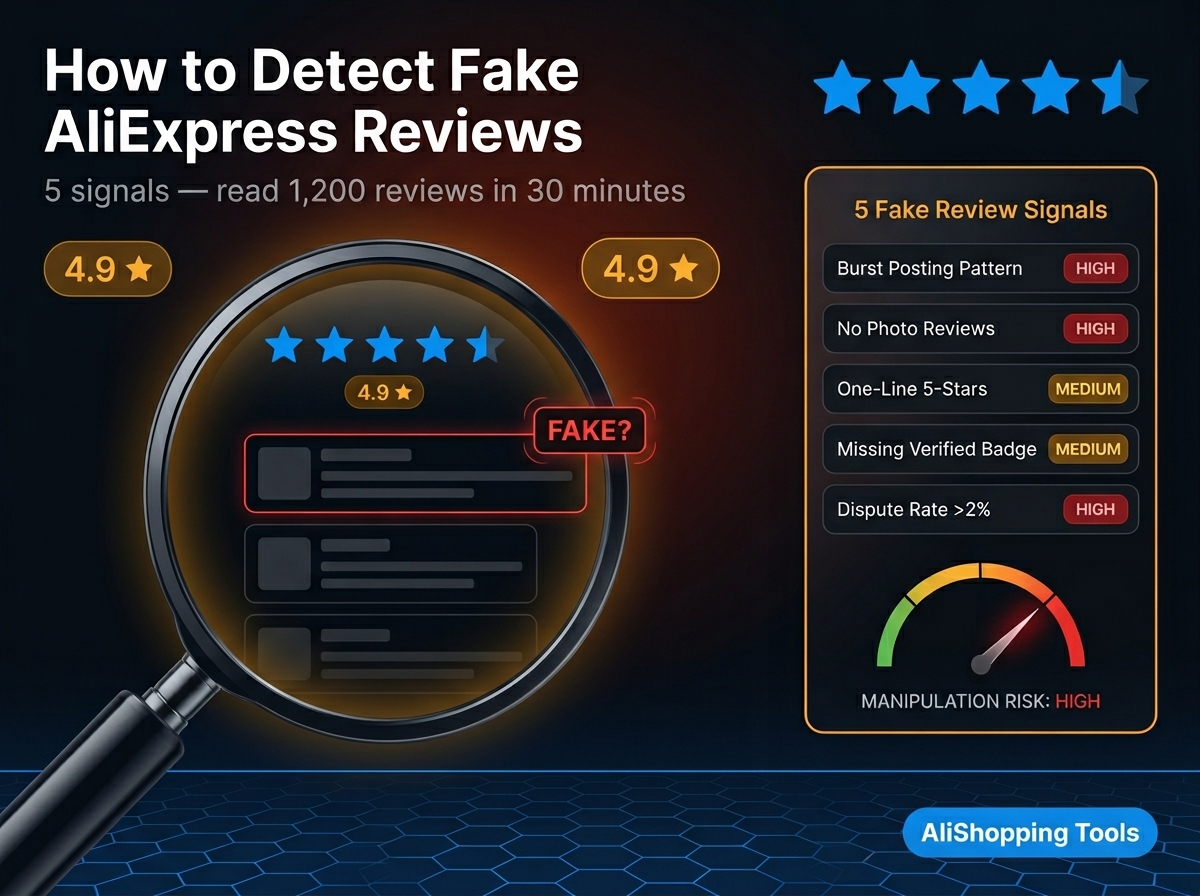
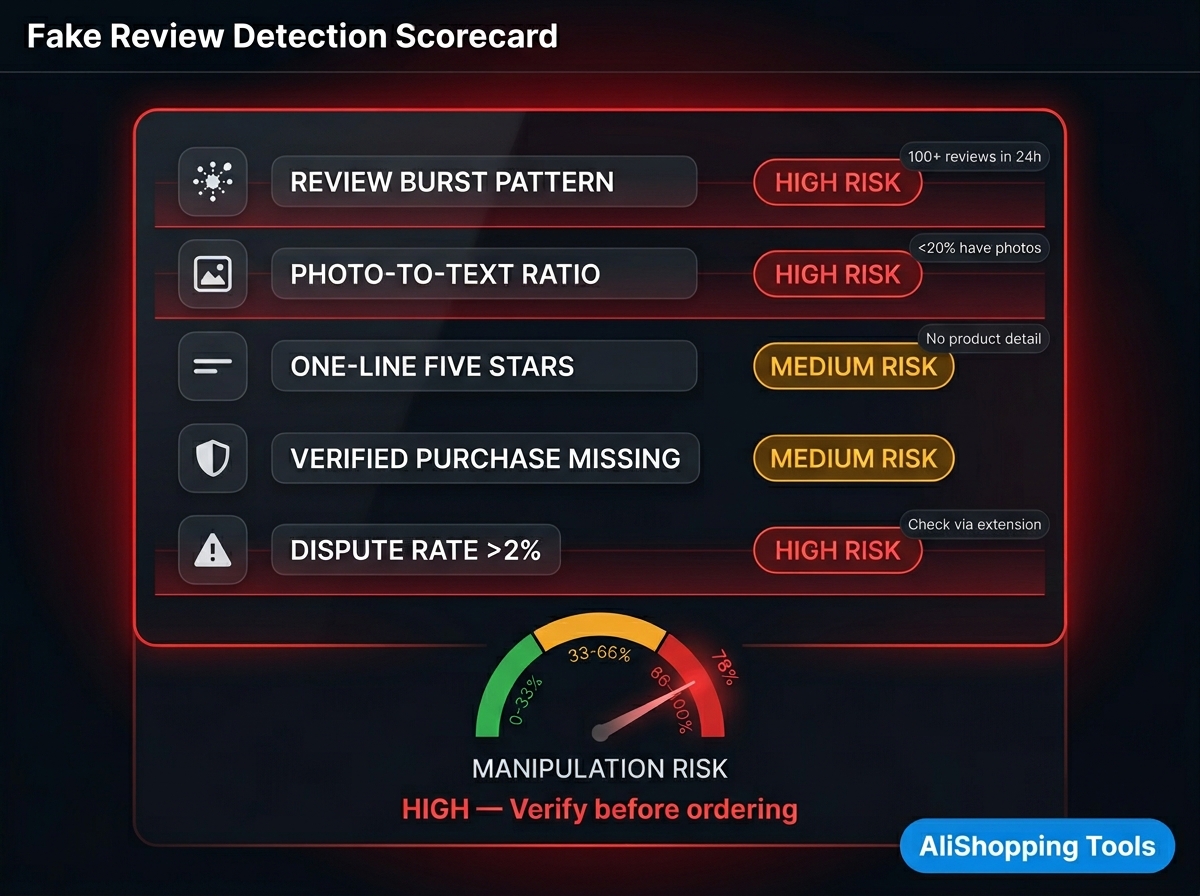
Quick answer: To detect fake AliExpress reviews, check 5 signals:
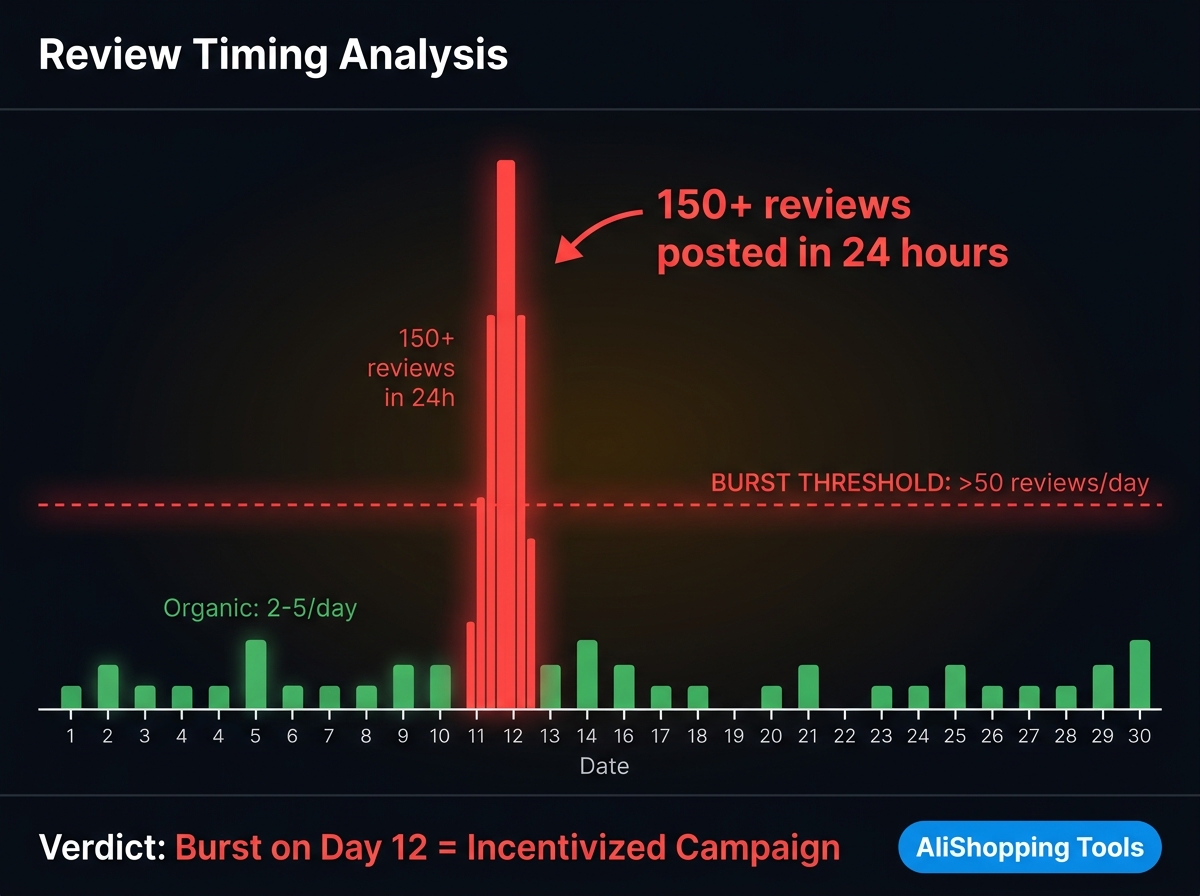
- 1timing clusters — 100+ reviews arriving in 24 hours signals paid incentives,
- 2photo-to-text ratio — authentic reviews have 40%+ with photos,
- 3one-line 5-star reviews with no content,
- 4missing verified purchase badges on bulk 5-star reviews, and
- 5supplier dispute rate above 2% via AliShopping Tools — a reliable signal that overrides any star rating.
A 4.8-star AliExpress product with 3,000 reviews is not automatically safe. Many AliExpress review sections contain incentivized, copied, or manufactured ratings. Here is how to read reviews accurately and identify the signals that separate real feedback from inflated scores.
Install AliShopping Tools — supplier risk score without manual review reading →
Why star ratings alone mislead you
AliExpress star ratings are an aggregate. They cannot tell you:
- Whether the current product batch matches older reviews
- Whether the supplier offered discounts or gifts for 5-star reviews
- Whether the recent review velocity is organic or purchased
- Whether the dispute rate (buyers who raised formal complaints) contradicts the star count
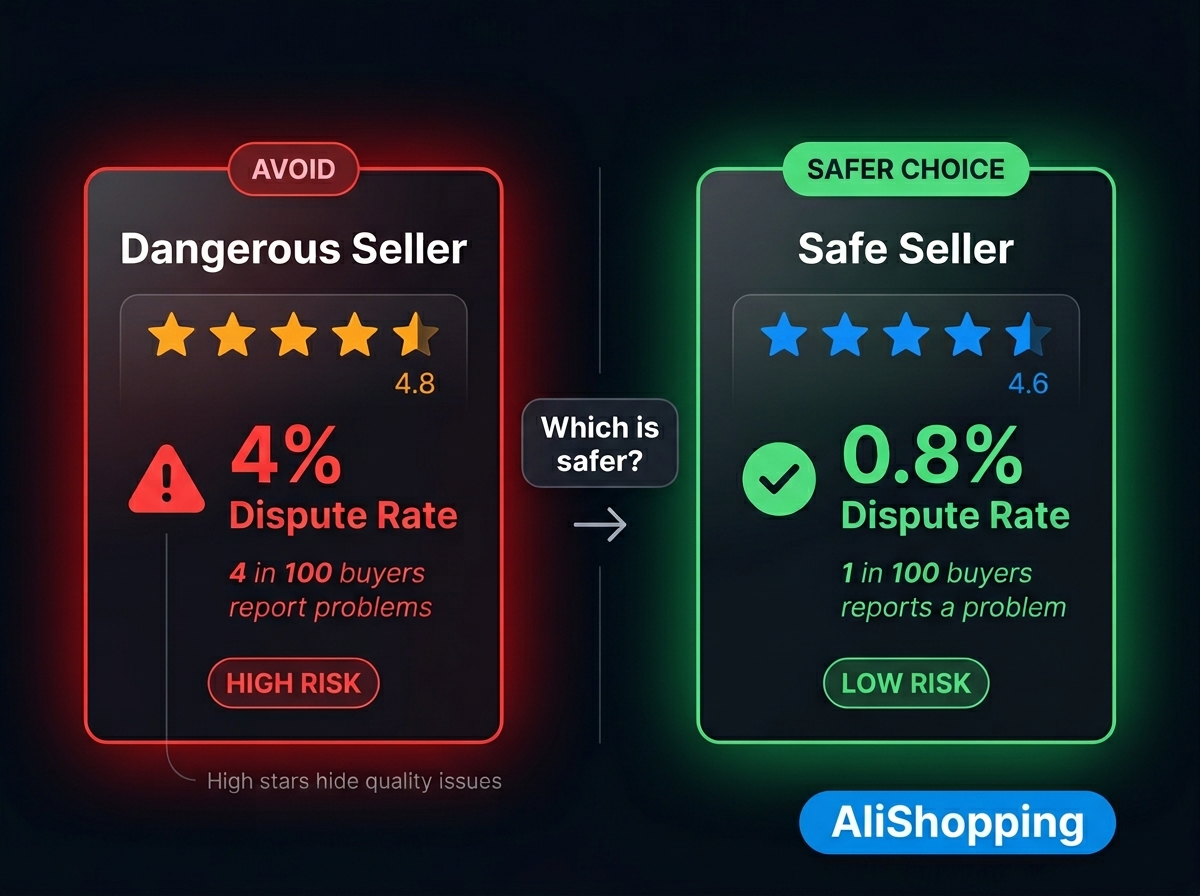
A supplier with 4.9 stars and 6% dispute rate has a structural quality or fulfilment problem that reviews are covering up.
The 5-signal fake review detection method
Signal 1 — Review timing clusters
Sort reviews by newest first. Look at the posting dates.
Normal pattern: 2-15 reviews per week, spread across days.
Fake pattern: 50-200 reviews within 24-48 hours, then silence.
This timing cluster indicates a paid review campaign — the seller offered a discount or refund in exchange for reviews within a specific window. The reviews themselves may describe real products but the incentive structure means negative experiences were systematically excluded.
How to check: AliExpress shows review dates in the review list. Sort by newest and scan the date column for clustering.
Signal 2 — Photo-to-text ratio
Normal pattern: 35-55% of reviews include a photo. Photos show the product as received, not the stock image.
Fake pattern: Under 15% photo rate combined with high star count. Or photo rate suddenly drops in recent reviews while it was high in older ones.
Real buyers who care enough to leave a review usually photograph the product. Incentivized reviewers writing quickly often skip photos — or submit the same stock photo repeated.
Red flag: A product with 2,000 reviews but fewer than 50 photos. At 4.8 stars, that is statistically unlikely for an organic review pool.
Signal 3 — One-line 5-star reviews with no content
Read the top 20 most recent reviews. Flag any that are:
- "Good product" with no detail
- "Fast shipping" and nothing else
- Emoji-only reviews (⭐⭐⭐⭐⭐)
- Identical or near-identical wording across multiple reviews from different buyers
Genuine reviews describe specific product attributes, mention the colour/size variant received, compare to expectations, or note shipping experience with specific timeframes.
Threshold: If more than 40% of recent reviews have under 10 words and give 5 stars, the review pool is inflated.
Signal 4 — Verified purchase badge and review age mismatch
AliExpress shows a verified purchase indicator on genuine reviews (the buyer's order was confirmed). Some review manipulation methods use accounts that place and immediately refund orders to generate verified reviews without actual receipt of the product.
Cross-check: Is the reviewer's account newly created (profile registration date visible on some regional AliExpress versions)? Clusters of reviews from accounts all registered within a short window before the review = coordinated campaign.
Signal 5 — Dispute rate vs. star rating mismatch (the most reliable signal)
This is the most actionable signal and the hardest to fake.
Dispute rate = the percentage of orders where the buyer raised a formal AliExpress dispute (Item Not as Described, Not Received, Quality Issue). Disputes trigger AliExpress buyer protection and are tracked separately from star ratings.
Why it matters: A buyer who posts a 3-star review is visible. A buyer who gets a discount in exchange for not escalating and posts 5 stars instead is invisible in the rating — but the underlying quality issue shows up in dispute rate.
| Dispute Rate | Risk Level | What to do |
|---|---|---|
| Under 1% | Low | Good supplier — proceed |
| 1-2% | Acceptable | Acceptable — check other signals |
| 2-5% | High | Structural quality or fulfilment issue — find alternative supplier |
| Over 5% | Very High | Avoid regardless of star rating |
AliShopping Tools shows dispute rate directly in the Supplier Risk tab without requiring manual calculation. You see it in 5 seconds vs. the manual method of calculating disputes from review text patterns.
Reading negative reviews correctly
Negative reviews (1-3 star) contain the most useful information but require interpretation:
Useful negatives: "Item arrived broken," "colour different from photo," "size runs small — order 1 size up," "shipping took 6 weeks not 2-3."
Less useful negatives: "Shipping was slow" (may be carrier, not supplier), "I ordered wrong size" (buyer error), "Customs held it" (country-specific, not supplier).
Pattern to find: If 3+ negative reviews mention the same specific defect (e.g., "clasp breaks within 2 weeks," "stitching comes apart"), this is a product quality signal that affects your customer service burden — regardless of the overall star count.
The 30-minute review analysis workflow
For any product you are seriously considering:
- Sort by newest — scan dates for clusters (2 min)
- Check photo count — total reviews vs photos ratio (1 min)
- Read top 20 recent — flag one-liners, flag identical phrasing (5 min)
- Read 20 negative reviews — identify recurring specific defects (10 min)
- Open AliShopping Tools Supplier Risk tab — check dispute rate (30 sec)
- Decision: if dispute rate under 2% AND no recurring specific defects in negatives = acceptable supplier
Total: 18-20 minutes for thorough analysis. Under 5 minutes if using AliShopping Tools for the dispute rate check (replaces steps 1-4 for experienced operators who trust the composite signal).
What the dispute rate catches that reviews miss
Scenario: Supplier has 4.8 stars (12,000 reviews) but 3.8% dispute rate.
Explanation: The seller ran a post-purchase discount campaign. Buyers who accepted the $2 partial refund for a minor defect posted 5-star reviews. Buyers with serious defects opened disputes instead of reviews. The 3.8% dispute rate represents 456 formal complaints on 12,000 orders — a real operational problem the star rating hides.
Scenario: Supplier has 4.5 stars (800 reviews) but 0.6% dispute rate.
Explanation: Lower star count because the seller did not run incentive campaigns. Customers posted honest 4-5 star reviews without prompting. 0.6% dispute rate means structural quality is sound. This supplier is lower risk than the 4.8-star alternative above.
Always weight dispute rate above star rating for sourcing decisions.
FAQ
How can you tell if AliExpress reviews are fake?
Look for:
- 1review timing clusters — dozens of reviews within 24-48 hours,
- 2photo rate under 15% on a high-review-count product,
- 3one-line "good product" reviews with no content at 5 stars,
- 4a high star rating combined with a dispute rate above 2%. Dispute rate is the hardest signal to fake and the most reliable.
What is a good AliExpress supplier dispute rate?
Under 2% is acceptable. Under 1% is good. Above 2% indicates a structural quality or fulfilment issue that will affect your customer service load and return rate. AliShopping Tools shows dispute rate on the Supplier Risk tab without manual research.
Should I trust AliExpress reviews for dropshipping?
Partially. AliExpress reviews reflect buyer experience but are subject to incentive campaigns. Star ratings alone are unreliable. Read negative reviews for specific recurring defects, check photo rate for authenticity signals, and cross-check with dispute rate (visible via AliShopping Tools) for the most accurate supplier quality picture.
How many reviews should an AliExpress product have before I source it?
For lower-risk sourcing: at least 50 reviews with photos. Dispute rate matters more than review count — a 200-review supplier with 0.5% dispute rate is safer than a 5,000-review supplier with 4% dispute rate.
Published by the AliShopping Tools team. Dispute rate thresholds based on observable AliExpress data patterns. May 2026.
Ready to find winning products?
Try AliShopping Tools — 15 free AI tools for product research.
Quick answers
Frequently Asked Questions
1How do I read AliExpress reviews to detect fakes?
Use 5 signals: review timing clusters (100 or more reviews in 24 hours suggests paid incentive), photo-to-text ratio (real reviews have 40 percent or more photo reviews), one-line 5-star reviews with no content, missing verified purchase badge on bulk 5-star reviews, and supplier dispute rate via AliShopping Tools above 2 percent indicating structural quality issues.
2Is a 4.8 AliExpress rating trustworthy?
Not by itself.
A supplier with 4.8 stars but 4 percent dispute rate is more dangerous than one with 4.6 stars and 0.8 percent dispute rate.
Rating can be inflated through incentivized reviews.
Always cross-reference rating with dispute rate.
High rating plus high dispute rate is a red flag combination indicating review manipulation coexisting with real quality problems.
3What does a healthy AliExpress review profile look like?
Healthy review profiles have: gradual review accumulation over time (not burst posting), a natural rating distribution (mostly 4 and 5 stars with some 3-star feedback), 30 to 50 percent photo reviews, country distribution matching the seller's primary shipping destinations, and varied review language and content rather than template phrasing.
4What tool helps analyze AliExpress reviews for fakes automatically?
AliShopping Tools Reviews tab automatically applies fake-detection analysis to any AliExpress listing's review section.
It surfaces posting date patterns, country distribution, photo review ratio, and rating distribution in one view — replacing manual review-by-review reading with an automated pattern detection check.
More from the blog
AliExpress Vacation Sale July 2026 Promo Codes — Up to 80% OFF + How to Apply
Every active AliExpress promo code for July 2026 — Vacation Sale codes by country and how to apply them at checkout.
3 min read
PDRN Collagen Skincare Dupes: 10 Real AliExpress Alternatives to TikTok Shop's #1 K-Beauty Trend (July 2026)
PDRN/collagen K-beauty is #1 on TikTok Shop US. 10 real AliExpress dupes — verified prices, sold counts, honest gaps.
14 min read
How to Use AStools Deals After You Sign Up: Full Guide
A complete walkthrough of your AStools Deals account after signing up — watchlist, collections, price alerts, profit simulator, and AliExpress connection.
8 min read