How to Check Any AliExpress Supplier's Reliability (60 Seconds)
How to Check Any AliExpress Supplier's Reliability in 60 Seconds
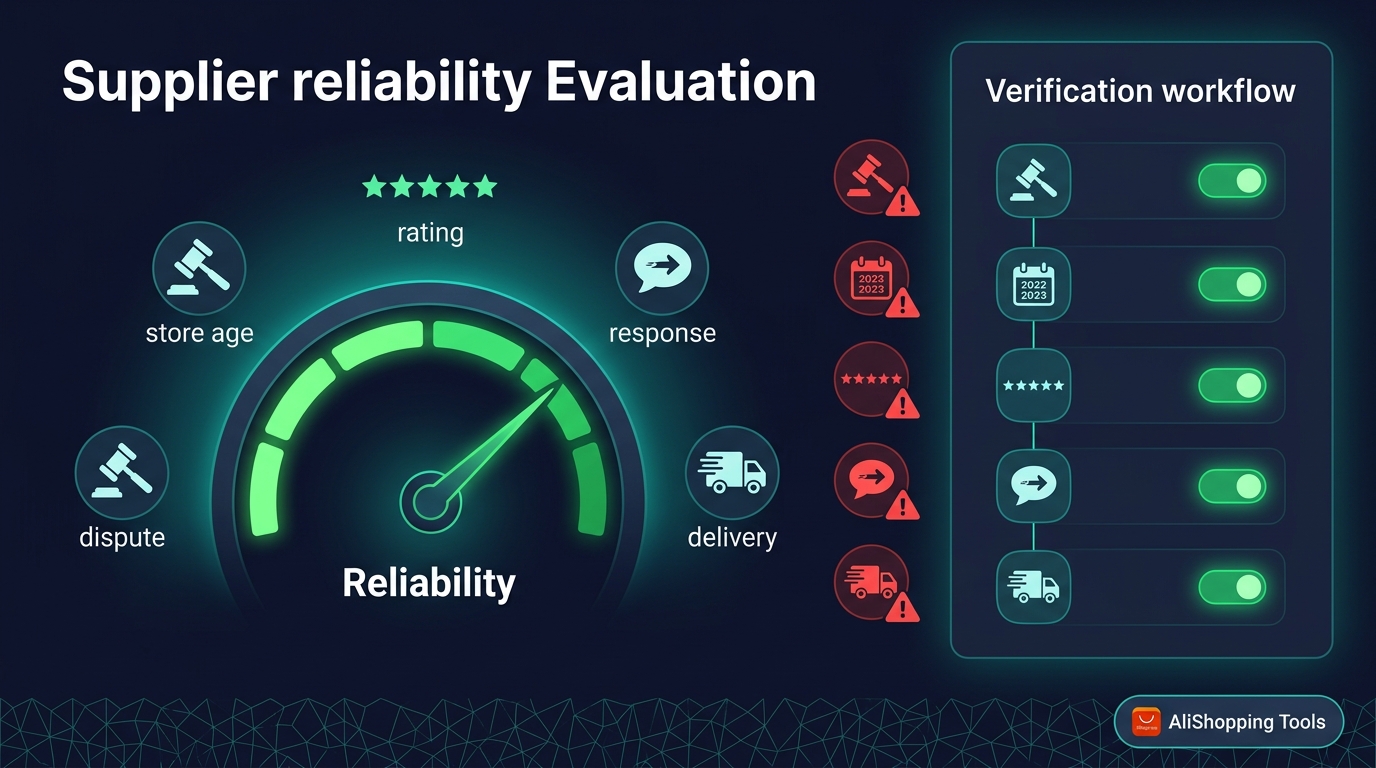
Quick answer: Check AliExpress supplier reliability in 60 seconds using five signals: dispute rate under 2%, store age of 2+ years, overall rating of 4.7+ with a natural review distribution (not suspiciously close to 100% five-star), response rate above 90%, and consistent positive feedback specifically mentioning shipping speed and packaging quality.
Supplier reliability is the most underrated factor in dropshipping success. A product that converts well with a supplier who ships late, damages products, or makes buyers file disputes will destroy your store's reputation faster than any marketing can fix it.
Install AliShopping Tools — supplier reliability check on every AliExpress product →
Here is the 60-second supplier reliability check using 5 signals.
The 5 reliability signals
Signal 1 — Dispute rate (most important)
Where to find it: Scroll to the bottom of any AliExpress product page or seller profile. Look for "Dispute Rate" percentage.
What it means: The percentage of orders that resulted in a formal buyer dispute (a complaint escalated beyond just a message to the seller). This reflects real, documented dissatisfaction — not just unhappy buyers who moved on.
| Dispute rate | Interpretation |
|---|---|
| Under 1% | Excellent — strong reliability |
| 1-2% | Good — acceptable for most categories |
| 2-5% | Caution — investigate before sourcing |
| Over 5% | Avoid — significant reliability problem |
AliShopping Tools shortcut: The Supplier Risk tab shows dispute rate automatically — no need to scroll the page manually.
Signal 2 — Store age
Where to find it: Seller profile page — "Opened [date]"
Why it matters: Established stores (2+ years) have survived AliExpress's enforcement actions and have reputation capital to protect. Newer stores (under 1 year) have no track record and lower accountability — they can close and reopen under a new name easily.
| Store age | Reliability signal |
|---|---|
| Under 6 months | High risk — no track record |
| 6 months - 1 year | Moderate risk — limited history |
| 1-3 years | Acceptable |
| 3+ years | Low risk — established operator |
Signal 3 — Rating quality (not just quantity)
What to check: Overall product rating AND the distribution of ratings.
Key insight: A 4.8-star rating from 500 reviews with 78% 5-star, 12% 4-star, 5% 3-star, 3% 2-star, 2% 1-star is more trustworthy than a 4.9-star rating from 200 reviews with 99% 5-star and 0 three-star reviews.
Near-perfect distributions are a signal of review manipulation (incentivized reviews). Real customer bases always include some disappointed buyers.
Target: 4.7+ rating with a natural distribution that includes 5-10% of reviews at 3 stars or below.
Signal 4 — Response rate and time
Where to find it: Seller profile shows response rate percentage and average response time.
Why it matters for dropshipping: When your customer has an issue, you contact the supplier. If the supplier takes 3 days to respond, your customer is waiting. A supplier with 95%+ response rate and under 24-hour response time dramatically reduces your customer service burden.
| Response rate | Interpretation |
|---|---|
| 95%+ | Excellent |
| 85-94% | Good |
| Under 85% | Risk — will be hard to reach when problems arise |
Signal 5 — Shipping consistency in reviews
How to check: Filter reviews by "Has Photos" and look at reviews that mention shipping time specifically. Read 3-star reviews — they are most candid about shipping experience.
Red flags:
- Multiple reviews mentioning "package arrived broken"
- Consistent complaints about shipping taking twice the estimated time
- Reviews mentioning wrong item shipped, missing items, or empty packages
Green flags:
- Buyers mentioning shipping was faster than expected
- Photo reviews showing product in good condition on arrival
- No pattern of shipping complaints across multiple buyers
The 60-second check workflow
- Open the AliExpress product page
- Open AliShopping Tools → Supplier Risk tab (shows dispute rate + rating data instantly)
- Click through to the seller profile: check store age and response rate
- Read the 10 most recent reviews filtered by "Lowest Rating" for unfiltered quality signals
- Decision: dispute rate under 2% + store 2+ years + rating 4.7+ natural distribution + response rate 90%+ = reliable supplier
When to test despite a mixed signal
A supplier with a 2.5% dispute rate might still be worth testing if:
- The dispute category is "late shipping" (which you can disclose to customers) rather than "item not as described" (quality problem)
- The store is established (3+ years) with high volume — 2.5% of 10,000 orders means 250 disputes, but 97.5% of 10,000 buyers were satisfied
- There is no alternative supplier for this specific product at acceptable quality
Always order a test unit before committing to a supplier for regular fulfilment.
FAQ
What is a good dispute rate on AliExpress?
Under 2% is good for most product categories. Electronics can tolerate up to 3% given complexity. Fashion/apparel with inherent sizing issues is higher — evaluate the specific reason for disputes, not just the percentage.
How do I find a supplier's dispute rate on AliExpress?
Scroll to the bottom of the seller's store page or the product page for "Item Dispute Rate" or "Dispute Rate." AliShopping Tools shows this automatically in the Supplier Risk tab on any product page.
How do I find reliable AliExpress suppliers?
Start with the 5-signal check above. For dropshipping, also check whether the supplier has dropshipping-specific experience (some listings mention dropshipping services, blind shipping, or custom packaging options). Reliable dropshipping suppliers offer blind shipping (no AliExpress branding on the package).
Can I trust AliExpress dispute rates?
The dispute rate reflects formal escalations — cases where the buyer chose to open an official dispute rather than accepting the seller's resolution or giving up. It understates total unhappiness (some dissatisfied buyers do not dispute) but is still the most reliable public quality signal available.
Based on publicly observable AliExpress marketplace data and seller profile information as of May 2026.
AliShopping Tools
See live AliExpress data in your browser.
Seller trust score, 90-day price history, and live promo codes — on every AliExpress product page. No account, free.
Ready to find winning products?
Try AliShopping Tools — 15 free AI tools for product research.
Quick answers
Frequently Asked Questions
1How do I check AliExpress supplier reliability in 60 seconds?
Check 5 signals: product dispute rate under 2%, store age of 2 or more years, rating 4.7 or above with some 3 and 4 star reviews (not suspicious near-100% 5-star), response rate above 90%, and positive shipping consistency comments in recent reviews.
AliShopping Tools automates these checks on any AliExpress product page.
2What is the AliExpress dispute rate and why does it matter?
The dispute rate shows what percentage of orders resulted in a formal dispute filed by buyers.
A rate above 2% indicates systematic problems with product quality, shipping, or misrepresentation.
For dropshippers, high supplier dispute rates translate directly into customer service costs, refunds, and negative reviews on your own store.
3How old should an AliExpress store be before I trust them as a supplier?
Prefer suppliers whose stores have been open at least 2 years.
New stores (under 6 months) lack track records and can disappear.
Stores between 6 months and 2 years need extra vetting.
Multi-year stores with stable ratings are the safest sourcing choice, especially for products you plan to sell at volume.
4Can I automate AliExpress supplier reliability checks?
AliShopping Tools automates the supplier risk check on any AliExpress product page — dispute rate, store age, risk score, and multiple red flags surface in the Risk tab without manual calculation.
This reduces the time to vet a supplier from several minutes of manual checking to under 30 seconds.
5What does shipping consistency mean on AliExpress and what threshold should I look for?
Shipping consistency is roughly the share of orders that arrive within the seller's stated delivery window.
A quick manual check: scroll to the product page's shipping section and skim the most recent reviews for "arrived on time" vs.
"late" mentions — a supplier where recent complaints about lateness are rare is a safer bet than one where they're common.
AliShopping Tools surfaces shipping-related signals as part of the Risk tab, saving you from digging through reviews one by one.
6Why should a supplier have a few 3‑star and 4‑star reviews, and how many is acceptable?
A healthy supplier usually has a mix of star ratings rather than an almost-perfect 5-star wall — a handful of honest 3- and 4-star reviews (mentioning minor issues but still net-positive) is a good sign that the reviews are real, not manufactured.
A near-100% 5-star profile with barely any 3-4 star reviews is itself a mild red flag worth a second look.
AliShopping Tools' Risk tab flags suspiciously one-sided rating distributions as part of its checks.
7How fast should a supplier reply to messages, and does response speed impact order safety?
Faster, more responsive sellers tend to correlate with fewer shipping and spec misunderstandings, since quick replies mean questions about product details, shipping options, or customs paperwork get resolved before they become order problems.
AliExpress surfaces a general response-rate/response-time indicator on many seller storefronts — a seller who replies quickly and consistently is a better bet for a smooth order than one with a spotty response history.
8If a supplier fails one of the five reliability signals, is it still safe to place a small test order?
A single failed signal doesn't automatically disqualify a supplier — treat it as a risk factor and limit your first exposure with a small test order rather than placing a bulk order right away.
If the other four signals (store age, rating quality, response rate, shipping consistency) look strong, a borderline dispute rate is often still an acceptable risk for a modest test batch.
Document how the test order goes, and only scale up once the product and supplier both check out.
More from the blog
AliExpress Vacation Sale July 2026 Promo Codes — Up to 80% OFF + How to Apply
Every active AliExpress promo code for July 2026 — Vacation Sale codes by country and how to apply them at checkout.
3 min read
PDRN Collagen Skincare Dupes: 10 Real AliExpress Alternatives to TikTok Shop's #1 K-Beauty Trend (July 2026)
PDRN/collagen K-beauty is #1 on TikTok Shop US. 10 real AliExpress dupes — verified prices, sold counts, honest gaps.
14 min read
How to Use AStools Deals After You Sign Up: Full Guide
A complete walkthrough of your AStools Deals account after signing up — watchlist, collections, price alerts, profit simulator, and AliExpress connection.
8 min read