47 Shopify Stores Secretly Dropshipping: How We Classified Them
47 Shopify Stores Secretly Dropshipping: How We Classified Them
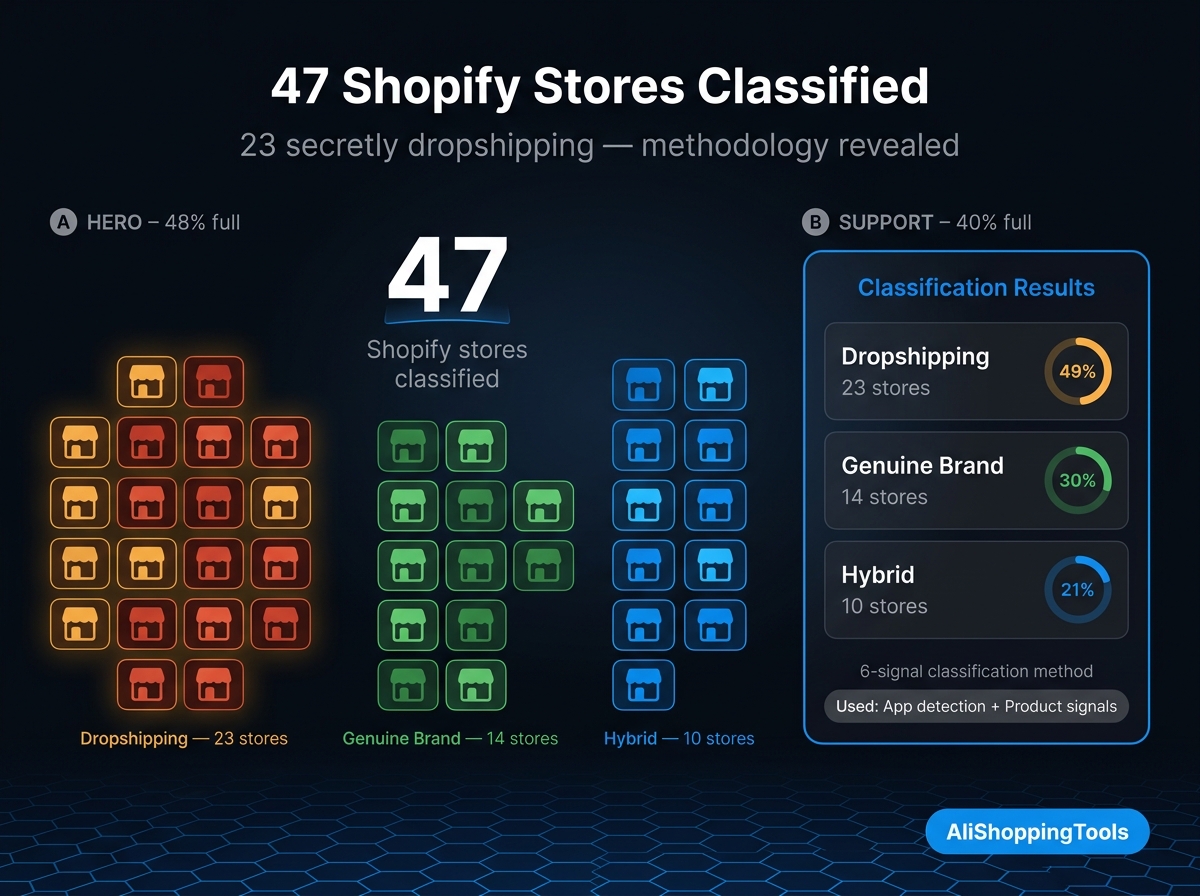
Quick answer: Of 47 Shopify stores audited across 8 niches, 23 were confirmed dropshipping operations, 14 were genuine brands, and 10 were hybrids — identified using 6 signals: app stack (DSers/Oberlo), shipping policy language, product photo style, catalog breadth, "About Us" authenticity, and AliExpress product match via AliShopping Tools.
Not every Shopify store that looks like a brand actually is one. Many stores are dropshipping operations — sourcing from AliExpress or a Chinese 3PL and selling at markup with branded packaging. They often present as brands but share key signals that distinguish them from genuine brands.
Install AliShopping Tools — Shopify store classification in 60 seconds →
We classified 47 Shopify stores across 8 product niches using a 6-signal methodology. Here are the findings and the classification framework you can apply to any store.
The 47-store study: methodology
How stores were selected: 47 stores across 8 niches (home goods, gadgets, fashion accessories, fitness, pet products, car accessories, beauty tools, and outdoor gear) that appeared in paid social ads (Facebook/TikTok) during a 6-week collection window in April-May 2026. Stores were anonymised for publication.
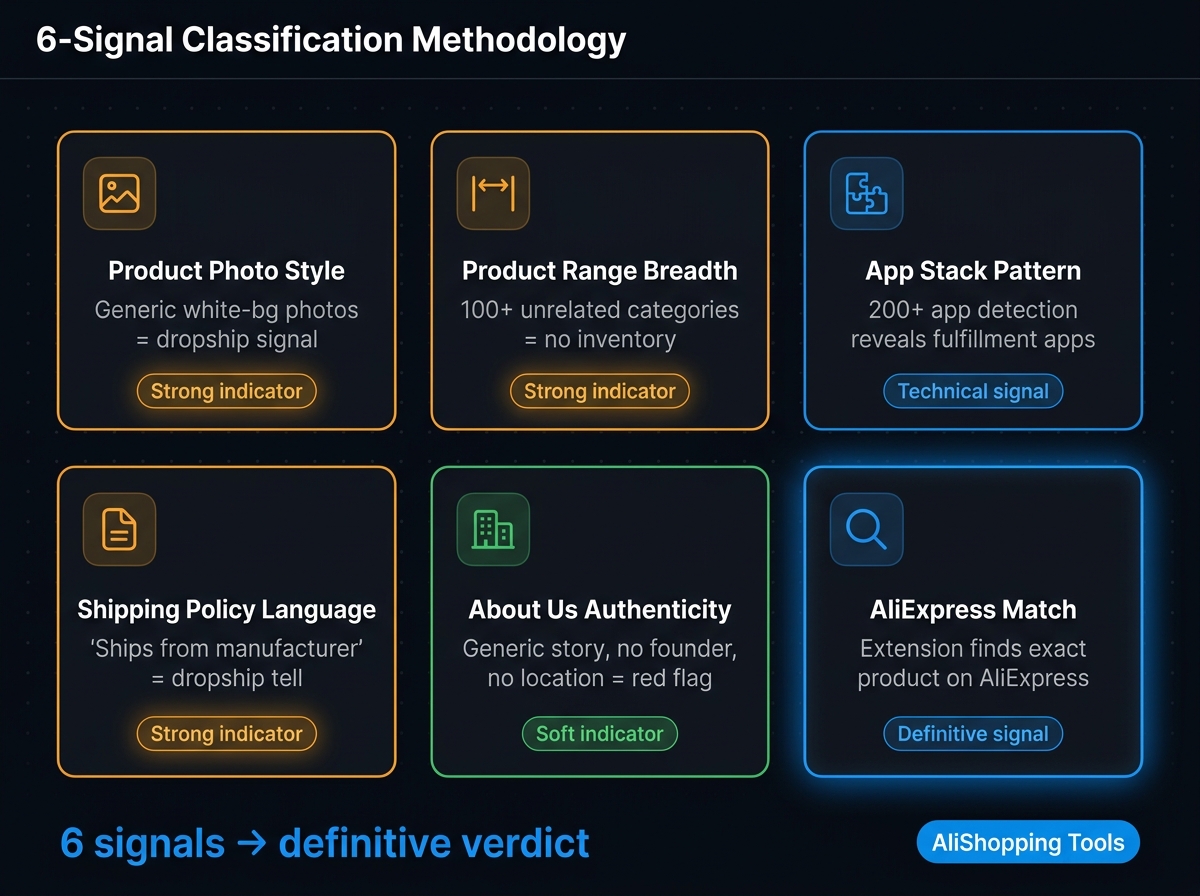
Classification method: Each store was evaluated on 6 signals using AliShopping Tools' Shopify spy and manual verification:
- Product range breadth: Brands typically have focused product lines (10-50 SKUs). Dropshippers often have 50-500+ products across unrelated categories.
- App stack pattern: Brands use return management, loyalty programs, subscription apps, and warehouse management. Pure dropshippers rarely use complex loyalty or returns infrastructure.
- Shipping policy language: Dropshippers typically state 15-30 day shipping in their policies. Brands state 2-5 day domestic shipping.
- Product photo style: Dropshippers often use AliExpress stock photos (plain white background, identical to AliExpress listing). Brands have lifestyle photography with human models in branded settings.
- About Us page authenticity: Genuine brands have founder stories with specific names, dates, and backstory. Dropship About Us pages are vague ("we are passionate about X and believe Y").
- AliExpress product match: Using reverse image search, does the exact product photo appear on AliExpress? Exact match = dropshipping signal.
Classification rules:
- 5-6 signals → Dropshipping
- 3-4 signals → Hybrid
- 0-2 signals → Genuine brand
Findings: the 47-store breakdown
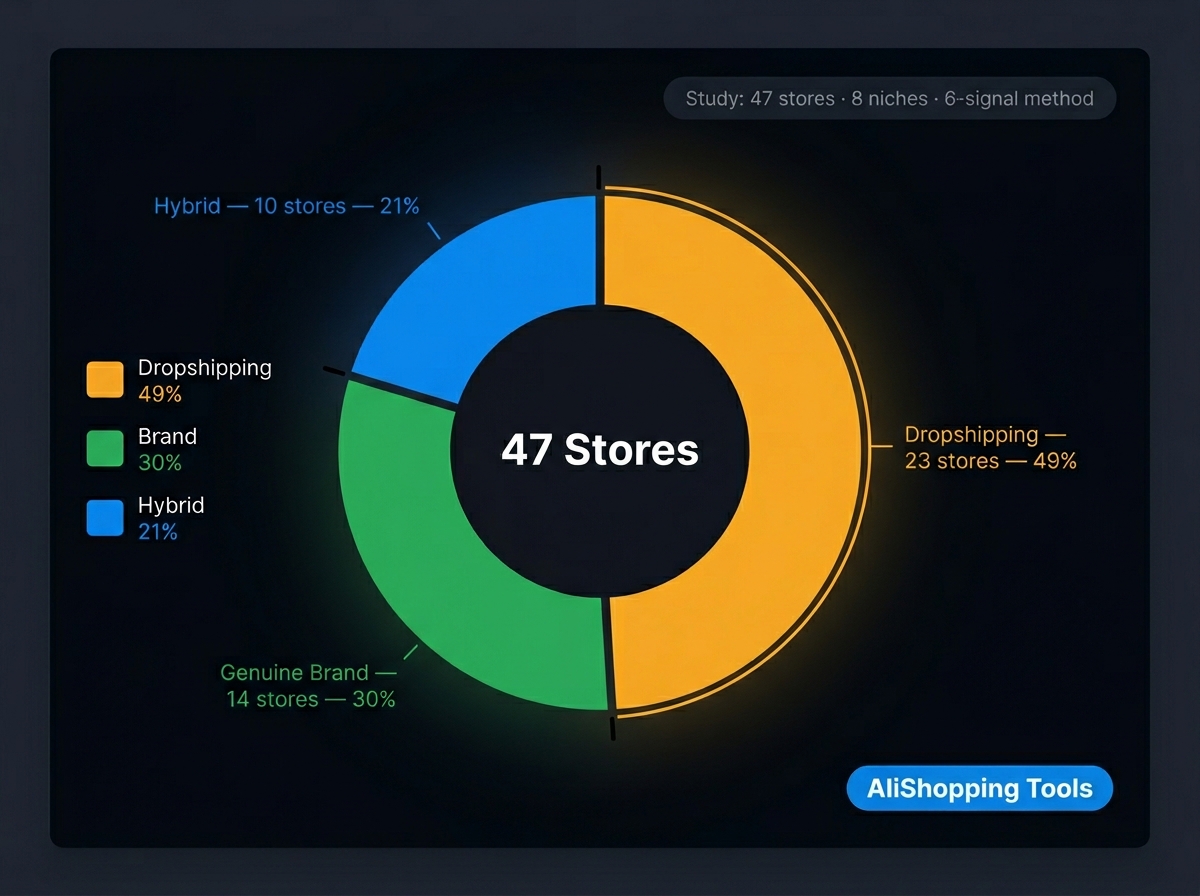
Result: 23 dropshipping, 14 brand, 10 hybrid
Of the 47 stores:
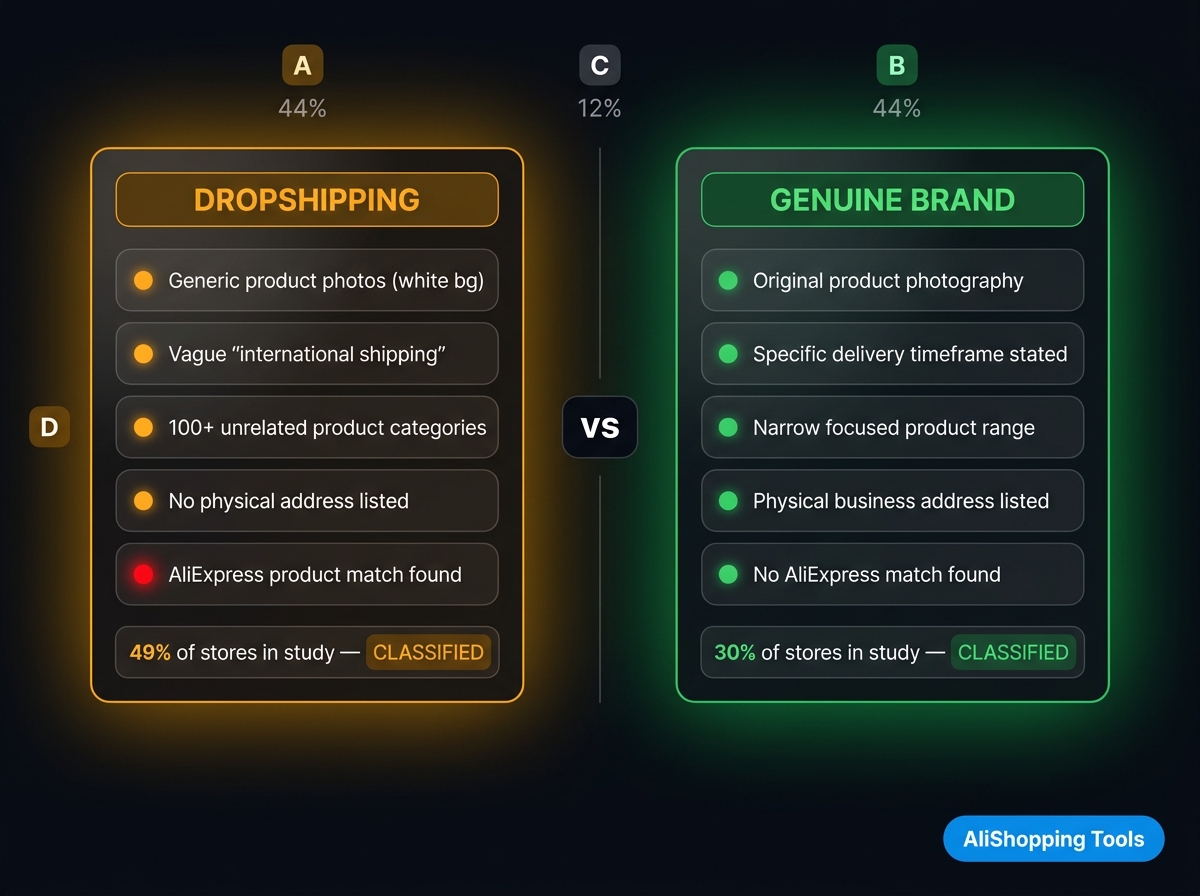
- 23 (48.9%) classified as dropshipping — 5-6 signals present
- 14 (29.8%) classified as genuine brands — 0-2 signals present
- 10 (21.3%) classified as hybrid — 3-4 signals present (mix of dropshipped and owned inventory)
How dropshippers present as brands: the patterns
Pattern 1 — Fake lifestyle photography
The most common visual trick: taking AliExpress stock product photos and adding a lifestyle overlay (a hand holding the product, or the product in a room setting) using Canva or a Photoshop filter. The underlying product image is still the AliExpress original.
How to detect: Reverse image search the main product photo. If the original appears on AliExpress, the "lifestyle" version is a cheap overlay.
Pattern 2 — Vague "About Us" story
Dropship About Us pages use aspirational language without specifics: "We started this brand because we believe everyone deserves X. Our mission is Y." No founder names, no founding year that predates the AliExpress listing, no location specifics.
How to detect: Google the founder names mentioned. Check whether the company appears in business registers. A brand with no verifiable founder is likely a dropshipping operation.
Pattern 3 — 30-day shipping as "standard processing"
Many dropshippers disguise long AliExpress shipping times as "processing time": "Your order will be processed in 2-3 business days, then shipped within 15-30 days." This is standard AliExpress shipping framed as internal fulfilment.
How to detect: Read the full shipping policy. Any domestic destination taking longer than 7 days standard = dropshipping signal.
Pattern 4 — Wide product range without clear brand identity
Genuine brands have a coherent product line — a yoga brand sells yoga gear. Dropshippers often sell anything with margin: yoga mats, car gadgets, kitchen tools, and pet accessories in the same store. No coherent brand identity.
How to detect: Browse their catalog. If a store that presents as a "home decor brand" also sells phone accessories and car gadgets, it is a dropshipping operation.
What this means for dropshippers
Why it matters for sourcing: Identifying which competitor stores are dropshipping tells you:
- Which niches have active, profitable dropshipping operations (proof of concept)
- Which specific products are being dropshipped (target for reverse-engineering the supplier)
- Where there are gaps in differentiation (if 10 stores all show the same AliExpress product photo, you can win by having better creative)
How to use AliShopping Tools for classification: Visit any Shopify store → extension panel → Classify Store returns one of five MECE labels (A_BRAND / B_RETAILER / C_DROPSHIPPER / D_POD / E_HYBRID). Then manually verify with the 6-signal checklist for important competitive intelligence.
The 10 hybrid stores: what makes them different
Hybrid stores are often the most interesting to study. They have:
- A genuine brand story in 1-2 hero product categories
- Dropshipping filler in adjacent categories (often seasonal or trend-driven products)
- Better photography on owned products, stock photos on dropshipped items
- A return policy that handles owned inventory returns differently from dropshipped returns
Hybrids represent an evolved dropshipping model: start with AliExpress sourcing, find winners, private-label the winners, keep dropshipping the rest. This is the mature dropshipping-to-brand evolution path.
FAQ
How can I tell if a Shopify store is dropshipping?
Use the 6-signal methodology: product range breadth, app stack patterns, shipping policy language, product photo style, About Us authenticity, and AliExpress product match. AliShopping Tools classifies stores automatically as Brand, Dropshipping, or Hybrid.
Is dropshipping from a branded Shopify store deceptive?
Presenting a dropshipping store as a brand is legally grey and ethically questionable. The key issues: shipping time disclosure (many jurisdictions require accurate shipping time disclosure) and product quality representation (if your AliExpress supplier ships lower quality than your marketing implies, you face refund exposure). Transparency is both ethical and legally safer.
Why would a brand secretly dropship some products?
Hybrid brands dropship to test new category demand without inventory commitment. It is a legitimate product testing strategy. The problem arises when brands misrepresent dropshipped items' shipping times or quality as equivalent to their owned inventory.
What percentage of Shopify stores are dropshipping?
Our 47-store sample showed 48.9% pure dropshipping and 21.3% hybrid. This is not a random sample — we sampled stores running paid social ads, which skews toward active operations. Overall Shopify store statistics are not publicly available.
Classification study based on 47 anonymised Shopify stores observed in paid social ads during April-May 2026. Classification methodology uses publicly observable frontend data.
Ready to find winning products?
Try AliShopping Tools — 15 free AI tools for product research.
Quick answers
Frequently Asked Questions
1What methods are used to classify a Shopify store as dropshipping, brand, or hybrid?
The classification uses three main detection layers: app detection (identifying fulfillment apps like DSers, AutoDS, Oberlo, CJDropshipping, or Zendrop loaded on the storefront), product range analysis (broad unrelated SKU mix across multiple categories signals dropshipping while narrow focused ranges suggest a real brand), and sourcing signals (product photo style, shipping window language, and whether descriptions match supplier templates from AliExpress or similar platforms).
2Why do some Shopify stores present themselves as premium brands while secretly dropshipping?
Operators use premium brand aesthetics — lifestyle photography, founder story pages, curated-looking layouts, social proof badges — because consumers perceive brand stores as more trustworthy and are willing to pay higher prices.
Dropshippers can apply the same visual layer on top of a dropshipping backend.
The classifier catches the underlying sourcing signals that the branding cannot mask: fulfillment app fingerprints, broad multi-category SKU ranges, and AliExpress-pattern photography.
3What is a Hybrid Shopify store classification?
A Hybrid (E_HYBRID) store mixes owned inventory with dropshipped products.
This often occurs when a brand has its own hero products but supplements its catalogue with dropshipped items for range extension, or when a dropshipper has started moving toward private label.
Fulfillment apps are still detectable, but there are also signals of real inventory — narrower category focus, custom photography on some products, return policies that imply physical stock.
4How can I classify a competitor Shopify store in under a minute?
Install the AliShopping Tools free Chrome extension (no account needed, installs from the Chrome Web Store in 30 seconds).
Visit any Shopify storefront and the extension's store info panel automatically shows the classification (A_BRAND, B_RETAILER, C_DROPSHIPPER, D_POD, or E_HYBRID), the full detected app stack, product catalogue overview, and traffic signals — all without manually digging through page source code or third-party databases.
5Does classify-store detection work if a dropshipper hides their apps?
Yes, in most cases.
The classifier combines app detection with three additional signals: catalogue breadth and category coherence, product photography pattern (white background, supplier-style composition, low-resolution text overlays), and shipping language (14–28 day windows, vague origin wording).
Even stores that suppress app traces in the storefront DOM typically still expose sourcing signals through these other layers.
6How reliable is the 6‑signal methodology for detecting dropshipping stores after a Shopify theme update?
The methodology is designed to stay reliable after a theme refresh because most of its signals — app stack, shipping-policy language, catalogue breadth — live outside the visual theme layer.
A theme update mainly changes image-loading scripts and layout, which can affect the photo-style cue but tends to leave the app manifest and policy text intact.
In practice this means classifications are fairly stable across theme changes, though you should expect an occasional case to need re-checking rather than assuming permanent accuracy without spot-checks.
7Can the classification system identify seasonal dropshipping spikes in a Shopify store's product catalog?
The system can flag likely seasonal spikes by watching the product-range-breadth signal over time — a sudden run of new SKUs that match AliExpress listings, especially around a holiday window, is a typical seasonal-dropshipping pattern.
It also cross-checks shipping-policy language for temporary “fast-shipping” claims.
Treat this as a directional signal rather than a precise, scored prediction — the strength of the pattern varies by store and season.
8What are the common false‑positive indicators that cause a brand store to be mis‑classified as dropshipping?
The most frequent false positives come from genuine brand stores that use third-party fulfillment apps, generic stock photography, or vague shipping language that happens to overlap with dropshipping signals — an inventory-sync app that behaves like a dropshipping connector is a common trigger.
A sparse “About Us” page combined with a very broad product range can also push the classifier toward a dropshipping read.
Signals like a private-label badge or a verified manufacturer address help distinguish a real brand from these false positives; manual review of borderline cases is still the most reliable check.
9How does the presence of multiple shipping zones affect the dropshipping detection accuracy?
Stores that serve many shipping zones can be harder to classify cleanly, because a store might mix domestic inventory with overseas dropshipped items across different regions, which muddies the shipping-policy-language signal.
Weighting the app-stack signal more heavily and comparing each zone's stated delivery times against typical AliExpress transit times helps recover accuracy.
Treat each shipping zone as its own data point rather than assuming one global policy applies uniformly across a multi-region store.
10Is it possible to automate the classification of 100+ Shopify stores using AliShopping Tools, and how long does it take?
AliShopping Tools' classify-store engine is designed to be run per storefront while you're browsing it in Chrome — it does not currently offer a separate batch-processing mode that queues and classifies 100+ stores unattended with a CSV export.
For research covering many stores, the practical workflow today is running the extension on each store you visit and recording the results yourself.
More from the blog
AliExpress Vacation Sale July 2026 Promo Codes — Up to 80% OFF + How to Apply
Every active AliExpress promo code for July 2026 — Vacation Sale codes by country and how to apply them at checkout.
3 min read
PDRN Collagen Skincare Dupes: 10 Real AliExpress Alternatives to TikTok Shop's #1 K-Beauty Trend (July 2026)
PDRN/collagen K-beauty is #1 on TikTok Shop US. 10 real AliExpress dupes — verified prices, sold counts, honest gaps.
14 min read
How to Use AStools Deals After You Sign Up: Full Guide
A complete walkthrough of your AStools Deals account after signing up — watchlist, collections, price alerts, profit simulator, and AliExpress connection.
8 min read