How to Research Dropshipping Products for Free: A Beginner's Guide (2026)
How to Research Dropshipping Products for Free: A Beginner's Guide (2026)
Quick answer: To research dropshipping products for free in 2026, install AliShopping Tools (free Chrome extension, no account) and browse AliExpress — it instantly shows AI verdict scores, profit calculators, competition saturation, supplier risk flags, and TikTok viral potential for any product. A winning product shows strength across five signals: demand (5,000+ monthly searches), healthy margins (30–50% after all costs), manageable competition, rising trend direction, and a reliable supplier.
Your first winning product is closer than you think — and it costs $0 to find.
If you are new to dropshipping, product research probably feels overwhelming. There are millions of products on AliExpress. YouTube gurus tell you to "find a winning product" but never explain exactly how. Paid tools promise to solve the problem for $30-50/month, but spending money on software before you have made your first sale feels backwards.
Here is the good news: in 2026, you can do professional-grade product research completely for free. This guide walks you through every step — from understanding what makes a product "winning" to finding your first real candidate in under a minute. No paid tools. No guesswork. No experience required.
What Is Product Research (and Why It Matters)?
Product research is the process of evaluating whether a product is worth selling in your dropshipping store. It answers one question: "If I list this product and spend money on ads, will I make a profit?"
This sounds simple, but the answer depends on multiple factors working together. A product can have amazing demand but terrible margins. It can have great margins but so much competition that your ads will cost too much. It can look perfect on paper but come from an unreliable supplier who ships late and damages your store's reputation.
Product research is how you check all of these factors before you commit money to a product. It is the difference between "I spent $200 on ads and made $50 in profit" and "I spent $200 on ads and lost all of it because the product was wrong."
Most failed dropshipping stores fail at product selection, not at marketing or operations. That is why this step matters more than anything else you will learn about dropshipping.
The 5 Signals of a Winning Product
Before we get into the tools and steps, you need to understand what you are looking for. A winning product shows strength across five signals:
1. Demand
People want this product. Not just a few people — enough people that you can profitably reach them with ads. Demand signals include high order volumes, wishlist additions, search volume, and social media buzz.
A product with 50 orders is not a demand signal. A product with 5,000 orders and an upward trajectory is.
2. Margin
You can sell this product at a price that leaves meaningful profit after every cost is subtracted. "Every cost" means the product price, shipping, platform fees, payment processing, estimated ad spend, and a return rate buffer.
Beginners often make the mistake of calculating margin as "selling price minus product price." That ignores 40-60% of your actual costs. A product that looks like it has a 70% margin often has a 15% margin once you include all real expenses — and 15% means one return wipes out the profit from five sales.
Healthy margins for dropshipping are typically 30-50% after all costs. Below 25%, the business model becomes fragile.
3. Competition
The market for this product is not so saturated that you cannot compete. Some competition is actually a good sign — it means the product sells. Too much competition means your ad costs will be high and your price will be driven down.
What you want: moderate competition (not zero, not hundreds of identical stores), a price range that allows healthy margins, and ideally a growing market where there is room for new entrants.
4. Trend Direction
The product is trending upward or stable — not declining. Selling a product whose peak was three months ago means you are fighting a losing battle. Every day, demand drops and competition from clearance pricing increases.
The best scenario is catching a product in its growth phase: demand is increasing, competition has not caught up yet, and the trend has momentum behind it.
5. Quality and Reliability
The supplier is reliable, the product quality is consistent, and shipping times are reasonable. This is the signal most beginners ignore — and it is the one that kills stores.
A product that scores perfectly on demand, margin, competition, and trend will destroy your business if the supplier ships late, sends defective items, or disappears after your first bulk order. Supplier vetting is not optional.
Step-by-Step: Finding Your First Winning Product
Here is the exact process, using free tools, from zero to your first product candidate.
Step 1: Install AliShopping Tools (3 Seconds, Free, No Account)
Go to the Chrome Web Store and install AliShopping Tools. Click "Add to Chrome." That is it.
No account creation. No email address. No credit card. No trial period. The extension is fully functional the moment you install it.
Step 2: Browse AliExpress and Click on Any Product
Open AliExpress and browse to a product category that interests you. If you do not have a niche in mind yet, start with categories that tend to produce winners for beginners:
- Home and kitchen — Problem-solving gadgets, organization tools, unique decor
- Pet products — Pet owners spend freely on their animals
- Health and beauty — Personal care tools, beauty gadgets, wellness products
- Phone accessories — Cases, stands, chargers with unique designs
- Car accessories — Organization, comfort, convenience products
Click on any product that looks interesting. The extension activates automatically.
Step 3: Read the AI Verdict (four states)
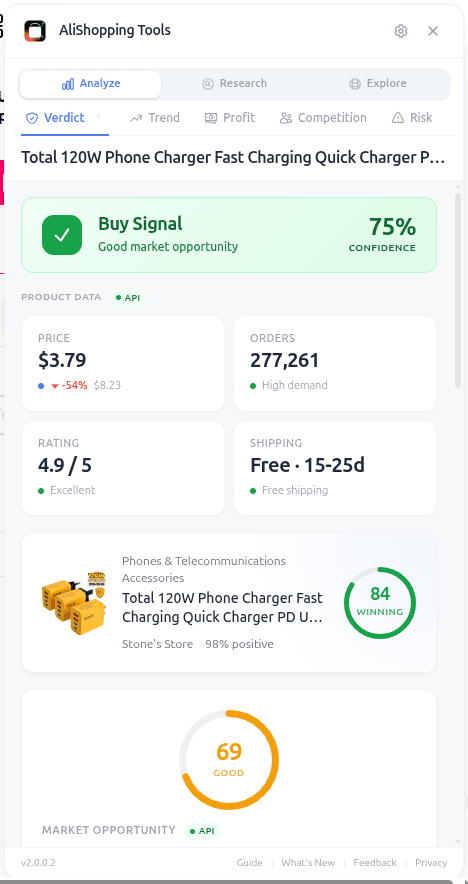
The first thing you will see is the AI Verdict. This is the extension's overall assessment of the product as a dropshipping opportunity, weighed from four dimensions — product fundamentals 30%, profit 30%, market saturation 20%, risk 20% — with a confidence figure shown beside it. There are four possible calls:
- Strong Buy (composite 80 and above) — strong across the four dimensions. Worth testing.
- Buy Signal (60-79) — good overall, usually with one softer dimension. Worth testing once you know which one is soft.
- Hold / Watch (40-59) — mixed signals. Investigate further before committing.
- Pass (below 40) — weak signals. Move on to the next product.
If the Verdict says Pass, do not overthink it. Go back to the category page and click on another product. The speed advantage of free tools means you can evaluate dozens of products in minutes. Do not get attached to any single product.
If the Verdict is Hold / Watch or better, continue to the next steps.
Below the overall Verdict, you will see factor breakdowns explaining why the product scored the way it did. Read these. They tell you specifically what is strong (maybe demand is excellent) and what is weak (maybe competition is high). This context helps you make better decisions as you gain experience.
Step 4: Check the Profit Calculator (Real Margins After All Fees)
This is where beginners learn the most important lesson in dropshipping: the margin you think you have is not the margin you actually have.
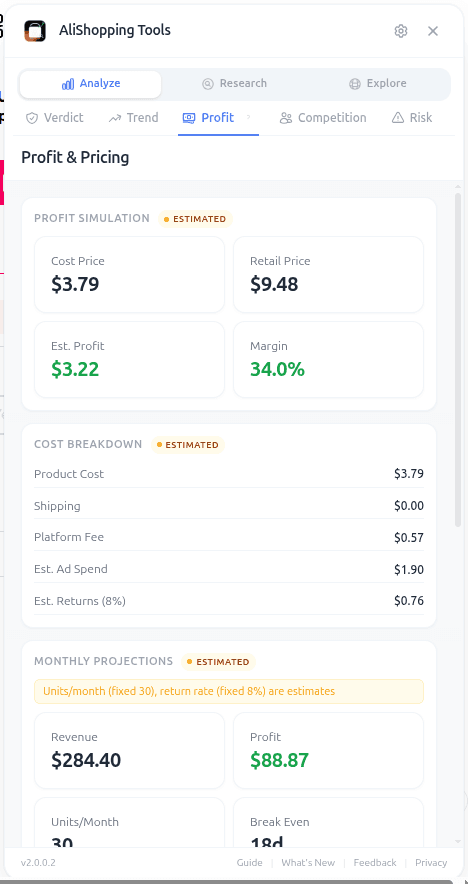
The Profit Calculator shows you the real picture. Enter your planned selling price, and it calculates your actual profit after:
- Product cost from the supplier
- Shipping to your target market
- Shopify or platform fees
- Payment processing fees (Stripe, PayPal)
- Estimated advertising cost per sale
- A buffer for returns and chargebacks
What to look for: A margin of 30% or higher after all costs. If the calculator shows 15% margin, that product is too tight. One return, one refund, or a slight increase in ad costs will push you into negative territory.
Pro tip: Try different selling prices. Sometimes a product that does not work at $19.99 works perfectly at $24.99 or $29.99. The calculator updates in real time as you adjust.
Step 5: Analyze Competition (Is the Market Saturated?)
The Competition Analysis shows you the landscape:
- How many other sellers offer this product or close variants
- What price range they are using
- Whether the competitive field is growing (more sellers entering) or shrinking
What to look for:
- Low competition (fewer than 20 sellers): Great opportunity, but make sure demand is actually there. Low competition sometimes just means low demand.
- Moderate competition (20-100 sellers): The sweet spot. Enough sellers to confirm the product sells, not so many that you cannot compete.
- High competition (100+ sellers): Proceed with caution. You will need a strong angle — better branding, a bundled offer, or a different target audience — to stand out.
Also check the price range. If competitors are selling between $15 and $20, and your profit calculator says you need to sell at $35 to maintain margins, you will have a hard time converting customers.
Step 6: Check the Trend (Growing or Declining?)
The Trend indicator shows the product's sales trajectory over time.
What to look for:
- Upward trend: Demand is growing. This is the best scenario — you are catching a wave.
- Stable trend: Consistent demand. This works for evergreen products (phone cases, kitchen tools) that sell steadily year-round.
- Declining trend: Demand is falling. Unless you have a specific reason to believe this is a temporary dip (seasonal product approaching its season), avoid declining products.
- Seasonal spike: The product surges at certain times of year. This is fine if you time it right, but be careful about ordering inventory or committing ad spend outside the peak window.
Step 7: Export Photos for Your Listing
When you have found a product that passes all five checks — Buy verdict, healthy margins, manageable competition, positive trend, reliable supplier — it is time to create your listing.
Click the Export button. The extension downloads:
- All product images in high resolution
- Product description and specifications
- Variant details (sizes, colors, options)
You now have everything you need to create a product listing on Shopify, WooCommerce, or whatever platform you use. No manual screenshots. No copying text from AliExpress and reformatting it. One click.
Common Beginner Mistakes (and How AI Scoring Prevents Them)
Mistake 1: Choosing Products Based on Personal Preference
"I think this product is cool, so other people will too." This is the number one beginner mistake. Your personal taste is irrelevant — data is what matters.
How AI scoring prevents it: The Verdict system evaluates products based on market data, not opinions. It does not care whether you personally like the product. It tells you whether the market wants it.
Mistake 2: Ignoring Shipping Times
A product with amazing margins and strong demand that takes 45 days to ship will generate chargebacks, negative reviews, and PayPal disputes that destroy your store.
How AI scoring prevents it: The supplier reliability factor in the Verdict system evaluates shipping consistency, dispute rates, and seller history. Products from unreliable suppliers get flagged before you commit.
Mistake 3: Underestimating Real Costs
"This product costs $3 and I will sell it for $20. That is $17 profit!" No, it is not. After shipping ($3-5), platform fees ($1-2), payment processing ($0.60-0.80), and ad spend ($5-10 per sale), your "$17 profit" is actually $2-5.
How AI scoring prevents it: The Profit Calculator includes all real costs. You see actual margin, not fantasy margin.
Mistake 4: Entering Saturated Markets Without a Differentiator
Seeing that a product has 10,000 orders and thinking "this product is proven!" without checking that 200 other stores are already selling it at rock-bottom prices.
How AI scoring prevents it: The Competition Analysis shows you exactly how crowded the market is. A product with strong demand and 200 competitors gets a lower Verdict score than one with moderate demand and 15 competitors.
Mistake 5: Chasing Dead Trends
Finding a product that was trending three months ago and assuming it still is. By the time most people discover a "trending" product through blog posts and YouTube videos, the trend has often already peaked.
How AI scoring prevents it: The Trend indicator shows real-time trajectory, not historical peak. You see whether the product is currently growing, stable, or declining — not where it was months ago.
Frequently Asked Questions
How many products should I evaluate before picking one to test?
Plan to evaluate 20-30 products in your first research session. With free tools like AliShopping Tools, this takes about 15-20 minutes since you can assess each product in under a minute. Out of 30 products, you might find 2-4 that pass all five checks. Choose the strongest one to test first.
Do I need any dropshipping experience to use these research tools?
No. AliShopping Tools is designed to work for complete beginners. The AI Verdict gives you a clear call — Strong Buy, Buy Signal, Hold / Watch or Pass — without requiring you to interpret complex data. The factor breakdowns explain why each product scored the way it did, which helps you learn the evaluation process over time.
Can I do product research on my phone?
Product research works best on a desktop or laptop browser since the Chrome extension operates within the browser. You can browse AliExpress on your phone to spot interesting products, then evaluate them properly on your computer with the extension active.
How often should I do product research?
When starting out, dedicate 30-60 minutes per week to product research. As you learn what signals to look for, you will get faster. Many experienced dropshippers spend 15-20 minutes per session, two to three times per week, to maintain a pipeline of tested product ideas.
What if the AI says "Hold" on a product I really like?
A "Hold" verdict means mixed signals — some factors are strong, others are weak. Read the factor breakdown carefully. If the weak factor is something you can address (for example, competition is high but you have a unique marketing angle), the product might still work. If the weak factor is fundamental (low demand or declining trend), trust the data and move on.
Your Product Research Checklist
Before you commit to testing any product, make sure it checks every box:
- Verdict Score: Buy or strong Hold
- Profit Margin: 30% or higher after all costs
- Competition: Low to moderate (under 100 direct competitors)
- Trend: Upward or stable (not declining)
- Supplier: Reliable history, consistent shipping times, low dispute rate
- Selling Price: Within the competitive range for your market
- Shipping Time: Under 15 days to your target market (ideally under 10)
If a product misses one or two checkboxes, it might still work with adjustments. If it misses three or more, move on. There are millions of products on AliExpress. Do not force a bad candidate.
Start Researching — It Takes 30 Seconds
You now know exactly what to look for, exactly how to evaluate products, and exactly which mistakes to avoid. The only thing left is to start.
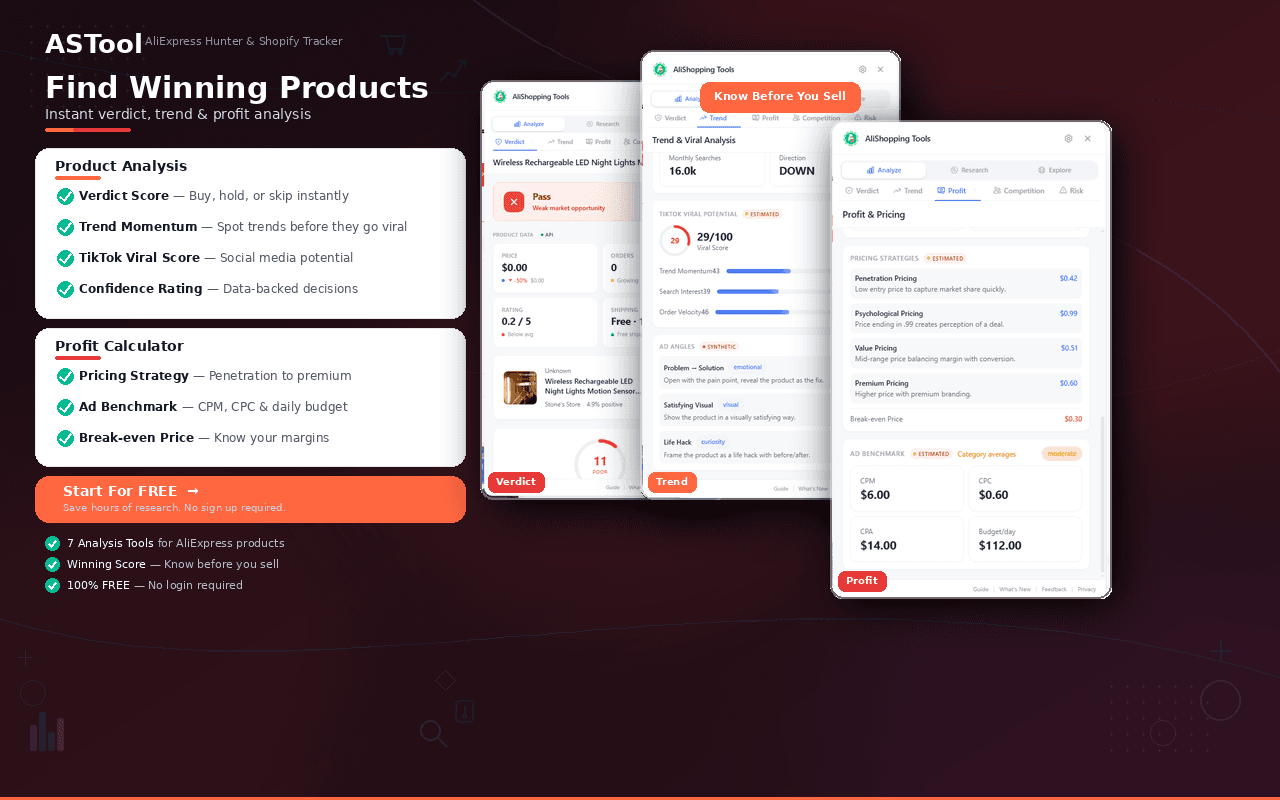
Install AliShopping Tools — Free
No account. No credit card. No trial expiration. Install in 3 seconds, and evaluate your first product in the next 30. Your first winning product might be the very next product you click on.
The tools are free. The knowledge is in this guide. The only cost is your time — and with AI-powered scoring, even that cost is measured in seconds, not hours.
Sẵn sàng tìm sản phẩm thắng?
Thử AliShopping Tools — 15 công cụ AI miễn phí cho nghiên cứu sản phẩm.
Giải đáp nhanh
Câu hỏi thường gặp
1Product research thật sự trả lời câu hỏi gì?
Theo bài: "Nếu tôi list sản phẩm và chi ads, tôi có lãi không?" Nghe đơn giản nhưng câu trả lời phụ thuộc nhiều yếu tố ghép lại — sản phẩm có thể demand tuyệt nhưng biên tệ, hoặc biên tốt nhưng cạnh tranh quá nên ads không lãi, hoặc nhìn hoàn hảo trên giấy nhưng supplier không đáng tin. Đa số store dropshipping chết ở chọn sản phẩm chứ không phải marketing hay vận hành — nên bước này quan trọng hơn mọi thứ khác.
2Năm tín hiệu của winning product là gì?
Demand (volume đơn cao, wishlist, search volume, buzz mạng xã hội — 50 đơn không phải tín hiệu, 5.000 đơn với quỹ đạo đi lên thì có), margin (ít nhất 30–50% sau mọi chi phí thật; dưới 25% mô hình dễ vỡ vì một đơn hoàn xóa lãi 5 đơn), competition (vừa phải — không phải 0 tức không demand, không phải hàng trăm store giống hệt tức chiến giá mỏng), hướng trend (lên hoặc ổn định, không giảm — bán sản phẩm peak 3 tháng trước là trận thua), và tín hiệu thứ năm đề cập sau trong bài.
3Vì sao bài nhấn mạnh biên thật thay vì "giá bán trừ giá vốn"?
Vì người mới tính biên kiểu giá bán trừ giá vốn bỏ qua 40–60% chi phí thật — sản phẩm nhìn như biên 70% thường chỉ 15% sau khi cộng ship, phí platform, phí thanh toán, ad spend ước lượng và dự phòng hoàn.
Và 15% nghĩa là một đơn hoàn xóa lãi 5 đơn.
Biên dropshipping lành là 30–50% sau mọi chi phí; dưới 25% mô hình dễ vỡ về cấu trúc.
Bài viết khác
How to Do Product Research for Dropshipping: 7-Step Framework (Free Tools, 2026)
A repeatable 7-step product research framework for dropshippers in 2026 — from idea sourcing to live testing, using only free tools. No Ecomhunt subscription needed.
Ecomhunt Free in 2026: Is There a Real Free Tier? (+ The Free Alternative That Actually Works)
Ecomhunt's 'free' tier is 72-hour delayed and category-locked. Here's what you actually get for free, what the $29/mo plan adds, and the Chrome extension that replaces Ecomhunt's core workflow at $0.
How to Validate a Dropshipping Product Before Spending on Ads (Free Framework)
Stop burning $200–500 on untested products. This 6-step free validation framework tells you if a dropshipping product will sell before you spend a dollar on ads.