Best Shopify Spy Tools in 2026: Free and Paid Options Compared
Best Shopify Spy Tools in 2026: Free and Paid Options Compared
Quick answer: The best Shopify spy tools in 2026 are AliShopping Tools (200+ app detection, live sales counter, revenue estimation — free), Koala Inspector (freemium), and Commerce Inspector (paid bulk monitoring). Free extensions cover 80–90% of solo-operator workflow at $0; paid platforms add dashboard monitoring and agency-scale store tracking. Install AliShopping Tools on the Chrome Web Store →
What Do Shopify Spy Tools Actually Do?
Shopify spy tools let you peek behind the curtain of any Shopify store. They reveal data that store owners do not publicly share: installed apps, theme details, estimated traffic, best-selling products, pricing history, and technology stack. Some go further and track changes over time, showing you when competitors add products, change prices, or launch new ad campaigns.
The market for these tools has expanded significantly since 2024. There are now dozens of options ranging from free browser extensions to enterprise-grade platforms costing hundreds per month. This guide cuts through the noise and compares the tools that actually deliver useful intelligence for ecommerce sellers and dropshippers. Competitor spying is just one stage of effective product research -- our Complete Dropshipping Product Research Guide explains how store intelligence fits into the larger workflow.
What to Look For in a Shopify Spy Tool
Before comparing specific tools, understand the features that matter most for different use cases.
Core Detection Features
- Theme identification: Which Shopify theme a store uses, including paid vs. free themes
- App detection: Which Shopify apps are installed (reviews, upsells, email marketing, etc.)
- Technology stack: Payment processors, analytics tools, chat widgets, and third-party integrations
- Product catalog data: Number of products, price ranges, collection structure
Advanced Intelligence Features
- Traffic estimation: Monthly visitors, traffic sources, geographic breakdown
- Sales estimation: Estimated revenue, order volume, and conversion rates
- Best-seller identification: Which products generate the most sales
- Ad intelligence: Active Facebook, Google, and TikTok ads
- Historical tracking: Changes over time in products, pricing, and traffic
Practical Considerations
- Accuracy: How reliable are the estimates? All spy tools use approximations, but some are significantly more accurate than others
- Update frequency: Daily data is more useful than monthly snapshots
- Export options: Can you export data to spreadsheets for deeper analysis?
- Learning curve: Some tools require hours of setup; others work with one click
- Price to value ratio: Does the pricing make sense for your business size?

Which Shopify Spy Tools Are Free?
Manual Source Inspection (Built-in)
Cost: Free. Right-click any Shopify store, View Page Source, and search for Shopify.theme to identify the theme. Check /meta.json for version data. No tools required, but only reveals the theme -- not apps, traffic, or products. For a full walkthrough of this technique, see our guide on how to analyze Shopify stores.
Wappalyzer (Free Browser Extension)
Cost: Free (browser extension), paid plans for bulk analysis. Detects CMS, analytics, payment processors, and marketing tools on any website. Accurate and well-organized, but does not identify Shopify-specific apps or estimate traffic. Best for understanding the technical stack behind a competitor's store.
BuiltWith (Free Tier)
Cost: Free lookups for basic results, paid from $295/month. Offers deep technology profiling with historical data on when technologies were added or removed. The free tier is limited and paid plans are expensive for individual sellers, but useful for researchers tracking technology trends across many stores.
Facebook Ad Library
Cost: Free, no usage limits. Shows every active ad on Facebook and Instagram, including creative, copy, landing pages, and launch dates. Does not cover TikTok or Google, and does not show spend or performance metrics. Essential for any competitive analysis workflow.
SimilarWeb (Free Tier)
Cost: Free for basic data, paid from $149/month. Estimates traffic volume, sources, and geographic breakdown. Free tier limits monthly lookups and accuracy drops for smaller sites (under 50,000 monthly visits). Best for understanding relative traffic levels and prioritizing which competitors deserve deeper study.
Paid Shopify Spy Tools
popular Shopify spy extensions
Cost: Free basic version, Pro from $9.99/month What it does: Browser extension specifically built for Shopify store analysis. Detects themes, apps, product data, best-sellers, and basic traffic estimates.
Strengths:
- Purpose-built for Shopify analysis
- One-click analysis while browsing any Shopify store
- Shows recently added products and best sellers
- App detection with links to Shopify App Store listings
- Affordable pricing
Limitations: Only works on Shopify stores. Traffic estimates are rough approximations. No ad intelligence. Limited historical data.
Best for: Dropshippers who want quick Shopify store analysis without leaving their browser. Good value for the price.
paid Shopify analytics tools
Cost: From $29/month What it does: Comprehensive Shopify store analysis platform. Detects apps, themes, products, estimated revenue, and tracks changes over time.
Strengths:
- Detailed product-level data including pricing history
- Revenue estimation based on multiple data signals
- Change tracking shows when competitors add or remove products
- Clean dashboard for monitoring multiple competitors
Limitations: Revenue estimates should be treated as directional rather than precise. Higher price point than simpler alternatives. Occasional delays in data updates.
Best for: Serious sellers who want to monitor multiple competitors over time and need more than surface-level data.
Store Leads
Cost: From $49/month What it does: Shopify store database with filtering, ranking, and export. Find stores by category, technology, traffic level, and other criteria.
Strengths:
- Database of millions of Shopify stores
- Advanced filtering (by app, theme, category, country, traffic level)
- Contact information for store owners (useful for B2B)
- Export to CSV for bulk analysis
- Regular database updates
Limitations: Focused on store discovery rather than deep analysis of individual stores. Contact data accuracy varies. Not designed for product-level intelligence.
Best for: Finding new competitors you did not know existed. B2B sellers targeting Shopify store owners. Market sizing and trend analysis.
Dropship Spy / Ecom Hunt
Cost: $29 to $49/month (varies by platform) What it does: Curated winning product databases with supplier information, Facebook ad examples, and profit calculations.
Strengths:
- Products are pre-vetted by analysts
- Includes supplier links and pricing
- Shows example Facebook ads for each product
- Profit margin calculations included
Limitations: Everyone using the tool sees the same products, increasing competition. Products may be saturated by the time they appear. Limited to their curated selection rather than the full market.
Best for: Beginners looking for product ideas with supporting data. Not a substitute for independent research but useful as a starting point.
SEMrush / Ahrefs
Cost: From $129/month (SEMrush), $99/month (Ahrefs) What it does: Comprehensive SEO and digital marketing platforms. Not Shopify-specific but provide deep competitive intelligence on organic search, paid ads, backlinks, and content.
Strengths:
- Most accurate traffic and keyword data available
- Complete backlink analysis
- Paid ad copy and keyword intelligence
- Content gap analysis
- Position tracking over time
Limitations: Expensive for solo sellers or beginners. Not Shopify-specific; requires interpretation of general data. Steep learning curve for full utilization.
Best for: Established sellers investing seriously in SEO and content marketing. Agencies managing multiple ecommerce brands.

Comparison Table
Pricing disclaimer: All prices shown are approximate and based on publicly available information at the time of writing. Vendors change pricing frequently -- always verify current rates on the official website before purchasing.
| Tool | Starting Price | Theme/App Detection | Traffic Estimates | Product Tracking | Ad Intelligence | Best For |
|---|---|---|---|---|---|---|
| Manual Inspection | Free | Yes (basic) | No | No | No | One-off checks |
| Wappalyzer | Free | Tech stack only | No | No | No | Technology profiling |
| BuiltWith | Free / $295/mo | Yes | No | No | No | Historical tech data |
| Facebook Ad Library | Free | No | No | No | Meta only | Ad creative analysis |
| SimilarWeb | Free / $149/mo | No | Yes | No | No | Traffic benchmarking |
| popular Shopify spy extensions | Free / $9.99/mo | Yes | Basic | Limited | No | Quick Shopify analysis |
| paid Shopify analytics tools | $29/mo | Yes | Basic | Yes | No | Ongoing monitoring |
| Store Leads | $49/mo | Limited | Yes | No | No | Store discovery |
| SEMrush / Ahrefs | $99-129/mo | No | Yes | No | Yes | SEO and marketing intel |
For a step-by-step workflow that ties these tools together, read our complete competitor spy playbook.
The Tool Stack That Works for Most Sellers
You do not need every tool on this list. Here is what works for most dropshippers and ecommerce sellers at different stages.
Beginner (Budget: $0 to $10/month)
- Facebook Ad Library (free) for ad research
- Wappalyzer extension (free) for technology detection
- SimilarWeb free tier for traffic estimates
- popular Shopify spy extensions free version for Shopify-specific data
- Google Sheets for tracking findings
This combination costs nothing and covers the fundamentals. You will spend more time on manual research, but the data is sufficient for making informed decisions. For the manual workflow behind these free tools, see how to spy on Shopify stores free; for a single free extension that automates revenue, apps, and live sales, see the free Shopify spy tool.
Intermediate ($30 to $80/month)
- popular Shopify spy extensions Pro ($9.99/month) for quick Shopify analysis
- paid Shopify analytics tools ($29/month) for competitor monitoring
- Facebook Ad Library (free)
- SimilarWeb free tier
At this level, you save significant time through automation and get access to historical data that reveals trends.
Advanced ($150 to $300/month)
- SEMrush or Ahrefs ($99 to $129/month) for comprehensive marketing intelligence
- paid Shopify analytics tools ($29/month) for Shopify-specific monitoring
- Store Leads ($49/month) for market discovery
- Facebook Ad Library and TikTok Creative Center (free)
This stack provides enterprise-grade intelligence. It makes sense when you are managing multiple stores or your revenue justifies the investment.
What Spy Tools Cannot Tell You
It is important to understand the limitations of any competitive intelligence tool.
Profit margins are invisible. You can see prices and estimate revenue, but you cannot see a competitor's actual costs: ad spend, supplier prices, shipping costs, returns, and operational overhead. A store doing $100,000/month in revenue might be losing money.
Conversion rate data is private. Tools can estimate traffic and revenue, but the conversion rate (which determines actual business health) is internal data that no external tool can accurately determine.
Strategic intent is unknowable. When a competitor drops a product, you do not know if it was unprofitable, if their supplier ran out, or if they are pivoting strategy. Tools show what happened; you must infer why.
Small store data is unreliable. Traffic and revenue estimates become increasingly unreliable below roughly 30,000 monthly visits. For stores under 10,000 monthly visits, external estimates are essentially guesses.
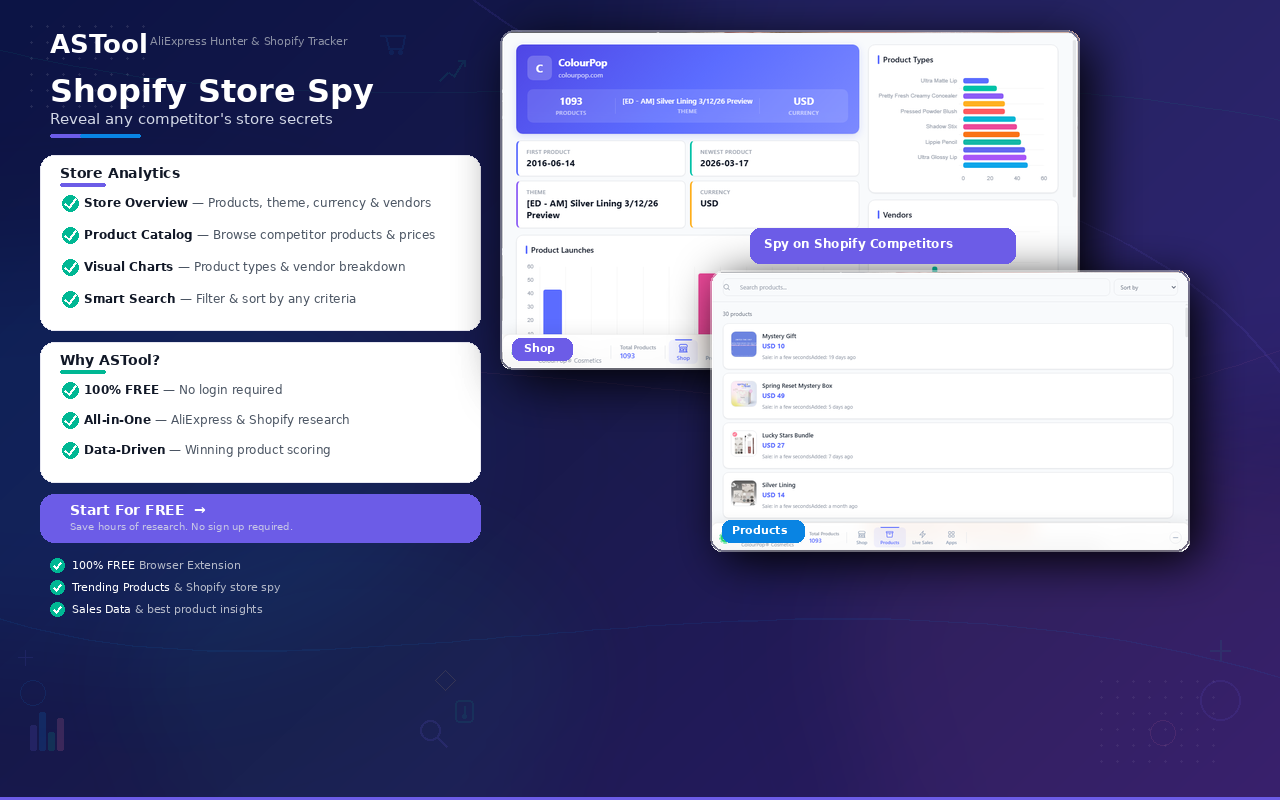
Supplementing Store Intelligence with Product Research
Spy tools show you what competitors sell, but they do not always help you evaluate the source products themselves. When you identify a product that a competitor sells successfully, the next step is evaluating the AliExpress supplier behind it.
When evaluating source products, the ASTools Chrome Extension overlays winning scores, risk flags, and margin estimates directly on AliExpress listings -- reducing the tab-switching and manual calculations that slow down product evaluation.
This combination of store-level intelligence (from spy tools) and product-level analysis creates a complete picture: you know which products succeed in the market and which suppliers can deliver them reliably. Once you have identified promising products, our guide on how to track competitor products and pricing covers the ongoing monitoring workflow.
How to Evaluate Whether a Tool Is Worth the Cost
Apply a simple framework before committing to any paid tool. First, estimate how many hours it saves you monthly -- if a $30/month tool saves 5 hours of manual work, you are paying $6/hour for automation. Second, commit for exactly 3 months, then evaluate: did it inform decisions that made or saved you money? If you forgot you had the subscription, that is your answer.
Final Recommendations
Start free. The Facebook Ad Library, Wappalyzer, SimilarWeb free tier, and manual source code inspection cover the majority of what most sellers need. Add paid tools only when you hit specific limitations that cost you time or lead to poor decisions. No single tool provides complete competitive intelligence -- combine multiple data sources with your own judgment and market experience.
Frequently Asked Questions
Do I need a paid spy tool to start competitor research?
No. Free tools like the Facebook Ad Library, Wappalyzer, SimilarWeb free tier, and manual page source inspection cover the fundamentals. Paid tools become worthwhile once you are monitoring multiple competitors regularly and the time savings justify the cost.
How accurate are traffic and revenue estimates from spy tools?
All external estimates are approximations. Traffic estimates from tools like SimilarWeb tend to be directionally accurate for sites above 50,000 monthly visits but unreliable for smaller stores. Revenue estimates should be treated as order-of-magnitude guides rather than precise figures.
Can competitors tell that I am using a spy tool on their store?
Browser extensions that analyze page source code operate entirely on your machine -- the store owner sees a normal page visit in their analytics, nothing more. Cloud-based tools that crawl stores may appear in server logs, but this is standard web traffic and not distinguishable from regular visitors.
What is the best free alternative to paid Shopify spy tools?
Combine manual source inspection for theme and app detection, Facebook Ad Library for ad research, and SimilarWeb free tier for traffic estimates. Supplement with Google search operators to discover competitors. This stack covers the majority of what paid tools offer.
AliShopping Tools
See live AliExpress data in your browser.
Shipping rates, profit margins, and Shopify import — all without leaving the product page.
Sẵn sàng tìm sản phẩm thắng?
Thử AliShopping Tools — 15 công cụ AI miễn phí cho nghiên cứu sản phẩm.
Giải đáp nhanh
Câu hỏi thường gặp
Công cụ Shopify spy thực sự lộ ra gì?
Công cụ spy Shopify làm lộ data mà chủ store không công bố: app đã cài, theme đang dùng, ước lượng traffic, sản phẩm bán chạy nhất, lịch sử giá, và tech stack — cổng thanh toán, analytics, widget chat, tích hợp bên thứ ba.
Công cụ nâng cao còn theo dõi thay đổi theo thời gian, cho biết khi đối thủ thêm sản phẩm, đổi giá, hoặc chạy campaign mới.
Mục đích là lấy intel mà nếu không có tool bạn phải suy luận gián tiếp từ HTML storefront công khai.
Tính năng nào quan trọng nhất khi chọn công cụ spy Shopify?
Bài chia tính năng thành core detection (nhận diện theme, detect app, tech stack, data catalog sản phẩm), advanced intelligence (ước lượng traffic, ước lượng doanh thu, xác định best-seller, ad intelligence Facebook/Google/TikTok, theo dõi lịch sử), và practical (độ chính xác — mọi spy tool đều ước lượng nhưng mức độ khác nhau, tần suất cập nhật — daily hơn monthly, tùy chọn export, learning curve, và tỉ lệ giá/giá trị).
Chọn theo workflow thực tế cần tính năng nào.
Bài có những lựa chọn spy Shopify miễn phí nào?
Bài đề cập vài lựa chọn miễn phí: kiểm tra source thủ công (chuột phải store Shopify, View Page Source, tìm "Shopify.theme" — chỉ lộ theme, không app hay traffic), Wappalyzer free browser extension (detect CMS, analytics, cổng thanh toán, công cụ marketing, nhưng không detect app Shopify riêng), BuiltWith free tier (tra cứu tech cơ bản; gói paid từ 295 USD/tháng — đắt cho cá nhân), và Facebook Ad Library để xem quảng cáo đang chạy.
Bài viết khác
Best Shopify Apps for AliExpress Dropshipping 2026
Top 5 Shopify apps for AliExpress dropshipping in 2026 — AliShopping Tools, DSers, AutoDS, Zendrop, CJdropshipping. Compare features, pricing, and integration.
13 phút đọc
AliExpress Shopify Direct Import Tutorial 2026 Guide
Import AliExpress products to Shopify in one click with AliShopping Tools v2.0.0.23. No CSV, no copy-paste — direct API import with multi-store picker.
12 phút đọc
Shopify Multi-Store AliExpress Dropshipping Guide 2026
Manage multiple Shopify stores sourcing from AliExpress with AliShopping Tools v2.0.0.23 multi-store picker. Connect and import across stores in one click.
10 phút đọc