AliExpress AI Verdict Explained 2026 — How the Buy/Hold/Pass Dropshipping Score Works
AI Verdict Explained — How the Score Actually Works
Quick answer: AliShopping's AI Verdict scores any AliExpress product in under 1 second using 30+ signals across 4 weighted categories: demand (30%), seller trust (25%), price attractiveness (25%), and recent momentum (20%). The output is Buy, Hold, or Pass with a 0–100 confidence score. Every signal contribution is visible and hoverable in the UI — no black box.
AI Verdict is the headline feature of AliShopping Tools' AliExpress analysis. Open any product page and within 1 second you get one of three outputs: Buy, Hold, or Pass, with a confidence score (0-100) and expandable signal breakdown.
This post explains exactly how the score is computed. No black box — you should know what you are trusting.
The 4 Signal Categories
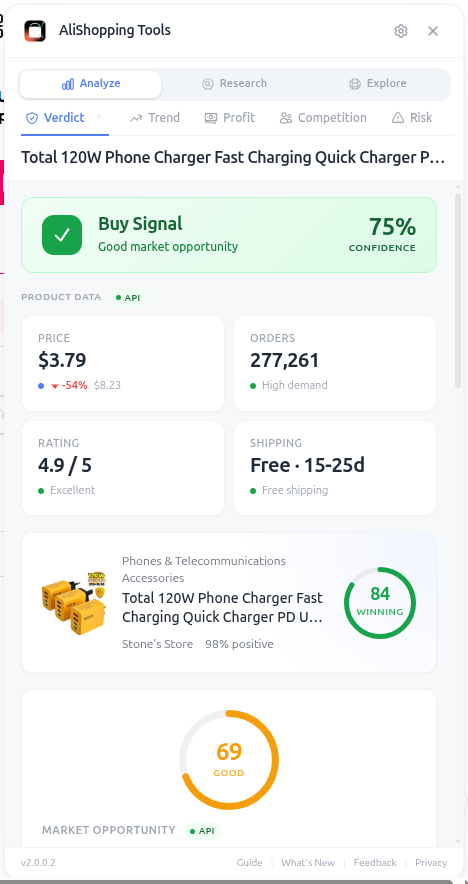
The score synthesizes 30+ individual signals grouped into 4 categories with these weights:
- Demand signals: 30% of score weight
- Seller trust signals: 25% of score weight
- Price attractiveness signals: 25% of score weight
- Recent momentum signals: 20% of score weight
Each category contains multiple individual signals that roll up to the category score.
Category 1: Demand Signals (30%)
Measures whether people are actually buying this product, and at what velocity.
Individual signals:
- Raw order count — lifetime orders as reported by AliExpress
- 30-day order velocity — orders per day estimated from recent activity
- Review count — total reviews (verified + unverified)
- Review recency — reviews in the last 30 days
- Review momentum — is review velocity rising, flat, or falling?
- Order-to-review ratio — healthy ratio indicates real purchases
- Wishlist/favorite signals — supplementary engagement metric where available
Strongest single signal: 30-day order velocity. A product with 10,000 lifetime orders but zero orders in the last 30 days scores lower on demand than a product with 500 lifetime orders and 100 in the last 30 days.
Category 2: Seller Trust Signals (25%)
Measures the supplier reliability behind the product.
Individual signals:
- Seller rating — percentage positive feedback
- Years active on AliExpress
- Dispute rate — percentage of orders requiring dispute resolution
- Response time — how fast the seller replies to buyer messages
- Shipping reliability — percentage of orders shipping within stated window
- Product count — how diverse their catalog is
- Tenure stability — has the seller maintained the same business profile or had recent resets?
Red flags automatically reduce seller trust score:
- Less than 1 year active
- Below 95% positive feedback
- Dispute rate > 5%
- Response time > 24 hours
Category 3: Price Attractiveness Signals (25%)
Measures whether the price makes economic sense.
Individual signals:
- Price vs category median — is this price competitive within the product category?
- Price stability over 90 days — rising prices signal demand > supply; falling prices signal saturation
- Wholesale tier discount depth — steeper discounts at volume = better margin opportunity
- Shipping cost as percentage of total — high shipping ratios signal profit leaks
- Currency risk — products priced in volatile currencies flag accordingly
- Coupon and promotion density — how often this product gets promotional discount
Key insight: a product priced 50% below category median is often not a value — it usually signals saturation, old inventory, or a race-to-bottom supplier. A product priced at or slightly above category median with stable pricing usually indicates genuine demand supporting the price.
Category 4: Recent Momentum Signals (20%)
Measures whether the product is gaining or losing traction right now.
Individual signals:
- New seller velocity — are new sellers joining this product category?
- Competition density delta — is the number of sellers growing or shrinking?
- TikTok Viral Score — cross-reference with TikTok hashtag volume and creator mentions
- Search trend momentum — is the product keyword trending up or down?
- Phase classification — emerging / peak / declining / saturated (derived from velocity + price + seller count trend)
Products in emerging phase score highest on momentum. Products in declining phase score lowest.
How Signals Combine Into Final Score
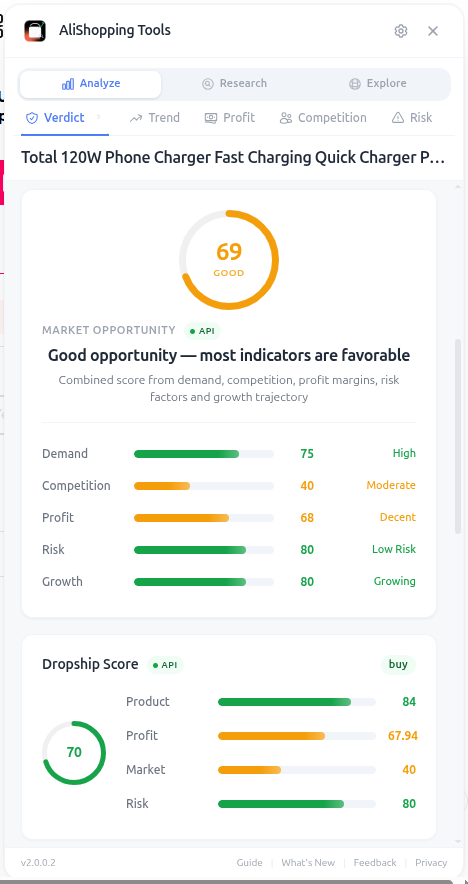
Each category produces a 0-100 sub-score. The final Verdict score is:
Final Score = 0.30 * Demand + 0.25 * SellerTrust + 0.25 * PriceAttractiveness + 0.20 * Momentum
Verdict thresholds:
- Buy (0-100): Final score ≥ 70 with confidence ≥ 80
- Hold (0-100): Final score 50-69 OR confidence 50-79 (uncertain)
- Pass (0-100): Final score < 50 OR confidence < 50 (low signal quality)
Confidence score is separate from the final score. It reflects how much data the system has to base the scoring on. A brand new AliExpress product with only 10 reviews has low confidence even if the limited data looks positive.
Why Hoverable Transparency
Every signal in the scoring breakdown is hoverable in the UI. Click through, and you see exactly what signal contributed what weight to the final score. Example expansions:
- "Demand: 82/100 — Strong 30-day velocity (+25), healthy review momentum (+20), robust lifetime orders (+20), neutral order-to-review ratio (+15), average wishlist engagement (+2)"
- "Seller Trust: 65/100 — High feedback score (+22), 2 years active (lower tenure weight) (+15), response time under 12h (+13), no dispute flags (+15)"
This transparency exists because operators should not trust black-box scores. You can see what drove the verdict and decide if you agree with the emphasis. If the system weights "recent TikTok signals" heavily on a product you know will sell regardless of TikTok (say, a category where TikTok is irrelevant), you can discount that signal yourself.
When the Verdict Is Wrong
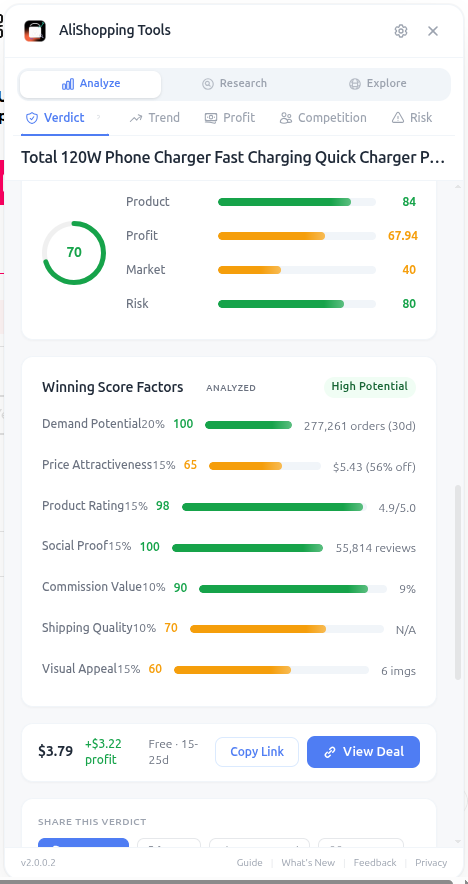
The Verdict is directional, not predictive. It can be wrong in specific ways:
Niche blindness: The Verdict does not know your niche. A product scored "Buy" might succeed only in specific demographics you are not targeting. Or vice-versa — a "Hold" product might be perfect for your audience.
Seasonal products: A Christmas product scored in February will show low momentum. Same product scored in October would show high momentum. The score reflects the moment, not the seasonality.
Counterfeit signals: Some products have fake reviews or seeded order counts. The Verdict detects obvious patterns (the Reviews tab flags 7 red flags) but sophisticated review farms can game the basic signals.
Sample size limitations: Brand new AliExpress listings have low confidence scores. The Verdict might be correct but uncertain.
How to Use It Pragmatically
- Buy verdict: Still validate with your specific niche knowledge. Check the Reviews tab for fake-review flags. Check the Profit tab for margin viability. Buy verdict alone is not enough to commit ad spend.
- Hold verdict: Product is worth watching but not testing yet. Check back in 30 days to see if momentum shifts.
- Pass verdict: Skip unless you have specific insider knowledge that overrides the signal. The Pass usually means the product is in decline or oversaturated.
Compare to Paid Tools
Sell The Trend, Minea, Ecomhunt, Pexgle all offer scoring systems. Differences:
- AliShopping: 30+ signals, hoverable transparency, runs on any AE product in your browser, free
- Paid tools: 10-30 signals (varies), black-box methodologies, web-app only, $30-99/month subscription
No methodology is objectively correct. Choose based on transparency preferences. AliShopping's methodology is fully documented here because trust comes from explanation, not secrecy.
Install and Verify Yourself
Run the Verdict on 10 products you already know. For products you trust will sell, check if the Verdict agrees. For products you know are dead, check if the Verdict correctly flags them. After 10 validations, you will know whether the scoring matches your judgment.
Install AliShopping Tools free — one Chrome permission, no account, no paywall. Runs locally on any AliExpress product page. The first 5 Verdicts you check will either build or destroy your trust in the score — either outcome is useful information.
Sẵn sàng tìm sản phẩm thắng?
Thử AliShopping Tools — 15 công cụ AI miễn phí cho nghiên cứu sản phẩm.
Giải đáp nhanh
Câu hỏi thường gặp
AI Verdict score trên AliExpress là gì và đầu ra của nó là gì?
AI Verdict là hệ thống chấm điểm tổng hợp của AliShopping Tools, tổng hợp 30+ tín hiệu dữ liệu thành một trong ba kết quả — Buy, Hold, hoặc Pass — cộng điểm tin cậy (0–100).
Buy nghĩa là sản phẩm có momentum cầu mạnh, tiềm năng biên lợi nhuận tốt, rủi ro nhà cung cấp chấp nhận được, và cạnh tranh có thể kiểm soát.
Hold nghĩa là dữ liệu hỗn hợp hoặc chưa đủ để quyết định.
Pass nghĩa là sản phẩm thất bại trên một hoặc nhiều chiều quan trọng như review giả, cạnh tranh bão hòa, hoặc xu hướng tiêu cực.
AI Verdict tổng hợp hơn 30 tín hiệu nào?
Chấm điểm bao gồm năm cluster tín hiệu chính: tín hiệu cầu (tốc độ đơn 90 ngày, trend search interest, TikTok viral score, pattern mùa vụ), tín hiệu biên (giá AliExpress so với giá bán thường, ước lượng chi phí vận chuyển, khả năng đáp ứng chi phí quảng cáo), tín hiệu nhà cung cấp (đánh giá seller, tốc độ fulfillment, tỷ lệ hoàn hàng, tuổi shop, điểm xác thực review), tín hiệu cạnh tranh (số seller, áp lực giá, chỉ số bão hòa thị trường, mức độ adoption store Shopify), và tín hiệu rủi ro (cờ IP/thương hiệu, điểm mô tả gây hiểu lầm, phát hiện review có thưởng, rủi ro vận chuyển địa chính trị).
Khi nào AI Verdict sai hoặc không đáng tin cậy?
Bài ghi lại một số edge case nơi Verdict kém hiệu quả: sản phẩm mới ra mắt (ít hơn ~500 đơn — dữ liệu tốc độ đơn không đủ); sản phẩm theo mùa được chấm điểm ngoài cửa sổ peak; sản phẩm niche hẹp với keyword quá hẹp cho dữ liệu trend có nghĩa; sản phẩm có chất lượng listing khác biệt nhiều với chất lượng thực tế (model chấm điểm listing, không phải mẫu vật lý); và môi trường quy định hoặc thuế quan thay đổi nhanh mà chậm cập nhật trong chấm điểm rủi ro tĩnh.
Phương pháp AI Verdict có minh bạch hay là hộp đen không?
Bài cam kết minh bạch rõ ràng — phương pháp đầy đủ gồm category tín hiệu, cách tính trọng số, và giới hạn đã biết được ghi lại thay vì ẩn sau tuyên bố 'thuật toán độc quyền'.
Lý do là dropshipper cần hiểu tại sao sản phẩm chấm điểm như vậy mới đưa ra quyết định sourcing thật sự, không chỉ nhìn số.
Mỗi hiển thị Verdict trong extension phân tích điểm tín hiệu góp phần, không chỉ kết quả cuối.
Điểm tin cậy khác với verdict Buy/Hold/Pass như thế nào?
Buy/Hold/Pass là khuyến nghị theo hướng dựa trên ngưỡng điểm tổng hợp. Điểm tin cậy (0–100) đo tính đầy đủ của dữ liệu và tính nhất quán của tín hiệu đằng sau khuyến nghị đó.
Sản phẩm có thể đạt Buy ở 91% tin cậy (dữ liệu dồi dào, nhất quán xác nhận hướng) hoặc Buy ở 54% tin cậy (tín hiệu thưa hoặc mâu thuẫn nghiêng tích cực nhưng không ủng hộ mạnh). Điểm tin cậy thấp là tín hiệu để xác thực bằng nghiên cứu bổ sung thay vì hành động chỉ dựa trên Verdict.
Bài viết khác
Winning Products June 2026: 12 AI-Verified Picks (with AStools Verdict Scores)
12 winning dropshipping products for June 2026, scored fresh on June 1: Verdict ≥70, Saturation under 40%, Trend phase Emerging or Growing. Refresh weekly.
11 phút đọc
How to Spot Fake AliExpress Reviews in 30 Seconds (2026 Guide)
Fake AliExpress reviews follow 7 patterns: burst dates, identical wording, no buyer photos. Spot all 7 in 30 seconds — or auto-flag them with a free extension.
13 phút đọc
Winning Products Singapore 2026: 10 Top Picks
10 winning dropshipping products for Singapore 2026 — verified margins, local demand signals, cultural calendar anchors (CNY, Hari Raya, National Day, Deepavali), and AliShopping Tools scores.
12 phút đọc