47 Shopify Stores Secretly Dropshipping: How We Classified Them
47 Shopify Stores Secretly Dropshipping: How We Classified Them
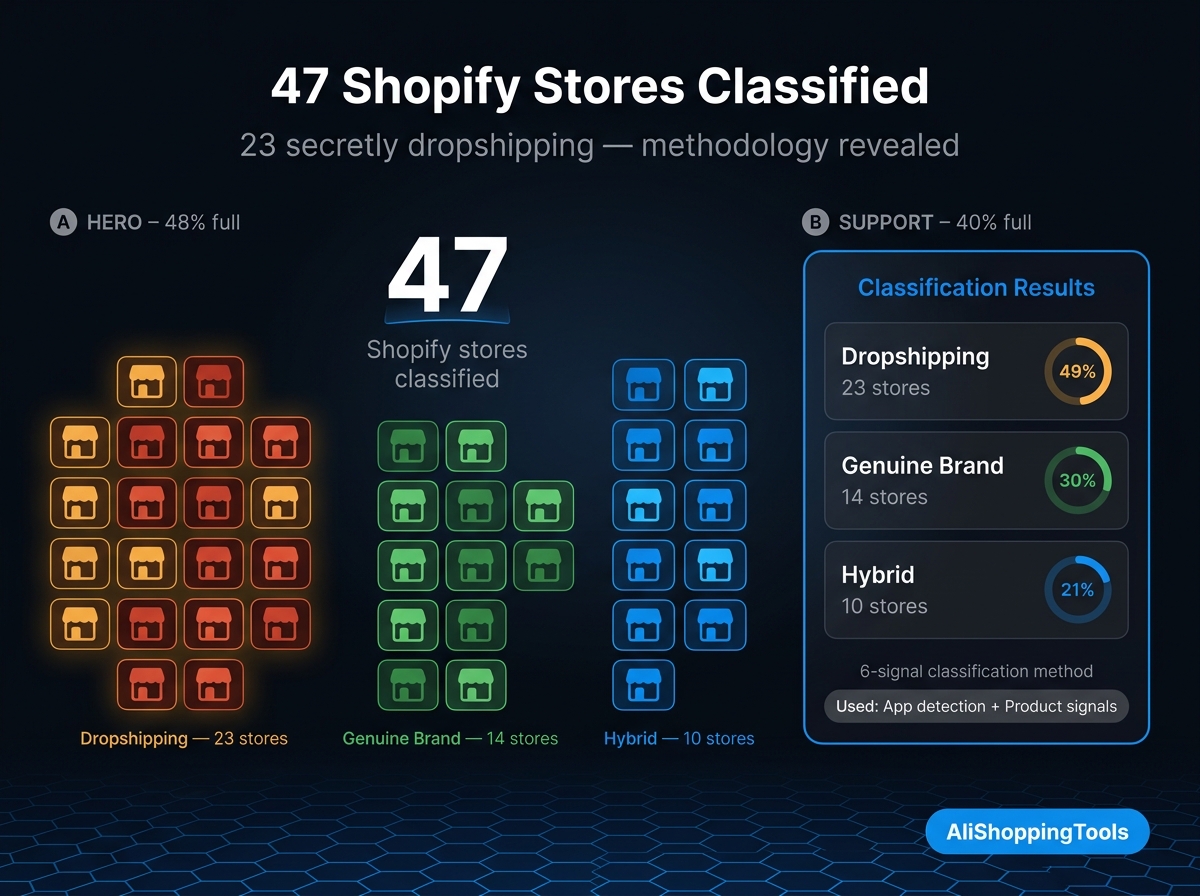
Quick answer: Of 47 Shopify stores audited across 8 niches, 23 were confirmed dropshipping operations, 14 were genuine brands, and 10 were hybrids — identified using 6 signals: app stack (DSers/Oberlo), shipping policy language, product photo style, catalog breadth, "About Us" authenticity, and AliExpress product match via AliShopping Tools.
Not every Shopify store that looks like a brand actually is one. Many stores are dropshipping operations — sourcing from AliExpress or a Chinese 3PL and selling at markup with branded packaging. They often present as brands but share key signals that distinguish them from genuine brands.
Install AliShopping Tools — Shopify store classification in 60 seconds →
We classified 47 Shopify stores across 8 product niches using a 6-signal methodology. Here are the findings and the classification framework you can apply to any store.
The 47-store study: methodology
How stores were selected: 47 stores across 8 niches (home goods, gadgets, fashion accessories, fitness, pet products, car accessories, beauty tools, and outdoor gear) that appeared in paid social ads (Facebook/TikTok) during a 6-week collection window in April-May 2026. Stores were anonymised for publication.
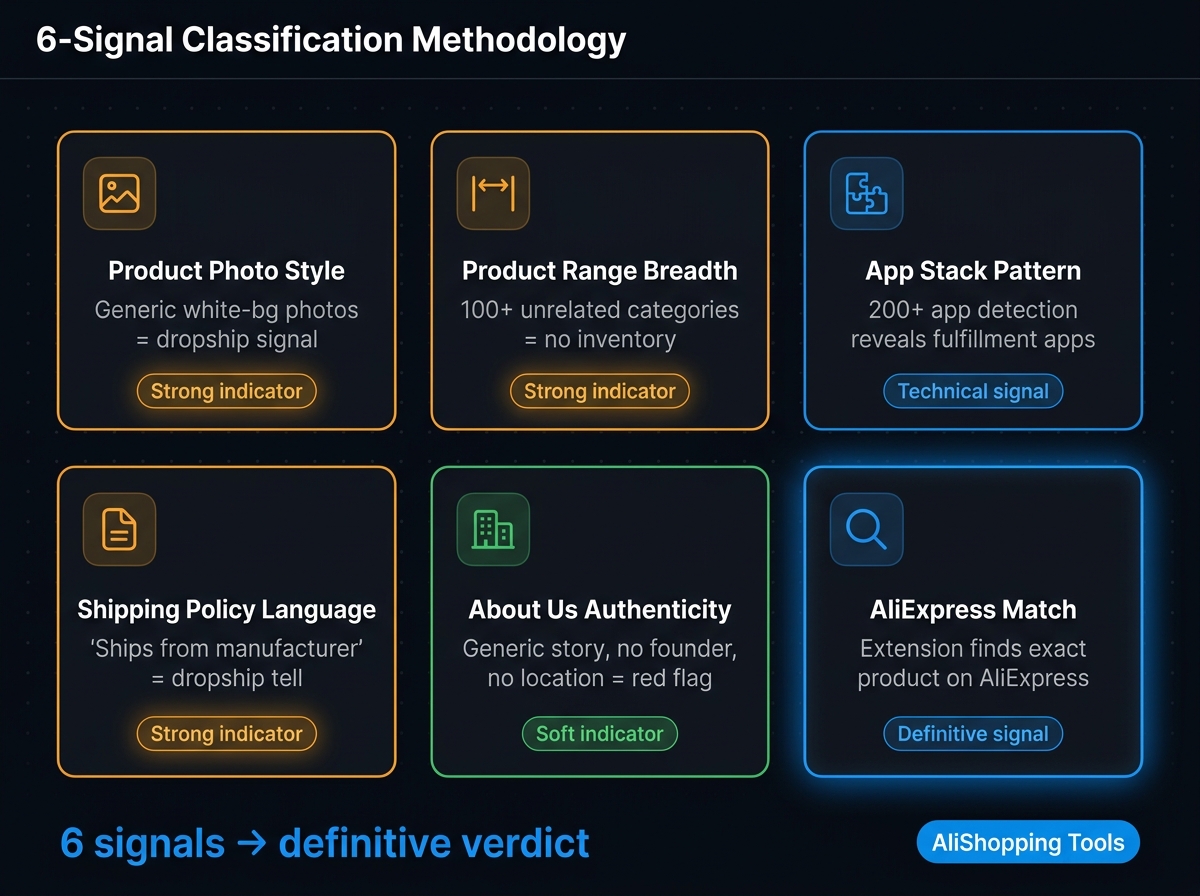
Classification method: Each store was evaluated on 6 signals using AliShopping Tools' Shopify spy and manual verification:
- Product range breadth: Brands typically have focused product lines (10-50 SKUs). Dropshippers often have 50-500+ products across unrelated categories.
- App stack pattern: Brands use return management, loyalty programs, subscription apps, and warehouse management. Pure dropshippers rarely use complex loyalty or returns infrastructure.
- Shipping policy language: Dropshippers typically state 15-30 day shipping in their policies. Brands state 2-5 day domestic shipping.
- Product photo style: Dropshippers often use AliExpress stock photos (plain white background, identical to AliExpress listing). Brands have lifestyle photography with human models in branded settings.
- About Us page authenticity: Genuine brands have founder stories with specific names, dates, and backstory. Dropship About Us pages are vague ("we are passionate about X and believe Y").
- AliExpress product match: Using reverse image search, does the exact product photo appear on AliExpress? Exact match = dropshipping signal.
Classification rules:
- 5-6 signals → Dropshipping
- 3-4 signals → Hybrid
- 0-2 signals → Genuine brand
Findings: the 47-store breakdown
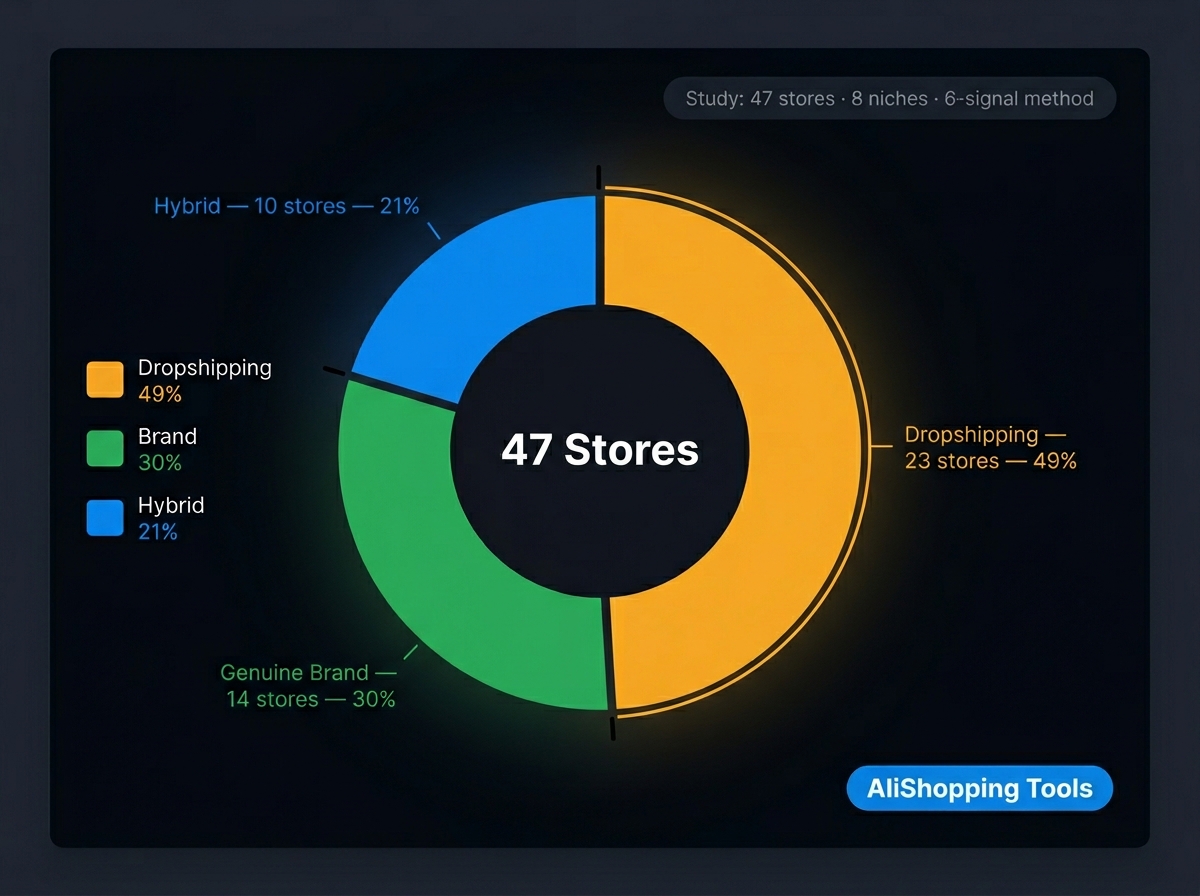
Result: 23 dropshipping, 14 brand, 10 hybrid
Of the 47 stores:
- 23 (48.9%) classified as dropshipping — 5-6 signals present
- 14 (29.8%) classified as genuine brands — 0-2 signals present
- 10 (21.3%) classified as hybrid — 3-4 signals present (mix of dropshipped and owned inventory)
How dropshippers present as brands: the patterns
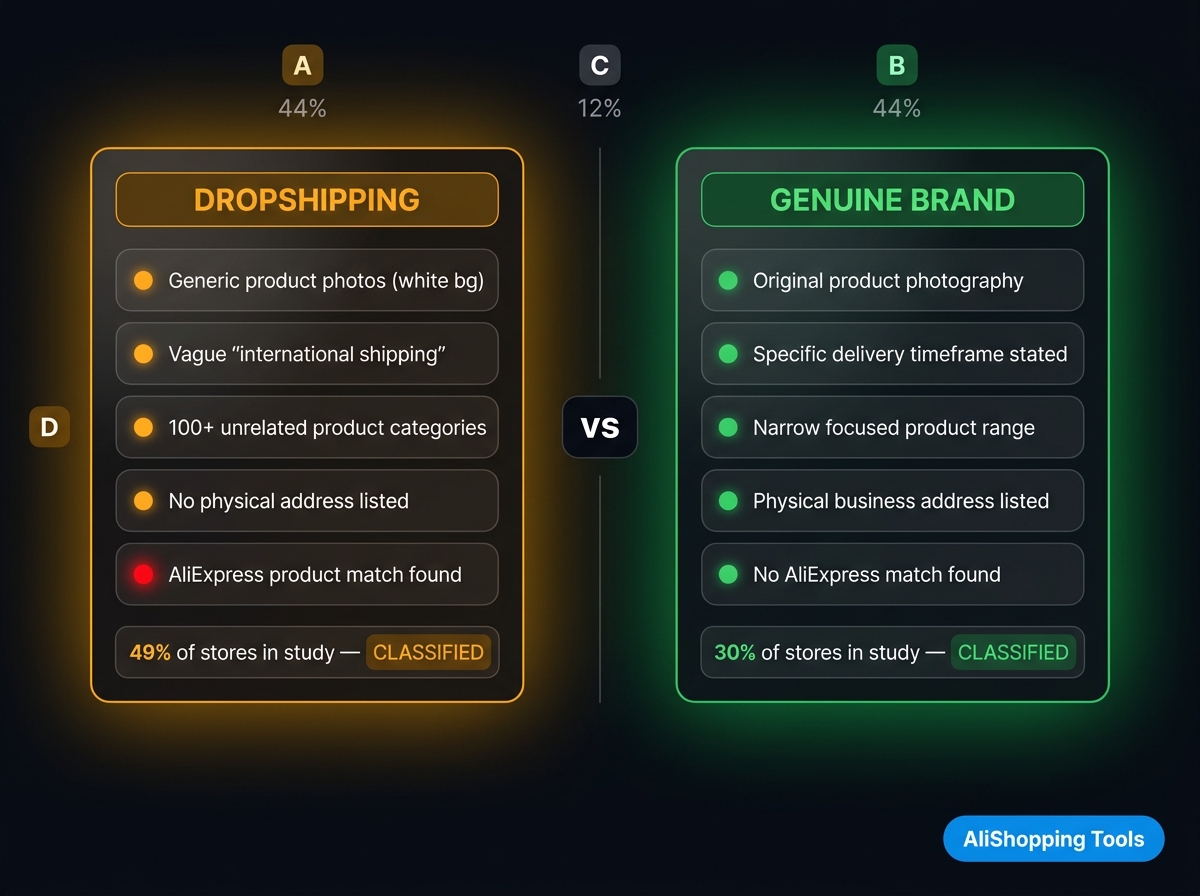
Pattern 1 — Fake lifestyle photography
The most common visual trick: taking AliExpress stock product photos and adding a lifestyle overlay (a hand holding the product, or the product in a room setting) using Canva or a Photoshop filter. The underlying product image is still the AliExpress original.
How to detect: Reverse image search the main product photo. If the original appears on AliExpress, the "lifestyle" version is a cheap overlay.
Pattern 2 — Vague "About Us" story
Dropship About Us pages use aspirational language without specifics: "We started this brand because we believe everyone deserves X. Our mission is Y." No founder names, no founding year that predates the AliExpress listing, no location specifics.
How to detect: Google the founder names mentioned. Check whether the company appears in business registers. A brand with no verifiable founder is likely a dropshipping operation.
Pattern 3 — 30-day shipping as "standard processing"
Many dropshippers disguise long AliExpress shipping times as "processing time": "Your order will be processed in 2-3 business days, then shipped within 15-30 days." This is standard AliExpress shipping framed as internal fulfilment.
How to detect: Read the full shipping policy. Any domestic destination taking longer than 7 days standard = dropshipping signal.
Pattern 4 — Wide product range without clear brand identity
Genuine brands have a coherent product line — a yoga brand sells yoga gear. Dropshippers often sell anything with margin: yoga mats, car gadgets, kitchen tools, and pet accessories in the same store. No coherent brand identity.
How to detect: Browse their catalog. If a store that presents as a "home decor brand" also sells phone accessories and car gadgets, it is a dropshipping operation.
What this means for dropshippers
Why it matters for sourcing: Identifying which competitor stores are dropshipping tells you:
- Which niches have active, profitable dropshipping operations (proof of concept)
- Which specific products are being dropshipped (target for reverse-engineering the supplier)
- Where there are gaps in differentiation (if 10 stores all show the same AliExpress product photo, you can win by having better creative)
How to use AliShopping Tools for classification: Visit any Shopify store → extension panel → Classification label shows Brand / Dropshipping / Hybrid. Then manually verify with the 6-signal checklist for important competitive intelligence.
The 10 hybrid stores: what makes them different
Hybrid stores are often the most interesting to study. They have:
- A genuine brand story in 1-2 hero product categories
- Dropshipping filler in adjacent categories (often seasonal or trend-driven products)
- Better photography on owned products, stock photos on dropshipped items
- A return policy that handles owned inventory returns differently from dropshipped returns
Hybrids represent an evolved dropshipping model: start with AliExpress sourcing, find winners, private-label the winners, keep dropshipping the rest. This is the mature dropshipping-to-brand evolution path.
FAQ
How can I tell if a Shopify store is dropshipping?
Use the 6-signal methodology: product range breadth, app stack patterns, shipping policy language, product photo style, About Us authenticity, and AliExpress product match. AliShopping Tools classifies stores automatically as Brand, Dropshipping, or Hybrid.
Is dropshipping from a branded Shopify store deceptive?
Presenting a dropshipping store as a brand is legally grey and ethically questionable. The key issues: shipping time disclosure (many jurisdictions require accurate shipping time disclosure) and product quality representation (if your AliExpress supplier ships lower quality than your marketing implies, you face refund exposure). Transparency is both ethical and legally safer.
Why would a brand secretly dropship some products?
Hybrid brands dropship to test new category demand without inventory commitment. It is a legitimate product testing strategy. The problem arises when brands misrepresent dropshipped items' shipping times or quality as equivalent to their owned inventory.
What percentage of Shopify stores are dropshipping?
Our 47-store sample showed 48.9% pure dropshipping and 21.3% hybrid. This is not a random sample — we sampled stores running paid social ads, which skews toward active operations. Overall Shopify store statistics are not publicly available.
Classification study based on 47 anonymised Shopify stores observed in paid social ads during April-May 2026. Classification methodology uses publicly observable frontend data.
Sẵn sàng tìm sản phẩm thắng?
Thử AliShopping Tools — 15 công cụ AI miễn phí cho nghiên cứu sản phẩm.
Giải đáp nhanh
Câu hỏi thường gặp
Những phương pháp nào dùng để phân loại store Shopify là dropshipping, brand, hay hybrid?
Phân loại sử dụng ba lớp phát hiện chính: phát hiện app (nhận dạng app fulfillment như DSers, AutoDS, Oberlo, CJDropshipping, hoặc Zendrop trên storefront), phân tích dải sản phẩm (SKU rộng trải nhiều category không liên quan báo hiệu dropshipping; dải hẹp, tập trung gợi ý brand thật), và tín hiệu nguồn hàng (phong cách ảnh sản phẩm, ngôn ngữ cửa sổ vận chuyển, và mô tả có khớp template supplier AliExpress không).
Tại sao một số store Shopify tự trình bày như brand cao cấp trong khi bí mật dropshipping?
Người vận hành dùng thẩm mỹ brand cao cấp — ảnh lifestyle, trang kể chuyện founder, layout trông được tuyển chọn, badge chứng minh xã hội — vì khách hàng tin tưởng brand store hơn và sẵn trả giá cao hơn.
Dropshipper có thể áp layer hình ảnh tương tự lên trên backend dropshipping.
Classifier bắt các tín hiệu nguồn hàng bên dưới mà branding không che được: dấu vân tay app fulfillment, dải SKU rộng đa category, và ảnh kiểu AliExpress.
Phân loại Hybrid Shopify store là gì?
Store Hybrid (E_HYBRID) kết hợp hàng tồn kho chính hãng với sản phẩm dropshipping. Điều này xảy ra khi brand có sản phẩm hero riêng nhưng bổ sung catalog bằng hàng dropshipping, hoặc khi dropshipper bắt đầu chuyển sang private label.
App fulfillment vẫn phát hiện được, nhưng cũng có tín hiệu hàng thật — tập trung category hơn, ảnh tự chụp trên một số sản phẩm, chính sách hoàn hàng ngụ ý có hàng vật lý.
Làm sao phân loại store Shopify đối thủ trong dưới một phút?
Cài Chrome extension AliShopping Tools miễn phí (không cần tài khoản, cài từ Chrome Web Store trong 30 giây).
Vào bất kỳ storefront Shopify, panel thông tin store của extension tự động hiển thị phân loại (A_BRAND, B_RETAILER, C_DROPSHIPPER, D_POD, hoặc E_HYBRID), app stack phát hiện đầy đủ, tổng quan catalog, và tín hiệu traffic — không cần đào page source code hay database bên thứ ba.
Phát hiện classify-store có hoạt động nếu dropshipper ẩn app không?
Có, trong hầu hết trường hợp.
Classifier kết hợp phát hiện app với ba tín hiệu bổ sung: độ rộng catalog và liên kết category, pattern ảnh sản phẩm (nền trắng, phong cách chụp supplier, text overlay độ phân giải thấp), và ngôn ngữ vận chuyển (cửa sổ 14–28 ngày, mô tả xuất xứ mơ hồ).
Dù store chặn dấu vết app trong DOM storefront, thường vẫn lộ tín hiệu nguồn hàng qua các lớp kia.
Bài viết khác
AliExpress August 2026 Promo Codes — Back to School Sale Deals + How to Apply
Every active AliExpress promo code for August 2026 — Back to School Sale codes by country, how to apply them at checkout, and the best categories to shop this month. Codes updated regularly.
3 phút đọc
How to Do Product Research for Dropshipping: 7-Step Framework (Free Tools, 2026)
A repeatable 7-step product research framework for dropshippers in 2026 — from idea sourcing to live testing, using only free tools. No Ecomhunt subscription needed.
12 phút đọc
AliExpress Shipping Time Calculator 2026: Estimate Delivery to Any Country (Free Tool)
Free AliExpress shipping time estimator: get realistic delivery time ranges for 30+ countries by shipping method. Standard, Direct, Premium, and Saver compared — with the Chrome extension that shows estimates live on product pages.
11 phút đọc